Measuring Visual Binary Stars
with an 8-inch Telescope
N.Y.A.A, R.A.S.C. (Belleville), R.A.S.D.
Dave Cotterell
Why measure binary stars?
A brief history.
First double star discoveries:
Mizar, 1650, Riccioli
Gamma Arietis, 1664, Hooke
Alpha Crucis, 1685, Fontenay
All early discoveries were thought to be
chance alignments
The brighter the star, the nearer
it was thought to be.
Astronomers in the 17th century
and early 18th century…
…..had mostly accepted the work of
Copernicus and Kepler,
as applied to the Solar System
….still assumed all Stars were intrinsically
the same brightness.
Apparent Brightness showed Distance..
BUT
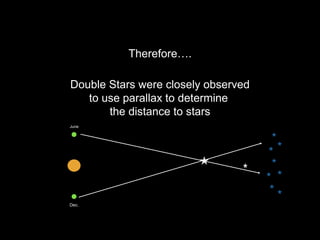
Double Stars were closely observed
to use parallax to determine
the distance to stars
June
Dec.
Therefore….
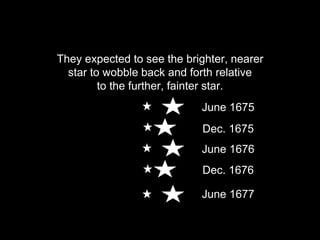
They expected to see the brighter, nearer
star to wobble back and forth relative
to the further, fainter star.
June 1675
Dec. 1675
June 1676
Dec. 1676
June 1677
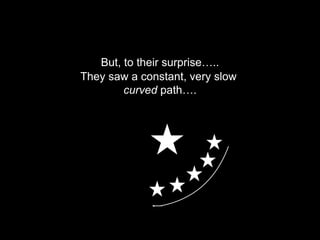
But, to their surprise…..
They saw a constant, very slow
curved path….
The universe was
Copernican and Keplerian!!!
The masses of stars could be found!
Along with spectral studies and
an accurate magnitude scale….
Modern Astrophysics was born…
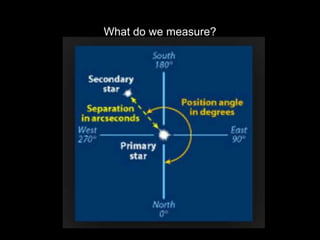
What do we measure?
S
Separation
(Rho)180
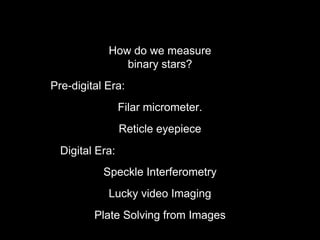
How do we measure
binary stars?
Pre-digital Era:
Filar micrometer.
Reticle eyepiece
Digital Era:
Speckle Interferometry
Lucky video Imaging
Plate Solving from Images
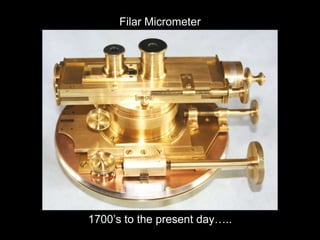
Filar Micrometer
1700’s to the present day…..
Problems with the Filar Micrometer
Placing the stars on the filaments.
Illuminated filaments drown out faint companions
Slow, painstaking work. Up to 10 measures / hour
of ONE pair which are averaged to constitute
a single ‘measure’ for publication .
Seeing makes the stars ‘dance’
at the long focal lengths
necessary for 0.1” accuracy.
Difficulty getting filaments to be
perpendicular to sub-arcsecond accuracy
Difficulty ensuring moving filament
maintains perfect perpendicularity.
Despite these issues, the Filar Micrometer
was the ONLY methodology available
from the 17th century until the 1960’s.
Skilled observers like F.G.W. Struve, J. Herschel
Burnham, van den Bos, Aitken and many others
achieved consistent, sub-arc second accuracy
in their measures….…
……..using LARGE refractors of 10 to 40 inches
aperture.
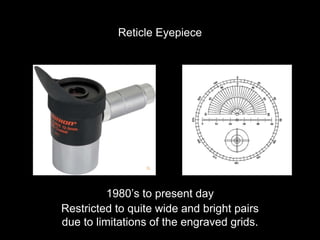
Reticle Eyepiece
1980’s to present day
Restricted to quite wide and bright pairs
due to limitations of the engraved grids.
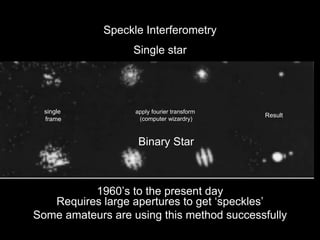
Speckle Interferometry
Single star
Binary Star
1960’s to the present day
single
frame
apply fourier transform
(computer wizardry)
Result
Requires large apertures to get ‘speckles’
Some amateurs are using this method successfully
Plate Solving
- Software can derive the Pixel (x , y)
coordinates of all stars in a
particular field of view.
- The rotational angle of the camera
relative to celestial north can
also be found
- Unfortunately my set-up has
a field of view of only
2’ x 3’ and does not contain
enough stars for Plate Solving to
be useful.
A closer look at my methodology….
Lucky Imaging.
Begin with a short video.
Lucky Imaging
Gamma Leonis.
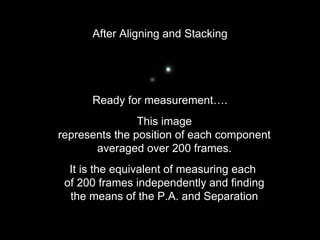
After Aligning and Stacking
Ready for measurement….
This image
represents the position of each component
averaged over 200 frames.
It is the equivalent of measuring each
of 200 frames independently and finding
the means of the P.A. and Separation
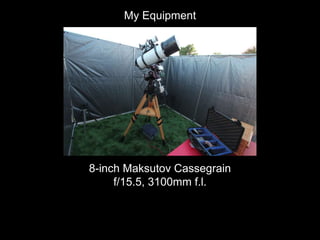
My Equipment
8-inch Maksutov Cassegrain
f/15.5, 3100mm f.l.
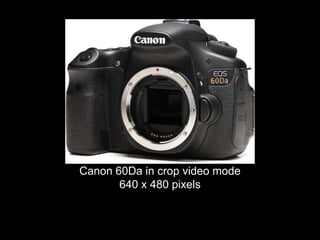
Canon 60Da in crop video mode
640 x 480 pixels
My Laptop
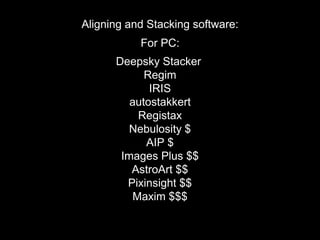
Aligning and Stacking software:
For PC:
Deepsky Stacker
Regim
IRIS
autostakkert
Registax
Nebulosity $
AIP $
Images Plus $$
AstroArt $$
Pixinsight $$
Maxim $$$
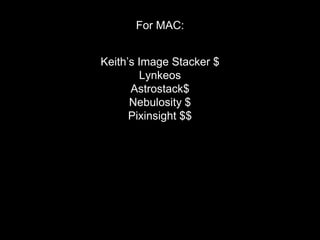
For MAC:
Keith’s Image Stacker $
Lynkeos
Astrostack$
Nebulosity $
Pixinsight $$
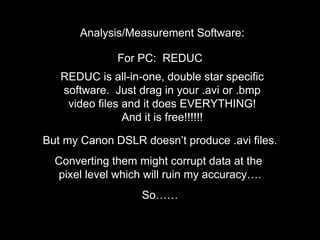
Analysis/Measurement Software:
For PC: REDUC
REDUC is all-in-one, double star specific
software. Just drag in your .avi or .bmp
video files and it does EVERYTHING!
And it is free!!!!!!
But my Canon DSLR doesn’t produce .avi files.
Converting them might corrupt data at the
pixel level which will ruin my accuracy….
So……
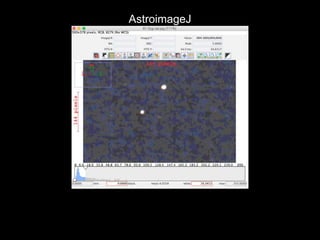
AstroimageJ
AstroimageJ was originally developed
to analyze microscope imagery
for bacterial, viral and tissue research.
It finds Centroids of stellar images
to sub-sub-pixel accuracy
It will also calculate stellar magnitudes
compared to a calibration star….
Is available for both PC and MAC platforms
And it is FREE!!!!
The Importance of Calibration
The angle of the camera relative to the
telescope, and the sky, must be known
to as much precision as possible
to produce accurate Position Angle
measurements.
The plate scale of the telescope/camera
combination must be known to as much
precision as possible to produce accurate
Separation measurements.
Calibration for Position Angle
Simple question: at what angle to celestial
north is my DSLR inserted into my telescope?
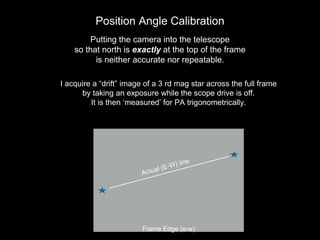
Position Angle Calibration
Putting the camera into the telescope
so that north is exactly at the top of the frame
is neither accurate nor repeatable.
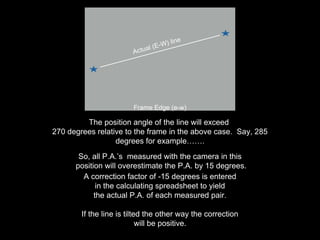
I acquire a “drift” image of a 3 rd mag star across the full frame
by taking an exposure while the scope drive is off.
It is then ‘measured’ for PA trigonometrically.
Frame Edge (e-w)
Frame Edge (e-w)
The position angle of the line will exceed
270 degrees relative to the frame in the above case. Say, 285
degrees for example…….
So, all P.A.’s measured with the camera in this
position will overestimate the P.A. by 15 degrees.
A correction factor of -15 degrees is entered
in the calculating spreadsheet to yield
the actual P.A. of each measured pair.
If the line is tilted the other way the correction

will be positive.
Calibration for Plate Scale:
Simple Question: At what focal length
is my image acquisition system operating
and how is that related to the size of the
pixels in my camera?
Calibrating Plate Scale.
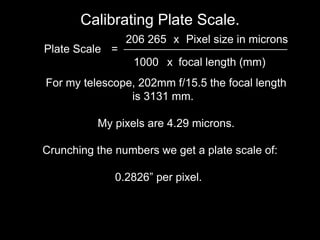
Plate Scale =
206 265 Pixel size in microns
1000
x
focal length (mm)x
For my telescope, 202mm f/15.5 the focal length
is 3131 mm.
My pixels are 4.29 microns.
Crunching the numbers we get a plate scale of:
0.2826” per pixel.
Simple, right?!?!
Not so fast.
The plate scale hinges entirely upon knowing
the precise focal length of the telescope.
Do you really know this important number?
For scopes such as SCT’s and,
Maksutovs which move
the main mirror to achieve focus
it is well known that the focal length
changes with the separation between
the primary and secondary mirrors.
As much as 10 or more percent!!!
Refractors change their focal length
by as much as 1% over
the -30C to +30C range as well…
Two main ways
to calibrate the plate scale.
1. Image and measure a pair of stars
of “known” separation.
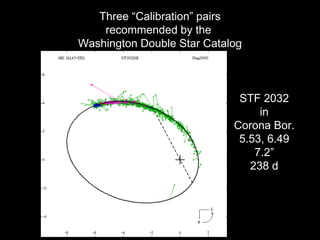
Three “Calibration” pairs
recommended by the
Washington Double Star Catalog
STF 2032
in
Corona Bor.
5.53, 6.49
7.2”
238 d
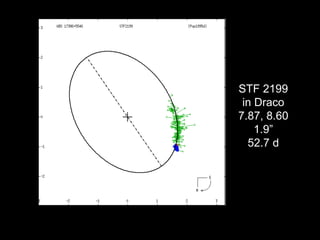
STF 2199
in Draco
7.87, 8.60
1.9”
52.7 d
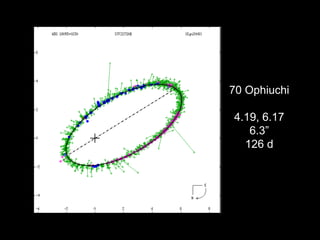
70 Ophiuchi
4.19, 6.17
6.3”
126 d
Not reliable.
Human error………
Using an erroneous measure to
determine plate scale
or Position angle correction
reduces my accuracy greatly…
Measuring the calibration pair involves
some error. This error compounds the
same error in the measured star’s data…
“using measurements of double stars to calibrate
the measurements of other double stars is certainly
circular (or, if you will, Keplerian). We strongly
advocate the use of other absolute calibration
techniques.” (6th Catalog of Orbits, WDS).
As the Washington Double Star Catalog itself
tells us:
A method independent of
human error….
…depending only on the grid spacing
and the wavelength of light.
Enter, the Diffraction Grating
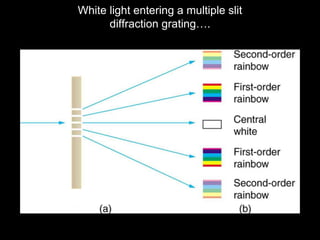
White light entering a multiple slit
diffraction grating….
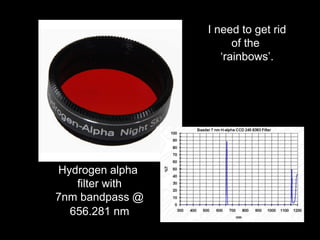
I need to get rid
of the
‘rainbows’.
Hydrogen alpha
filter with
7nm bandpass @
656.281 nm
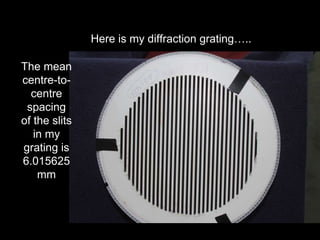
Here is my diffraction grating…..
The mean
centre-to-
centre
spacing
of the slits
in my
grating is
6.015625
mm
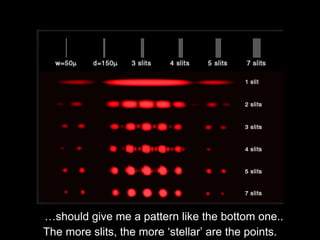
…should give me a pattern like the bottom one..
The more slits, the more ‘stellar’ are the points.
The angular separation of the
central point and the first point
on either side…
…I have called ‘z’
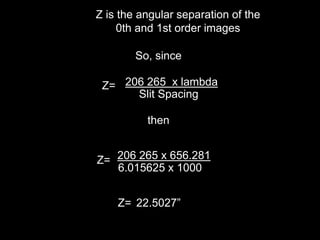
So, since
Z= 206 265 x lambda
Slit Spacing
then
Z= 206 265 x 656.281
6.015625 x 1000
Z= 22.5027”
Z is the angular separation of the
0th and 1st order images
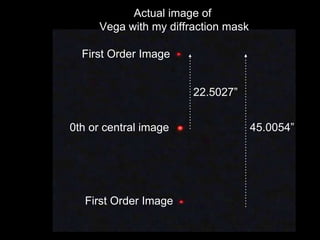
First Order Image
First Order Image
22.5027”
45.0054”
Actual image of
Vega with my diffraction mask
0th or central image
The two first-order images
seem to be rounder and more
‘stellar’ so I measure this
‘2z’ spacing…
If my analysis software shows that
these two first order centroids
are 180 pixels apart (for example)
then the plate scale for that image is
45.0054”
180
= 0.25003 arc seconds per pixel…
Note that this figure is found without
needing to know the exact pixel size
of my camera or the focal length
of the scope/camera system!!
Any pixel-size error or approximation
given by my camera’s manufacturer
can be ignored!
Step by Step….
Acquire the video of the target binaries.
Take a drift image, 1.5 - 2 minutes,
full frame, to establish E-W line.
Take a diffraction mask video
of a first magnitude star. (H-alpha filter)
-remove mask and filter.
Field Protocol
Focus on 1st mag star carefully
using Bahtinov Mask - remove when done
Lock focus and camera rotation
Take a final drift image to check
that camera has not rotated.
Home Protocol (1)
Analyze ‘drift’ image to establish
Position Angle correction.
Align and Stack and analyze
Diffraction Grating video
to determine plate scale.
Enter these calibration values
in the spreadsheet
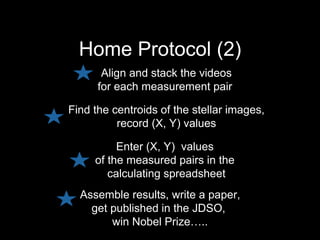
Home Protocol (2)
Align and stack the videos
for each measurement pair
Find the centroids of the stellar images,
record (X, Y) values
Enter (X, Y) values
of the measured pairs in the
calculating spreadsheet
Assemble results, write a paper,
get published in the JDSO,
win Nobel Prize…..
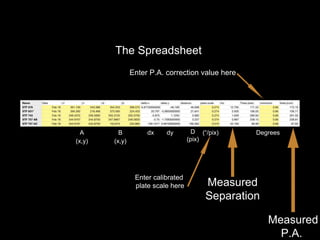
The Spreadsheet
A B
(x,y) (x,y)
dx dy D
(pix)
(“/pix)
Measured
Separation
Measured
P.A.
Degrees
Enter calibrated
plate scale here
Enter P.A. correction value here
Typical Results.
I often measure Iota Cancri (STF 1268)
since its Separation, 30.1” and
Position Angle, 308 degrees
are virtually unchanged since its discovery
in 1777…
I use this pair as a calibration check
on my own calibration methods.
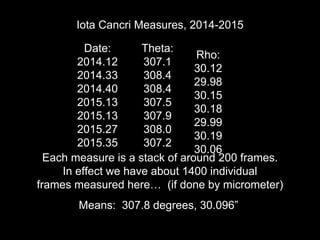
I have done seven measures of this pair….
Date:
2014.12
2014.33
2014.40
2015.13
2015.13
2015.27
2015.35
Theta:
307.1
308.4
308.4
307.5
307.9
308.0
307.2
Rho:
30.12
29.98
30.15
30.18
29.99
30.19
30.06
Iota Cancri Measures, 2014-2015
Each measure is a stack of around 200 frames.
In effect we have about 1400 individual
frames measured here… (if done by micrometer)
Means: 307.8 degrees, 30.096”
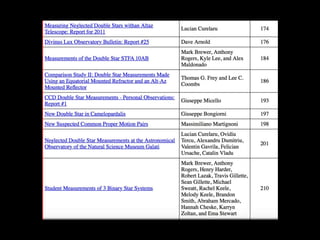
The Journal of Double Star Observations:
where the Pros and the Amateurs
meet on equal ground..
What can Amateurs do??
Other Amateur Double Star Contributions:
Discovering new pairs
Developing novel techniques
Involving High School and College
undergrads….
Contributing measures to the WDS
Photometry
Data Mining - Common Proper Motion Studies
Adapting amateur-sized equipment to
professional quality work
There is plenty of work to be done!
Now
an actual Align, Stack and Analysis
Demonstration.
Align and Stacking software:
Lynkeos.(PC folks use Registax or
any other Stacking software).
Centroid-finding software:
AstroimageJ
(available for Mac or PC)

Measuring doubles with 8" neaf copy

  • 1.
    Measuring Visual BinaryStars with an 8-inch Telescope N.Y.A.A, R.A.S.C. (Belleville), R.A.S.D. Dave Cotterell
  • 2.
    Why measure binarystars? A brief history.
  • 3.
    First double stardiscoveries: Mizar, 1650, Riccioli Gamma Arietis, 1664, Hooke Alpha Crucis, 1685, Fontenay All early discoveries were thought to be chance alignments The brighter the star, the nearer it was thought to be.
  • 4.
    Astronomers in the17th century and early 18th century… …..had mostly accepted the work of Copernicus and Kepler, as applied to the Solar System ….still assumed all Stars were intrinsically the same brightness. Apparent Brightness showed Distance.. BUT
  • 5.
    Double Stars wereclosely observed to use parallax to determine the distance to stars June Dec. Therefore….
  • 6.
    They expected tosee the brighter, nearer star to wobble back and forth relative to the further, fainter star. June 1675 Dec. 1675 June 1676 Dec. 1676 June 1677
  • 7.
    But, to theirsurprise….. They saw a constant, very slow curved path….
  • 8.
    The universe was Copernicanand Keplerian!!! The masses of stars could be found! Along with spectral studies and an accurate magnitude scale…. Modern Astrophysics was born…
  • 9.
    What do wemeasure? S Separation (Rho)180
  • 10.
    How do wemeasure binary stars? Pre-digital Era: Filar micrometer. Reticle eyepiece Digital Era: Speckle Interferometry Lucky video Imaging Plate Solving from Images
  • 11.
    Filar Micrometer 1700’s tothe present day…..
  • 12.
    Problems with theFilar Micrometer Placing the stars on the filaments. Illuminated filaments drown out faint companions Slow, painstaking work. Up to 10 measures / hour of ONE pair which are averaged to constitute a single ‘measure’ for publication . Seeing makes the stars ‘dance’ at the long focal lengths necessary for 0.1” accuracy. Difficulty getting filaments to be perpendicular to sub-arcsecond accuracy Difficulty ensuring moving filament maintains perfect perpendicularity.
  • 13.
    Despite these issues,the Filar Micrometer was the ONLY methodology available from the 17th century until the 1960’s. Skilled observers like F.G.W. Struve, J. Herschel Burnham, van den Bos, Aitken and many others achieved consistent, sub-arc second accuracy in their measures….… ……..using LARGE refractors of 10 to 40 inches aperture.
  • 14.
    Reticle Eyepiece 1980’s topresent day Restricted to quite wide and bright pairs due to limitations of the engraved grids.
  • 15.
    Speckle Interferometry Single star BinaryStar 1960’s to the present day single frame apply fourier transform (computer wizardry) Result Requires large apertures to get ‘speckles’ Some amateurs are using this method successfully
  • 16.
    Plate Solving - Softwarecan derive the Pixel (x , y) coordinates of all stars in a particular field of view. - The rotational angle of the camera relative to celestial north can also be found - Unfortunately my set-up has a field of view of only 2’ x 3’ and does not contain enough stars for Plate Solving to be useful.
  • 17.
    A closer lookat my methodology….
  • 18.
  • 19.
  • 20.
    After Aligning andStacking Ready for measurement…. This image represents the position of each component averaged over 200 frames. It is the equivalent of measuring each of 200 frames independently and finding the means of the P.A. and Separation
  • 21.
    My Equipment 8-inch MaksutovCassegrain f/15.5, 3100mm f.l.
  • 22.
    Canon 60Da incrop video mode 640 x 480 pixels
  • 23.
  • 24.
    Aligning and Stackingsoftware: For PC: Deepsky Stacker Regim IRIS autostakkert Registax Nebulosity $ AIP $ Images Plus $$ AstroArt $$ Pixinsight $$ Maxim $$$
  • 25.
    For MAC: Keith’s ImageStacker $ Lynkeos Astrostack$ Nebulosity $ Pixinsight $$
  • 26.
    Analysis/Measurement Software: For PC:REDUC REDUC is all-in-one, double star specific software. Just drag in your .avi or .bmp video files and it does EVERYTHING! And it is free!!!!!! But my Canon DSLR doesn’t produce .avi files. Converting them might corrupt data at the pixel level which will ruin my accuracy…. So……
  • 27.
  • 28.
    AstroimageJ was originallydeveloped to analyze microscope imagery for bacterial, viral and tissue research. It finds Centroids of stellar images to sub-sub-pixel accuracy It will also calculate stellar magnitudes compared to a calibration star…. Is available for both PC and MAC platforms And it is FREE!!!!
  • 29.
    The Importance ofCalibration The angle of the camera relative to the telescope, and the sky, must be known to as much precision as possible to produce accurate Position Angle measurements. The plate scale of the telescope/camera combination must be known to as much precision as possible to produce accurate Separation measurements.
  • 30.
    Calibration for PositionAngle Simple question: at what angle to celestial north is my DSLR inserted into my telescope?
  • 31.
    Position Angle Calibration Puttingthe camera into the telescope so that north is exactly at the top of the frame is neither accurate nor repeatable. I acquire a “drift” image of a 3 rd mag star across the full frame by taking an exposure while the scope drive is off. It is then ‘measured’ for PA trigonometrically. Frame Edge (e-w)
  • 32.
    Frame Edge (e-w) Theposition angle of the line will exceed 270 degrees relative to the frame in the above case. Say, 285 degrees for example……. So, all P.A.’s measured with the camera in this position will overestimate the P.A. by 15 degrees. A correction factor of -15 degrees is entered in the calculating spreadsheet to yield the actual P.A. of each measured pair. If the line is tilted the other way the correction will be positive.
  • 33.
    Calibration for PlateScale: Simple Question: At what focal length is my image acquisition system operating and how is that related to the size of the pixels in my camera?
  • 34.
    Calibrating Plate Scale. PlateScale = 206 265 Pixel size in microns 1000 x focal length (mm)x For my telescope, 202mm f/15.5 the focal length is 3131 mm. My pixels are 4.29 microns. Crunching the numbers we get a plate scale of: 0.2826” per pixel.
  • 35.
  • 36.
  • 37.
    The plate scalehinges entirely upon knowing the precise focal length of the telescope. Do you really know this important number? For scopes such as SCT’s and, Maksutovs which move the main mirror to achieve focus it is well known that the focal length changes with the separation between the primary and secondary mirrors. As much as 10 or more percent!!! Refractors change their focal length by as much as 1% over the -30C to +30C range as well…
  • 38.
    Two main ways tocalibrate the plate scale. 1. Image and measure a pair of stars of “known” separation.
  • 39.
    Three “Calibration” pairs recommendedby the Washington Double Star Catalog STF 2032 in Corona Bor. 5.53, 6.49 7.2” 238 d
  • 40.
    STF 2199 in Draco 7.87,8.60 1.9” 52.7 d
  • 41.
  • 42.
    Not reliable. Human error……… Usingan erroneous measure to determine plate scale or Position angle correction reduces my accuracy greatly… Measuring the calibration pair involves some error. This error compounds the same error in the measured star’s data…
  • 43.
    “using measurements ofdouble stars to calibrate the measurements of other double stars is certainly circular (or, if you will, Keplerian). We strongly advocate the use of other absolute calibration techniques.” (6th Catalog of Orbits, WDS). As the Washington Double Star Catalog itself tells us:
  • 44.
    A method independentof human error…. …depending only on the grid spacing and the wavelength of light. Enter, the Diffraction Grating
  • 45.
    White light enteringa multiple slit diffraction grating….
  • 46.
    I need toget rid of the ‘rainbows’. Hydrogen alpha filter with 7nm bandpass @ 656.281 nm
  • 47.
    Here is mydiffraction grating….. The mean centre-to- centre spacing of the slits in my grating is 6.015625 mm
  • 48.
    …should give mea pattern like the bottom one.. The more slits, the more ‘stellar’ are the points.
  • 49.
    The angular separationof the central point and the first point on either side… …I have called ‘z’
  • 50.
    So, since Z= 206265 x lambda Slit Spacing then Z= 206 265 x 656.281 6.015625 x 1000 Z= 22.5027” Z is the angular separation of the 0th and 1st order images
  • 51.
    First Order Image FirstOrder Image 22.5027” 45.0054” Actual image of Vega with my diffraction mask 0th or central image
  • 52.
    The two first-orderimages seem to be rounder and more ‘stellar’ so I measure this ‘2z’ spacing…
  • 53.
    If my analysissoftware shows that these two first order centroids are 180 pixels apart (for example) then the plate scale for that image is 45.0054” 180 = 0.25003 arc seconds per pixel… Note that this figure is found without needing to know the exact pixel size of my camera or the focal length of the scope/camera system!! Any pixel-size error or approximation given by my camera’s manufacturer can be ignored!
  • 54.
  • 55.
    Acquire the videoof the target binaries. Take a drift image, 1.5 - 2 minutes, full frame, to establish E-W line. Take a diffraction mask video of a first magnitude star. (H-alpha filter) -remove mask and filter. Field Protocol Focus on 1st mag star carefully using Bahtinov Mask - remove when done Lock focus and camera rotation Take a final drift image to check that camera has not rotated.
  • 56.
    Home Protocol (1) Analyze‘drift’ image to establish Position Angle correction. Align and Stack and analyze Diffraction Grating video to determine plate scale. Enter these calibration values in the spreadsheet
  • 57.
    Home Protocol (2) Alignand stack the videos for each measurement pair Find the centroids of the stellar images, record (X, Y) values Enter (X, Y) values of the measured pairs in the calculating spreadsheet Assemble results, write a paper, get published in the JDSO, win Nobel Prize…..
  • 58.
    The Spreadsheet A B (x,y)(x,y) dx dy D (pix) (“/pix) Measured Separation Measured P.A. Degrees Enter calibrated plate scale here Enter P.A. correction value here
  • 59.
    Typical Results. I oftenmeasure Iota Cancri (STF 1268) since its Separation, 30.1” and Position Angle, 308 degrees are virtually unchanged since its discovery in 1777… I use this pair as a calibration check on my own calibration methods. I have done seven measures of this pair….
  • 60.
    Date: 2014.12 2014.33 2014.40 2015.13 2015.13 2015.27 2015.35 Theta: 307.1 308.4 308.4 307.5 307.9 308.0 307.2 Rho: 30.12 29.98 30.15 30.18 29.99 30.19 30.06 Iota Cancri Measures,2014-2015 Each measure is a stack of around 200 frames. In effect we have about 1400 individual frames measured here… (if done by micrometer) Means: 307.8 degrees, 30.096”
  • 61.
    The Journal ofDouble Star Observations: where the Pros and the Amateurs meet on equal ground..
  • 63.
  • 64.
    Other Amateur DoubleStar Contributions: Discovering new pairs Developing novel techniques Involving High School and College undergrads…. Contributing measures to the WDS Photometry Data Mining - Common Proper Motion Studies Adapting amateur-sized equipment to professional quality work
  • 65.
    There is plentyof work to be done!
  • 66.
    Now an actual Align,Stack and Analysis Demonstration. Align and Stacking software: Lynkeos.(PC folks use Registax or any other Stacking software). Centroid-finding software: AstroimageJ (available for Mac or PC)