3
Acknowledgement
I would like to thank respected Dr. Sambit Kumar Mishra ,
HOD of CSE department for giving me such a wonderful
opportunity to expand my knowledge for my own branch and
giving me guidelines to present a seminar report. It helped me
a lot to realize of what we study for.
Secondly, I would like to thank my parents who patiently
helped me as i went through my work and helped to modify
and eliminate some of the irrelevant or un-necessary stuffs.
Thirdly, I would like to thank my friends who helped me to
make my work more organized and well-stacked till the end.
Next, I would thank Microsoft for developing such a
wonderful tool like MS Word. It helped my work a lot to
remain error-free.
Last but clearly not the least, I would thank The Almighty for
giving me strength to complete my report on time.
CSE 6th
SEM
4
Contents
Sl. No. Content Page No.
1. Introduction 6 - 7
2. Why xMax? 8
3. Network Architecture 9 - 11
4. Working of xMax Technology. 12 - 13
5. Comparison Between xMax & Wi-Fi 14
6. Advantages of xMax 15
7. Limitations 16
8. Future Of xMax 17
09. Conclusion 18
10. References 19
5
Abstract
I have made this report file on the topic xMax Technology I have
tried my best to elucidate all the relevant detail to the topic to be
included in the report. While in the beginning I have tried to give a
general view about this topic.
xMax is a fixed and mobile wireless broadband system that includes a
complete product line of high-performance access points, fixed and
mobile personal WiFi hotspots, mobile switching centres (MSC) as
well as network management and deployment tools. xG’s unique and
patented protocol outperforms WiFi, WiMax and traditional cellular
technologies like LTE in shared and interference prone radio bands
Every aspect of the technology is designed for the highest possible
efficiency and QoS. xMax is designed to prioritize voice calls by
delivering dedicated time-slots, as well as a voice calling app for
android phones and tablets. This approach guarantees a low and fixed
latency for every call, which essential for reliable voice calls on
heavily loaded wireless broadband systems.
6
Introduction
xMax is a fixed and mobile wireless broadband system that includes a
complete product line of high-performance access points, fixed and
mobile personal WiFi hotspots, mobile switching centers (MSC) as
well as network management and deployment tools. xG’s unique and
patented protocol outperforms WiFi, WiMax and traditional cellular
technologies like LTE in shared and interference prone radio bands.
The xMax over the air waveform has been specifically designed for
use in a deterministic (i.e. fixed low latency) cognitive radio network.
This waveform, in conjunction with its purpose built Media Access
Control (MAC) layer, offers capabilities and performance not found
in other wireless solutions.
xMax is an end-to-end Internet Protocol (IP) network solution that
incorporates xG’s patented cognitive radio technologies to deliver the
first fully mobile VoIP and broadband network that also supports any
smartphone, laptop, tablet and other commercial WiFi or IP-enabled
devices via its xMod personal hotspot – while offering an excellent
quality of service (QoS) and fixed, low latency.
xG’s approach has been to develop a network that uses available free
spectrum instead of costly licensed spectrum and an all-IP
architecture that is less expensive to deploy and operate. The
company’s xMax system addresses the numerous technical hurdles
involved with mobile VoIP and data in today’s crowded airwaves.
The result is an extremely efficient network solution that delivers high
quality fixed and mobile wireless Internet services at very low cost.
Every aspect of the technology is designed for the highest possible
efficiency and QoS. xMax is designed to prioritize voice calls by
delivering dedicated time-slots, as well as a voice calling app for
android phones and tablets. This approach guarantees a low and fixed
latency for every call, which essential for reliable voice calls on
7
heavily loaded wireless broadband systems. The xMax system ability
to provide fixed low latency connectivity for real-time
communications is in contrast to technologies like Wi-Fi and
WiMAX, both of which are contention-based “best effort” delivery
systems that cannot provide scalable voice services without
significantly reducing their data carrying capacity. xG’s proprietary
air interface addresses these limitations, while supporting full sensing-
based cognitive network operation.
xMax carrier class cognitive radio networking solutions are made up
of the following key products:
 CN5100 Mobile Hotspot.
 CN3100 Vehicle Modem.
 CN3200 Dual Band Routing Modem.
 CN1100 Access Point.
 CN7000 Mobile Control Center.
 xDrive and xMonitor Network Tools.
8
Why xMax?
xMax is designed to prioritize voice by delivering dedicated timeslots
and bandwidth to every user. This approach guarantees a minimal and
fixed latency for every call, which is an essential factor for any high
Quality of Service (QoS) mobile VoIP system. This is in contrast to
technologies like Wi-Fi and WiMAX, both of which are contention-
based "best effort" delivery systems that are limited by scalability
constraints.
9
Network Architecture
Flexible Architecture Enhances and Extends
Today’s Services
The primary consideration in the network architecture design of the
xMax system is to achieve the goal of providing robust, scalable, and
full-featured voice and data services to fixed and mobile subscribers
at a fraction of the cost of traditional approaches. The system uses a
proprietary over the air waveform that has been optimized for our
sensing-based cognitive radio. While based on Orthogonal
Frequency-Division Multiplexing (OFDM), xG’s unique and patented
protocol outperforms WiFi, WiMax and traditional cellular
technologies like LTE in shared and interference prone radio bands.
In addition to its proprietary and highly optimized over the air
protocol, xMax offers several unique and valuable capabilities not
found in other cognitive (and traditional) radio networks. These
include its all-IP (Internet Protocol) architecture, as well as its support
of commercial smartphones, laptops, tablets and other WiFi and
Ethernet capable Internet appliances via the xMod personal hotspot.
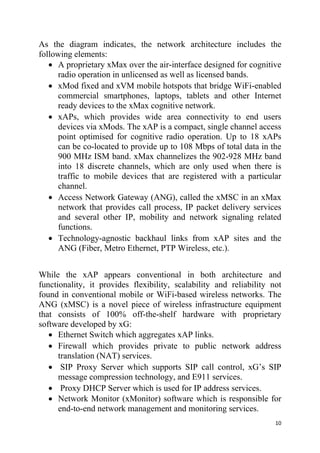
A sample reference model of the resulting Internet Protocol (IP)
centric network architecture is given in figure given below.
10
As the diagram indicates, the network architecture includes the
following elements:
 A proprietary xMax over the air-interface designed for cognitive
radio operation in unlicensed as well as licensed bands.
 xMod fixed and xVM mobile hotspots that bridge WiFi-enabled
commercial smartphones, laptops, tablets and other Internet
ready devices to the xMax cognitive network.
 xAPs, which provides wide area connectivity to end users
devices via xMods. The xAP is a compact, single channel access
point optimised for cognitive radio operation. Up to 18 xAPs
can be co-located to provide up to 108 Mbps of total data in the
900 MHz ISM band. xMax channelizes the 902-928 MHz band
into 18 discrete channels, which are only used when there is
traffic to mobile devices that are registered with a particular
channel.
 Access Network Gateway (ANG), called the xMSC in an xMax
network that provides call process, IP packet delivery services
and several other IP, mobility and network signaling related
functions.
 Technology-agnostic backhaul links from xAP sites and the
ANG (Fiber, Metro Ethernet, PTP Wireless, etc.).
While the xAP appears conventional in both architecture and
functionality, it provides flexibility, scalability and reliability not
found in conventional mobile or WiFi-based wireless networks. The
ANG (xMSC) is a novel piece of wireless infrastructure equipment
that consists of 100% off-the-shelf hardware with proprietary
software developed by xG:
 Ethernet Switch which aggregates xAP links.
 Firewall which provides private to public network address
translation (NAT) services.
 SIP Proxy Server which supports SIP call control, xG’s SIP
message compression technology, and E911 services.
 Proxy DHCP Server which is used for IP address services.
 Network Monitor (xMonitor) software which is responsible for
end-to-end network management and monitoring services.
11
The architecture further supports low-cost service deployment
objectives by leveraging commercial off the shelf (COTS) voice over
IP (VoIP) equipment, software and services within the xMSC. The
VoIP core contained within the xMSC consists of the following
elements:
 SIP Proxy Server which provides traditional SIP call control
services.
 Media Gateway – which provides media transcoding between IP
and PSTN networks and is responsible for subscriber
accounting/billing, PSTN call termination, “Direct Inward
Dialing” (DID) phone number maintenance, voicemail services,
and inter-network call signal routing, among others.
 The VoIP core can be owned and operated by the xMax
operator, or can be provided as a third party service.
12
Working Of xMax Technology
End-to-end IP architecture and shared spectrum optimization:
All the components of the xMax system are IP based. COTS routers
and switches are used as network components. The xMax xAP
supports both Ethernet and Fibre interfaces. Voice is transported as
mobile-optimized Voice over IP (VoIP), enabling the entire system to
operate as a data packet network – but with full voice calling features.
Standard SIP signalling supports integrated COTS voice switches and
gateways, or an external (cloud-based) switch/gateway service may be
utilized.
The air interface between the xMod and xAP is an advanced Physical
Layer (PHY) featuring OFDM modulation and MIMO transmit and
receive. This interface, combined with other xG innovations, was
optimized to provide licensed quality service in free, unlicensed
spectrum. Since this is a shared spectrum resource, implementing
interference immunity and spectral efficiency was paramount for
commercial applications.
Cognitive operation including DSA and interference mitigation:
xMax employs advanced cognitive radio and networking techniques,
including Dynamic Spectrum Access to provide reliable operation in
unlicensed but interference prone spectrum. xMax’s Dynamic
Spectrum Access technology is frequency agnostic and can be re-
tuned to operate in TV white spaces, unlicensed or licensed
commercial bands. Another benefit of xMax’s cognitive technology is
that the network has the ability to self-configure and self-organize.
This is planned to be further enhanced to support full meshing
capabilities in future xMax product releases.
Advanced cognitive sensing, signal and multi-spatial processing:
13
Real time RF sensing and dynamic spectrum access are the
cornerstones of xMax radio technology. The commercial xMax
system (slated for release in H1 2012) utilizes the 902-928 MHz and
the 5.725- 5.825 GHz band for license free operation. Using these
freely available bands allows the xMax system to scan over 125
channels (in release 3) for interference-free operation. Both the xAP
and xMod devices are frequency agile and have several built-in
capabilities to mitigate interference by first employing advanced
signal/spatial processing as well as dynamically switching channels to
avoid overwhelming interference or jamming.
Interference tolerance, frequency reuse and high link reliability:
By applying cognitive capabilities to enhance active interference
mitigation, xMax can operate effectively under higher interference
and jamming levels than competing solutions. This is critical for
maximizing reliability as well as increasing the utilization of scarce
spectrum resources. By enabling xMax to tolerate high levels of
interference before requiring the radios to switch channels, more
“gray spectrum” (spectrum containing interference or jamming) can
be used in place of white spectrum (clean and interference-free
spectrum). This capability increases the network’s total throughput
and capacity greatly – without consuming additional scarce spectrum
resources. Since the technique is primarily implemented within the
receiver chain, the RF environment is not made noisier as would be
the case for mitigation techniques that rely on raising the transmitter
power to overcome the interferer. This technique significantly
increases the system capacity of an xMax network.
14
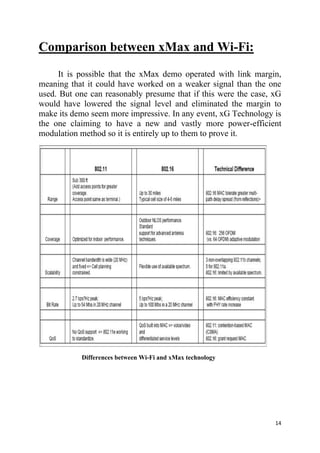
Comparison between xMax and Wi-Fi:
It is possible that the xMax demo operated with link margin,
meaning that it could have worked on a weaker signal than the one
used. But one can reasonably presume that if this were the case, xG
would have lowered the signal level and eliminated the margin to
make its demo seem more impressive. In any event, xG Technology is
the one claiming to have a new and vastly more power-efficient
modulation method so it is entirely up to them to prove it.
Differences between Wi-Fi and xMax technology
15
Advantages of xMax:
 Quality of service (QoS) to support long ranges mobile VoIP.
 Deterministic latency on wireless links for voice packets.
 Header compression.
 Zero latency network configuration.
 Soft hand- off mechanism.
 Substantially lower capital requirements for materially more
sophisticated product offering.
 No spectrum license costs.
 Exclusive service territories.
 Network capacity managed through software-defined radio
system.
 Path to 4G performance with a revolutionary battery solution for
user device.
 xMax, is a 900MHz wireless technology and uses less than 1
Watt of power. What makes xMax unique is its sharing of
crowded radio spectrum, such as the frequencies used by cable
television or Wi-Fi. The consumption of power in xMax is less
when compared to other wireless technology devices.
 xMax offers consumers the prospect of lower phone bills
because:
 xMax transmits over unlicensed spectrum-the same as
baby monitors and cordless phones. Major national cellular
carriers paid billions of dollars for licensed spectrum that
they recoup from customers.
16
Limitations:
 VoIP technology is great at saving its users money, but it does
have some disadvantages – you have to be connected to a
computer to use it, and VoIP calls are blocked on some
networks by cellular companies concerned that they are missing
out on revenues.
 There is also an issue with quality, as cellular networks are not
designed for Internet voice traffic.
 US-based xG Technology has addressed these problems with its
xMax system, which has been specifically designed for mobile
VoIP.
 The network uses available free spectrum, rather than licensed
spectrum and an all-IP architecture that is less expensive to
operate than traditional networks.
 Although the test was limited in its scope, he used a phone
connected to a laptop while being driven around Fort
Lauderdale and reported that the voice quality was fine.
 There still seems to be issues to address, as the phone
eventually overheated, but it seems that mobile VoIP could not
be too far away.
17
Future Of xMax:
According to Whitely, the technology will benefit rural ISPs due to
the lower number of base stations required.
xMax, because it has 20 times the range of Bluetooth, could challenge
that technology .
Other possibilities are enterprise WLANs and metropolitan networks.
Use of xMax to reduce the power consumptions in wireless
technologies to a greater extent.
The XMAX™ technology can provide fixed, nomadic, portable
solution and with OFDMA at the heart of the technology, it can also
deliver mobile wireless broadband connectivity across vast open and
congested areas over many kilometres.
With the XMAX™ Customer Premises Equipment, IPaXIom gives
businesses, enterprise and the end customer get more options for
broadband connectivity at lower cost. The XMAX™ comes with its
own NMS for comprehensive and user friendly day-to-day
management and support function.
18
Conclusion
From my analysis it seems that xG's xMax technology is
nothing special. Despite xG's implications to the contrary, no
spectacular results have been demonstrated, certainly nothing that
would call into question the fundamental principles of communication
theory that have been firmly established for six decades. And a
reading of xG's published claims and patents belie a surprising lack of
awareness of these principles. Prospective investors should be very
wary.
19
References:
 www.xgtechnology.com
 A review of bobier's tristate integer cycle modulation, added 16
may 2007
 Comments on micom lab test of xmax, added 4 june 2007
 Comments on prof. Stu schwartz's evaluation of xmax added 6
june 2007
 An analysis of xg's claims that xmax requires 3,000,000 times
less power than wifi, revised 29 june 2007
 Prof. Ben friedlander's blog on xmax and other wireless
fantasies, added 21 june 2007
 Comments on patent application 20040196910 from an engineer
who wishes to remain anonymous, added 17 june 2007.

Xmax

  • 1.
    3 Acknowledgement I would liketo thank respected Dr. Sambit Kumar Mishra , HOD of CSE department for giving me such a wonderful opportunity to expand my knowledge for my own branch and giving me guidelines to present a seminar report. It helped me a lot to realize of what we study for. Secondly, I would like to thank my parents who patiently helped me as i went through my work and helped to modify and eliminate some of the irrelevant or un-necessary stuffs. Thirdly, I would like to thank my friends who helped me to make my work more organized and well-stacked till the end. Next, I would thank Microsoft for developing such a wonderful tool like MS Word. It helped my work a lot to remain error-free. Last but clearly not the least, I would thank The Almighty for giving me strength to complete my report on time. CSE 6th SEM
  • 2.
    4 Contents Sl. No. ContentPage No. 1. Introduction 6 - 7 2. Why xMax? 8 3. Network Architecture 9 - 11 4. Working of xMax Technology. 12 - 13 5. Comparison Between xMax & Wi-Fi 14 6. Advantages of xMax 15 7. Limitations 16 8. Future Of xMax 17 09. Conclusion 18 10. References 19
  • 3.
    5 Abstract I have madethis report file on the topic xMax Technology I have tried my best to elucidate all the relevant detail to the topic to be included in the report. While in the beginning I have tried to give a general view about this topic. xMax is a fixed and mobile wireless broadband system that includes a complete product line of high-performance access points, fixed and mobile personal WiFi hotspots, mobile switching centres (MSC) as well as network management and deployment tools. xG’s unique and patented protocol outperforms WiFi, WiMax and traditional cellular technologies like LTE in shared and interference prone radio bands Every aspect of the technology is designed for the highest possible efficiency and QoS. xMax is designed to prioritize voice calls by delivering dedicated time-slots, as well as a voice calling app for android phones and tablets. This approach guarantees a low and fixed latency for every call, which essential for reliable voice calls on heavily loaded wireless broadband systems.
  • 4.
    6 Introduction xMax is afixed and mobile wireless broadband system that includes a complete product line of high-performance access points, fixed and mobile personal WiFi hotspots, mobile switching centers (MSC) as well as network management and deployment tools. xG’s unique and patented protocol outperforms WiFi, WiMax and traditional cellular technologies like LTE in shared and interference prone radio bands. The xMax over the air waveform has been specifically designed for use in a deterministic (i.e. fixed low latency) cognitive radio network. This waveform, in conjunction with its purpose built Media Access Control (MAC) layer, offers capabilities and performance not found in other wireless solutions. xMax is an end-to-end Internet Protocol (IP) network solution that incorporates xG’s patented cognitive radio technologies to deliver the first fully mobile VoIP and broadband network that also supports any smartphone, laptop, tablet and other commercial WiFi or IP-enabled devices via its xMod personal hotspot – while offering an excellent quality of service (QoS) and fixed, low latency. xG’s approach has been to develop a network that uses available free spectrum instead of costly licensed spectrum and an all-IP architecture that is less expensive to deploy and operate. The company’s xMax system addresses the numerous technical hurdles involved with mobile VoIP and data in today’s crowded airwaves. The result is an extremely efficient network solution that delivers high quality fixed and mobile wireless Internet services at very low cost. Every aspect of the technology is designed for the highest possible efficiency and QoS. xMax is designed to prioritize voice calls by delivering dedicated time-slots, as well as a voice calling app for android phones and tablets. This approach guarantees a low and fixed latency for every call, which essential for reliable voice calls on
  • 5.
    7 heavily loaded wirelessbroadband systems. The xMax system ability to provide fixed low latency connectivity for real-time communications is in contrast to technologies like Wi-Fi and WiMAX, both of which are contention-based “best effort” delivery systems that cannot provide scalable voice services without significantly reducing their data carrying capacity. xG’s proprietary air interface addresses these limitations, while supporting full sensing- based cognitive network operation. xMax carrier class cognitive radio networking solutions are made up of the following key products:  CN5100 Mobile Hotspot.  CN3100 Vehicle Modem.  CN3200 Dual Band Routing Modem.  CN1100 Access Point.  CN7000 Mobile Control Center.  xDrive and xMonitor Network Tools.
  • 6.
    8 Why xMax? xMax isdesigned to prioritize voice by delivering dedicated timeslots and bandwidth to every user. This approach guarantees a minimal and fixed latency for every call, which is an essential factor for any high Quality of Service (QoS) mobile VoIP system. This is in contrast to technologies like Wi-Fi and WiMAX, both of which are contention- based "best effort" delivery systems that are limited by scalability constraints.
  • 7.
    9 Network Architecture Flexible ArchitectureEnhances and Extends Today’s Services The primary consideration in the network architecture design of the xMax system is to achieve the goal of providing robust, scalable, and full-featured voice and data services to fixed and mobile subscribers at a fraction of the cost of traditional approaches. The system uses a proprietary over the air waveform that has been optimized for our sensing-based cognitive radio. While based on Orthogonal Frequency-Division Multiplexing (OFDM), xG’s unique and patented protocol outperforms WiFi, WiMax and traditional cellular technologies like LTE in shared and interference prone radio bands. In addition to its proprietary and highly optimized over the air protocol, xMax offers several unique and valuable capabilities not found in other cognitive (and traditional) radio networks. These include its all-IP (Internet Protocol) architecture, as well as its support of commercial smartphones, laptops, tablets and other WiFi and Ethernet capable Internet appliances via the xMod personal hotspot. A sample reference model of the resulting Internet Protocol (IP) centric network architecture is given in figure given below.
  • 8.
    10 As the diagramindicates, the network architecture includes the following elements:  A proprietary xMax over the air-interface designed for cognitive radio operation in unlicensed as well as licensed bands.  xMod fixed and xVM mobile hotspots that bridge WiFi-enabled commercial smartphones, laptops, tablets and other Internet ready devices to the xMax cognitive network.  xAPs, which provides wide area connectivity to end users devices via xMods. The xAP is a compact, single channel access point optimised for cognitive radio operation. Up to 18 xAPs can be co-located to provide up to 108 Mbps of total data in the 900 MHz ISM band. xMax channelizes the 902-928 MHz band into 18 discrete channels, which are only used when there is traffic to mobile devices that are registered with a particular channel.  Access Network Gateway (ANG), called the xMSC in an xMax network that provides call process, IP packet delivery services and several other IP, mobility and network signaling related functions.  Technology-agnostic backhaul links from xAP sites and the ANG (Fiber, Metro Ethernet, PTP Wireless, etc.). While the xAP appears conventional in both architecture and functionality, it provides flexibility, scalability and reliability not found in conventional mobile or WiFi-based wireless networks. The ANG (xMSC) is a novel piece of wireless infrastructure equipment that consists of 100% off-the-shelf hardware with proprietary software developed by xG:  Ethernet Switch which aggregates xAP links.  Firewall which provides private to public network address translation (NAT) services.  SIP Proxy Server which supports SIP call control, xG’s SIP message compression technology, and E911 services.  Proxy DHCP Server which is used for IP address services.  Network Monitor (xMonitor) software which is responsible for end-to-end network management and monitoring services.
  • 9.
    11 The architecture furthersupports low-cost service deployment objectives by leveraging commercial off the shelf (COTS) voice over IP (VoIP) equipment, software and services within the xMSC. The VoIP core contained within the xMSC consists of the following elements:  SIP Proxy Server which provides traditional SIP call control services.  Media Gateway – which provides media transcoding between IP and PSTN networks and is responsible for subscriber accounting/billing, PSTN call termination, “Direct Inward Dialing” (DID) phone number maintenance, voicemail services, and inter-network call signal routing, among others.  The VoIP core can be owned and operated by the xMax operator, or can be provided as a third party service.
  • 10.
    12 Working Of xMaxTechnology End-to-end IP architecture and shared spectrum optimization: All the components of the xMax system are IP based. COTS routers and switches are used as network components. The xMax xAP supports both Ethernet and Fibre interfaces. Voice is transported as mobile-optimized Voice over IP (VoIP), enabling the entire system to operate as a data packet network – but with full voice calling features. Standard SIP signalling supports integrated COTS voice switches and gateways, or an external (cloud-based) switch/gateway service may be utilized. The air interface between the xMod and xAP is an advanced Physical Layer (PHY) featuring OFDM modulation and MIMO transmit and receive. This interface, combined with other xG innovations, was optimized to provide licensed quality service in free, unlicensed spectrum. Since this is a shared spectrum resource, implementing interference immunity and spectral efficiency was paramount for commercial applications. Cognitive operation including DSA and interference mitigation: xMax employs advanced cognitive radio and networking techniques, including Dynamic Spectrum Access to provide reliable operation in unlicensed but interference prone spectrum. xMax’s Dynamic Spectrum Access technology is frequency agnostic and can be re- tuned to operate in TV white spaces, unlicensed or licensed commercial bands. Another benefit of xMax’s cognitive technology is that the network has the ability to self-configure and self-organize. This is planned to be further enhanced to support full meshing capabilities in future xMax product releases. Advanced cognitive sensing, signal and multi-spatial processing:
  • 11.
    13 Real time RFsensing and dynamic spectrum access are the cornerstones of xMax radio technology. The commercial xMax system (slated for release in H1 2012) utilizes the 902-928 MHz and the 5.725- 5.825 GHz band for license free operation. Using these freely available bands allows the xMax system to scan over 125 channels (in release 3) for interference-free operation. Both the xAP and xMod devices are frequency agile and have several built-in capabilities to mitigate interference by first employing advanced signal/spatial processing as well as dynamically switching channels to avoid overwhelming interference or jamming. Interference tolerance, frequency reuse and high link reliability: By applying cognitive capabilities to enhance active interference mitigation, xMax can operate effectively under higher interference and jamming levels than competing solutions. This is critical for maximizing reliability as well as increasing the utilization of scarce spectrum resources. By enabling xMax to tolerate high levels of interference before requiring the radios to switch channels, more “gray spectrum” (spectrum containing interference or jamming) can be used in place of white spectrum (clean and interference-free spectrum). This capability increases the network’s total throughput and capacity greatly – without consuming additional scarce spectrum resources. Since the technique is primarily implemented within the receiver chain, the RF environment is not made noisier as would be the case for mitigation techniques that rely on raising the transmitter power to overcome the interferer. This technique significantly increases the system capacity of an xMax network.
  • 12.
    14 Comparison between xMaxand Wi-Fi: It is possible that the xMax demo operated with link margin, meaning that it could have worked on a weaker signal than the one used. But one can reasonably presume that if this were the case, xG would have lowered the signal level and eliminated the margin to make its demo seem more impressive. In any event, xG Technology is the one claiming to have a new and vastly more power-efficient modulation method so it is entirely up to them to prove it. Differences between Wi-Fi and xMax technology
  • 13.
    15 Advantages of xMax: Quality of service (QoS) to support long ranges mobile VoIP.  Deterministic latency on wireless links for voice packets.  Header compression.  Zero latency network configuration.  Soft hand- off mechanism.  Substantially lower capital requirements for materially more sophisticated product offering.  No spectrum license costs.  Exclusive service territories.  Network capacity managed through software-defined radio system.  Path to 4G performance with a revolutionary battery solution for user device.  xMax, is a 900MHz wireless technology and uses less than 1 Watt of power. What makes xMax unique is its sharing of crowded radio spectrum, such as the frequencies used by cable television or Wi-Fi. The consumption of power in xMax is less when compared to other wireless technology devices.  xMax offers consumers the prospect of lower phone bills because:  xMax transmits over unlicensed spectrum-the same as baby monitors and cordless phones. Major national cellular carriers paid billions of dollars for licensed spectrum that they recoup from customers.
  • 14.
    16 Limitations:  VoIP technologyis great at saving its users money, but it does have some disadvantages – you have to be connected to a computer to use it, and VoIP calls are blocked on some networks by cellular companies concerned that they are missing out on revenues.  There is also an issue with quality, as cellular networks are not designed for Internet voice traffic.  US-based xG Technology has addressed these problems with its xMax system, which has been specifically designed for mobile VoIP.  The network uses available free spectrum, rather than licensed spectrum and an all-IP architecture that is less expensive to operate than traditional networks.  Although the test was limited in its scope, he used a phone connected to a laptop while being driven around Fort Lauderdale and reported that the voice quality was fine.  There still seems to be issues to address, as the phone eventually overheated, but it seems that mobile VoIP could not be too far away.
  • 15.
    17 Future Of xMax: Accordingto Whitely, the technology will benefit rural ISPs due to the lower number of base stations required. xMax, because it has 20 times the range of Bluetooth, could challenge that technology . Other possibilities are enterprise WLANs and metropolitan networks. Use of xMax to reduce the power consumptions in wireless technologies to a greater extent. The XMAX™ technology can provide fixed, nomadic, portable solution and with OFDMA at the heart of the technology, it can also deliver mobile wireless broadband connectivity across vast open and congested areas over many kilometres. With the XMAX™ Customer Premises Equipment, IPaXIom gives businesses, enterprise and the end customer get more options for broadband connectivity at lower cost. The XMAX™ comes with its own NMS for comprehensive and user friendly day-to-day management and support function.
  • 16.
    18 Conclusion From my analysisit seems that xG's xMax technology is nothing special. Despite xG's implications to the contrary, no spectacular results have been demonstrated, certainly nothing that would call into question the fundamental principles of communication theory that have been firmly established for six decades. And a reading of xG's published claims and patents belie a surprising lack of awareness of these principles. Prospective investors should be very wary.
  • 17.
    19 References:  www.xgtechnology.com  Areview of bobier's tristate integer cycle modulation, added 16 may 2007  Comments on micom lab test of xmax, added 4 june 2007  Comments on prof. Stu schwartz's evaluation of xmax added 6 june 2007  An analysis of xg's claims that xmax requires 3,000,000 times less power than wifi, revised 29 june 2007  Prof. Ben friedlander's blog on xmax and other wireless fantasies, added 21 june 2007  Comments on patent application 20040196910 from an engineer who wishes to remain anonymous, added 17 june 2007.