Technologies and Market Forces Behind Fixed Mobile Convergence VON, San Jose March 17, 2008 Fanny Mlinarsky President, octoScope
Agenda 9:00 – 11:00 am   FMC and Femtocell History, Architecture and Standards  Fanny Mlinarsky, President, octoScope Moe Tanabian, Principal, IBB Consulting Group  11:00 – 11:15 am   Break 11:15 – 12:00 noon  Femtocell Regulatory Issues Bill Leslie, CEO, Longboard  12:00 – 1:00 pm   Lunch 1:00 – 2:45 pm  FMC and Femtocell Solutions Today Steve Shaw, AVP of Marketing, Kineto Wireless  Natasha Tamaskar, VP of Product Management and Marketing, NextPoint Networks  2:45 – 3:00 pm   Break 3:00 – 4:45 pm  IMS and Wi-Fi Based FMC Solutions Michael Khalilian, Chairman and President, IMS Forum  Francis daCosta, Founder and CTO, Mesh Dynamics  4:45 – 5:00 pm  Question & Answer period  Entire panel www.octoscope.com
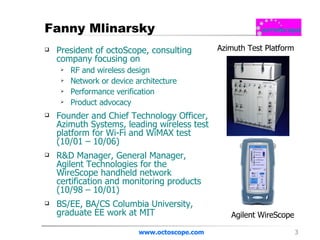
Fanny Mlinarsky President of octoScope, consulting company focusing on  RF and wireless design  Network or device architecture Performance verification Product advocacy Founder and Chief Technology Officer, Azimuth Systems, leading wireless test platform for Wi-Fi and WiMAX test (10/01 – 10/06) R&D Manager, General Manager, Agilent Technologies for the WireScope handheld network certification and monitoring products (10/98 – 10/01) BS/EE, BA/CS Columbia University, graduate EE work at MIT www.octoscope.com Azimuth Test Platform Agilent WireScope
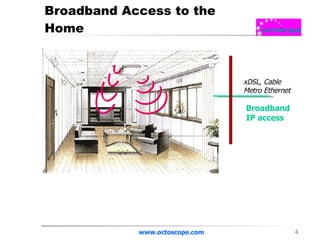
Broadband Access to the Home  www.octoscope.com xDSL, Cable Metro Ethernet Broadband  IP access
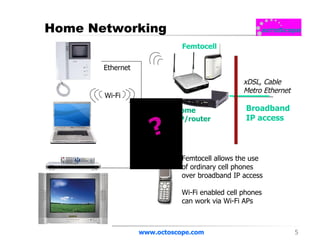
Home Networking www.octoscope.com Ethernet xDSL, Cable Metro Ethernet Home  AP/router Broadband  IP access Wi-Fi Femtocell Femtocell allows the use of ordinary cell phones over broadband IP access Wi-Fi enabled cell phones can work via Wi-Fi APs ?
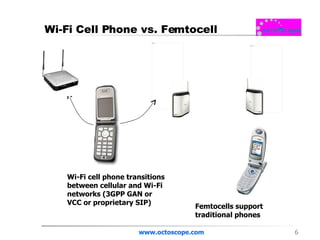
Wi-Fi Cell Phone vs. Femtocell www.octoscope.com Wi-Fi cell phone transitions between cellular and Wi-Fi networks (3GPP GAN or VCC or proprietary SIP) Femtocells support traditional phones
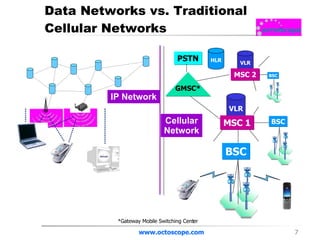
Data Networks vs. Traditional Cellular Networks www.octoscope.com VLR VLR BSC MSC 1 HLR GMSC* PSTN MSC 2 *Gateway Mobile Switching Center IP Network Cellular Network
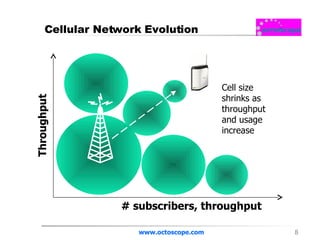
Cellular Network Evolution www.octoscope.com Throughput # subscribers, throughput Cell size shrinks as throughput and usage increase
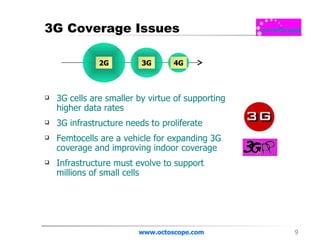
3G Coverage Issues 3G cells are smaller by virtue of supporting higher data rates 3G infrastructure needs to proliferate Femtocells are a vehicle for expanding 3G coverage and improving indoor coverage Infrastructure must evolve to support millions of small cells www.octoscope.com 2G 3G 4G
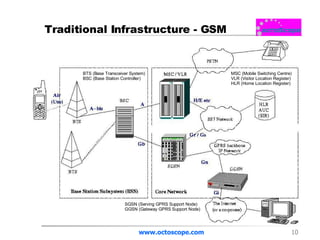
Traditional Infrastructure - GSM www.octoscope.com MSC (Mobile Switching Centre) VLR (Visitor Location Register) HLR (Home Location Register) SGSN (Serving GPRS Support Node) GGSN (Gateway GPRS Support Node) BTS (Base Transceiver System) BSC (Base Station Controller)
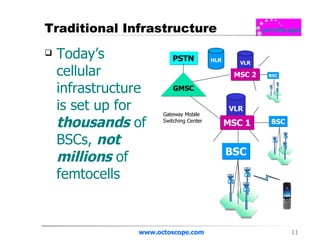
Traditional Infrastructure Today’s cellular infrastructure is set up for  thousands  of BSCs,  not millions  of femtocells www.octoscope.com VLR VLR BSC MSC 1 HLR GMSC PSTN MSC 2 Gateway Mobile Switching Center
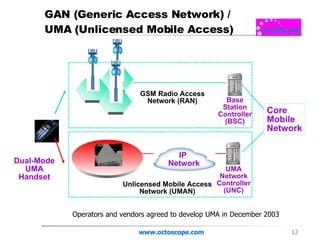
GAN (Generic Access Network) / UMA (Unlicensed Mobile Access) www.octoscope.com Dual-Mode UMA Handset Base Station Controller (BSC) IP  Network UMA Network Controller (UNC) GSM Radio Access Network (RAN) Unlicensed Mobile Access Network (UMAN) Core Mobile Network Operators and vendors agreed to develop UMA in December 2003
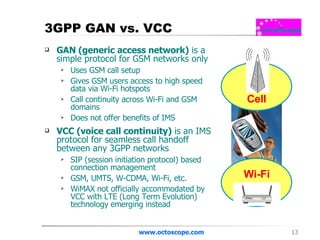
3GPP GAN vs. VCC GAN (generic access network)  is a simple protocol for GSM networks only Uses GSM call setup Gives GSM users access to high speed data via Wi-Fi hotspots Call continuity across Wi-Fi and GSM domains Does not offer benefits of IMS VCC (voice call continuity)  is an IMS protocol for seamless call handoff between any 3GPP networks SIP (session initiation protocol) based connection management GSM, UMTS, W-CDMA, Wi-Fi, etc. WiMAX not officially accommodated by VCC with LTE (Long Term Evolution) technology emerging instead www.octoscope.com Cell Wi-Fi
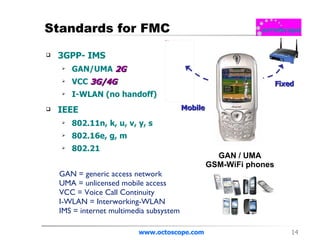
Standards for FMC 3GPP- IMS GAN/UMA  2G VCC  3G/4G I-WLAN (no handoff) IEEE  802.11n, k, u, v, y, s 802.16e, g, m  802.21 www.octoscope.com GAN = generic access network UMA = unlicensed mobile access VCC = Voice Call Continuity I-WLAN = Interworking-WLAN IMS = internet multimedia subsystem GAN / UMA GSM-WiFi phones Fixed Mobile
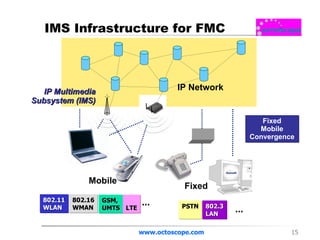
IMS Infrastructure for FMC www.octoscope.com Fixed Mobile IP Network IP Multimedia Subsystem (IMS) Fixed Mobile Convergence 802.16 WMAN 802.11 WLAN 802.3 LAN GSM, UMTS … PSTN … LTE …
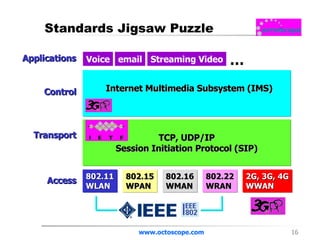
Standards Jigsaw Puzzle www.octoscope.com 802.16 WMAN 802.11 WLAN 802.15 WPAN 802.22 WRAN 2G, 3G, 4G WWAN TCP, UDP/IP Session Initiation Protocol (SIP) Internet Multimedia Subsystem (IMS) Access Transport Control Applications Voice Streaming Video email …
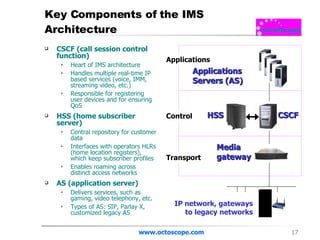
Key Components of the IMS Architecture CSCF (call session control function) Heart of IMS architecture Handles multiple real-time IP based services (voice, IMM, streaming video, etc.) Responsible for registering user devices and for ensuring QoS HSS (home subscriber server) Central repository for customer data Interfaces with operators HLRs (home location registers), which keep subscriber profiles Enables roaming across distinct access networks  AS (application server) Delivers services, such as gaming, video telephony, etc. Types of AS: SIP, Parlay X, customized legacy AS www.octoscope.com CSCF HSS Applications  Servers (AS) Media gateway Transport Control Applications IP network, gateways to legacy networks
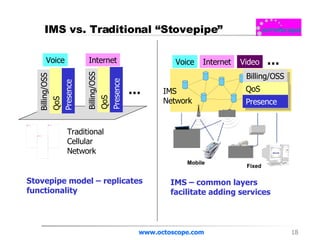
IMS vs. Traditional “Stovepipe” www.octoscope.com Traditional Cellular Network  Stovepipe model – replicates functionality IMS – common layers facilitate adding services Voice Internet Video … Voice Internet … IMS Network  Billing/OSS QoS Presence Billing/OSS QoS Presence Billing/OSS QoS Presence
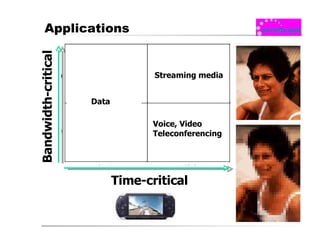
Applications Streaming media Voice, Video  Teleconferencing Data  Time-critical Bandwidth-critical
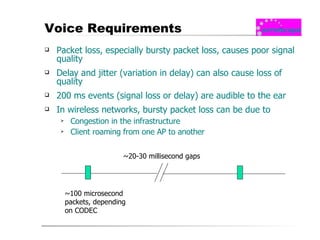
Voice Requirements Packet loss, especially bursty packet loss, causes poor signal quality Delay and jitter (variation in delay) can also cause loss of quality 200 ms events (signal loss or delay) are audible to the ear In wireless networks, bursty packet loss can be due to  Congestion in the infrastructure Client roaming from one AP to another ~100 microsecond packets, depending on CODEC ~20-30 millisecond gaps
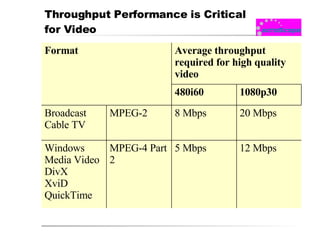
Throughput Performance is Critical for Video  Format Average throughput required for high quality video 480i60 1080p30  Broadcast Cable TV MPEG-2 8 Mbps 20 Mbps Windows Media Video DivX XviD QuickTime MPEG-4 Part 2 5 Mbps 12 Mbps
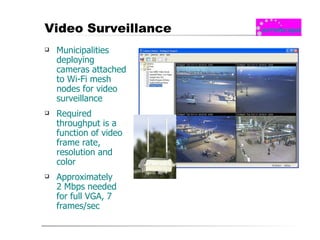
Video Surveillance Municipalities deploying cameras attached to Wi-Fi mesh nodes for video surveillance Required throughput is a function of video frame rate, resolution and color Approximately  2 Mbps needed for full VGA, 7 frames/sec
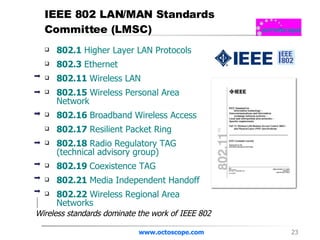
IEEE 802 LAN/MAN Standards Committee (LMSC) 802.1  Higher Layer LAN Protocols 802.3  Ethernet 802.11  Wireless LAN 802.15  Wireless Personal Area Network 802.16  Broadband Wireless Access 802.17  Resilient Packet Ring 802.18  Radio Regulatory TAG (technical advisory group) 802.19  Coexistence TAG  802.21  Media Independent Handoff 802.22  Wireless Regional Area Networks www.octoscope.com Wireless standards dominate the work of IEEE 802
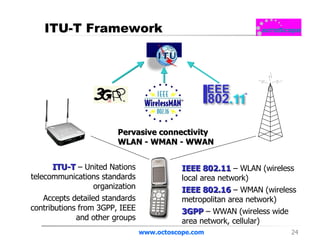
ITU-T Framework www.octoscope.com IEEE 802.11  – WLAN (wireless local area network) IEEE 802.16  – WMAN (wireless metropolitan area network) 3GPP  – WWAN (wireless wide area network, cellular) ITU-T  – United Nations telecommunications standards organization Accepts detailed standards contributions from 3GPP, IEEE and other groups Pervasive connectivity WLAN - WMAN - WWAN
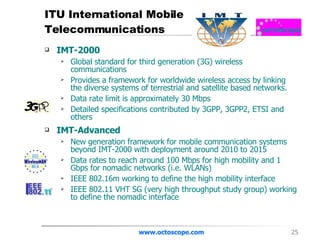
ITU International Mobile Telecommunications IMT-2000 Global standard for third generation (3G) wireless communications Provides a framework for worldwide wireless access by linking the diverse systems of terrestrial and satellite based networks.  Data rate limit is approximately 30 Mbps  Detailed specifications contributed by 3GPP, 3GPP2, ETSI and others IMT-Advanced New generation framework for mobile communication systems beyond IMT-2000 with deployment around 2010 to 2015  Data rates to reach around 100 Mbps for high mobility and 1 Gbps for nomadic networks (i.e. WLANs) IEEE 802.16m working to define the high mobility interface IEEE 802.11 VHT SG (very high throughput study group) working to define the nomadic interface www.octoscope.com
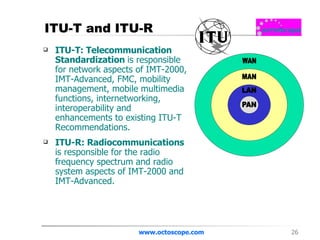
ITU-T and ITU-R ITU-T: Telecommunication Standardization  is responsible for network aspects of IMT-2000, IMT-Advanced, FMC, mobility management, mobile multimedia functions, internetworking, interoperability and enhancements to existing ITU-T Recommendations. ITU-R: Radiocommunications  is responsible for the radio frequency spectrum and radio system aspects of IMT-2000 and IMT-Advanced.  www.octoscope.com
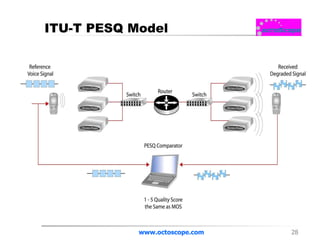
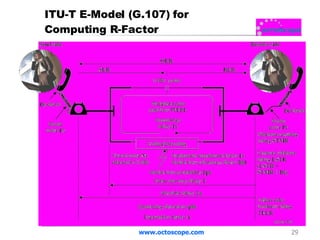
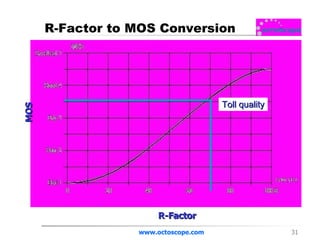
ITU-T Voice Quality Standards MOS (mean opinion score)  uses a wide range of human subjects to provide a subjective quality score (ITU-T P.800) PESQ (perceptual speech quality measure)  sends a voice pattern across a network and then compares received pattern to the original pattern and computes the quality rating (ITU-T P.862) R-Factor (Rating factor)  computed based on delay packet loss and other network performance parameters; R-Factor directly translates into MOS (ITU-T G.107) www.octoscope.com
ITU-T PESQ Model www.octoscope.com
ITU-T E-Model (G.107) for Computing R-Factor  www.octoscope.com
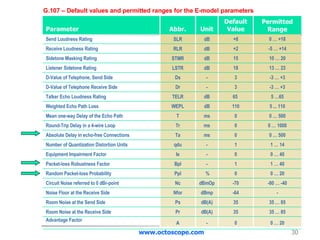
www.octoscope.com G.107 – Default values and permitted ranges for the E-model parameters Parameter Abbr. Unit Default Value Permitted Range Send Loudness Rating SLR dB +8 0 … +18 Receive Loudness Rating RLR dB +2 -5 … +14 Sidetone Masking Rating STMR dB 15 10 … 20 Listener Sidetone Rating LSTR dB 18 13 … 23 D-Value of Telephone, Send Side Ds - 3 -3 … +3 D-Value of Telephone Receive Side Dr - 3 -3 … +3 Talker Echo Loudness Rating TELR dB 65  5 …65 Weighted Echo Path Loss WEPL dB 110 5 ... 110 Mean one-way Delay of the Echo Path T ms 0 0 … 500 Round-Trip Delay in a 4-wire Loop Tr ms 0 0 … 1000 Absolute Delay in echo-free Connections Ta ms 0 0 … 500 Number of Quantization Distortion Units qdu - 1 1 … 14 Equipment Impairment Factor Ie - 0 0 … 40 Packet-loss Robustness Factor Bpl - 1 1 … 40 Random Packet-loss Probability Ppl % 0 0 … 20 Circuit Noise referred to 0 dBr-point Nc dBmOp -70 -80 … -40 Noise Floor at the Receive Side Nfor dBmp -64 - Room Noise at the Send Side Ps dB(A) 35 35 … 85 Room Noise at the Receive Side Pr dB(A) 35 35 … 85 Advantage Factor A - 0 0 … 20
R-Factor to MOS Conversion www.octoscope.com Toll quality MOS R-Factor
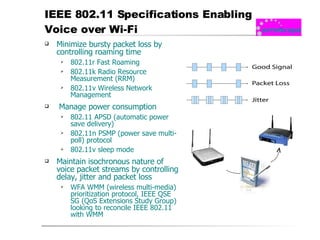
IEEE 802.11 Specifications Enabling Voice over Wi-Fi Minimize bursty packet loss by controlling roaming time 802.11r Fast Roaming 802.11k Radio Resource Measurement (RRM) 802.11v Wireless Network Management Manage power consumption 802.11 APSD (automatic power save delivery) 802.11n PSMP (power save multi-poll) protocol 802.11v sleep mode Maintain isochronous nature of voice packet streams by controlling delay, jitter and packet loss WFA WMM (wireless multi-media) prioritization protocol, IEEE QSE SG (QoS Extensions Study Group) looking to reconcile IEEE 802.11 with WMM
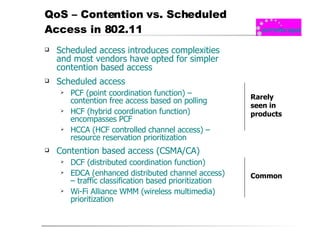
QoS – Contention vs. Scheduled Access in 802.11 Scheduled access introduces complexities and most vendors have opted for simpler contention based access Scheduled access PCF (point coordination function) – contention free access based on polling HCF (hybrid coordination function) encompasses PCF HCCA (HCF controlled channel access) – resource reservation prioritization Contention based access (CSMA/CA) DCF (distributed coordination function) EDCA (enhanced distributed channel access) – traffic classification based prioritization Wi-Fi Alliance WMM (wireless multimedia) prioritization Rarely seen in products Common
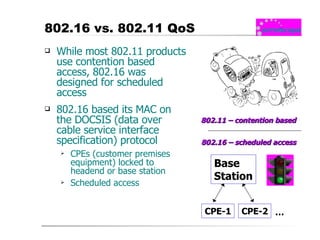
802.16 vs. 802.11 QoS While most 802.11 products use contention based access, 802.16 was designed for scheduled access 802.16 based its MAC on the DOCSIS (data over cable service interface specification) protocol CPEs (customer premises equipment) locked to headend or base station Scheduled access Base  Station CPE-1 CPE-2 … 802.11 – contention based 802.16 – scheduled access
Video Metrics Media Delivery Index (MDI) defined in IETF RFC 4445 describes media capacity of a network composed of the Media Loss Rate (MLR) and Delay Factor (DF) MLR is a media-weighted metric that expresses the number of expected IEEE Std 802.11 packets dropped from a video stream DF represents the amount of time required to drain the endstation buffer at the bit rate of the media stream MLR = (Packets Expected - Packets Received) / Interval in Seconds DF is calculated as follows: VB = |Bytes Received - Bytes Drained| DF = (max(VB) – min(VB)) / Video Bit rate in Bytes Where VB = video buffer
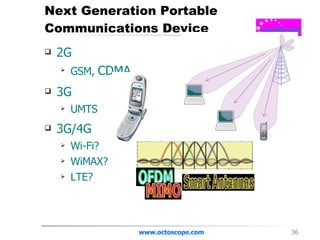
Next Generation Portable Communications Device 2G GSM,  CDMA 3G UMTS 3G/4G Wi-Fi? WiMAX? LTE? www.octoscope.com
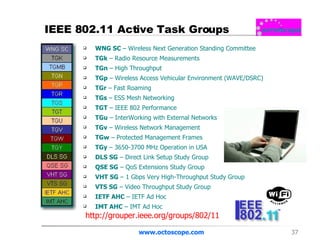
IEEE 802.11 Active Task Groups WNG SC  – Wireless Next Generation Standing Committee TGk  – Radio Resource Measurements TGn  – High Throughput TGp  – Wireless Access Vehicular Environment (WAVE/DSRC) TGr  – Fast Roaming TGs  – ESS Mesh Networking TGT  – IEEE 802 Performance TGu  – InterWorking with External Networks TGv  – Wireless Network Management TGw  – Protected Management Frames TGy  – 3650-3700 MHz Operation in USA DLS SG  – Direct Link Setup Study Group  QSE SG  – QoS Extensions Study Group  VHT SG  – 1 Gbps Very High-Throughput Study Group  VTS SG  – Video Throughput Study Group IETF AHC  – IETF Ad Hoc IMT AHC  – IMT Ad Hoc www.octoscope.com http://grouper.ieee.org/groups/802/11
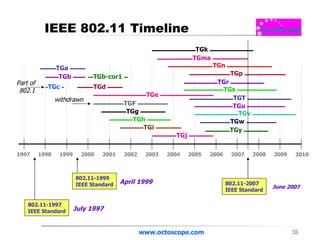
IEEE 802.11 Timeline www.octoscope.com 802.11-1997  IEEE Standard 802.11-1999  IEEE Standard July 1997 April 1999  802.11-2007  IEEE Standard TGk  TGma  TGn  TGp  TGr  TGs  TGT  TGu  TGv  TGw  TGy  TGF  Part of  802.1  withdrawn June 2007 1997 1998 1999 2000 2001 2002 2003 2004 2005 2006 2007 2008 2009 2010 TGa  TGb  TGb-cor1  TGc  TGd  TGe  TGg  TGh  TGi  TGj
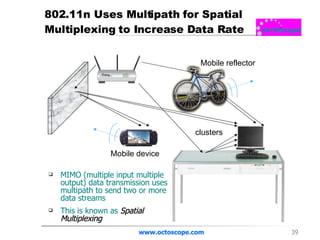
802.11n Uses Multipath for Spatial Multiplexing to Increase Data Rate MIMO (multiple input multiple output) data transmission uses multipath to send two or more data streams This is known as  Spatial Multiplexing www.octoscope.com clusters Mobile reflector Mobile device
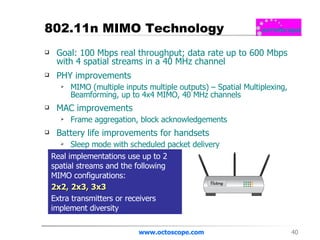
802.11n MIMO Technology Goal: 100 Mbps real throughput; data rate up to 600 Mbps with 4 spatial streams in a 40 MHz channel PHY improvements MIMO (multiple inputs multiple outputs) – Spatial Multiplexing, Beamforming, up to 4x4 MIMO, 40 MHz channels MAC improvements Frame aggregation, block acknowledgements Battery life improvements for handsets Sleep mode with scheduled packet delivery www.octoscope.com Real implementations use up to 2 spatial streams and the following MIMO configurations: 2x2, 2x3, 3x3 Extra transmitters or receivers implement diversity
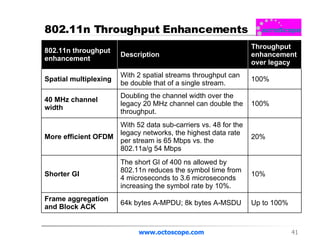
802.11n Throughput Enhancements www.octoscope.com 802.11n throughput enhancement Description Throughput enhancement over legacy Spatial multiplexing With 2 spatial streams throughput can be double that of a single stream. 100% 40 MHz channel width Doubling the channel width over the legacy 20 MHz channel can double the throughput. 100% More efficient OFDM With 52 data sub-carriers vs. 48 for the legacy networks, the highest data rate per stream is 65 Mbps vs. the 802.11a/g 54 Mbps 20% Shorter GI The short GI of 400 ns allowed by 802.11n reduces the symbol time from 4 microseconds to 3.6 microseconds increasing the symbol rate by 10%. 10% Frame aggregation and Block ACK  64k bytes A-MPDU; 8k bytes A-MSDU Up to 100%
IEEE 802.11a,b,g,n www.octoscope.com [1,]  GI = Guard Interval, period within an OFDM symbol allocated to letting the signal settle prior to transmitting the next symbol.  Legacy 802.11a/b/g devices use 800ns GI.  GI of 400ns is optional for 802.11n .   20 MHz Channel 40 MHz Channel 1 stream 2 streams 1 stream 2 streams Data Rate, in Mbps 802.11b  2.4 GHz 1, 2, 5.5, 11       802.11a  5 GHz 6, 9, 12, 18, 24, 36, 48, 54       802.11g  2.4 GHz 1, 2, 6, 9, 12, 18, 24, 36, 48, 54       802.11n GI [1] =800ns  2.4 GHz 6.5, 13, 19.5, 26, 39, 52, 58.5, 65 13, 26, 39, 52, 78, 104, 117, 130 802.11n GI [1] =800ns  5 GHz 6.5, 13, 19.5, 26, 39, 52, 58.5, 65 13, 26, 39, 52, 78, 104, 117, 130 13.5, 27, 40.5, 54, 81, 108, 121.5, 135 27, 54, 81, 108, 162, 216, 243, 270 802.11n, GI=400ns  2.4 and 5 GHz 7.2, 14.4, 21.7, 28.9, 43.3, 57.8, 65, 72.2 14.4, 28.9, 43.3, 57.8, 86.7, 115.6, 130, 144.4 15, 30, 45, 60, 90, 120, 135, 150 30, 60, 90, 120, 180, 240, 270,  300
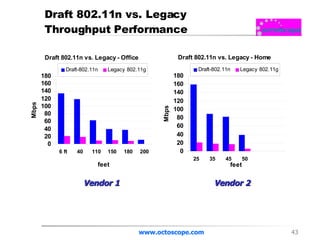
Draft 802.11n vs. Legacy Throughput Performance www.octoscope.com Vendor 1 Vendor 2
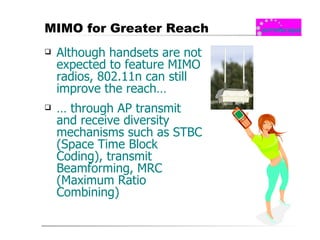
MIMO for Greater Reach  Although handsets are not expected to feature MIMO radios, 802.11n can still improve the reach… …  through AP transmit and receive diversity mechanisms such as STBC ( Space Time Block Coding),  transmit Beamforming, MRC ( Maximum Ratio Combining)
Transitions and QoS in Wi-Fi Networks www.octoscope.com
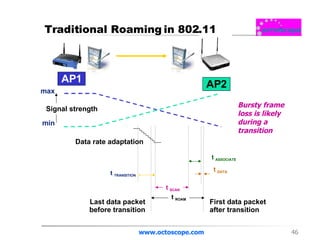
Traditional Roaming in 802.11 www.octoscope.com AP1 AP2 max min Signal strength t  TRANSITION t  SCAN Last data packet before transition t  ASSOCIATE t  ROAM Data rate adaptation First data packet after transition t  DATA Bursty frame loss is likely during a transition
802.11r Fast Transition (Roaming) Needed by voice applications Basic methodology involves propagating authentication information for connected stations through the ‘mobility domain’ to eliminate the need for re-authentication upon station transition from one AP to another The station preparing the roam can setup the target AP to minimize the actual transition time Roaming from one mobility domain to another requires authentication and is not considered fast transition www.octoscope.com
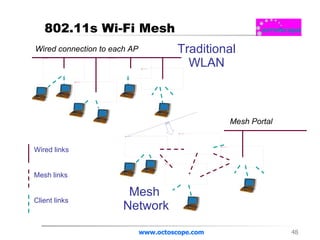
802.11s Wi-Fi Mesh www.octoscope.com Traditional WLAN Mesh  Network Mesh Portal Wired connection to each AP Mesh links Client links Wired links
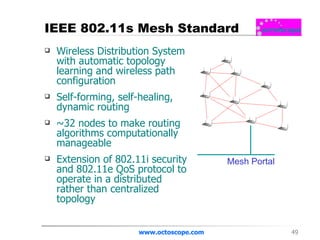
IEEE 802.11s Mesh Standard Wireless Distribution System with automatic topology learning and wireless path configuration Self-forming, self-healing, dynamic routing ~32 nodes to make routing algorithms computationally manageable Extension of 802.11i security and 802.11e QoS protocol to operate in a distributed rather than centralized topology www.octoscope.com Mesh Portal
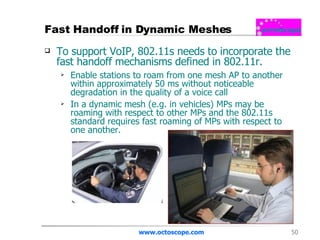
Fast Handoff in Dynamic Meshes To support VoIP, 802.11s needs to incorporate the fast handoff mechanisms defined in 802.11r.  Enable stations to roam from one mesh AP to another within approximately 50 ms without noticeable degradation in the quality of a voice call  In a dynamic mesh (e.g. in vehicles) MPs may be roaming with respect to other MPs and the 802.11s standard requires fast roaming of MPs with respect to one another.  www.octoscope.com
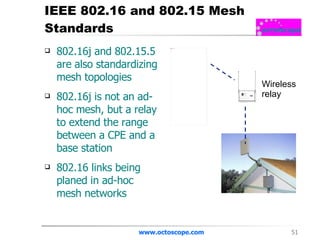
IEEE 802.16 and 802.15 Mesh Standards 802.16j and 802.15.5 are also standardizing mesh topologies 802.16j is not an ad-hoc mesh, but a relay to extend the range between a CPE and a base station 802.16 links being planed in ad-hoc mesh networks www.octoscope.com Wireless  relay
Lightly Regulated Band for 802.11, 802.16 March 2005 FCC offered 50 MHz 3650 to 3700 MHz   for  contention-based protocol 802.11y meets FCC requirement; 802.16h is working to comply  21 st  century regulation geared for digital communications multiple services to share the band in an orderly way www.octoscope.com 300 Million licenses one for every person or company $300 per license for 10 years Registered stations   (base stations):   1 W/MHz ,   ~15 km Unregistered stations   (handsets, laptops):   40 mW/MHz ,   1-1.5 km
802.11k Radio Resource Measurement Impetus for 802.11k came from the Enterprises that needed to manage their WLANs from a central point 802.11k makes a centralized network management system by providing layer 2 mechanisms for Discovering network topology Monitoring WLAN devices, their receive power levels, PHY configuration and network activity Can be used to assists 802.11r Fast Transition (roaming) protocol with handoff decisions based on the loading of the infrastructure www.octoscope.com
802.11v Wireless Network Management  TGv’s charter is to build on the network  measurement  mechanisms defined by TGk and introduce network  management  functions to provide Enterprises with centralized network management and load balancing capabilities.  Major goals:  manageability, improved power efficiency  and  interference avoidance   Defines a protocol for requesting and reporting location capability Location information may be CIVIC (street address) or GEO (longitude, latitude coordinates)  For the handset, TGv may enable awareness of AP e911 capabilities while the handset is in sleep mode; this work has common ground with TGu www.octoscope.com
802.11v Improves Power Efficiency TGv defines FBMS (flexible broadcast multicast service) - the mechanism to let devices extend their sleep period  Devices can specifying the wake up interval to be longer than a single DTIM (delivery traffic indication message). This consolidates traffic receive/transmit intervals and extends battery life of handsets. Sleep mode is also part of 802.11n (PSMP) and 802.11u.  TGs is also dealing with power conservation and sleep mode protocol, working to make this protocol distributed whereby a mesh point registers its sleep mode with the neighbors.  TGv may extend the sleep mode protocol to include the ability of maintaining location awareness while in sleep mode.  www.octoscope.com
802.11w Protected Management Frames 802.11w protects against the forgery of management frames  802.11k and now 802.11v are both adding new mgt frames that can exchange sensitive information  Information about network topology, location and loading Configuration commands to optimize the network These frames can be easily forged by the attackers to disrupt the network For example, an attacker can forge AP loading messages redirecting client associations or locking users out of the network TGw provides protection for the management frames after association and after keys have been set up through 802.11i or 802.11r mechanisms.  www.octoscope.com
802.11u  Interworking With External Networks Main goal is to enable Interworking with external networks, including other 802 based networks such as 802.16 and 802.3 and 3GPP based IMS networks. TGu specification deals with Network discovery Emergency call support (e911) Roaming Location and availability The network discovery capabilities give a station looking to connect information about Networks in range Service providers Subscription status with service providers Type of QoS that’s available and whether the network is suitable for services like VoIP or video 802.11u makes 802.11 networks more like cellular networks where such information is provided by the infrastructure www.octoscope.com
Missing Link between IEEE 802 and  3GPP IMS? Liaison exists between 802.21, 802.11u, 802.16g and 3GPP 802.21 – MIH (media independent handover) GAS (generic advertising service) gives stations information about 802.11 and 802.16 networks – SSP, SSID, radio, available services, etc.  802.11u and 802.16g are defining protocols to let a station to access the 802.21 information server 802.11u, 802.16g – Interworking Cellular-like network discovery with information on service providers, QoS, emergency call support (e911), roaming, location and availability  SSP (service subscription provider) – carrier or operator www.octoscope.com working to make 802 wireless networks more like cellular
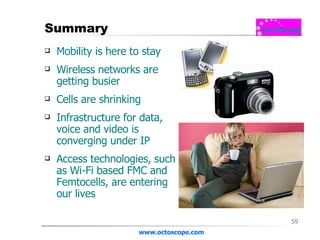
Summary Mobility is here to stay Wireless networks are getting busier Cells are shrinking Infrastructure for data, voice and video is converging under IP Access technologies, such as Wi-Fi based FMC and Femtocells, are entering our lives www.octoscope.com
Agenda 9:00 – 11:00 am   FMC and Femtocell History, Architecture and Standards  Fanny Mlinarsky, President, octoScope Moe Tanabian, Principal, IBB Consulting Group  11:00 – 11:15 am   Break 11:15 – 12:00 noon  Femtocell Regulatory Issues Bill Leslie, CEO at Longboard  12:00 – 1:00 pm   Lunch 1:00 – 2:45 pm  FMC and Femtocell Solutions Today Steve Shaw, AVP of Marketing, Kineto Wireless  Natasha Tamaskar, VP of Product Management and Marketing, NextPoint Networks  2:45 – 3:00 pm   Break 3:00 – 4:45 pm  IMS and Wi-Fi Based FMC Solutions Michael Khalilian, Chairman and President, IMS Forum  Francis daCosta, Founder and CTO, Mesh Dynamics  4:45 – 5:00 pm  Question & Answer period  Entire panel www.octoscope.com

Mlinarsky Fanny

  • 1.
    Technologies and MarketForces Behind Fixed Mobile Convergence VON, San Jose March 17, 2008 Fanny Mlinarsky President, octoScope
  • 2.
    Agenda 9:00 –11:00 am FMC and Femtocell History, Architecture and Standards Fanny Mlinarsky, President, octoScope Moe Tanabian, Principal, IBB Consulting Group 11:00 – 11:15 am Break 11:15 – 12:00 noon Femtocell Regulatory Issues Bill Leslie, CEO, Longboard 12:00 – 1:00 pm Lunch 1:00 – 2:45 pm FMC and Femtocell Solutions Today Steve Shaw, AVP of Marketing, Kineto Wireless Natasha Tamaskar, VP of Product Management and Marketing, NextPoint Networks 2:45 – 3:00 pm Break 3:00 – 4:45 pm IMS and Wi-Fi Based FMC Solutions Michael Khalilian, Chairman and President, IMS Forum Francis daCosta, Founder and CTO, Mesh Dynamics 4:45 – 5:00 pm Question & Answer period Entire panel www.octoscope.com
  • 3.
    Fanny Mlinarsky Presidentof octoScope, consulting company focusing on RF and wireless design Network or device architecture Performance verification Product advocacy Founder and Chief Technology Officer, Azimuth Systems, leading wireless test platform for Wi-Fi and WiMAX test (10/01 – 10/06) R&D Manager, General Manager, Agilent Technologies for the WireScope handheld network certification and monitoring products (10/98 – 10/01) BS/EE, BA/CS Columbia University, graduate EE work at MIT www.octoscope.com Azimuth Test Platform Agilent WireScope
  • 4.
    Broadband Access tothe Home www.octoscope.com xDSL, Cable Metro Ethernet Broadband IP access
  • 5.
    Home Networking www.octoscope.comEthernet xDSL, Cable Metro Ethernet Home AP/router Broadband IP access Wi-Fi Femtocell Femtocell allows the use of ordinary cell phones over broadband IP access Wi-Fi enabled cell phones can work via Wi-Fi APs ?
  • 6.
    Wi-Fi Cell Phonevs. Femtocell www.octoscope.com Wi-Fi cell phone transitions between cellular and Wi-Fi networks (3GPP GAN or VCC or proprietary SIP) Femtocells support traditional phones
  • 7.
    Data Networks vs.Traditional Cellular Networks www.octoscope.com VLR VLR BSC MSC 1 HLR GMSC* PSTN MSC 2 *Gateway Mobile Switching Center IP Network Cellular Network
  • 8.
    Cellular Network Evolutionwww.octoscope.com Throughput # subscribers, throughput Cell size shrinks as throughput and usage increase
  • 9.
    3G Coverage Issues3G cells are smaller by virtue of supporting higher data rates 3G infrastructure needs to proliferate Femtocells are a vehicle for expanding 3G coverage and improving indoor coverage Infrastructure must evolve to support millions of small cells www.octoscope.com 2G 3G 4G
  • 10.
    Traditional Infrastructure -GSM www.octoscope.com MSC (Mobile Switching Centre) VLR (Visitor Location Register) HLR (Home Location Register) SGSN (Serving GPRS Support Node) GGSN (Gateway GPRS Support Node) BTS (Base Transceiver System) BSC (Base Station Controller)
  • 11.
    Traditional Infrastructure Today’scellular infrastructure is set up for thousands of BSCs, not millions of femtocells www.octoscope.com VLR VLR BSC MSC 1 HLR GMSC PSTN MSC 2 Gateway Mobile Switching Center
  • 12.
    GAN (Generic AccessNetwork) / UMA (Unlicensed Mobile Access) www.octoscope.com Dual-Mode UMA Handset Base Station Controller (BSC) IP Network UMA Network Controller (UNC) GSM Radio Access Network (RAN) Unlicensed Mobile Access Network (UMAN) Core Mobile Network Operators and vendors agreed to develop UMA in December 2003
  • 13.
    3GPP GAN vs.VCC GAN (generic access network) is a simple protocol for GSM networks only Uses GSM call setup Gives GSM users access to high speed data via Wi-Fi hotspots Call continuity across Wi-Fi and GSM domains Does not offer benefits of IMS VCC (voice call continuity) is an IMS protocol for seamless call handoff between any 3GPP networks SIP (session initiation protocol) based connection management GSM, UMTS, W-CDMA, Wi-Fi, etc. WiMAX not officially accommodated by VCC with LTE (Long Term Evolution) technology emerging instead www.octoscope.com Cell Wi-Fi
  • 14.
    Standards for FMC3GPP- IMS GAN/UMA 2G VCC 3G/4G I-WLAN (no handoff) IEEE 802.11n, k, u, v, y, s 802.16e, g, m 802.21 www.octoscope.com GAN = generic access network UMA = unlicensed mobile access VCC = Voice Call Continuity I-WLAN = Interworking-WLAN IMS = internet multimedia subsystem GAN / UMA GSM-WiFi phones Fixed Mobile
  • 15.
    IMS Infrastructure forFMC www.octoscope.com Fixed Mobile IP Network IP Multimedia Subsystem (IMS) Fixed Mobile Convergence 802.16 WMAN 802.11 WLAN 802.3 LAN GSM, UMTS … PSTN … LTE …
  • 16.
    Standards Jigsaw Puzzlewww.octoscope.com 802.16 WMAN 802.11 WLAN 802.15 WPAN 802.22 WRAN 2G, 3G, 4G WWAN TCP, UDP/IP Session Initiation Protocol (SIP) Internet Multimedia Subsystem (IMS) Access Transport Control Applications Voice Streaming Video email …
  • 17.
    Key Components ofthe IMS Architecture CSCF (call session control function) Heart of IMS architecture Handles multiple real-time IP based services (voice, IMM, streaming video, etc.) Responsible for registering user devices and for ensuring QoS HSS (home subscriber server) Central repository for customer data Interfaces with operators HLRs (home location registers), which keep subscriber profiles Enables roaming across distinct access networks AS (application server) Delivers services, such as gaming, video telephony, etc. Types of AS: SIP, Parlay X, customized legacy AS www.octoscope.com CSCF HSS Applications Servers (AS) Media gateway Transport Control Applications IP network, gateways to legacy networks
  • 18.
    IMS vs. Traditional“Stovepipe” www.octoscope.com Traditional Cellular Network Stovepipe model – replicates functionality IMS – common layers facilitate adding services Voice Internet Video … Voice Internet … IMS Network Billing/OSS QoS Presence Billing/OSS QoS Presence Billing/OSS QoS Presence
  • 19.
    Applications Streaming mediaVoice, Video Teleconferencing Data Time-critical Bandwidth-critical
  • 20.
    Voice Requirements Packetloss, especially bursty packet loss, causes poor signal quality Delay and jitter (variation in delay) can also cause loss of quality 200 ms events (signal loss or delay) are audible to the ear In wireless networks, bursty packet loss can be due to Congestion in the infrastructure Client roaming from one AP to another ~100 microsecond packets, depending on CODEC ~20-30 millisecond gaps
  • 21.
    Throughput Performance isCritical for Video Format Average throughput required for high quality video 480i60 1080p30 Broadcast Cable TV MPEG-2 8 Mbps 20 Mbps Windows Media Video DivX XviD QuickTime MPEG-4 Part 2 5 Mbps 12 Mbps
  • 22.
    Video Surveillance Municipalitiesdeploying cameras attached to Wi-Fi mesh nodes for video surveillance Required throughput is a function of video frame rate, resolution and color Approximately 2 Mbps needed for full VGA, 7 frames/sec
  • 23.
    IEEE 802 LAN/MANStandards Committee (LMSC) 802.1 Higher Layer LAN Protocols 802.3 Ethernet 802.11 Wireless LAN 802.15 Wireless Personal Area Network 802.16 Broadband Wireless Access 802.17 Resilient Packet Ring 802.18 Radio Regulatory TAG (technical advisory group) 802.19 Coexistence TAG 802.21 Media Independent Handoff 802.22 Wireless Regional Area Networks www.octoscope.com Wireless standards dominate the work of IEEE 802
  • 24.
    ITU-T Framework www.octoscope.comIEEE 802.11 – WLAN (wireless local area network) IEEE 802.16 – WMAN (wireless metropolitan area network) 3GPP – WWAN (wireless wide area network, cellular) ITU-T – United Nations telecommunications standards organization Accepts detailed standards contributions from 3GPP, IEEE and other groups Pervasive connectivity WLAN - WMAN - WWAN
  • 25.
    ITU International MobileTelecommunications IMT-2000 Global standard for third generation (3G) wireless communications Provides a framework for worldwide wireless access by linking the diverse systems of terrestrial and satellite based networks. Data rate limit is approximately 30 Mbps Detailed specifications contributed by 3GPP, 3GPP2, ETSI and others IMT-Advanced New generation framework for mobile communication systems beyond IMT-2000 with deployment around 2010 to 2015 Data rates to reach around 100 Mbps for high mobility and 1 Gbps for nomadic networks (i.e. WLANs) IEEE 802.16m working to define the high mobility interface IEEE 802.11 VHT SG (very high throughput study group) working to define the nomadic interface www.octoscope.com
  • 26.
    ITU-T and ITU-RITU-T: Telecommunication Standardization is responsible for network aspects of IMT-2000, IMT-Advanced, FMC, mobility management, mobile multimedia functions, internetworking, interoperability and enhancements to existing ITU-T Recommendations. ITU-R: Radiocommunications is responsible for the radio frequency spectrum and radio system aspects of IMT-2000 and IMT-Advanced. www.octoscope.com
  • 27.
    ITU-T Voice QualityStandards MOS (mean opinion score) uses a wide range of human subjects to provide a subjective quality score (ITU-T P.800) PESQ (perceptual speech quality measure) sends a voice pattern across a network and then compares received pattern to the original pattern and computes the quality rating (ITU-T P.862) R-Factor (Rating factor) computed based on delay packet loss and other network performance parameters; R-Factor directly translates into MOS (ITU-T G.107) www.octoscope.com
  • 28.
    ITU-T PESQ Modelwww.octoscope.com
  • 29.
    ITU-T E-Model (G.107)for Computing R-Factor www.octoscope.com
  • 30.
    www.octoscope.com G.107 –Default values and permitted ranges for the E-model parameters Parameter Abbr. Unit Default Value Permitted Range Send Loudness Rating SLR dB +8 0 … +18 Receive Loudness Rating RLR dB +2 -5 … +14 Sidetone Masking Rating STMR dB 15 10 … 20 Listener Sidetone Rating LSTR dB 18 13 … 23 D-Value of Telephone, Send Side Ds - 3 -3 … +3 D-Value of Telephone Receive Side Dr - 3 -3 … +3 Talker Echo Loudness Rating TELR dB 65 5 …65 Weighted Echo Path Loss WEPL dB 110 5 ... 110 Mean one-way Delay of the Echo Path T ms 0 0 … 500 Round-Trip Delay in a 4-wire Loop Tr ms 0 0 … 1000 Absolute Delay in echo-free Connections Ta ms 0 0 … 500 Number of Quantization Distortion Units qdu - 1 1 … 14 Equipment Impairment Factor Ie - 0 0 … 40 Packet-loss Robustness Factor Bpl - 1 1 … 40 Random Packet-loss Probability Ppl % 0 0 … 20 Circuit Noise referred to 0 dBr-point Nc dBmOp -70 -80 … -40 Noise Floor at the Receive Side Nfor dBmp -64 - Room Noise at the Send Side Ps dB(A) 35 35 … 85 Room Noise at the Receive Side Pr dB(A) 35 35 … 85 Advantage Factor A - 0 0 … 20
  • 31.
    R-Factor to MOSConversion www.octoscope.com Toll quality MOS R-Factor
  • 32.
    IEEE 802.11 SpecificationsEnabling Voice over Wi-Fi Minimize bursty packet loss by controlling roaming time 802.11r Fast Roaming 802.11k Radio Resource Measurement (RRM) 802.11v Wireless Network Management Manage power consumption 802.11 APSD (automatic power save delivery) 802.11n PSMP (power save multi-poll) protocol 802.11v sleep mode Maintain isochronous nature of voice packet streams by controlling delay, jitter and packet loss WFA WMM (wireless multi-media) prioritization protocol, IEEE QSE SG (QoS Extensions Study Group) looking to reconcile IEEE 802.11 with WMM
  • 33.
    QoS – Contentionvs. Scheduled Access in 802.11 Scheduled access introduces complexities and most vendors have opted for simpler contention based access Scheduled access PCF (point coordination function) – contention free access based on polling HCF (hybrid coordination function) encompasses PCF HCCA (HCF controlled channel access) – resource reservation prioritization Contention based access (CSMA/CA) DCF (distributed coordination function) EDCA (enhanced distributed channel access) – traffic classification based prioritization Wi-Fi Alliance WMM (wireless multimedia) prioritization Rarely seen in products Common
  • 34.
    802.16 vs. 802.11QoS While most 802.11 products use contention based access, 802.16 was designed for scheduled access 802.16 based its MAC on the DOCSIS (data over cable service interface specification) protocol CPEs (customer premises equipment) locked to headend or base station Scheduled access Base Station CPE-1 CPE-2 … 802.11 – contention based 802.16 – scheduled access
  • 35.
    Video Metrics MediaDelivery Index (MDI) defined in IETF RFC 4445 describes media capacity of a network composed of the Media Loss Rate (MLR) and Delay Factor (DF) MLR is a media-weighted metric that expresses the number of expected IEEE Std 802.11 packets dropped from a video stream DF represents the amount of time required to drain the endstation buffer at the bit rate of the media stream MLR = (Packets Expected - Packets Received) / Interval in Seconds DF is calculated as follows: VB = |Bytes Received - Bytes Drained| DF = (max(VB) – min(VB)) / Video Bit rate in Bytes Where VB = video buffer
  • 36.
    Next Generation PortableCommunications Device 2G GSM, CDMA 3G UMTS 3G/4G Wi-Fi? WiMAX? LTE? www.octoscope.com
  • 37.
    IEEE 802.11 ActiveTask Groups WNG SC – Wireless Next Generation Standing Committee TGk – Radio Resource Measurements TGn – High Throughput TGp – Wireless Access Vehicular Environment (WAVE/DSRC) TGr – Fast Roaming TGs – ESS Mesh Networking TGT – IEEE 802 Performance TGu – InterWorking with External Networks TGv – Wireless Network Management TGw – Protected Management Frames TGy – 3650-3700 MHz Operation in USA DLS SG – Direct Link Setup Study Group QSE SG – QoS Extensions Study Group VHT SG – 1 Gbps Very High-Throughput Study Group VTS SG – Video Throughput Study Group IETF AHC – IETF Ad Hoc IMT AHC – IMT Ad Hoc www.octoscope.com http://grouper.ieee.org/groups/802/11
  • 38.
    IEEE 802.11 Timelinewww.octoscope.com 802.11-1997 IEEE Standard 802.11-1999 IEEE Standard July 1997 April 1999 802.11-2007 IEEE Standard TGk TGma TGn TGp TGr TGs TGT TGu TGv TGw TGy TGF Part of 802.1 withdrawn June 2007 1997 1998 1999 2000 2001 2002 2003 2004 2005 2006 2007 2008 2009 2010 TGa TGb TGb-cor1 TGc TGd TGe TGg TGh TGi TGj
  • 39.
    802.11n Uses Multipathfor Spatial Multiplexing to Increase Data Rate MIMO (multiple input multiple output) data transmission uses multipath to send two or more data streams This is known as Spatial Multiplexing www.octoscope.com clusters Mobile reflector Mobile device
  • 40.
    802.11n MIMO TechnologyGoal: 100 Mbps real throughput; data rate up to 600 Mbps with 4 spatial streams in a 40 MHz channel PHY improvements MIMO (multiple inputs multiple outputs) – Spatial Multiplexing, Beamforming, up to 4x4 MIMO, 40 MHz channels MAC improvements Frame aggregation, block acknowledgements Battery life improvements for handsets Sleep mode with scheduled packet delivery www.octoscope.com Real implementations use up to 2 spatial streams and the following MIMO configurations: 2x2, 2x3, 3x3 Extra transmitters or receivers implement diversity
  • 41.
    802.11n Throughput Enhancementswww.octoscope.com 802.11n throughput enhancement Description Throughput enhancement over legacy Spatial multiplexing With 2 spatial streams throughput can be double that of a single stream. 100% 40 MHz channel width Doubling the channel width over the legacy 20 MHz channel can double the throughput. 100% More efficient OFDM With 52 data sub-carriers vs. 48 for the legacy networks, the highest data rate per stream is 65 Mbps vs. the 802.11a/g 54 Mbps 20% Shorter GI The short GI of 400 ns allowed by 802.11n reduces the symbol time from 4 microseconds to 3.6 microseconds increasing the symbol rate by 10%. 10% Frame aggregation and Block ACK 64k bytes A-MPDU; 8k bytes A-MSDU Up to 100%
  • 42.
    IEEE 802.11a,b,g,n www.octoscope.com[1,] GI = Guard Interval, period within an OFDM symbol allocated to letting the signal settle prior to transmitting the next symbol. Legacy 802.11a/b/g devices use 800ns GI. GI of 400ns is optional for 802.11n .   20 MHz Channel 40 MHz Channel 1 stream 2 streams 1 stream 2 streams Data Rate, in Mbps 802.11b 2.4 GHz 1, 2, 5.5, 11       802.11a 5 GHz 6, 9, 12, 18, 24, 36, 48, 54       802.11g 2.4 GHz 1, 2, 6, 9, 12, 18, 24, 36, 48, 54       802.11n GI [1] =800ns 2.4 GHz 6.5, 13, 19.5, 26, 39, 52, 58.5, 65 13, 26, 39, 52, 78, 104, 117, 130 802.11n GI [1] =800ns 5 GHz 6.5, 13, 19.5, 26, 39, 52, 58.5, 65 13, 26, 39, 52, 78, 104, 117, 130 13.5, 27, 40.5, 54, 81, 108, 121.5, 135 27, 54, 81, 108, 162, 216, 243, 270 802.11n, GI=400ns 2.4 and 5 GHz 7.2, 14.4, 21.7, 28.9, 43.3, 57.8, 65, 72.2 14.4, 28.9, 43.3, 57.8, 86.7, 115.6, 130, 144.4 15, 30, 45, 60, 90, 120, 135, 150 30, 60, 90, 120, 180, 240, 270, 300
  • 43.
    Draft 802.11n vs.Legacy Throughput Performance www.octoscope.com Vendor 1 Vendor 2
  • 44.
    MIMO for GreaterReach Although handsets are not expected to feature MIMO radios, 802.11n can still improve the reach… … through AP transmit and receive diversity mechanisms such as STBC ( Space Time Block Coding), transmit Beamforming, MRC ( Maximum Ratio Combining)
  • 45.
    Transitions and QoSin Wi-Fi Networks www.octoscope.com
  • 46.
    Traditional Roaming in802.11 www.octoscope.com AP1 AP2 max min Signal strength t TRANSITION t SCAN Last data packet before transition t ASSOCIATE t ROAM Data rate adaptation First data packet after transition t DATA Bursty frame loss is likely during a transition
  • 47.
    802.11r Fast Transition(Roaming) Needed by voice applications Basic methodology involves propagating authentication information for connected stations through the ‘mobility domain’ to eliminate the need for re-authentication upon station transition from one AP to another The station preparing the roam can setup the target AP to minimize the actual transition time Roaming from one mobility domain to another requires authentication and is not considered fast transition www.octoscope.com
  • 48.
    802.11s Wi-Fi Meshwww.octoscope.com Traditional WLAN Mesh Network Mesh Portal Wired connection to each AP Mesh links Client links Wired links
  • 49.
    IEEE 802.11s MeshStandard Wireless Distribution System with automatic topology learning and wireless path configuration Self-forming, self-healing, dynamic routing ~32 nodes to make routing algorithms computationally manageable Extension of 802.11i security and 802.11e QoS protocol to operate in a distributed rather than centralized topology www.octoscope.com Mesh Portal
  • 50.
    Fast Handoff inDynamic Meshes To support VoIP, 802.11s needs to incorporate the fast handoff mechanisms defined in 802.11r. Enable stations to roam from one mesh AP to another within approximately 50 ms without noticeable degradation in the quality of a voice call In a dynamic mesh (e.g. in vehicles) MPs may be roaming with respect to other MPs and the 802.11s standard requires fast roaming of MPs with respect to one another. www.octoscope.com
  • 51.
    IEEE 802.16 and802.15 Mesh Standards 802.16j and 802.15.5 are also standardizing mesh topologies 802.16j is not an ad-hoc mesh, but a relay to extend the range between a CPE and a base station 802.16 links being planed in ad-hoc mesh networks www.octoscope.com Wireless relay
  • 52.
    Lightly Regulated Bandfor 802.11, 802.16 March 2005 FCC offered 50 MHz 3650 to 3700 MHz for contention-based protocol 802.11y meets FCC requirement; 802.16h is working to comply 21 st century regulation geared for digital communications multiple services to share the band in an orderly way www.octoscope.com 300 Million licenses one for every person or company $300 per license for 10 years Registered stations (base stations): 1 W/MHz , ~15 km Unregistered stations (handsets, laptops): 40 mW/MHz , 1-1.5 km
  • 53.
    802.11k Radio ResourceMeasurement Impetus for 802.11k came from the Enterprises that needed to manage their WLANs from a central point 802.11k makes a centralized network management system by providing layer 2 mechanisms for Discovering network topology Monitoring WLAN devices, their receive power levels, PHY configuration and network activity Can be used to assists 802.11r Fast Transition (roaming) protocol with handoff decisions based on the loading of the infrastructure www.octoscope.com
  • 54.
    802.11v Wireless NetworkManagement TGv’s charter is to build on the network measurement mechanisms defined by TGk and introduce network management functions to provide Enterprises with centralized network management and load balancing capabilities. Major goals: manageability, improved power efficiency and interference avoidance Defines a protocol for requesting and reporting location capability Location information may be CIVIC (street address) or GEO (longitude, latitude coordinates) For the handset, TGv may enable awareness of AP e911 capabilities while the handset is in sleep mode; this work has common ground with TGu www.octoscope.com
  • 55.
    802.11v Improves PowerEfficiency TGv defines FBMS (flexible broadcast multicast service) - the mechanism to let devices extend their sleep period Devices can specifying the wake up interval to be longer than a single DTIM (delivery traffic indication message). This consolidates traffic receive/transmit intervals and extends battery life of handsets. Sleep mode is also part of 802.11n (PSMP) and 802.11u. TGs is also dealing with power conservation and sleep mode protocol, working to make this protocol distributed whereby a mesh point registers its sleep mode with the neighbors. TGv may extend the sleep mode protocol to include the ability of maintaining location awareness while in sleep mode. www.octoscope.com
  • 56.
    802.11w Protected ManagementFrames 802.11w protects against the forgery of management frames 802.11k and now 802.11v are both adding new mgt frames that can exchange sensitive information Information about network topology, location and loading Configuration commands to optimize the network These frames can be easily forged by the attackers to disrupt the network For example, an attacker can forge AP loading messages redirecting client associations or locking users out of the network TGw provides protection for the management frames after association and after keys have been set up through 802.11i or 802.11r mechanisms. www.octoscope.com
  • 57.
    802.11u InterworkingWith External Networks Main goal is to enable Interworking with external networks, including other 802 based networks such as 802.16 and 802.3 and 3GPP based IMS networks. TGu specification deals with Network discovery Emergency call support (e911) Roaming Location and availability The network discovery capabilities give a station looking to connect information about Networks in range Service providers Subscription status with service providers Type of QoS that’s available and whether the network is suitable for services like VoIP or video 802.11u makes 802.11 networks more like cellular networks where such information is provided by the infrastructure www.octoscope.com
  • 58.
    Missing Link betweenIEEE 802 and 3GPP IMS? Liaison exists between 802.21, 802.11u, 802.16g and 3GPP 802.21 – MIH (media independent handover) GAS (generic advertising service) gives stations information about 802.11 and 802.16 networks – SSP, SSID, radio, available services, etc. 802.11u and 802.16g are defining protocols to let a station to access the 802.21 information server 802.11u, 802.16g – Interworking Cellular-like network discovery with information on service providers, QoS, emergency call support (e911), roaming, location and availability SSP (service subscription provider) – carrier or operator www.octoscope.com working to make 802 wireless networks more like cellular
  • 59.
    Summary Mobility ishere to stay Wireless networks are getting busier Cells are shrinking Infrastructure for data, voice and video is converging under IP Access technologies, such as Wi-Fi based FMC and Femtocells, are entering our lives www.octoscope.com
  • 60.
    Agenda 9:00 –11:00 am FMC and Femtocell History, Architecture and Standards Fanny Mlinarsky, President, octoScope Moe Tanabian, Principal, IBB Consulting Group 11:00 – 11:15 am Break 11:15 – 12:00 noon Femtocell Regulatory Issues Bill Leslie, CEO at Longboard 12:00 – 1:00 pm Lunch 1:00 – 2:45 pm FMC and Femtocell Solutions Today Steve Shaw, AVP of Marketing, Kineto Wireless Natasha Tamaskar, VP of Product Management and Marketing, NextPoint Networks 2:45 – 3:00 pm Break 3:00 – 4:45 pm IMS and Wi-Fi Based FMC Solutions Michael Khalilian, Chairman and President, IMS Forum Francis daCosta, Founder and CTO, Mesh Dynamics 4:45 – 5:00 pm Question & Answer period Entire panel www.octoscope.com
  • 61.
    Agenda 9:00 –11:00 am FMC and Femtocell History, Architecture and Standards Fanny Mlinarsky, President, octoScope Moe Tanabian, Principal, IBB Consulting Group 11:00 – 11:15 am Break 11:15 – 12:00 noon Femtocell Regulatory Issues Bill Leslie, CEO at Longboard 12:00 – 1:00 pm Lunch 1:00 – 2:45 pm FMC and Femtocell Solutions Today Steve Shaw, AVP of Marketing, Kineto Wireless Natasha Tamaskar, VP of Product Management and Marketing, NextPoint Networks 2:45 – 3:00 pm Break 3:00 – 4:45 pm IMS and Wi-Fi Based FMC Solutions Michael Khalilian, Chairman and President, IMS Forum Francis daCosta, Founder and CTO, Mesh Dynamics 4:45 – 5:00 pm Question & Answer period Entire panel www.octoscope.com
  • 62.
    Agenda 9:00 –11:00 am FMC and Femtocell History, Architecture and Standards Fanny Mlinarsky, President, octoScope Moe Tanabian, Principal, IBB Consulting Group 11:00 – 11:15 am Break 11:15 – 12:00 noon Femtocell Regulatory Issues Bill Leslie, CEO at Longboard 12:00 – 1:00 pm Lunch 1:00 – 2:45 pm FMC and Femtocell Solutions Today Steve Shaw, AVP of Marketing, Kineto Wireless Natasha Tamaskar, VP of Product Management and Marketing, NextPoint Networks 2:45 – 3:00 pm Break 3:00 – 4:45 pm IMS and Wi-Fi Based FMC Solutions Michael Khalilian, Chairman and President, IMS Forum Francis daCosta, Founder and CTO, Mesh Dynamics 4:45 – 5:00 pm Question & Answer period Entire panel www.octoscope.com
  • 63.
    Agenda 9:00 –11:00 am FMC and Femtocell History, Architecture and Standards Fanny Mlinarsky, President, octoScope Moe Tanabian, Principal, IBB Consulting Group 11:00 – 11:15 am Break 11:15 – 12:00 noon Femtocell Regulatory Issues Bill Leslie, CEO at Longboard 12:00 – 1:00 pm Lunch 1:00 – 2:45 pm FMC and Femtocell Solutions Today Steve Shaw, AVP of Marketing, Kineto Wireless Natasha Tamaskar, VP of Product Management and Marketing, NextPoint Networks 2:45 – 3:00 pm Break 3:00 – 4:45 pm IMS and Wi-Fi Based FMC Solutions Michael Khalilian, Chairman and President, IMS Forum Francis daCosta, Founder and CTO, Mesh Dynamics 4:45 – 5:00 pm Question & Answer period Entire panel www.octoscope.com
  • 64.
    Agenda 9:00 –11:00 am FMC and Femtocell History, Architecture and Standards Fanny Mlinarsky, President, octoScope Moe Tanabian, Principal, IBB Consulting Group 11:00 – 11:15 am Break 11:15 – 12:00 noon Femtocell Regulatory Issues Bill Leslie, CEO at Longboard 12:00 – 1:00 pm Lunch 1:00 – 2:45 pm FMC and Femtocell Solutions Today Steve Shaw, AVP of Marketing, Kineto Wireless Natasha Tamaskar, VP of Product Management and Marketing, NextPoint Networks 2:45 – 3:00 pm Break 3:00 – 4:45 pm IMS and Wi-Fi Based FMC Solutions Michael Khalilian, Chairman and President, IMS Forum Francis daCosta, Founder and CTO, Mesh Dynamics 4:45 – 5:00 pm Question & Answer period Entire panel www.octoscope.com
  • 65.
    Agenda 9:00 –11:00 am FMC and Femtocell History, Architecture and Standards Fanny Mlinarsky, President, octoScope Moe Tanabian, Principal, IBB Consulting Group 11:00 – 11:15 am Break 11:15 – 12:00 noon Femtocell Regulatory Issues Bill Leslie, CEO at Longboard 12:00 – 1:00 pm Lunch 1:00 – 2:45 pm FMC and Femtocell Solutions Today Steve Shaw, AVP of Marketing, Kineto Wireless Natasha Tamaskar, VP of Product Management and Marketing, NextPoint Networks 2:45 – 3:00 pm Break 3:00 – 4:45 pm IMS and Wi-Fi Based FMC Solutions Michael Khalilian, Chairman and President, IMS Forum Francis daCosta, Founder and CTO, Mesh Dynamics 4:45 – 5:00 pm Question & Answer period Entire panel www.octoscope.com
  • 66.
    Agenda 9:00 –11:00 am FMC and Femtocell History, Architecture and Standards Fanny Mlinarsky, President, octoScope Moe Tanabian, Principal, IBB Consulting Group 11:00 – 11:15 am Break 11:15 – 12:00 noon Femtocell Regulatory Issues Bill Leslie, CEO at Longboard 12:00 – 1:00 pm Lunch 1:00 – 2:45 pm FMC and Femtocell Solutions Today Steve Shaw, AVP of Marketing, Kineto Wireless Natasha Tamaskar, VP of Product Management and Marketing, NextPoint Networks 2:45 – 3:00 pm Break 3:00 – 4:45 pm IMS and Wi-Fi Based FMC Solutions Michael Khalilian, Chairman and President, IMS Forum Francis daCosta, Founder and CTO, Mesh Dynamics 4:45 – 5:00 pm Question & Answer period Entire panel www.octoscope.com
  • 67.
    Agenda 9:00 –11:00 am FMC and Femtocell History, Architecture and Standards Fanny Mlinarsky, President, octoScope Moe Tanabian, Principal, IBB Consulting Group 11:00 – 11:15 am Break 11:15 – 12:00 noon Femtocell Regulatory Issues Bill Leslie, CEO at Longboard 12:00 – 1:00 pm Lunch 1:00 – 2:45 pm FMC and Femtocell Solutions Today Steve Shaw, AVP of Marketing, Kineto Wireless Natasha Tamaskar, VP of Product Management and Marketing, NextPoint Networks 2:45 – 3:00 pm Break 3:00 – 4:45 pm IMS and Wi-Fi Based FMC Solutions Michael Khalilian, Chairman and President, IMS Forum Francis daCosta, Founder and CTO, Mesh Dynamics 4:45 – 5:00 pm Question & Answer period Entire panel www.octoscope.com