CONSTITUTION:WHY&HOW?
POLITICAL SCIENCE
CLASS 11
TOPICS IN THIS CHAPTER
FUNCTIONS AND IMPORTANCE OF
CONSTITUTION
WHAT IS PREAMBLE?
WHY IS PREAMBLE IMPORTANT FOR US?
HORIZONTAL AND VERTICAL DIVISION OF
POWER
BALANCED INSTITUTIONAL DESIGN
MAKING OF THE INDIAN CONSTITUTION
OBJECTIVE RESOLUTION
BAG OF BORROWINGS
WHY DO WE NEED THE
CONSTITUTION?
o Allows for coordination and assurance.
o Clarifies power of decision-making.
o Puts limitations on the powers of
government.
o Gives aspirations and goals of the
society.
o Provides fundamental identity of
people.
1.Allows for coordination and assurance
o In our country , there is a lot of
diversity and all of us are dependent
on each other and need corporation
of each other.
o It provides a basic sets of rules that
allow for minimal coordination and
assurance among the members of a
society.
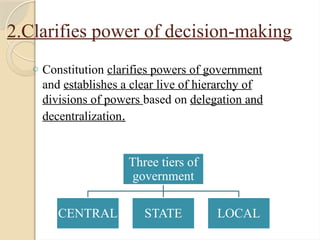
2.Clarifies power of decision-making
o Constitution clarifies powers of government
and establishes a clear live of hierarchy of
divisions of powers based on delegation and
decentralization.
Three tiers of
government
CENTRAL STATE LOCAL
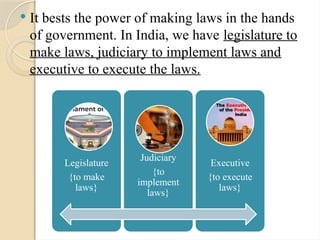
 It bests the power of making laws in the hands
of government. In India, we have legislature to
make laws, judiciary to implement laws and
executive to execute the laws.
Legislature
{to make
laws}
Judiciary
{to
implement
laws}
Executive
{to execute
laws}
3.Puts limitations on powers of government
o The Indian constitution puts a limit on the powers of
government to impose restrictions on its citizens.
o These limits are fundamental in the governance of the
country as the government can never trespass them.
o There are various methods through which restrictions
can be imposed:
JUDICIARY
DEBATES IN THE PARLIAMENT
NO CONFIDENCE MOTION
APPROVAL AND RATIFICATION OF LAWS
4.Gives aspirations and goals of the society
o The constitution of a country enables
the government to fulfill the
aspirations of people and lay the
foundations of a just society.
o Aim of the constitution is to remove
the inequalities and create an
environment that meets the
expectations of the people.
5.Fundamental identity of people
oThe constitution expresses the
fundamental identity of people.
oIt gives a collective identity to the
people by agreeing to a set of
norms on how one should be
governed and who should be
governed.
What is Preamble? Why do we need a
Preamble?
Preamble is the soul of the constitution. In other
words, it gives overview of the constitution.
Preamble is the mirror to the constitution as it
gives the reality check of the constitution.
It gives us the philosophies/ideas present in our
constitution such as idea of liberty, justice,
fraternity and equality.
All the above ideas were borrowed and
mentioned in our constitution from the French
revolution.
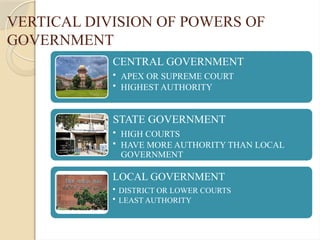
VERTICAL DIVISION OF POWERS OF
GOVERNMENT
CENTRAL GOVERNMENT
• APEX OR SUPREME COURT
• HIGHEST AUTHORITY
STATE GOVERNMENT
• HIGH COURTS
• HAVE MORE AUTHORITY THAN LOCAL
GOVERNMENT
LOCAL GOVERNMENT
• DISTRICT OR LOWER COURTS
• LEAST AUTHORITY
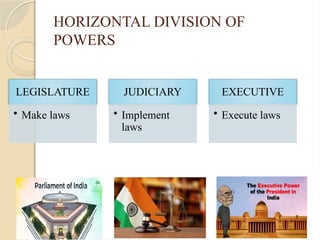
HORIZONTAL DIVISION OF
POWERS
LEGISLATURE
• Make laws
JUDICIARY
• Implement
laws
EXECUTIVE
• Execute laws
BALANCED INSTITUTIONAL
DESIGN
 Constitutions are often subverted, not by the people
but by small groups who wish to enhance their own
power.
 But, according to Indian constitution, no single
institution acquires the monopoly of the
power.Power is divided into different institutions
horizontally and vertically.
 So, Balanced institutional design means
decentralizing the power into different a stages of
government and keeping checks and balances to
facilitate success of constitution.
MAKING OF THE INDIAN CONSTITUTION
Constitution was made by the constituent
assembly which has been elected for undivided
India.
It held its first sitting on 9 December 1946 and
reassembled as constituent assembly on 14
August 1947.
Its members were chosen by indirect elections
by the members of the Provincial Legislative
Assemblies that had been established the
Government Of India Act, 1935.
The Constituent Assembly was roughly composed
along the lines suggested by the plan proposed by
the committee of British Cabinet, known as the
Cabinet mission.
The seats in each province were distributed among
the three main communities-Muslims, Sikhs and the
general, in proportion to their respective populations
Members of each community in the Provincial
Legislative Assembly elected their own
representatives by the method of proportional
representation with single transferrable vote.
The method of selection in the case of
representatives of Princely states were to be
determined by consultation.
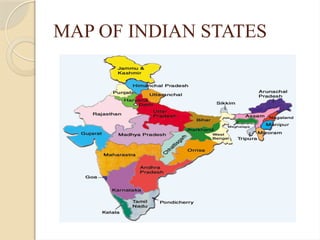
MAP OF INDIAN STATES
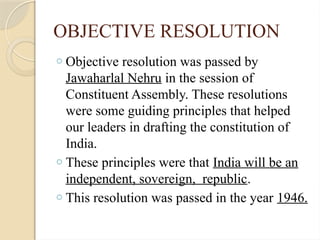
OBJECTIVE RESOLUTION
o Objective resolution was passed by
Jawaharlal Nehru in the session of
Constituent Assembly. These resolutions
were some guiding principles that helped
our leaders in drafting the constitution of
India.
o These principles were that India will be an
independent, sovereign, republic.
o This resolution was passed in the year 1946.
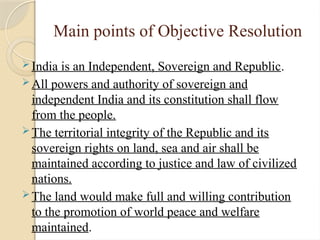
Main points of Objective Resolution
India is an Independent, Sovereign and Republic.
All powers and authority of sovereign and
independent India and its constitution shall flow
from the people.
The territorial integrity of the Republic and its
sovereign rights on land, sea and air shall be
maintained according to justice and law of civilized
nations.
The land would make full and willing contribution
to the promotion of world peace and welfare
maintained.
Why is Indian Constitution said to be a
bag of borrowings?
Our Indian Constitution is said
to be a bag of borrowings
because it is inspired from
various ideas and philosophies
of different constitutions of
different parts of world.
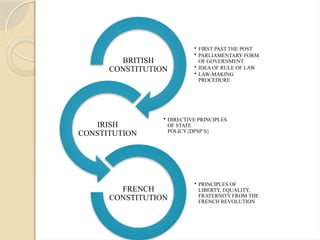
• FIRST PAST THE POST
• PARLIAMENTARY FORM
OF GOVERNMENT
• IDEA OF RULE OF LAW
• LAW-MAKING
PROCEDURE
BRITISH
CONSTITUTION
• DIRECTIVE PRINCIPLES
OF STATE
POLICY{DPSP’S}
IRISH
CONSTITUTION
• PRINCIPLES OF
LIBERTY, EQUALITY,
FRATERNITY FROM THE
FRENCH REVOLUTION
FRENCH
CONSTITUTION
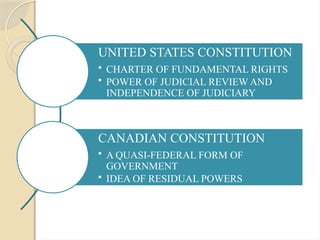
UNITED STATES CONSTITUTION
• CHARTER OF FUNDAMENTAL RIGHTS
• POWER OF JUDICIAL REVIEW AND
INDEPENDENCE OF JUDICIARY
CANADIAN CONSTITUTION
• A QUASI-FEDERAL FORM OF
GOVERNMENT
• IDEA OF RESIDUAL POWERS

CONSTITUTION:WHY AND HOW? class 11 .pptx

  • 1.
  • 2.
    TOPICS IN THISCHAPTER FUNCTIONS AND IMPORTANCE OF CONSTITUTION WHAT IS PREAMBLE? WHY IS PREAMBLE IMPORTANT FOR US? HORIZONTAL AND VERTICAL DIVISION OF POWER BALANCED INSTITUTIONAL DESIGN MAKING OF THE INDIAN CONSTITUTION OBJECTIVE RESOLUTION BAG OF BORROWINGS
  • 3.
    WHY DO WENEED THE CONSTITUTION? o Allows for coordination and assurance. o Clarifies power of decision-making. o Puts limitations on the powers of government. o Gives aspirations and goals of the society. o Provides fundamental identity of people.
  • 4.
    1.Allows for coordinationand assurance o In our country , there is a lot of diversity and all of us are dependent on each other and need corporation of each other. o It provides a basic sets of rules that allow for minimal coordination and assurance among the members of a society.
  • 5.
    2.Clarifies power ofdecision-making o Constitution clarifies powers of government and establishes a clear live of hierarchy of divisions of powers based on delegation and decentralization. Three tiers of government CENTRAL STATE LOCAL
  • 6.
     It beststhe power of making laws in the hands of government. In India, we have legislature to make laws, judiciary to implement laws and executive to execute the laws. Legislature {to make laws} Judiciary {to implement laws} Executive {to execute laws}
  • 7.
    3.Puts limitations onpowers of government o The Indian constitution puts a limit on the powers of government to impose restrictions on its citizens. o These limits are fundamental in the governance of the country as the government can never trespass them. o There are various methods through which restrictions can be imposed: JUDICIARY DEBATES IN THE PARLIAMENT NO CONFIDENCE MOTION APPROVAL AND RATIFICATION OF LAWS
  • 8.
    4.Gives aspirations andgoals of the society o The constitution of a country enables the government to fulfill the aspirations of people and lay the foundations of a just society. o Aim of the constitution is to remove the inequalities and create an environment that meets the expectations of the people.
  • 9.
    5.Fundamental identity ofpeople oThe constitution expresses the fundamental identity of people. oIt gives a collective identity to the people by agreeing to a set of norms on how one should be governed and who should be governed.
  • 10.
    What is Preamble?Why do we need a Preamble? Preamble is the soul of the constitution. In other words, it gives overview of the constitution. Preamble is the mirror to the constitution as it gives the reality check of the constitution. It gives us the philosophies/ideas present in our constitution such as idea of liberty, justice, fraternity and equality. All the above ideas were borrowed and mentioned in our constitution from the French revolution.
  • 11.
    VERTICAL DIVISION OFPOWERS OF GOVERNMENT CENTRAL GOVERNMENT • APEX OR SUPREME COURT • HIGHEST AUTHORITY STATE GOVERNMENT • HIGH COURTS • HAVE MORE AUTHORITY THAN LOCAL GOVERNMENT LOCAL GOVERNMENT • DISTRICT OR LOWER COURTS • LEAST AUTHORITY
  • 12.
    HORIZONTAL DIVISION OF POWERS LEGISLATURE •Make laws JUDICIARY • Implement laws EXECUTIVE • Execute laws
  • 13.
    BALANCED INSTITUTIONAL DESIGN  Constitutionsare often subverted, not by the people but by small groups who wish to enhance their own power.  But, according to Indian constitution, no single institution acquires the monopoly of the power.Power is divided into different institutions horizontally and vertically.  So, Balanced institutional design means decentralizing the power into different a stages of government and keeping checks and balances to facilitate success of constitution.
  • 14.
    MAKING OF THEINDIAN CONSTITUTION Constitution was made by the constituent assembly which has been elected for undivided India. It held its first sitting on 9 December 1946 and reassembled as constituent assembly on 14 August 1947. Its members were chosen by indirect elections by the members of the Provincial Legislative Assemblies that had been established the Government Of India Act, 1935.
  • 15.
    The Constituent Assemblywas roughly composed along the lines suggested by the plan proposed by the committee of British Cabinet, known as the Cabinet mission. The seats in each province were distributed among the three main communities-Muslims, Sikhs and the general, in proportion to their respective populations Members of each community in the Provincial Legislative Assembly elected their own representatives by the method of proportional representation with single transferrable vote. The method of selection in the case of representatives of Princely states were to be determined by consultation.
  • 16.
  • 17.
    OBJECTIVE RESOLUTION o Objectiveresolution was passed by Jawaharlal Nehru in the session of Constituent Assembly. These resolutions were some guiding principles that helped our leaders in drafting the constitution of India. o These principles were that India will be an independent, sovereign, republic. o This resolution was passed in the year 1946.
  • 18.
    Main points ofObjective Resolution India is an Independent, Sovereign and Republic. All powers and authority of sovereign and independent India and its constitution shall flow from the people. The territorial integrity of the Republic and its sovereign rights on land, sea and air shall be maintained according to justice and law of civilized nations. The land would make full and willing contribution to the promotion of world peace and welfare maintained.
  • 19.
    Why is IndianConstitution said to be a bag of borrowings? Our Indian Constitution is said to be a bag of borrowings because it is inspired from various ideas and philosophies of different constitutions of different parts of world.
  • 20.
    • FIRST PASTTHE POST • PARLIAMENTARY FORM OF GOVERNMENT • IDEA OF RULE OF LAW • LAW-MAKING PROCEDURE BRITISH CONSTITUTION • DIRECTIVE PRINCIPLES OF STATE POLICY{DPSP’S} IRISH CONSTITUTION • PRINCIPLES OF LIBERTY, EQUALITY, FRATERNITY FROM THE FRENCH REVOLUTION FRENCH CONSTITUTION
  • 21.
    UNITED STATES CONSTITUTION •CHARTER OF FUNDAMENTAL RIGHTS • POWER OF JUDICIAL REVIEW AND INDEPENDENCE OF JUDICIARY CANADIAN CONSTITUTION • A QUASI-FEDERAL FORM OF GOVERNMENT • IDEA OF RESIDUAL POWERS