1
Presented by
Fathima Hameed
2
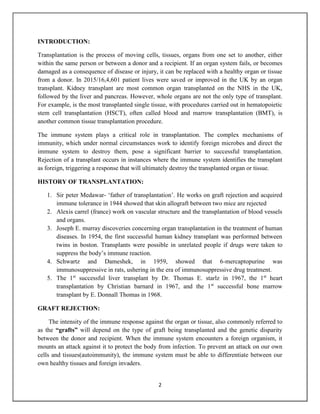
INTRODUCTION:
Transplantation is the process of moving cells, tissues, organs from one set to another, either
within the same person or between a donor and a recipient. If an organ system fails, or becomes
damaged as a consequence of disease or injury, it can be replaced with a healthy organ or tissue
from a donor. In 2015/16,4,601 patient lives were saved or improved in the UK by an organ
transplant. Kidney transplant are most common organ transplanted on the NHS in the UK,
followed by the liver and pancreas. However, whole organs are not the only type of transplant.
For example, is the most transplanted single tissue, with procedures carried out in hematopoietic
stem cell transplantation (HSCT), often called blood and marrow transplantation (BMT), is
another common tissue transplantation procedure.
The immune system plays a critical role in transplantation. The complex mechanisms of
immunity, which under normal circumstances work to identify foreign microbes and direct the
immune system to destroy them, pose a significant barrier to successful transplantation.
Rejection of a transplant occurs in instances where the immune system identifies the transplant
as foreign, triggering a response that will ultimately destroy the transplanted organ or tissue.
HISTORY OF TRANSPLANTATION:
1. Sir peter Medawar- ‘father of transplantation’. He works on graft rejection and acquired
immune tolerance in 1944 showed that skin allograft between two mice are rejected
2. Alexis carrel (france) work on vascular structure and the transplantation of blood vessels
and organs.
3. Joseph E. murray discoveries concerning organ transplantation in the treatment of human
diseases. In 1954, the first successful human kidney transplant was performed between
twins in boston. Transplants were possible in unrelated people if drugs were taken to
suppress the body’s immune reaction.
4. Schwartz and Dameshek, in 1959, showed that 6-mercaptopurine was
immunosuppressive in rats, ushering in the era of immunosuppressive drug treatment.
5. The 1st
successful liver transplant by Dr. Thomas E. starlz in 1967, the 1st
heart
transplantation by Christian barnard in 1967, and the 1st
successful bone marrow
transplant by E. Donnall Thomas in 1968.
GRAFT REJECTION:
The intensity of the immune response against the organ or tissue, also commonly referred to
as the “grafts” will depend on the type of graft being transplanted and the genetic disparity
between the donor and recipient. When the immune system encounters a foreign organism, it
mounts an attack against it to protect the body from infection. To prevent an attack on our own
cells and tissues(autoimmunity), the immune system must be able to differentiate between our
own healthy tissues and foreign invaders.
3
Foreign invaders are presented to the immune system in the form of small molecules called
“antigensˮ. Identification of these non-self antigens will trigger an immune response and will
stimulate the production of antigen specific antibodies that mark infected cells for destruction by
the immune system and help amplify the immune response. The human leukocyte
antigen(HLA)complex is a group of genes that encodes the proteins responsible for identifying
foreign agents to the immune system. These proteins are found on the surface of all cells and act
as “self-markersˮ telling the immune system not to trigger a response.
Each person will have their own specific set of HLA proteins, based upon their unique
genetic makeup, that the immune system will have learned not ot react to. Any cell not
displaying these specific HLA proteins will be identified as ‘non-self’ by the immune system
and will be treated as a foreign invader.
TYPES OF GRAFTS:
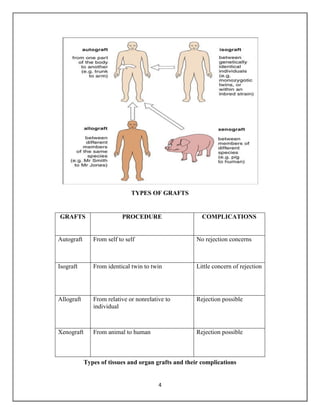
Grafting involves removing the tissue from one area of the body or, from another person
body and moving it to a different area of the body. There are four major types of grafts;
1. Autograft
2. Allograft
3. Isograft
4. Xenograft
1. Autograft:
Grafting one part of the body to another location in the same individuals. There is no chance
of rejection. It includes skin graft, taking vein from leg to use in a heart surgery.
2. Allograft:
Grafting between two non- identical members of same species but not same genotypes. It
includes the transplantation of heart, kidney, lung, etc, from members who donate their organs.
Anti-rejection drugs or immunosuppressant need to be taken to prevent the body from rejecting a
transplanted organ.
3. Isografts:
Grafting between two individuals, are identically twins or genetically same. Since, they
have the same genetics, there is no choice of graft rejection.
4. Xenograft:
Grafting between two individuals of different species. Most commonly from animal to man
such as pig heart valve used to replace human. There is more chance of graft rejection and to
reduce the rejection, person might need immunosuppressant as in allografts.
4
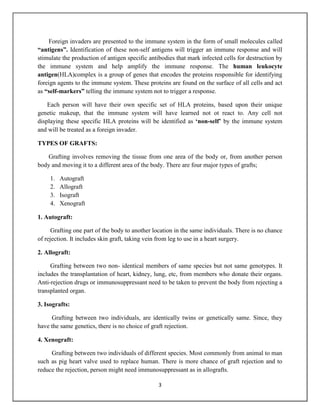
TYPES OF GRAFTS
Types of tissues and organ grafts and their complications
GRAFTS PROCEDURE COMPLICATIONS
Autograft From self to self No rejection concerns
Isograft From identical twin to twin Little concern of rejection
Allograft From relative or nonrelative to
individual
Rejection possible
Xenograft From animal to human Rejection possible
5
MECHANISM OF GRAFT REJECTION:
Graft rejection occurs when the recipient’s immune system attacks the donated graft and
begins destroying the transplanted tissue or organ.the immune response is usually triggered by
the presence of the donor’s own unique set of HLA proteins, which the recipient’s immune
system will identify as foreign.
The degree of similarity between the HLA genes of the donor and recipient is known as
histocompatibility; the more genetically compatible the donor and the recipient, the more tolerant
the recipient’s immune system should be of the graft. However, unless the donor and recipient
are genetically identical (e.g, as in identical twins) there will always be some degree of rejection.
As well as nonself HLA proteins, other surface proteins on the donor graft can also be identified
as a foreign antigen and illicit an immune response.
In some cases, a patient may experience something known as ‘graft versus host reaction’
where mature immune cells already present in the donor graft begin attacking the healthy cells of
the recipient. Graft versus host reaction, where the donor graft is described as being “immune
competentˮ(i.e., capable of producing an immune response) is a particular risk with stem cell
transplants (bone marrow transplant) and can also occur following blood transfusions.
REJECTION:
Rejection is a complex process in which “recipient immune system recognize the graft as
foreign and attacks it. It involves;
1. Cellular mediated rejection
2. Antibody mediated rejection
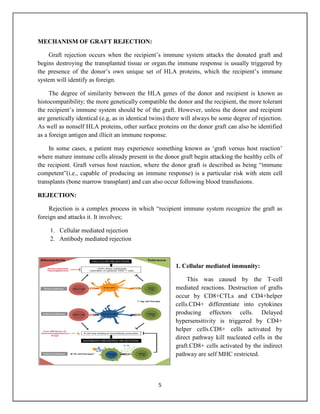
1. Cellular mediated immunity:
This was caused by the T-cell
mediated reactions. Destruction of grafts
occur by CD8+CTLs and CD4+helper
cells.CD4+ differentiate into cytokines
producing effectors cells. Delayed
hypersensitivity is triggered by CD4+
helper cells.CD8+ cells activated by
direct pathway kill nucleated cells in the
graft.CD8+ cells activated by the indirect
pathway are self MHC restricted.
6
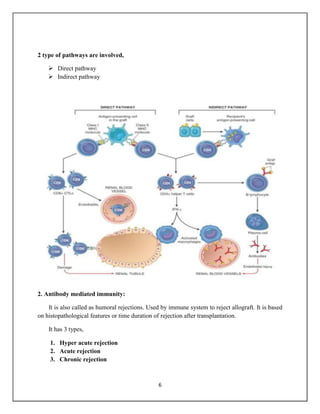
2 type of pathways are involved,
 Direct pathway
 Indirect pathway
2. Antibody mediated immunity:
It is also called as humoral rejections. Used by immune system to reject allograft. It is based
on histopathological features or time duration of rejection after transplantation.
It has 3 types,
1. Hyper acute rejection
2. Acute rejection
3. Chronic rejection
7
a) Hyper acute:
This occurs within minutes or hours after transplantation and is caused by the presence of
preexisting antibodies of the recipient that match the foreign antigens of the donor,
triggering an immune response against the transplant. The antibodies react with cells in
the blood vessels of the graft, causing blood clots to form, which will prevent blood
supply from reaching the graft resulting in immediate rejection of the transplant.
b) Acute rejection:
This occurs within the 1st
6 months after transplantation. Some degree of acute rejection
will occur in all transplantations, except between identical twins. Recipients are most at
risk in the first 3 months, but rejection can still occur at a later stage. Acute rejection is
caused by the formation of antibodies following the detection of non-self antigens in the
donated graft.
c) Chronic rejection:
Repeated episodes of acute rejection can ultimately lead to chronic rejection of the graft
and failure of the transplant. Chronic rejection commonly manifests as scarring of the
tissue or organ which can occur months to years after acute rejection has subsided. At
present, there is no cure for chronic rejection other than removal of the graft
Allograft reaction:
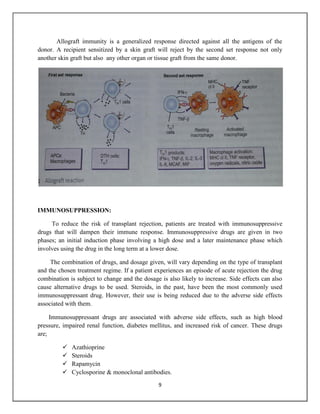
When a skin graft from an animal is applied on a genetically unrelated animal of the same
species, the graft appears to be accepted initially. The graft is vascularised and seems
morphologically and functionally healthy during the first two or three days. However, by about
the fourth day, inflammation becomes evident and the graft is invaded by lymphocytes and
macrophages. The blood vessels within the graft are occluded by thrombi, the vascularity
diminishes and the graft undergoes ischemic necrosis. With extending necrosis, the graft assumes
a scab- like appearance and sloughs off by the tenth day. This sequence of events resulting in the
rejection of the allograft is known as the first set response.
If, in an animal that has rejected a graft by the first set response, another graft from the
same donor is applied, it will be rejected in an accelerated fashion. This accelerated allograft
rejection is known as the second set response.
8
MECHANISM OF ALLOGRAFT REJECTION:
The immunological basis of graft rejection is evident from the specificity of the second set
response. Accelerated rejection is seen only if the second graft is from the same donor as the
first. Application of a skin graft from another donor will evoke only the first set response.
An allograft will be accepted if the animal is rendered immunologically tolerant. The
method of transferring immunity by means of lymphoid cells is known as “adoptive
immunization.
TRANSPLANTATION IMMUNITY IS PREDOMINANTLY CELL MEDIATED:
The first set response is brought about almost exclusively by T lymphocytes. Humoral
antibodies are also produced during allograft rejection. They can be detected by a variety of
methods including “hemmaglutination, lymphoctotoxicity, complement fixation, and
immunofluorescenceˮ.
Antibodies are formed more rapidly and abundantly during“second set responseˮ than
during primary rejection. Antibodies are believed to participate in the second set response along
with cell- mediated immunity. When a graft is applied to an animal possessing the specific
antibodies in high titres, hyper acute rejection takes place. The graft remains pale and is rejected
within hours without even an attempt at vascularisation. This is known as the “white graft
responses. This type of hyper acute rejection is sometimes seen in human recipients of kidney
transplants, who may possess pre-existing antibodies as a result of prior transplantation,
transfusion or pregnancy.
Humeral antibodies may sometimes act in opposition to cell mediated immunity, by
inhibiting graft rejection. This phenomenon, called “immunological enhancement was
originally described by kaliss in tumor transplants. If the recipient is penetrated with one or more
injections of killed donor tissue and the transplant applied subsequently, it survives much longer
than in control animals. The enhancing effect can be passively transferred to normal animals by
an injection of serum from immunized animals, showing that the effect is due to humoral
antibodies.
The antibodies may bring about the enhancing effect in various ways. They may combine
with the antigens released from the graft so that they are unable to initiate an immune
response(afferent inhibition) the antibodies may combine with the lymphoid cells of
appropriate specificity and, by a negative feedback influence, render them incapable of
responding to the antigens of the graft (central inhibition). They may also cause efferent
inhibition by coating the surface of cells in the graft so that sensitized lymphocytes are kept out
of contact with them.
9
Allograft immunity is a generalized response directed against all the antigens of the
donor. A recipient sensitized by a skin graft will reject by the second set response not only
another skin graft but also any other organ or tissue graft from the same donor.
IMMUNOSUPPRESSION:
To reduce the risk of transplant rejection, patients are treated with immunosuppressive
drugs that will dampen their immune response. Immunosuppressive drugs are given in two
phases; an initial induction phase involving a high dose and a later maintenance phase which
involves using the drug in the long term at a lower dose.
The combination of drugs, and dosage given, will vary depending on the type of transplant
and the chosen treatment regime. If a patient experiences an episode of acute rejection the drug
combination is subject to change and the dosage is also likely to increase. Side effects can also
cause alternative drugs to be used. Steroids, in the past, have been the most commonly used
immunosuppressant drug. However, their use is being reduced due to the adverse side effects
associated with them.
Immunosuppressant drugs are associated with adverse side effects, such as high blood
pressure, impaired renal function, diabetes mellitus, and increased risk of cancer. These drugs
are;
 Azathioprine
 Steroids
 Rapamycin
 Cyclosporine & monoclonal antibodies.
10
GRAFT VERSUS HOST REACTION:
Graft rejection is due to the reaction of the host to the grafted tissue (host- versus- graft
response). The contrary situation, in which the graft mounts an immune response against the
antigens of the host, is known as the “graft- versus host (GVH) reaction.
This occurs when the following conditions are present:
 The graft contains immunocompetent T cells.
 The recipient possess transplantation antigens that are absent in the graft.
 The recipient must not reject the graft. Examples of situations leading to the GVH
reaction are;
 Allograft in a recipient in whom specific immunological tolerance has been induced.
 Adult lymphocytes injected into an immunologically deficient recipient. The
immunological deficiency may be due to immaturity (newborn) or
immunosuppression.
 F1 hybrid receiving a transplant from any one parent strain.
The main clinical features of the GVH reaction in animals are retardation of growth,
emaciation, diarrhea, hepatosplenomegaly, lymphoid atrophy and anemia, terminating fatally.
The syndrome has been called runt diseases.
REFERENCES:
1. Text book of microbiology – Ananthanarayan & Paniker’s, 9th
edition.
2. www.immunology.org/policy-and-public-affairs/briefings-and-positions-statements/transplant-
immunology
3. https://www.slideshare.net/mobile/ARYAGEORGE1/graft-rejection
4. https://www.slideshare.net/mobile/svasan3/transplant-rejection
5. www.quora.com/what-are-the-types-of-graft-and-their-resources
11
12

immunology and immunodiagnostics

  • 1.
  • 2.
    2 INTRODUCTION: Transplantation is theprocess of moving cells, tissues, organs from one set to another, either within the same person or between a donor and a recipient. If an organ system fails, or becomes damaged as a consequence of disease or injury, it can be replaced with a healthy organ or tissue from a donor. In 2015/16,4,601 patient lives were saved or improved in the UK by an organ transplant. Kidney transplant are most common organ transplanted on the NHS in the UK, followed by the liver and pancreas. However, whole organs are not the only type of transplant. For example, is the most transplanted single tissue, with procedures carried out in hematopoietic stem cell transplantation (HSCT), often called blood and marrow transplantation (BMT), is another common tissue transplantation procedure. The immune system plays a critical role in transplantation. The complex mechanisms of immunity, which under normal circumstances work to identify foreign microbes and direct the immune system to destroy them, pose a significant barrier to successful transplantation. Rejection of a transplant occurs in instances where the immune system identifies the transplant as foreign, triggering a response that will ultimately destroy the transplanted organ or tissue. HISTORY OF TRANSPLANTATION: 1. Sir peter Medawar- ‘father of transplantation’. He works on graft rejection and acquired immune tolerance in 1944 showed that skin allograft between two mice are rejected 2. Alexis carrel (france) work on vascular structure and the transplantation of blood vessels and organs. 3. Joseph E. murray discoveries concerning organ transplantation in the treatment of human diseases. In 1954, the first successful human kidney transplant was performed between twins in boston. Transplants were possible in unrelated people if drugs were taken to suppress the body’s immune reaction. 4. Schwartz and Dameshek, in 1959, showed that 6-mercaptopurine was immunosuppressive in rats, ushering in the era of immunosuppressive drug treatment. 5. The 1st successful liver transplant by Dr. Thomas E. starlz in 1967, the 1st heart transplantation by Christian barnard in 1967, and the 1st successful bone marrow transplant by E. Donnall Thomas in 1968. GRAFT REJECTION: The intensity of the immune response against the organ or tissue, also commonly referred to as the “grafts” will depend on the type of graft being transplanted and the genetic disparity between the donor and recipient. When the immune system encounters a foreign organism, it mounts an attack against it to protect the body from infection. To prevent an attack on our own cells and tissues(autoimmunity), the immune system must be able to differentiate between our own healthy tissues and foreign invaders.
  • 3.
    3 Foreign invaders arepresented to the immune system in the form of small molecules called “antigensˮ. Identification of these non-self antigens will trigger an immune response and will stimulate the production of antigen specific antibodies that mark infected cells for destruction by the immune system and help amplify the immune response. The human leukocyte antigen(HLA)complex is a group of genes that encodes the proteins responsible for identifying foreign agents to the immune system. These proteins are found on the surface of all cells and act as “self-markersˮ telling the immune system not to trigger a response. Each person will have their own specific set of HLA proteins, based upon their unique genetic makeup, that the immune system will have learned not ot react to. Any cell not displaying these specific HLA proteins will be identified as ‘non-self’ by the immune system and will be treated as a foreign invader. TYPES OF GRAFTS: Grafting involves removing the tissue from one area of the body or, from another person body and moving it to a different area of the body. There are four major types of grafts; 1. Autograft 2. Allograft 3. Isograft 4. Xenograft 1. Autograft: Grafting one part of the body to another location in the same individuals. There is no chance of rejection. It includes skin graft, taking vein from leg to use in a heart surgery. 2. Allograft: Grafting between two non- identical members of same species but not same genotypes. It includes the transplantation of heart, kidney, lung, etc, from members who donate their organs. Anti-rejection drugs or immunosuppressant need to be taken to prevent the body from rejecting a transplanted organ. 3. Isografts: Grafting between two individuals, are identically twins or genetically same. Since, they have the same genetics, there is no choice of graft rejection. 4. Xenograft: Grafting between two individuals of different species. Most commonly from animal to man such as pig heart valve used to replace human. There is more chance of graft rejection and to reduce the rejection, person might need immunosuppressant as in allografts.
  • 4.
    4 TYPES OF GRAFTS Typesof tissues and organ grafts and their complications GRAFTS PROCEDURE COMPLICATIONS Autograft From self to self No rejection concerns Isograft From identical twin to twin Little concern of rejection Allograft From relative or nonrelative to individual Rejection possible Xenograft From animal to human Rejection possible
  • 5.
    5 MECHANISM OF GRAFTREJECTION: Graft rejection occurs when the recipient’s immune system attacks the donated graft and begins destroying the transplanted tissue or organ.the immune response is usually triggered by the presence of the donor’s own unique set of HLA proteins, which the recipient’s immune system will identify as foreign. The degree of similarity between the HLA genes of the donor and recipient is known as histocompatibility; the more genetically compatible the donor and the recipient, the more tolerant the recipient’s immune system should be of the graft. However, unless the donor and recipient are genetically identical (e.g, as in identical twins) there will always be some degree of rejection. As well as nonself HLA proteins, other surface proteins on the donor graft can also be identified as a foreign antigen and illicit an immune response. In some cases, a patient may experience something known as ‘graft versus host reaction’ where mature immune cells already present in the donor graft begin attacking the healthy cells of the recipient. Graft versus host reaction, where the donor graft is described as being “immune competentˮ(i.e., capable of producing an immune response) is a particular risk with stem cell transplants (bone marrow transplant) and can also occur following blood transfusions. REJECTION: Rejection is a complex process in which “recipient immune system recognize the graft as foreign and attacks it. It involves; 1. Cellular mediated rejection 2. Antibody mediated rejection 1. Cellular mediated immunity: This was caused by the T-cell mediated reactions. Destruction of grafts occur by CD8+CTLs and CD4+helper cells.CD4+ differentiate into cytokines producing effectors cells. Delayed hypersensitivity is triggered by CD4+ helper cells.CD8+ cells activated by direct pathway kill nucleated cells in the graft.CD8+ cells activated by the indirect pathway are self MHC restricted.
  • 6.
    6 2 type ofpathways are involved,  Direct pathway  Indirect pathway 2. Antibody mediated immunity: It is also called as humoral rejections. Used by immune system to reject allograft. It is based on histopathological features or time duration of rejection after transplantation. It has 3 types, 1. Hyper acute rejection 2. Acute rejection 3. Chronic rejection
  • 7.
    7 a) Hyper acute: Thisoccurs within minutes or hours after transplantation and is caused by the presence of preexisting antibodies of the recipient that match the foreign antigens of the donor, triggering an immune response against the transplant. The antibodies react with cells in the blood vessels of the graft, causing blood clots to form, which will prevent blood supply from reaching the graft resulting in immediate rejection of the transplant. b) Acute rejection: This occurs within the 1st 6 months after transplantation. Some degree of acute rejection will occur in all transplantations, except between identical twins. Recipients are most at risk in the first 3 months, but rejection can still occur at a later stage. Acute rejection is caused by the formation of antibodies following the detection of non-self antigens in the donated graft. c) Chronic rejection: Repeated episodes of acute rejection can ultimately lead to chronic rejection of the graft and failure of the transplant. Chronic rejection commonly manifests as scarring of the tissue or organ which can occur months to years after acute rejection has subsided. At present, there is no cure for chronic rejection other than removal of the graft Allograft reaction: When a skin graft from an animal is applied on a genetically unrelated animal of the same species, the graft appears to be accepted initially. The graft is vascularised and seems morphologically and functionally healthy during the first two or three days. However, by about the fourth day, inflammation becomes evident and the graft is invaded by lymphocytes and macrophages. The blood vessels within the graft are occluded by thrombi, the vascularity diminishes and the graft undergoes ischemic necrosis. With extending necrosis, the graft assumes a scab- like appearance and sloughs off by the tenth day. This sequence of events resulting in the rejection of the allograft is known as the first set response. If, in an animal that has rejected a graft by the first set response, another graft from the same donor is applied, it will be rejected in an accelerated fashion. This accelerated allograft rejection is known as the second set response.
  • 8.
    8 MECHANISM OF ALLOGRAFTREJECTION: The immunological basis of graft rejection is evident from the specificity of the second set response. Accelerated rejection is seen only if the second graft is from the same donor as the first. Application of a skin graft from another donor will evoke only the first set response. An allograft will be accepted if the animal is rendered immunologically tolerant. The method of transferring immunity by means of lymphoid cells is known as “adoptive immunization. TRANSPLANTATION IMMUNITY IS PREDOMINANTLY CELL MEDIATED: The first set response is brought about almost exclusively by T lymphocytes. Humoral antibodies are also produced during allograft rejection. They can be detected by a variety of methods including “hemmaglutination, lymphoctotoxicity, complement fixation, and immunofluorescenceˮ. Antibodies are formed more rapidly and abundantly during“second set responseˮ than during primary rejection. Antibodies are believed to participate in the second set response along with cell- mediated immunity. When a graft is applied to an animal possessing the specific antibodies in high titres, hyper acute rejection takes place. The graft remains pale and is rejected within hours without even an attempt at vascularisation. This is known as the “white graft responses. This type of hyper acute rejection is sometimes seen in human recipients of kidney transplants, who may possess pre-existing antibodies as a result of prior transplantation, transfusion or pregnancy. Humeral antibodies may sometimes act in opposition to cell mediated immunity, by inhibiting graft rejection. This phenomenon, called “immunological enhancement was originally described by kaliss in tumor transplants. If the recipient is penetrated with one or more injections of killed donor tissue and the transplant applied subsequently, it survives much longer than in control animals. The enhancing effect can be passively transferred to normal animals by an injection of serum from immunized animals, showing that the effect is due to humoral antibodies. The antibodies may bring about the enhancing effect in various ways. They may combine with the antigens released from the graft so that they are unable to initiate an immune response(afferent inhibition) the antibodies may combine with the lymphoid cells of appropriate specificity and, by a negative feedback influence, render them incapable of responding to the antigens of the graft (central inhibition). They may also cause efferent inhibition by coating the surface of cells in the graft so that sensitized lymphocytes are kept out of contact with them.
  • 9.
    9 Allograft immunity isa generalized response directed against all the antigens of the donor. A recipient sensitized by a skin graft will reject by the second set response not only another skin graft but also any other organ or tissue graft from the same donor. IMMUNOSUPPRESSION: To reduce the risk of transplant rejection, patients are treated with immunosuppressive drugs that will dampen their immune response. Immunosuppressive drugs are given in two phases; an initial induction phase involving a high dose and a later maintenance phase which involves using the drug in the long term at a lower dose. The combination of drugs, and dosage given, will vary depending on the type of transplant and the chosen treatment regime. If a patient experiences an episode of acute rejection the drug combination is subject to change and the dosage is also likely to increase. Side effects can also cause alternative drugs to be used. Steroids, in the past, have been the most commonly used immunosuppressant drug. However, their use is being reduced due to the adverse side effects associated with them. Immunosuppressant drugs are associated with adverse side effects, such as high blood pressure, impaired renal function, diabetes mellitus, and increased risk of cancer. These drugs are;  Azathioprine  Steroids  Rapamycin  Cyclosporine & monoclonal antibodies.
  • 10.
    10 GRAFT VERSUS HOSTREACTION: Graft rejection is due to the reaction of the host to the grafted tissue (host- versus- graft response). The contrary situation, in which the graft mounts an immune response against the antigens of the host, is known as the “graft- versus host (GVH) reaction. This occurs when the following conditions are present:  The graft contains immunocompetent T cells.  The recipient possess transplantation antigens that are absent in the graft.  The recipient must not reject the graft. Examples of situations leading to the GVH reaction are;  Allograft in a recipient in whom specific immunological tolerance has been induced.  Adult lymphocytes injected into an immunologically deficient recipient. The immunological deficiency may be due to immaturity (newborn) or immunosuppression.  F1 hybrid receiving a transplant from any one parent strain. The main clinical features of the GVH reaction in animals are retardation of growth, emaciation, diarrhea, hepatosplenomegaly, lymphoid atrophy and anemia, terminating fatally. The syndrome has been called runt diseases. REFERENCES: 1. Text book of microbiology – Ananthanarayan & Paniker’s, 9th edition. 2. www.immunology.org/policy-and-public-affairs/briefings-and-positions-statements/transplant- immunology 3. https://www.slideshare.net/mobile/ARYAGEORGE1/graft-rejection 4. https://www.slideshare.net/mobile/svasan3/transplant-rejection 5. www.quora.com/what-are-the-types-of-graft-and-their-resources
  • 11.
  • 12.