Warm-up Question?
 What impact do you think the
Holocaust had on the rest of the
  world’s image of Germany?

   Discuss with your partner
(the person who sits beside you)
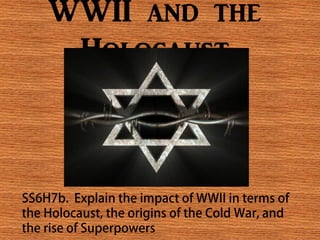
WWII and the
 Holocaust
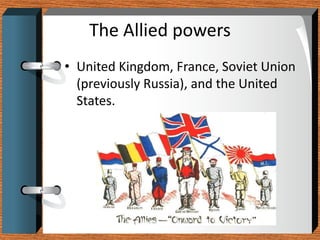
The Allied powers
• United Kingdom, France, Soviet Union
  (previously Russia), and the United
  States.
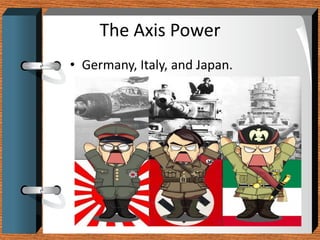
The Axis Power
• Germany, Italy, and Japan.
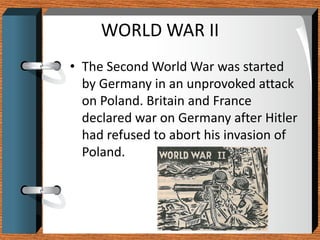
WORLD WAR II
• The Second World War was started
  by Germany in an unprovoked attack
  on Poland. Britain and France
  declared war on Germany after Hitler
  had refused to abort his invasion of
  Poland.
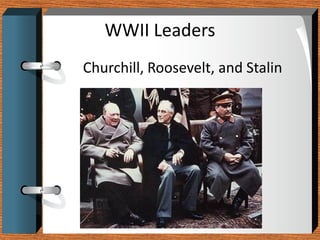
WWII Leaders
Churchill, Roosevelt, and Stalin
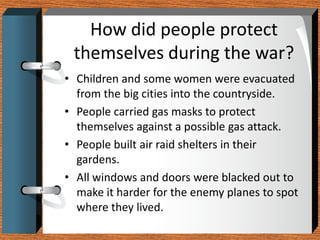
How did people protect
 themselves during the war?
• Children and some women were evacuated
  from the big cities into the countryside.
• People carried gas masks to protect
  themselves against a possible gas attack.
• People built air raid shelters in their
  gardens.
• All windows and doors were blacked out to
  make it harder for the enemy planes to spot
  where they lived.
What effect did the war have on
            people?
• World War II brought a lot of suffering and
  hardship to thousands of people.
• German bombers made terrifying night raids.
• Families were broken up as men were sent to the
  front lines to fight, some never to return.
• Children were sent out of the cities to stay with
  strangers, away from the bombing.
• Shops were half empty of things to buy and what
  was available was often rationed.
• The peaceful routine of everyday life was
  shattered.
• Britain was called the 'Home Front',
  because people felt that they were
  part of the war. The war effected
  everyone whether they were on the
  front line (in Europe) or on the home
  front (back in Britain).
• Not everyone went to fight, but
  everyone helped in the 'war effort' in
  some way or other.
DISCLAIMER:

 There are some
 horrific things that
 happened during
 WWII.


Please be respectful.
Hitler’s Plan
• As part of Hitler’s plan to conquer the
  new world, he began the systematic
  killing of every Jew – man, woman,
  and child – under Nazi rule.
• The Nazis imprisoned Jews in certain
  sections of cities, made them wear
  special identifying armbands, and
  separated them from their families.
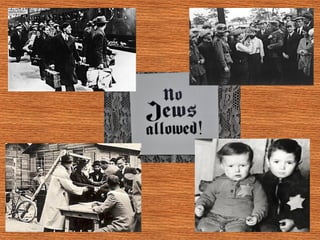
Jewish Treatment
• Jews were forced to give up their
  jobs and businesses. They were not
  allowed to attend school.
• They had to wear the Star of David
  which identified them as Jewish.
  They also had to carry papers which
  identified them.
Concentration Camps
• The Nazis built concentration camps
  and sent Jews from the cities by
  railcar to these camps.
• When the Jews arrived, their heads
  were shaved and a number was
  tattooed onto their arms.
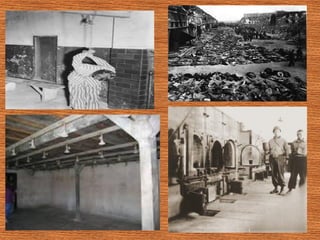
“The Showers”
• Many were immediately herded into
  “showers”, which were nothing more
  than gas chambers.
• In such places, as many as 2,000
  people could be killed at one time.
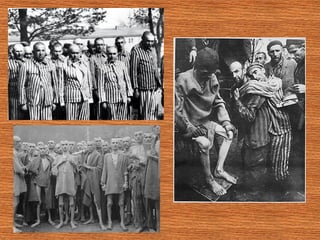
Living Conditions
• Thousands died from forced labor,
  little food, and exposure to the
  summer heat and winter cold.
• Disabled people, children, and
  especially twins were experimented
  on.
• The guards would play horrific games
  with the babies and children to put
  them to death.
By the time WWII
was over, as
many as 6 million
Jews were dead.
Germany surrenders
• World War II ended in 1945 with the
  unconditional surrender of the Axis powers.
• On 8 May 1945, the Allies accepted
  Germany’s surrender, about a week after
  Adolf Hitler had committed suicide.
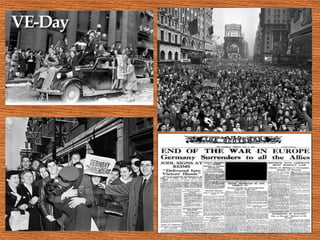
• VE Day – Victory in Europe celebrates the
  end of the Second World War on 8 May
  1945.
• Street parties were held all over Britain to
  celebrate the end of the war.
But ........
• Even though the war was officially at an end in
  the Far East the war raged on, claiming more
  lives.
• Japan, did not surrender at the same time as
  Germany. It was able to hold out for another few
  months. Atomic bombs were dropped on
  Hiroshima and Nagasaki on August 6 and 9
  respectively.
• After that the Imperial government sought the
  Emperor's personal authority to surrender which
  he granted. He made a personal radio address
  announcing the decision.
Japan surrenders
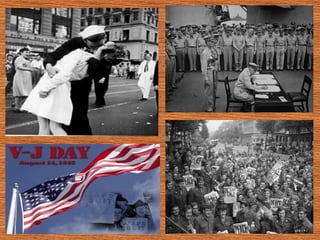
• V-J Day - Victory in Japan Day.
• 15 August 1945 - Japan surrenders to the
  Allies V-J Day (Victory in Japan)
• 2 September 1945 - Having agreed in
  principle to unconditional surrender on 15
  August 1945, Japan formally surrenders,
  ending World War II throughout the rest of
  the world.
• The surrender was signed on 2 Sept. 1945
  aboard the battleship U.S.S. Missouri in
  Tokyo Bay.
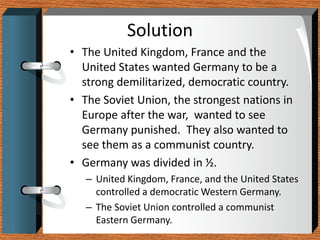
Solution
• The United Kingdom, France and the
  United States wanted Germany to be a
  strong demilitarized, democratic country.
• The Soviet Union, the strongest nations in
  Europe after the war, wanted to see
  Germany punished. They also wanted to
  see them as a communist country.
• Germany was divided in ½.
   – United Kingdom, France, and the United States
     controlled a democratic Western Germany.
   – The Soviet Union controlled a communist
     Eastern Germany.
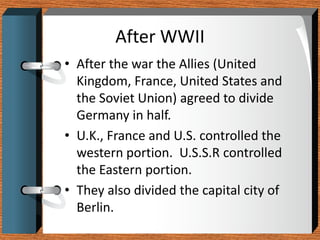
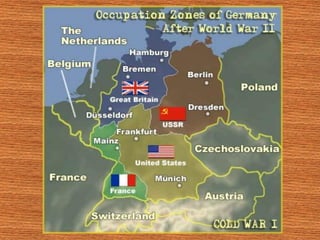
After WWII
• After the war the Allies (United
  Kingdom, France, United States and
  the Soviet Union) agreed to divide
  Germany in half.
• U.K., France and U.S. controlled the
  western portion. U.S.S.R controlled
  the Eastern portion.
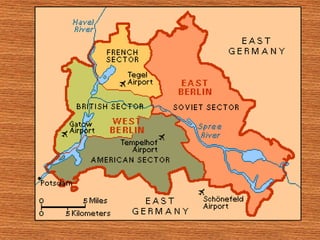
• They also divided the capital city of
  Berlin.
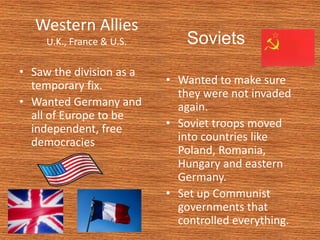
Western Allies
     U.K., France & U.S.       Soviets
• Saw the division as a
  temporary fix.           • Wanted to make sure
                             they were not invaded
• Wanted Germany and         again.
  all of Europe to be
  independent, free        • Soviet troops moved
  democracies                into countries like
                             Poland, Romania,
                             Hungary and eastern
                             Germany.
                           • Set up Communist
                             governments that
                             controlled everything.

WWII and The Holocaust

  • 1.
    Warm-up Question? Whatimpact do you think the Holocaust had on the rest of the world’s image of Germany? Discuss with your partner (the person who sits beside you)
  • 2.
    WWII and the Holocaust
  • 3.
    The Allied powers •United Kingdom, France, Soviet Union (previously Russia), and the United States.
  • 4.
    The Axis Power •Germany, Italy, and Japan.
  • 5.
    WORLD WAR II •The Second World War was started by Germany in an unprovoked attack on Poland. Britain and France declared war on Germany after Hitler had refused to abort his invasion of Poland.
  • 6.
  • 7.
    How did peopleprotect themselves during the war? • Children and some women were evacuated from the big cities into the countryside. • People carried gas masks to protect themselves against a possible gas attack. • People built air raid shelters in their gardens. • All windows and doors were blacked out to make it harder for the enemy planes to spot where they lived.
  • 8.
    What effect didthe war have on people? • World War II brought a lot of suffering and hardship to thousands of people. • German bombers made terrifying night raids. • Families were broken up as men were sent to the front lines to fight, some never to return. • Children were sent out of the cities to stay with strangers, away from the bombing. • Shops were half empty of things to buy and what was available was often rationed. • The peaceful routine of everyday life was shattered.
  • 9.
    • Britain wascalled the 'Home Front', because people felt that they were part of the war. The war effected everyone whether they were on the front line (in Europe) or on the home front (back in Britain). • Not everyone went to fight, but everyone helped in the 'war effort' in some way or other.
  • 10.
    DISCLAIMER: There aresome horrific things that happened during WWII. Please be respectful.
  • 11.
    Hitler’s Plan • Aspart of Hitler’s plan to conquer the new world, he began the systematic killing of every Jew – man, woman, and child – under Nazi rule. • The Nazis imprisoned Jews in certain sections of cities, made them wear special identifying armbands, and separated them from their families.
  • 12.
    Jewish Treatment • Jewswere forced to give up their jobs and businesses. They were not allowed to attend school. • They had to wear the Star of David which identified them as Jewish. They also had to carry papers which identified them.
  • 14.
    Concentration Camps • TheNazis built concentration camps and sent Jews from the cities by railcar to these camps. • When the Jews arrived, their heads were shaved and a number was tattooed onto their arms.
  • 16.
    “The Showers” • Manywere immediately herded into “showers”, which were nothing more than gas chambers. • In such places, as many as 2,000 people could be killed at one time.
  • 18.
    Living Conditions • Thousandsdied from forced labor, little food, and exposure to the summer heat and winter cold. • Disabled people, children, and especially twins were experimented on. • The guards would play horrific games with the babies and children to put them to death.
  • 19.
    By the timeWWII was over, as many as 6 million Jews were dead.
  • 20.
    Germany surrenders • WorldWar II ended in 1945 with the unconditional surrender of the Axis powers. • On 8 May 1945, the Allies accepted Germany’s surrender, about a week after Adolf Hitler had committed suicide. • VE Day – Victory in Europe celebrates the end of the Second World War on 8 May 1945. • Street parties were held all over Britain to celebrate the end of the war.
  • 22.
    But ........ • Eventhough the war was officially at an end in the Far East the war raged on, claiming more lives. • Japan, did not surrender at the same time as Germany. It was able to hold out for another few months. Atomic bombs were dropped on Hiroshima and Nagasaki on August 6 and 9 respectively. • After that the Imperial government sought the Emperor's personal authority to surrender which he granted. He made a personal radio address announcing the decision.
  • 23.
    Japan surrenders • V-JDay - Victory in Japan Day. • 15 August 1945 - Japan surrenders to the Allies V-J Day (Victory in Japan) • 2 September 1945 - Having agreed in principle to unconditional surrender on 15 August 1945, Japan formally surrenders, ending World War II throughout the rest of the world. • The surrender was signed on 2 Sept. 1945 aboard the battleship U.S.S. Missouri in Tokyo Bay.
  • 25.
    Solution • The UnitedKingdom, France and the United States wanted Germany to be a strong demilitarized, democratic country. • The Soviet Union, the strongest nations in Europe after the war, wanted to see Germany punished. They also wanted to see them as a communist country. • Germany was divided in ½. – United Kingdom, France, and the United States controlled a democratic Western Germany. – The Soviet Union controlled a communist Eastern Germany.
  • 26.
    After WWII • Afterthe war the Allies (United Kingdom, France, United States and the Soviet Union) agreed to divide Germany in half. • U.K., France and U.S. controlled the western portion. U.S.S.R controlled the Eastern portion. • They also divided the capital city of Berlin.
  • 29.
    Western Allies U.K., France & U.S. Soviets • Saw the division as a temporary fix. • Wanted to make sure they were not invaded • Wanted Germany and again. all of Europe to be independent, free • Soviet troops moved democracies into countries like Poland, Romania, Hungary and eastern Germany. • Set up Communist governments that controlled everything.