Unit 5 Posttest B
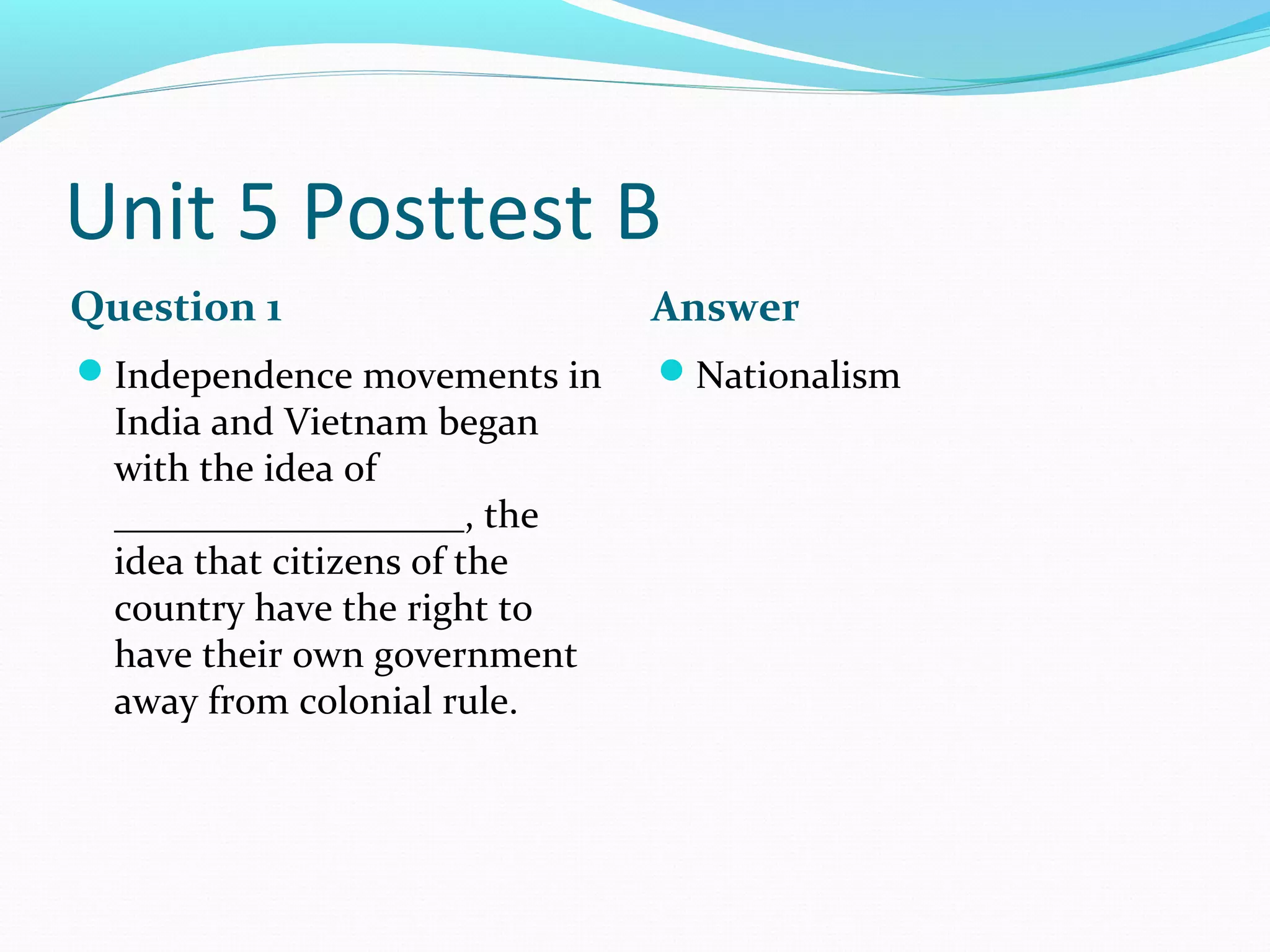
Question 1                    Answer
Independence movements in    Nationalism
  India and Vietnam began
  with the idea of
  __________________, the
  idea that citizens of the
  country have the right to
  have their own government
  away from colonial rule.
Unit 5 Posttest B
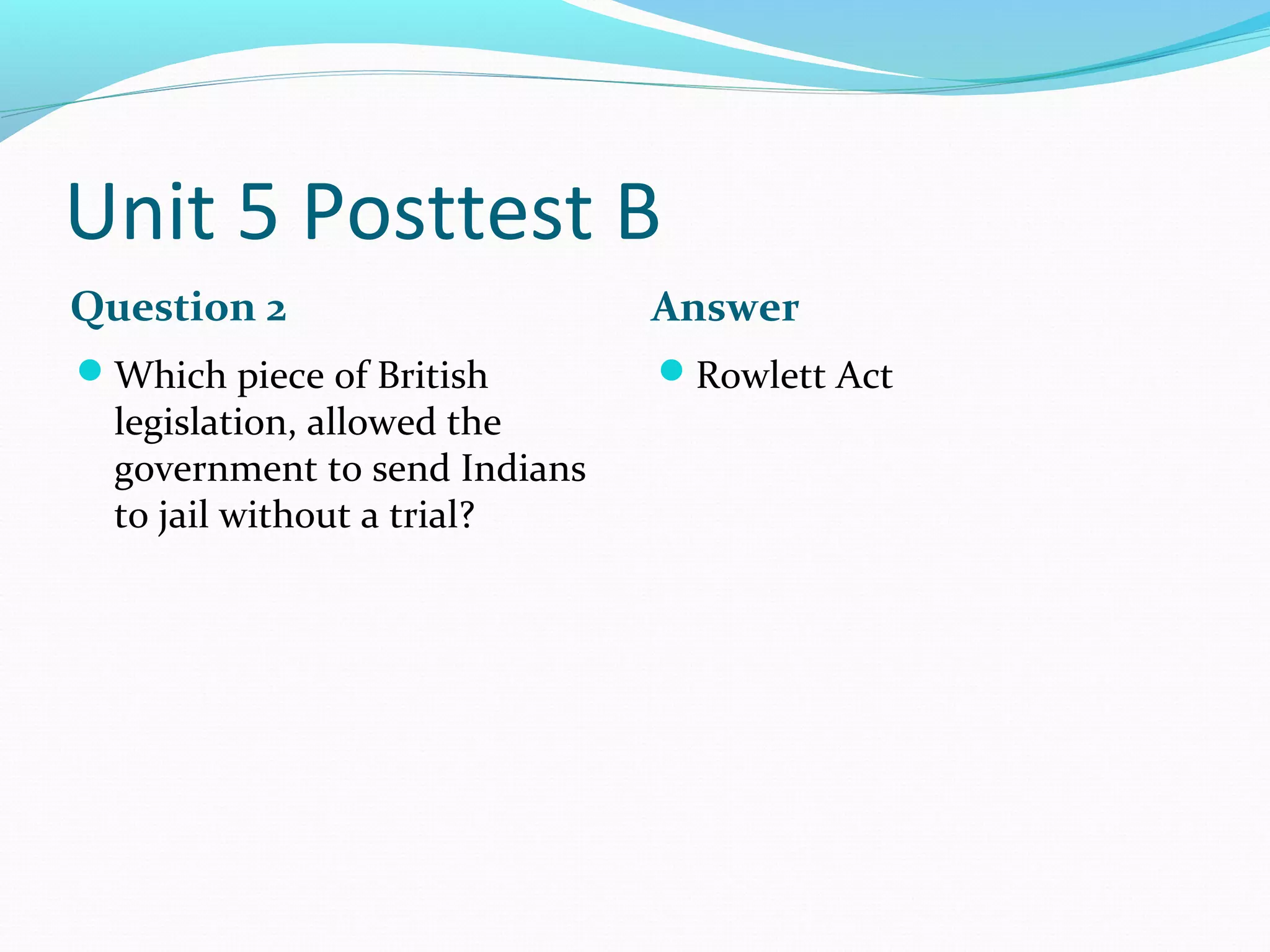
Question 2                     Answer
Which piece of British        Rowlett Act
  legislation, allowed the
  government to send Indians
  to jail without a trial?
Unit 5 Posttest B
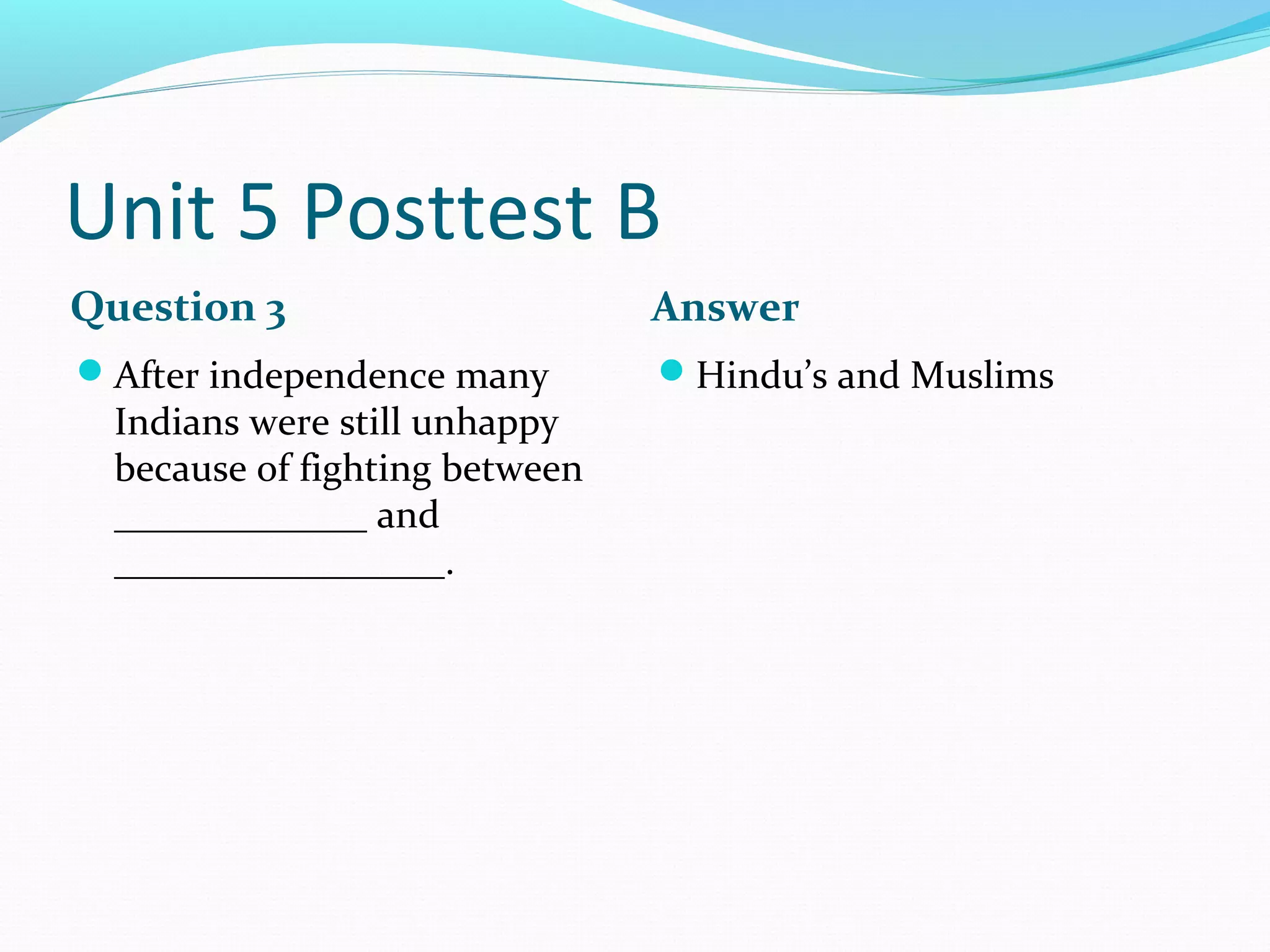
Question 3                      Answer
After independence many        Hindu’s and Muslims
  Indians were still unhappy
  because of fighting between
  _____________ and
  _________________.
Unit 5 Posttest B
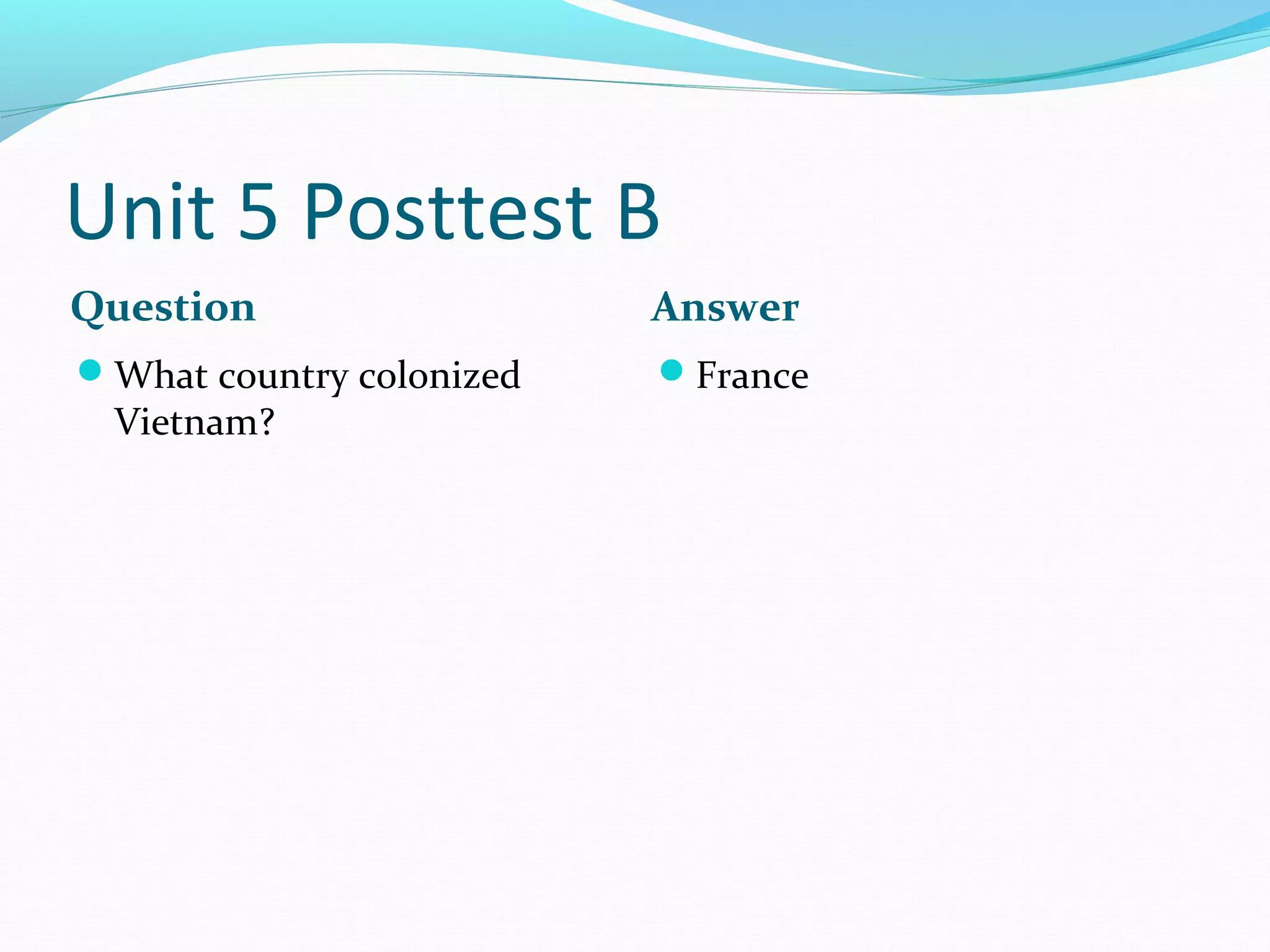
Question                  Answer
What country colonized   France
 Vietnam?
Unit 5 Posttest B
Question                   Answer
Gandhi believed in what   Nonviolent
  form of protest?
Unit 5 Posttest B
Question                       Answer
While a colony of France      Indochina
  Vietnam, Cambodia and Laos
  were known as?
Unit 5 Posttest B
Question                    Answer
Who led the movement for   Ho Chi Minh
 independence in Vietnam?
Unit 5 Posttest B
Question                      Answer
Who led the United States    General Douglas MacArthur
  army occupation of Japan?
Unit 5 Posttest B
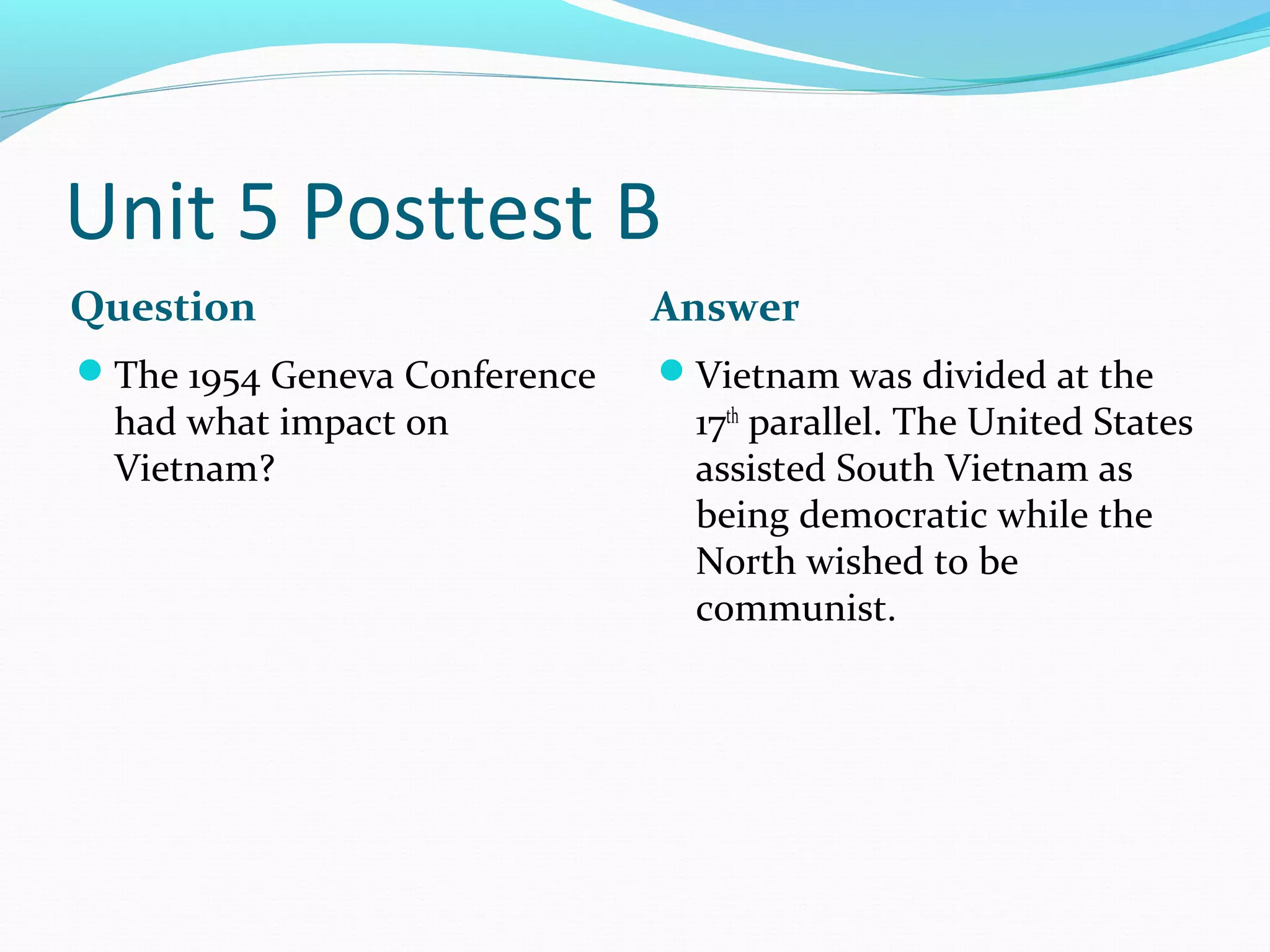
Question                      Answer
The 1954 Geneva Conference   Vietnam was divided at the
 had what impact on             17th parallel. The United States
 Vietnam?                       assisted South Vietnam as
                                being democratic while the
                                North wished to be
                                communist.
Unit 5 Posttest B
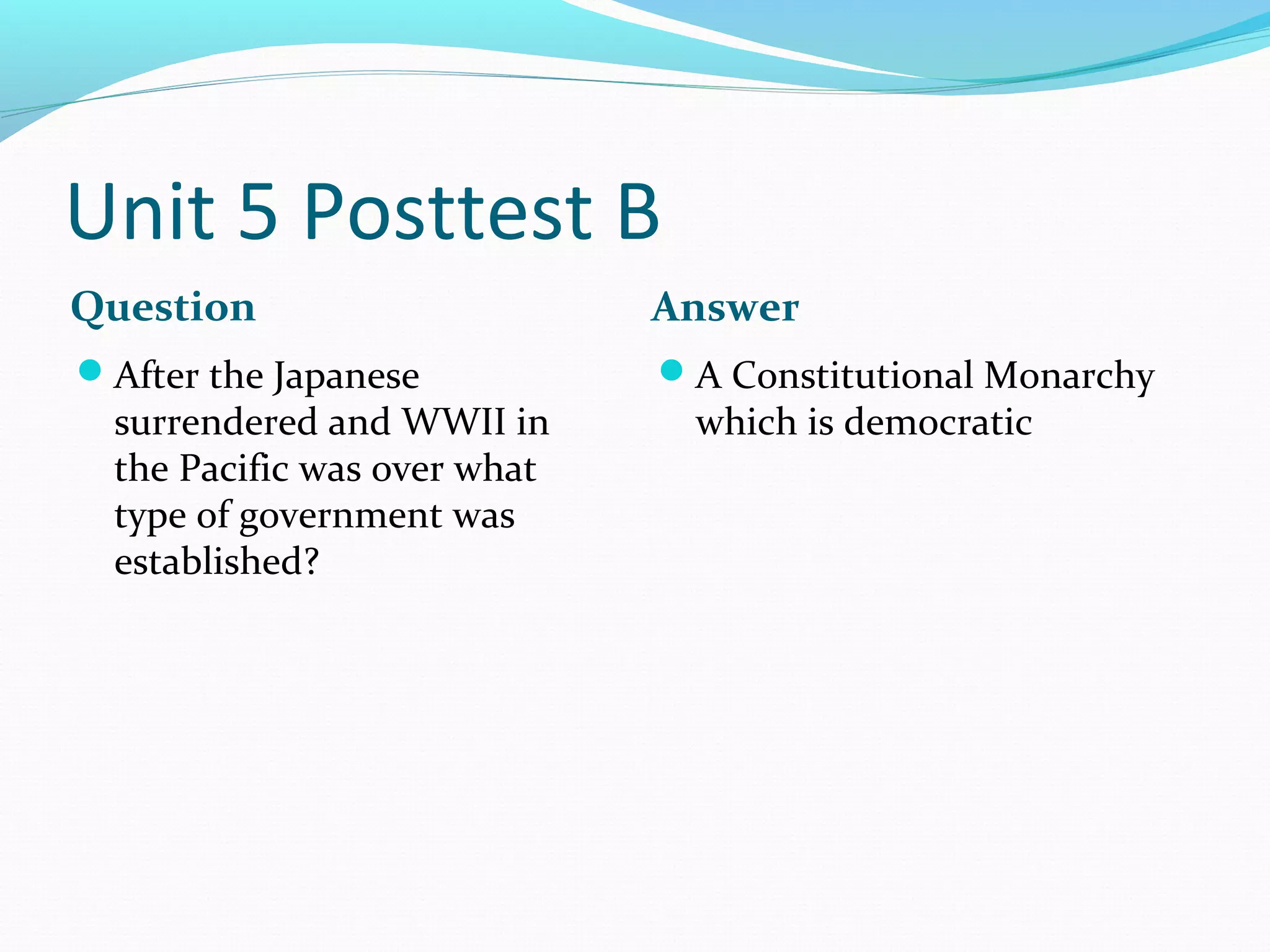
Question                      Answer
After the Japanese           A Constitutional Monarchy
  surrendered and WWII in      which is democratic
  the Pacific was over what
  type of government was
  established?
Unit 5 Posttest B
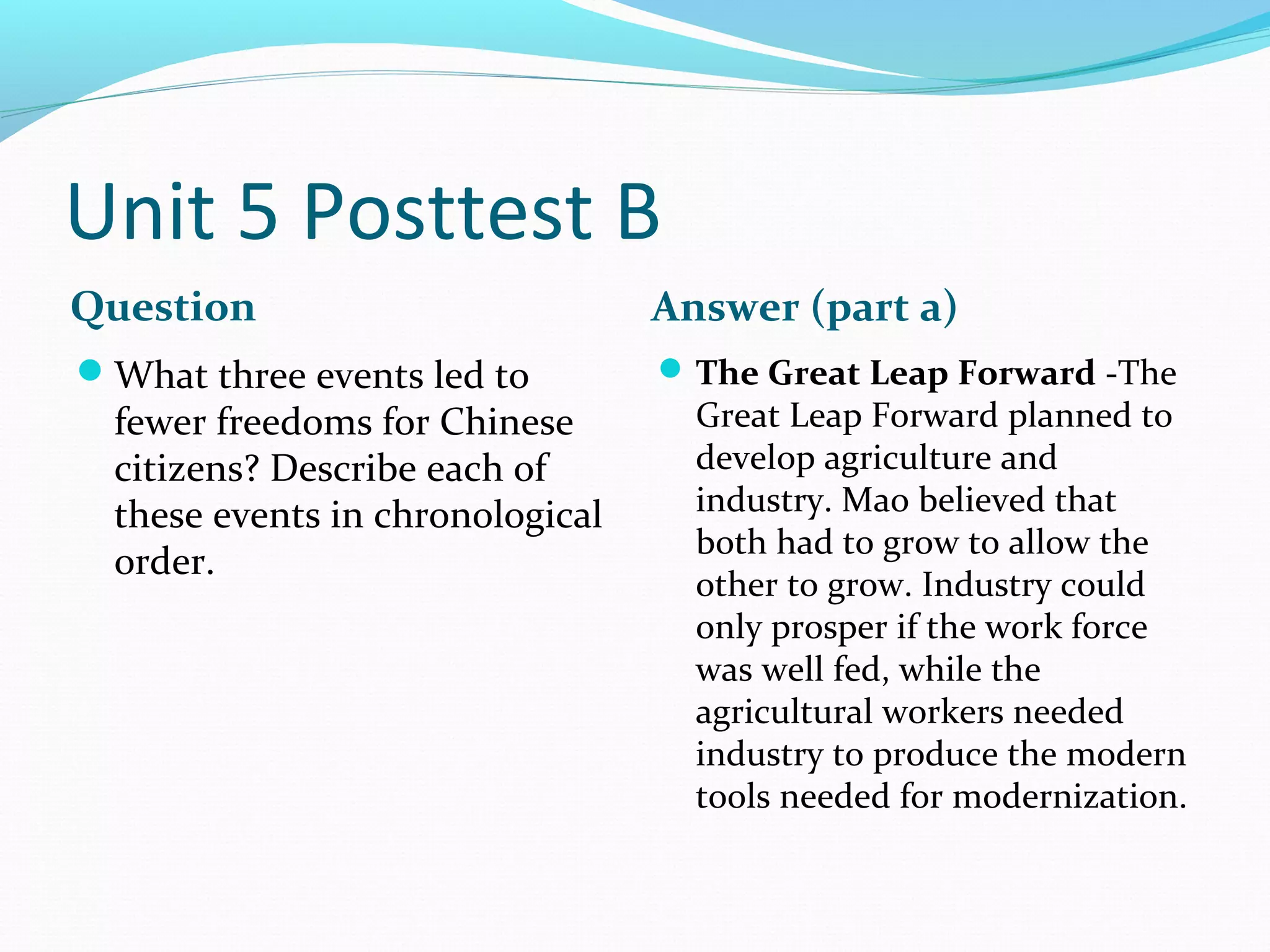
Question                          Answer (part a)
What three events led to          The Great Leap Forward -The
  fewer freedoms for Chinese        Great Leap Forward planned to
  citizens? Describe each of        develop agriculture and
  these events in chronological     industry. Mao believed that
                                    both had to grow to allow the
  order.
                                    other to grow. Industry could
                                    only prosper if the work force
                                    was well fed, while the
                                    agricultural workers needed
                                    industry to produce the modern
                                    tools needed for modernization.
Unit 5 Posttest B
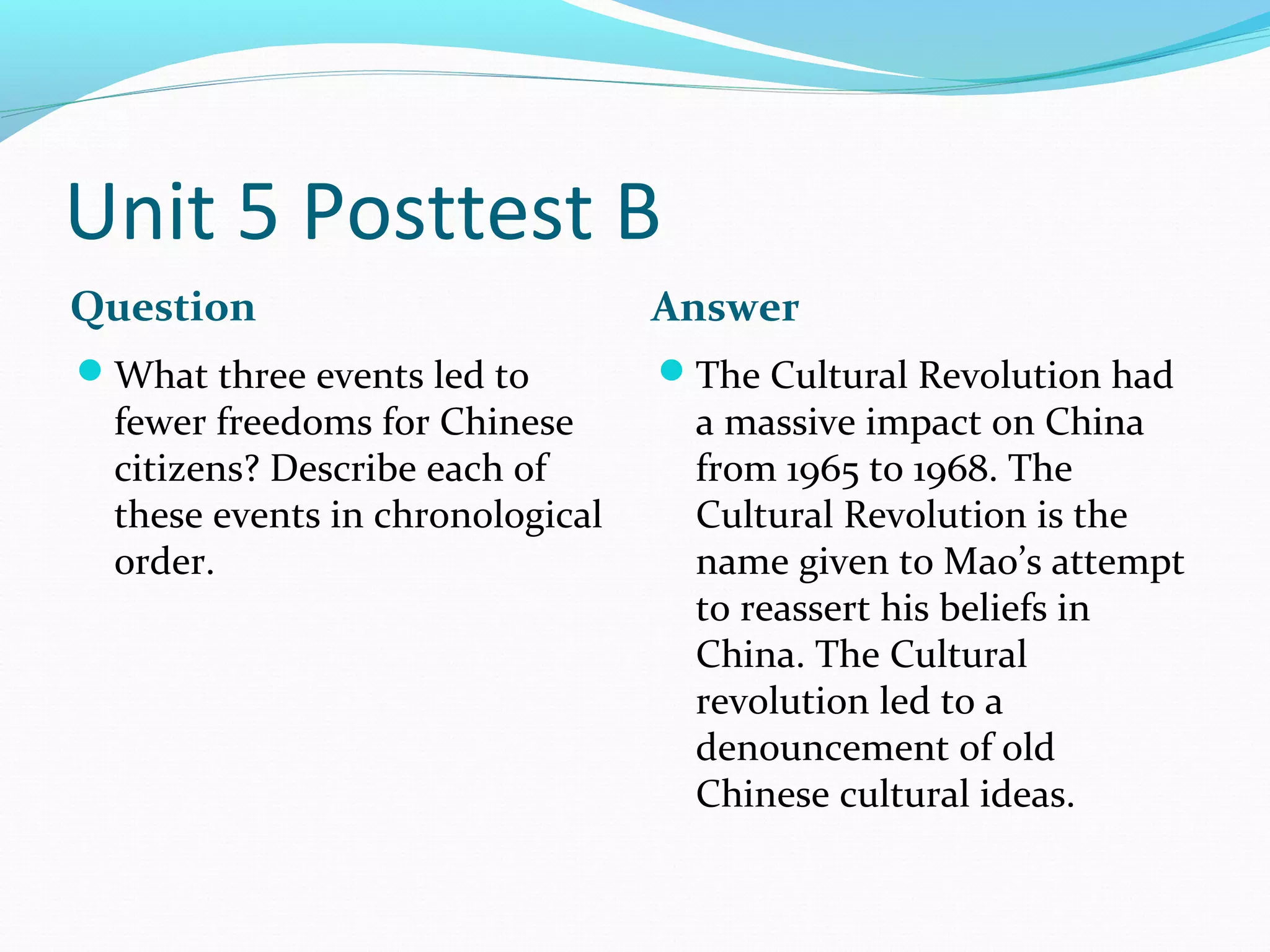
Question                          Answer
What three events led to         The Cultural Revolution had
  fewer freedoms for Chinese        a massive impact on China
  citizens? Describe each of        from 1965 to 1968. The
  these events in chronological     Cultural Revolution is the
  order.                            name given to Mao’s attempt
                                    to reassert his beliefs in
                                    China. The Cultural
                                    revolution led to a
                                    denouncement of old
                                    Chinese cultural ideas.
Unit 5 Posttest B
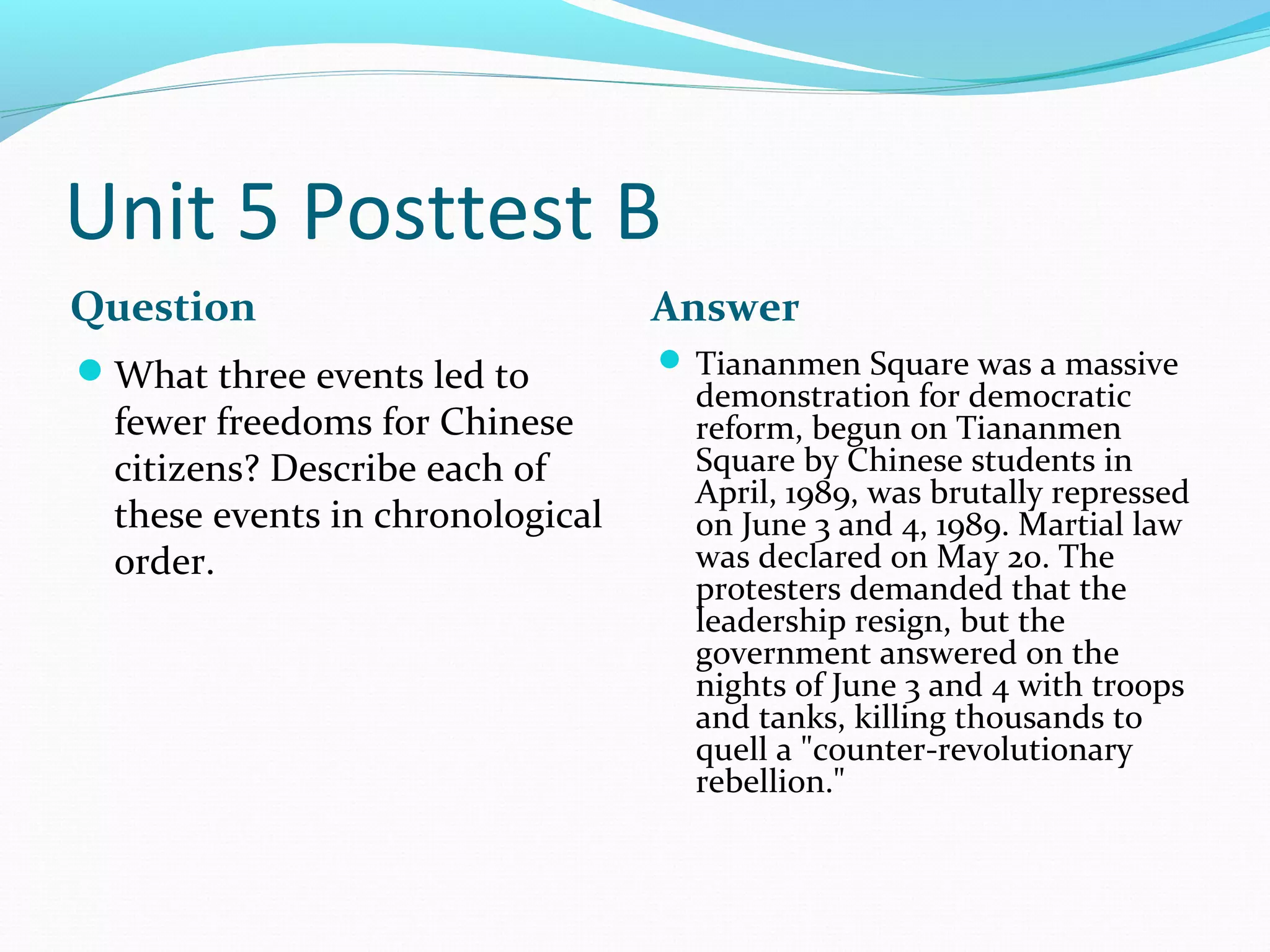
Question                          Answer
What three events led to          Tiananmen Square was a massive
                                    demonstration for democratic
  fewer freedoms for Chinese        reform, begun on Tiananmen
  citizens? Describe each of        Square by Chinese students in
                                    April, 1989, was brutally repressed
  these events in chronological     on June 3 and 4, 1989. Martial law
  order.                            was declared on May 20. The
                                    protesters demanded that the
                                    leadership resign, but the
                                    government answered on the
                                    nights of June 3 and 4 with troops
                                    and tanks, killing thousands to
                                    quell a "counter-revolutionary
                                    rebellion."
Unit 5 Posttest B
Question                     Answer
Who was the leader of the   Mao Ze Dong
  communist revolution in
  China?
Unit 5 Posttest B
Question                         Answer
How did the U.S. assist Japan   By providing funding for
  in recovering from WWII?         industry, rebuilding,
                                   infrastructure and helping to
                                   establish a new government
Unit 5 Posttest B
Question                       Answer
What policy led to the U.S.   Containment
  becoming involved in both
  Vietnam and Korea?
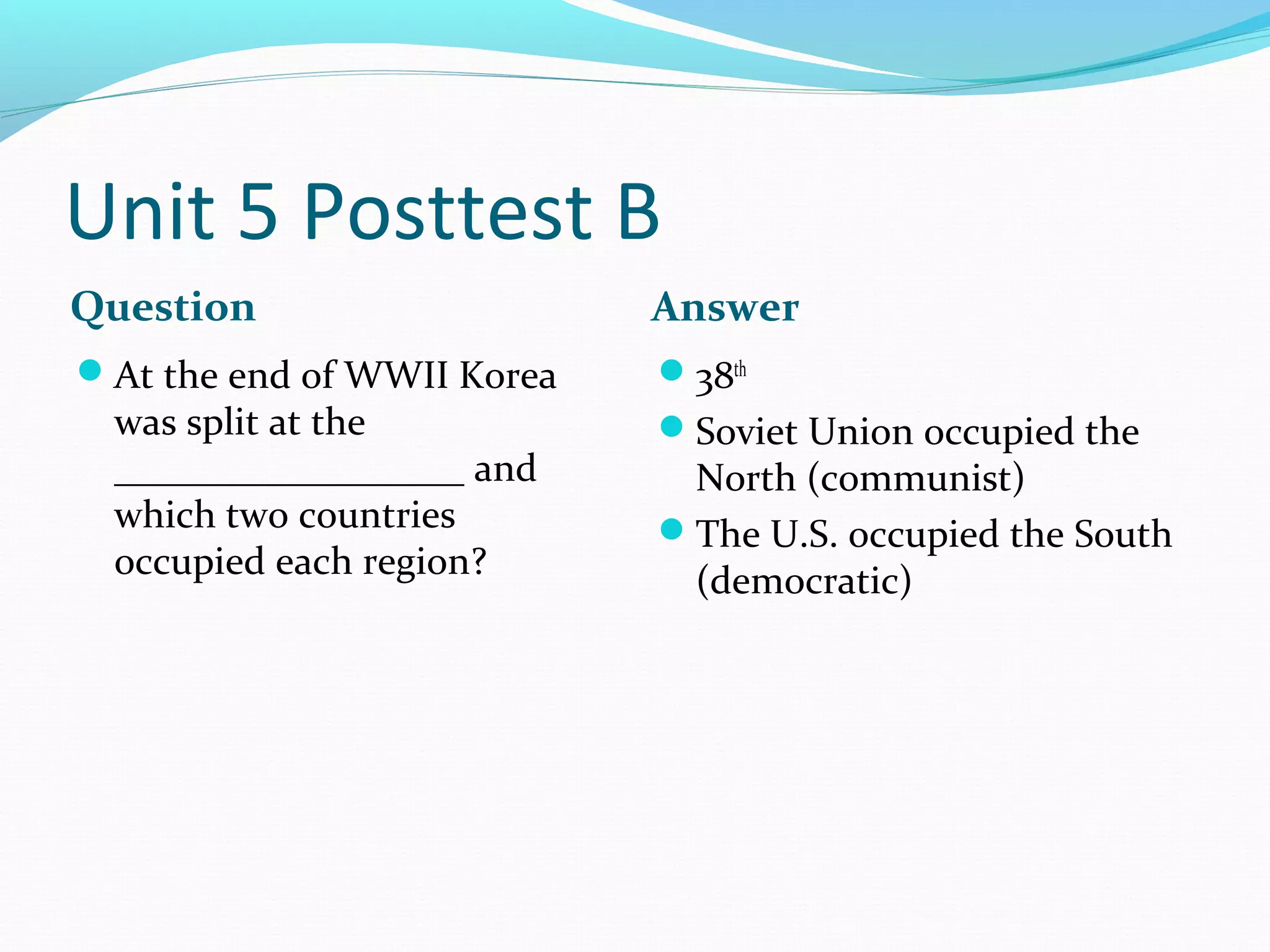
Unit 5 Posttest B
Question                    Answer
At the end of WWII Korea   38th
 was split at the           Soviet Union occupied the
 __________________ and      North (communist)
 which two countries        The U.S. occupied the South
 occupied each region?       (democratic)
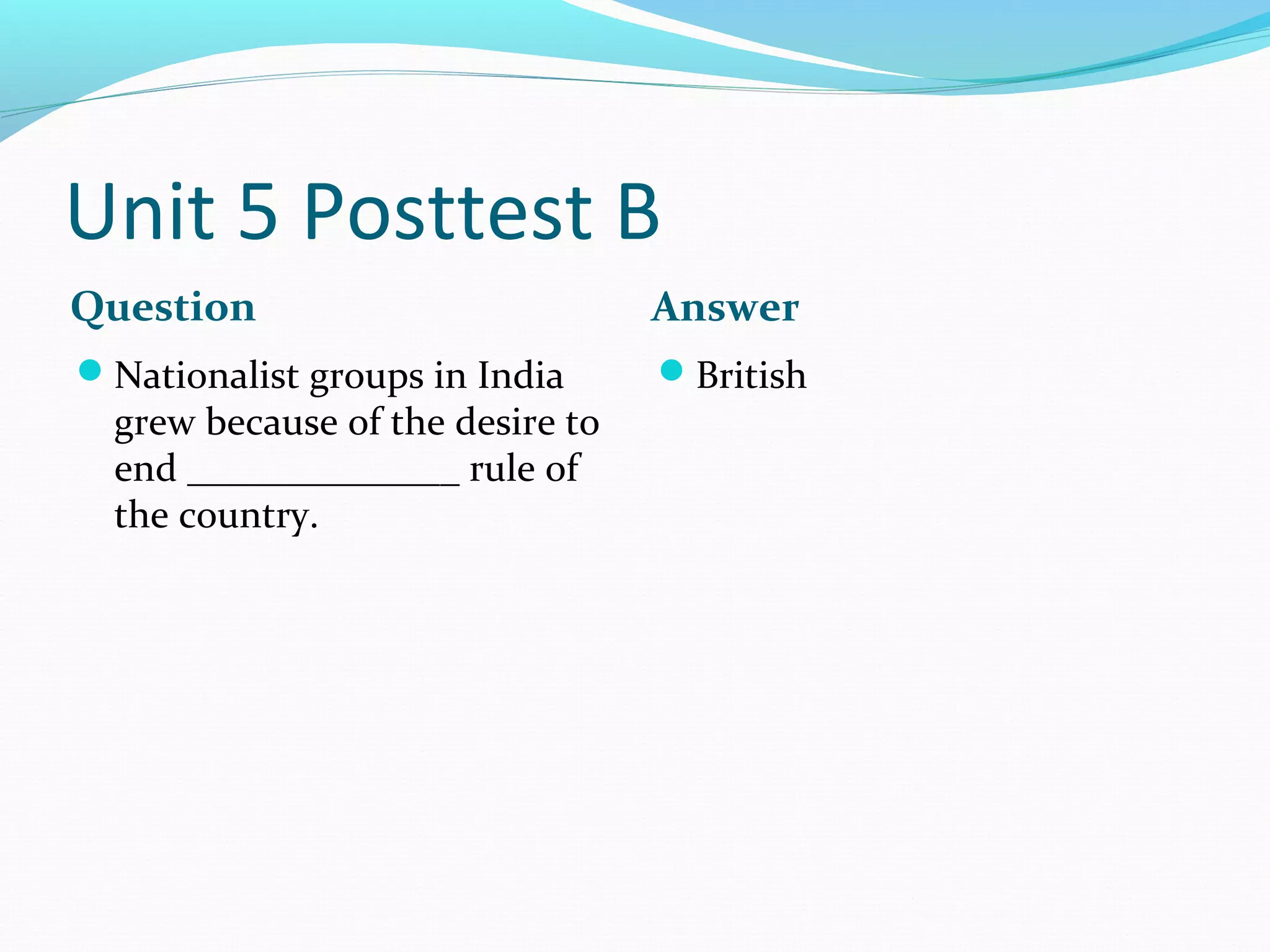
Unit 5 Posttest B
Question                          Answer
Nationalist groups in India      British
  grew because of the desire to
  end ______________ rule of
  the country.
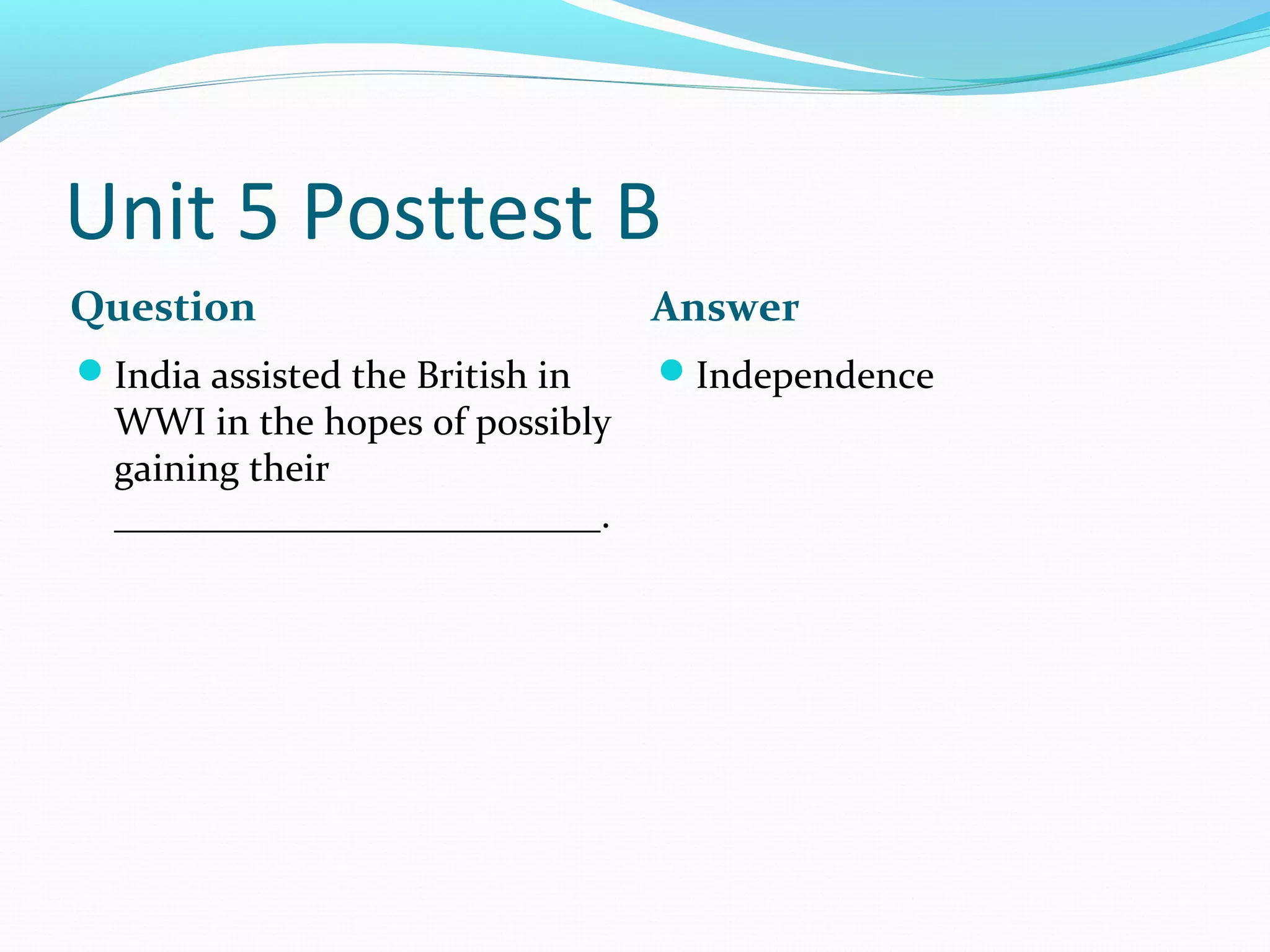
Unit 5 Posttest B
Question                         Answer
India assisted the British in   Independence
  WWI in the hopes of possibly
  gaining their
  _________________________.
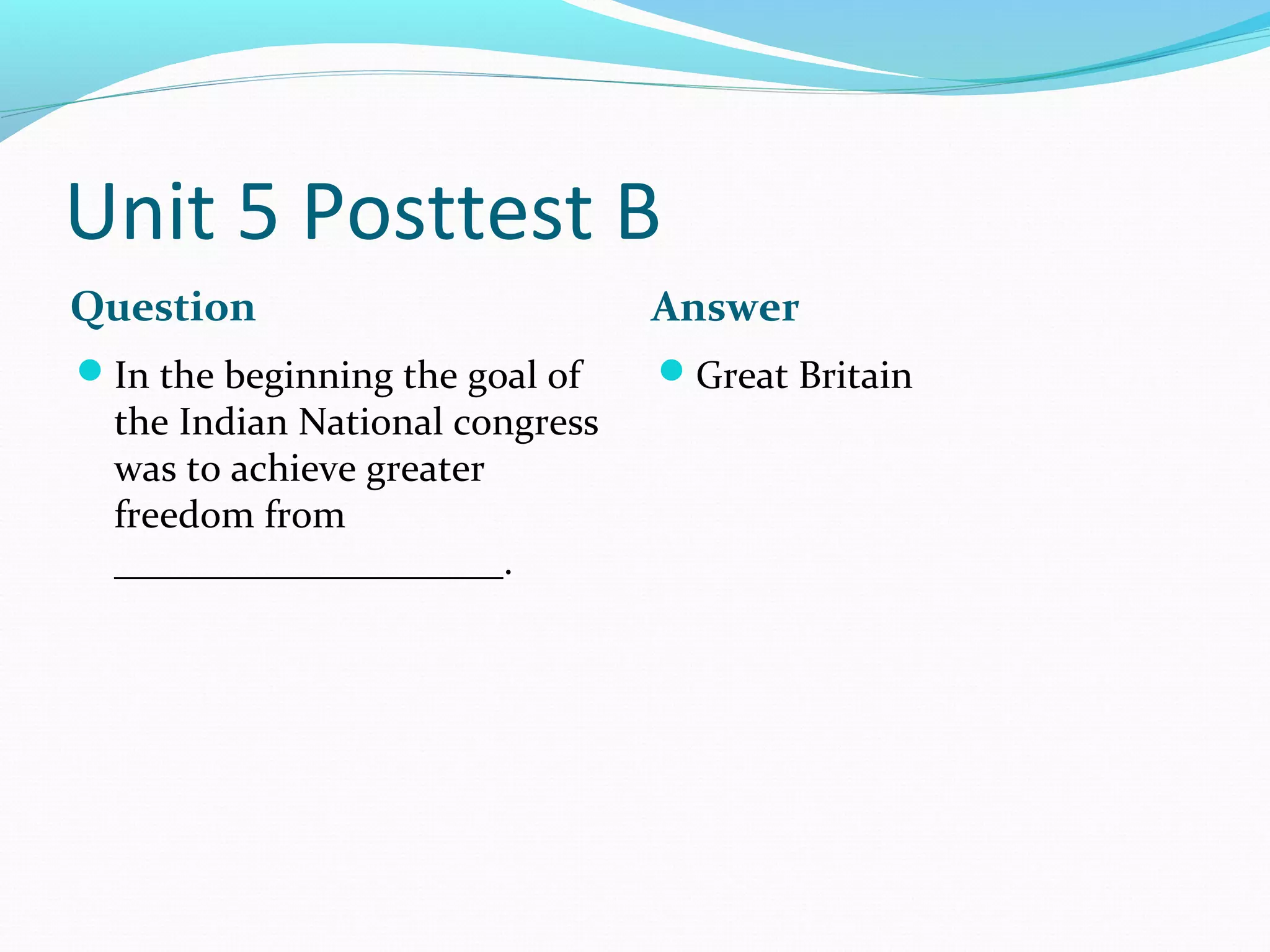
Unit 5 Posttest B
Question                         Answer
In the beginning the goal of    Great Britain
  the Indian National congress
  was to achieve greater
  freedom from
  ____________________.
Unit 5 Posttest B
Question                        Answer
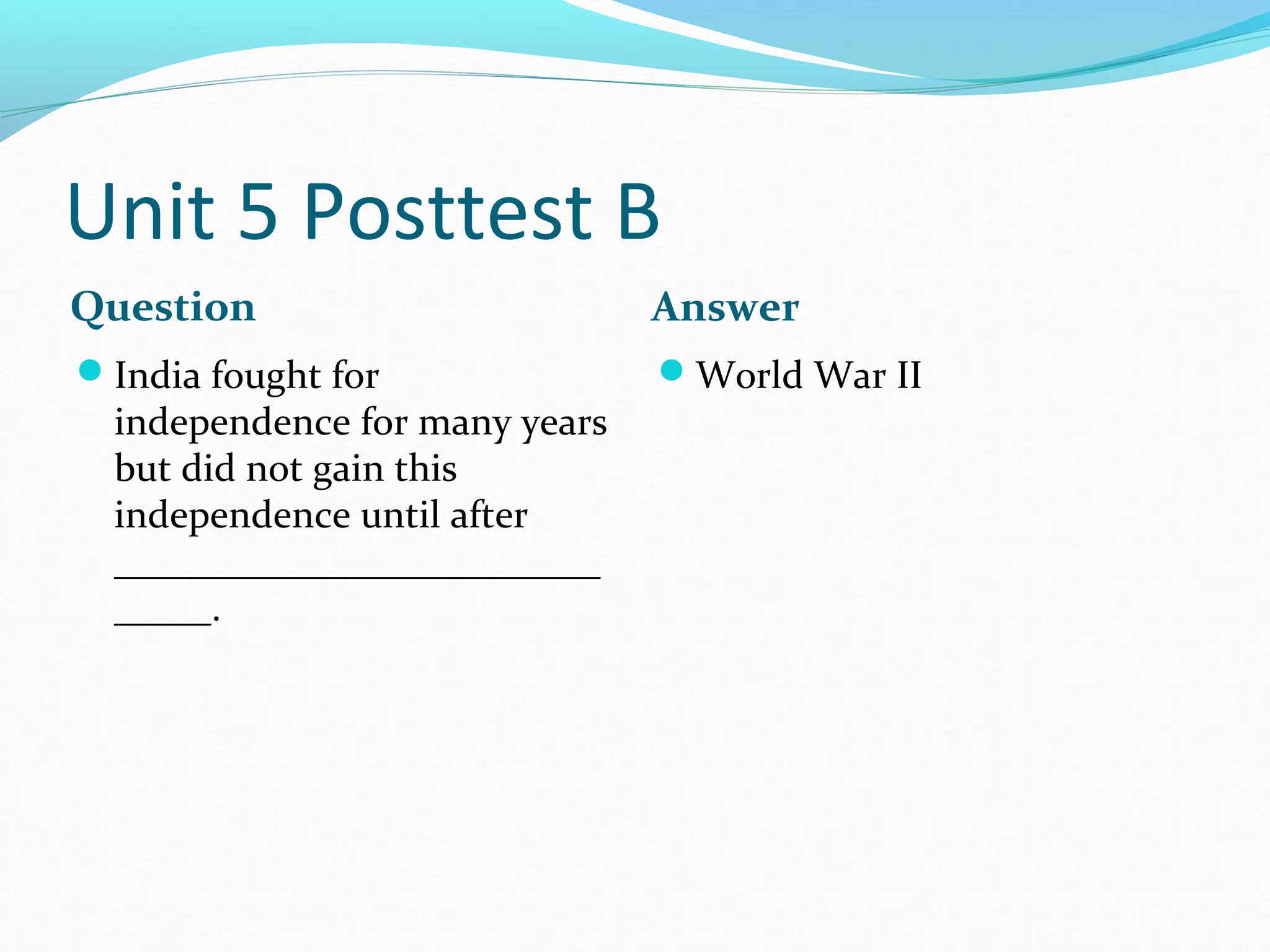
India fought for               World War II
  independence for many years
  but did not gain this
  independence until after
  _________________________
  _____.
Unit 5 Posttest B
Question                   Answer
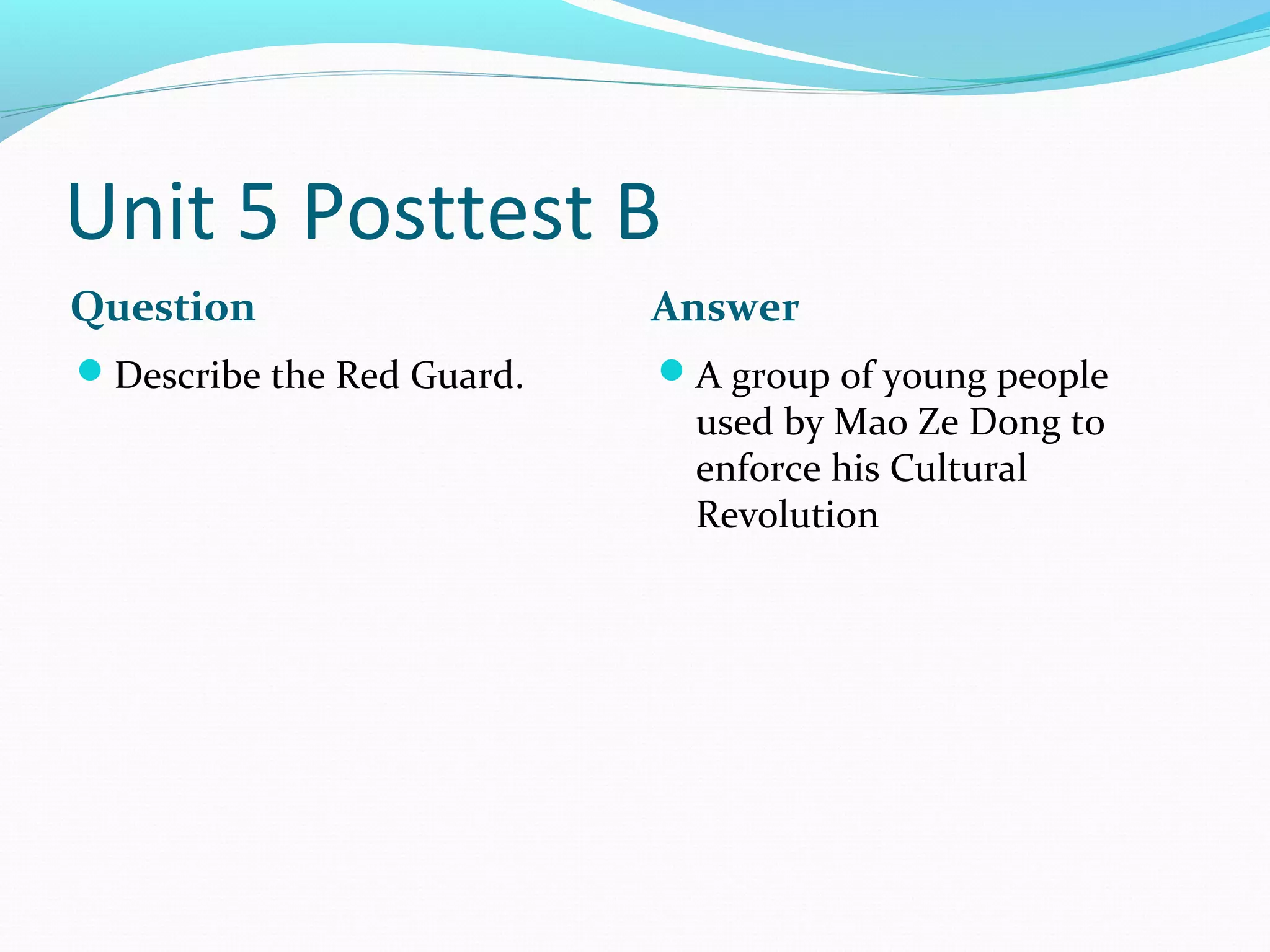
Describe the Red Guard.   A group of young people
                             used by Mao Ze Dong to
                             enforce his Cultural
                             Revolution
Unit 5 Posttest B
Question                       Answer
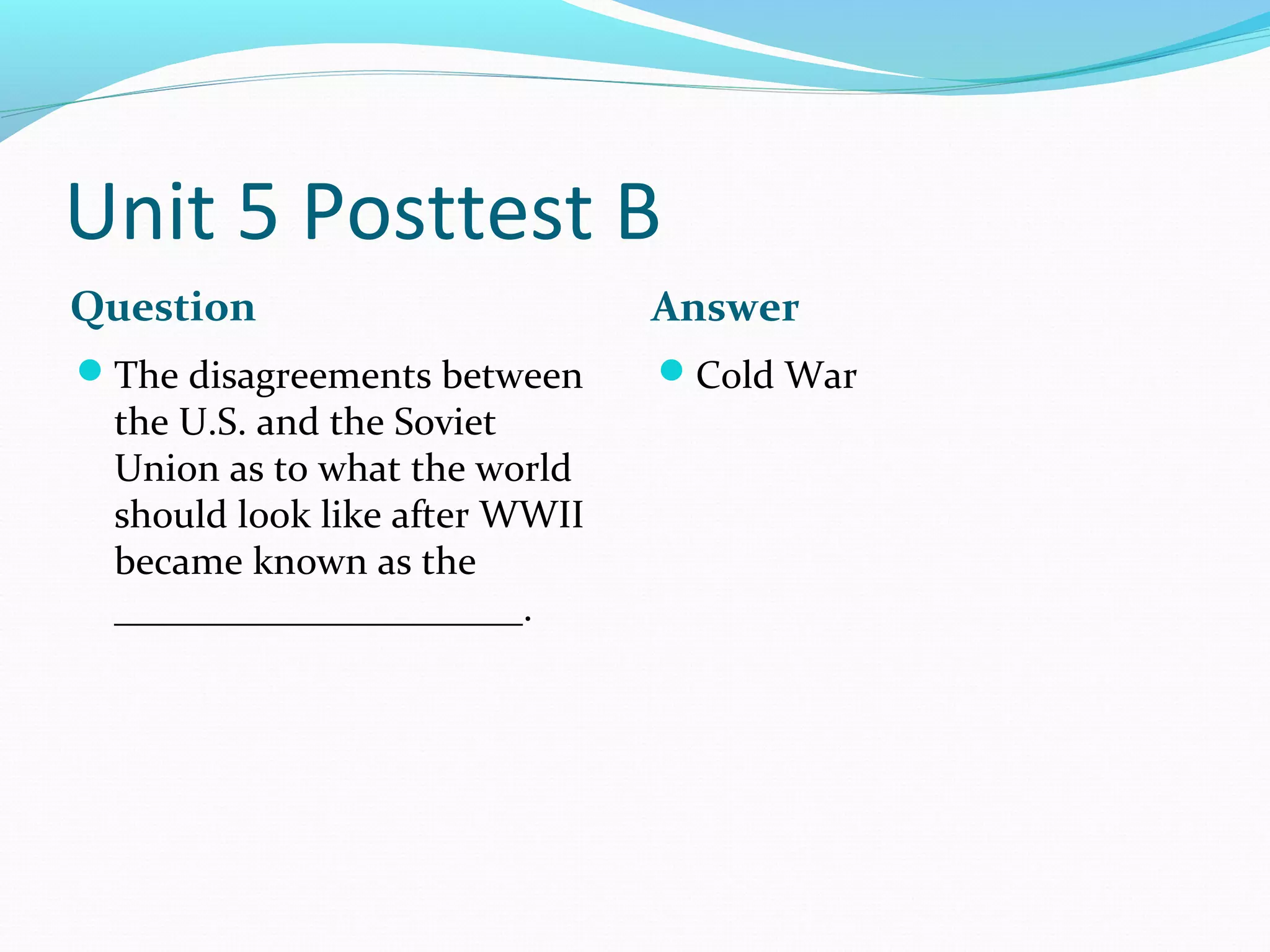
The disagreements between     Cold War
 the U.S. and the Soviet
 Union as to what the world
 should look like after WWII
 became known as the
 _____________________.
Unit 5 Posttest B
Question                          Answer
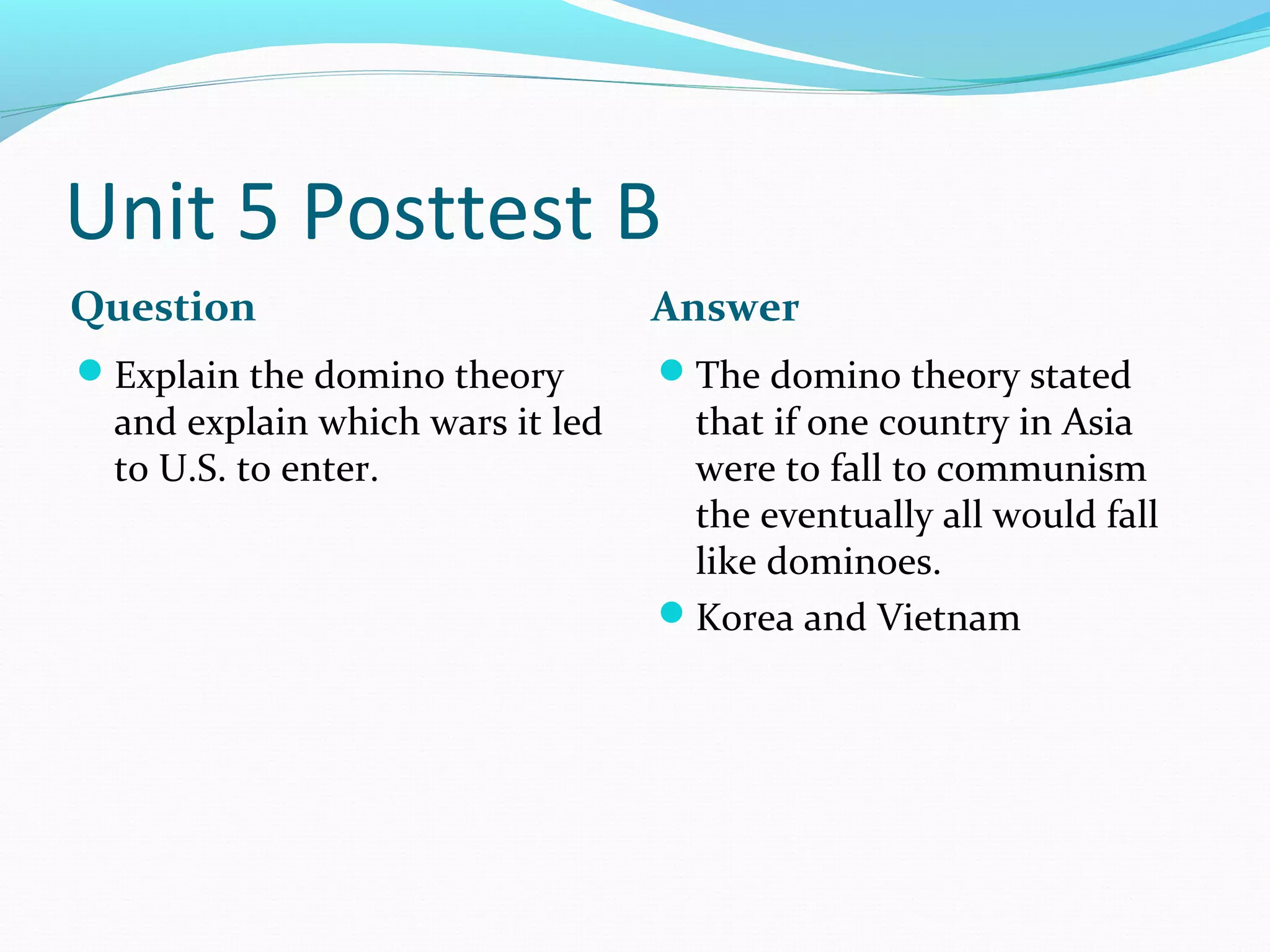
Explain the domino theory        The domino theory stated
  and explain which wars it led    that if one country in Asia
  to U.S. to enter.                were to fall to communism
                                   the eventually all would fall
                                   like dominoes.
                                  Korea and Vietnam
Unit 5 Posttest B
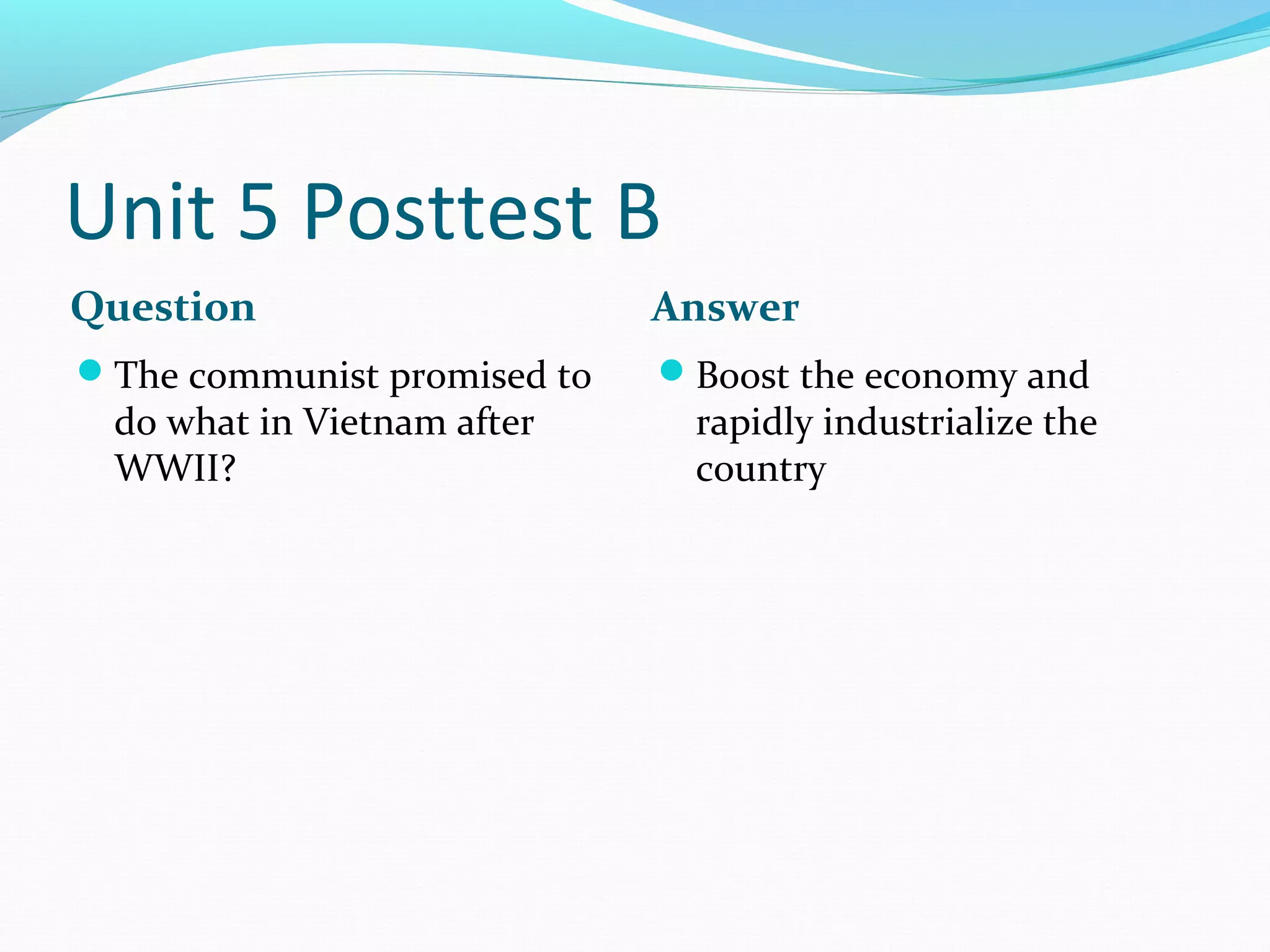
Question                     Answer
The communist promised to   Boost the economy and
 do what in Vietnam after     rapidly industrialize the
 WWII?                        country
Unit 5 Posttest B
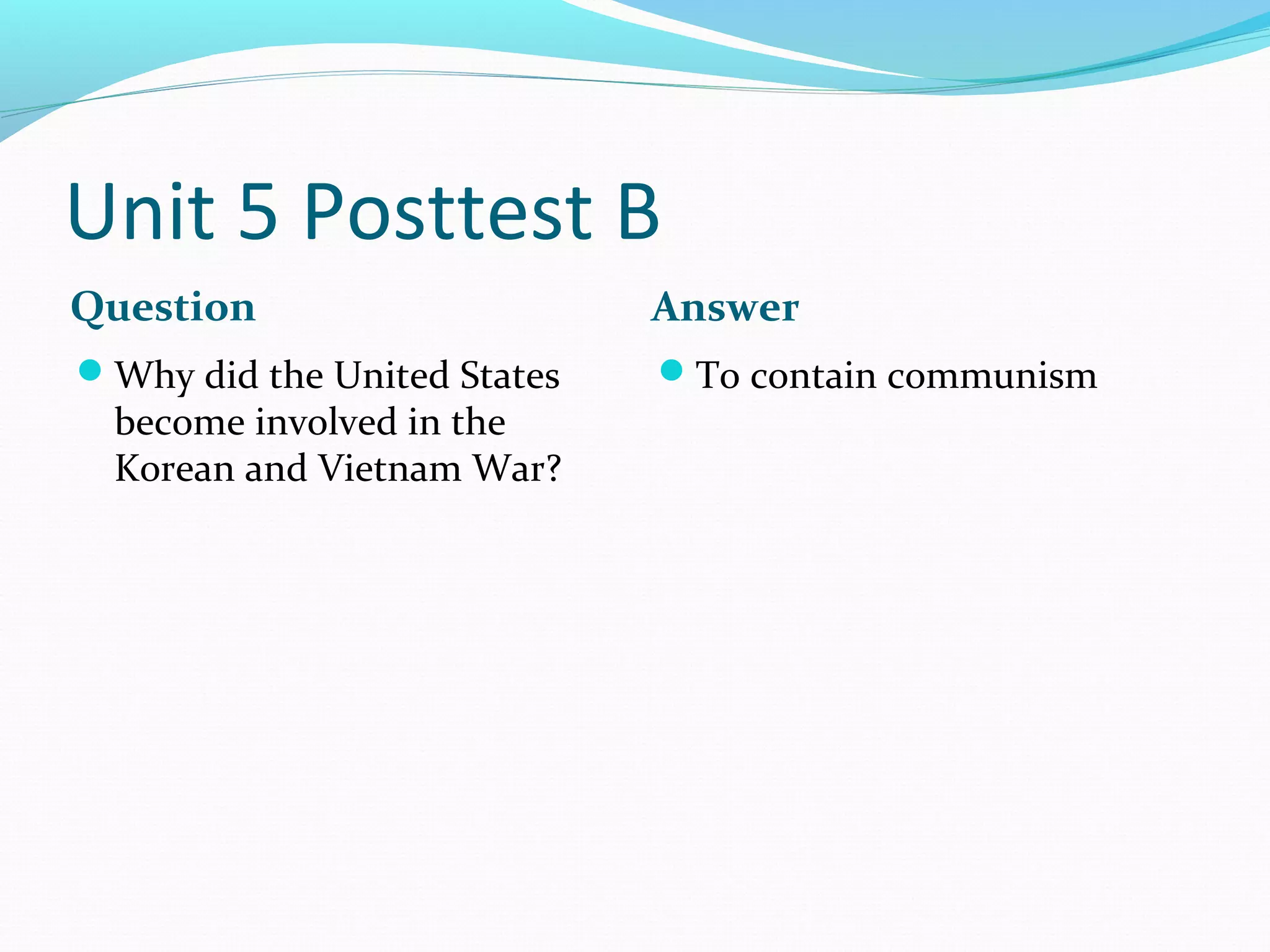
Question                     Answer
Why did the United States   To contain communism
  become involved in the
  Korean and Vietnam War?
Unit 5 Posttest B
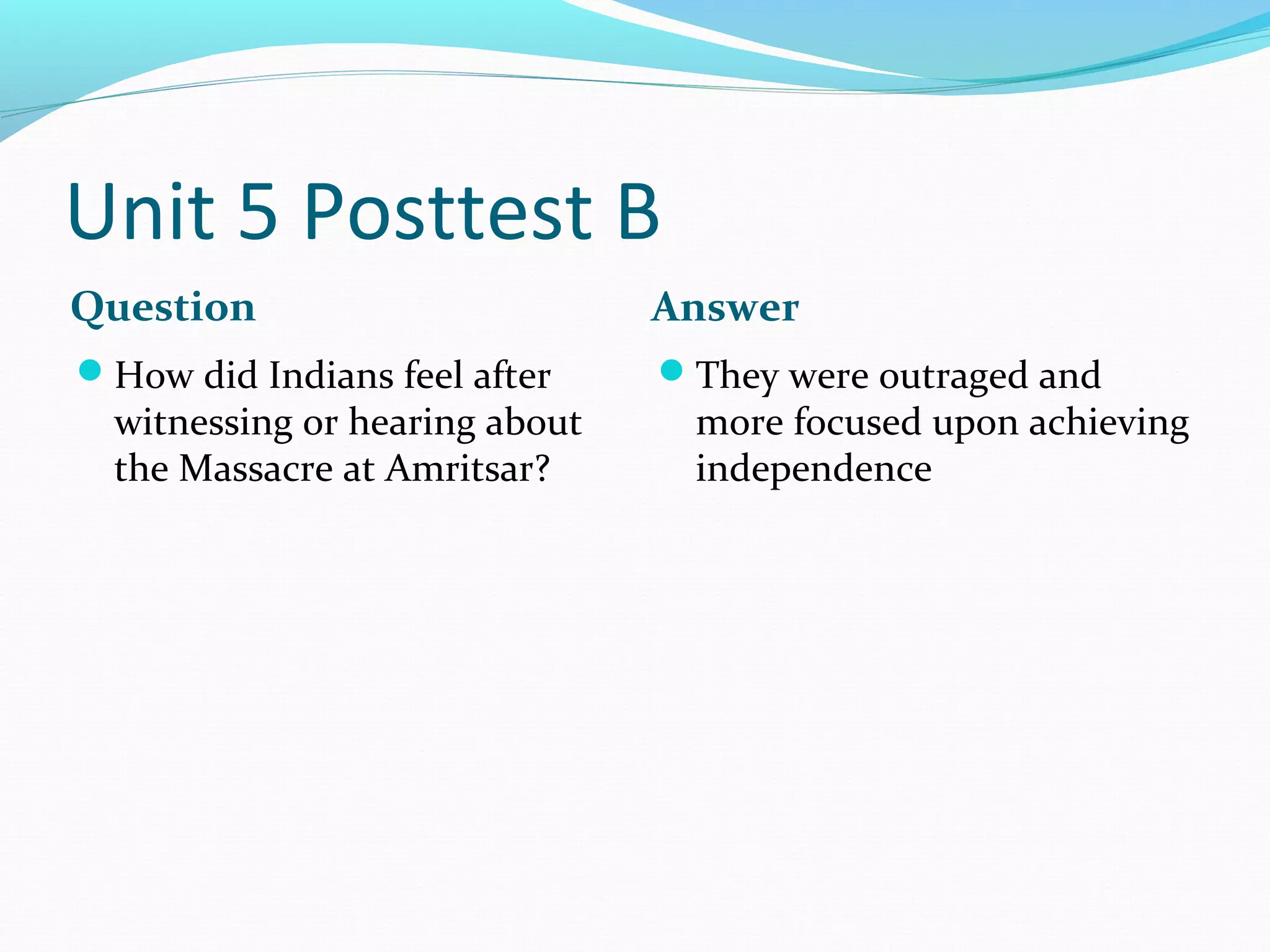
Question                        Answer
How did Indians feel after     They were outraged and
  witnessing or hearing about    more focused upon achieving
  the Massacre at Amritsar?      independence
Unit 5 Posttest B
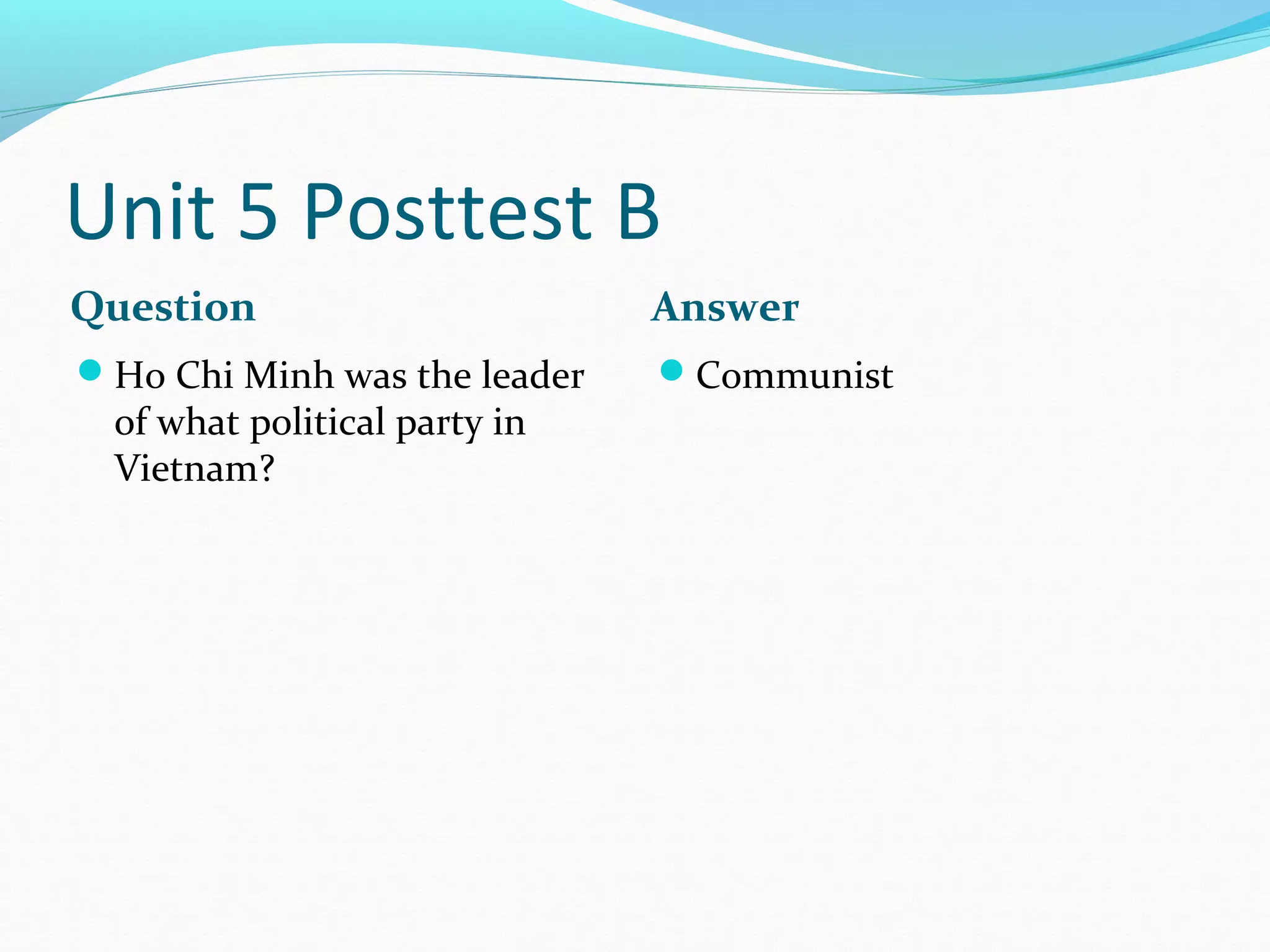
Question                       Answer
Ho Chi Minh was the leader    Communist
  of what political party in
  Vietnam?
Unit 5 Posttest B
Question        Answer
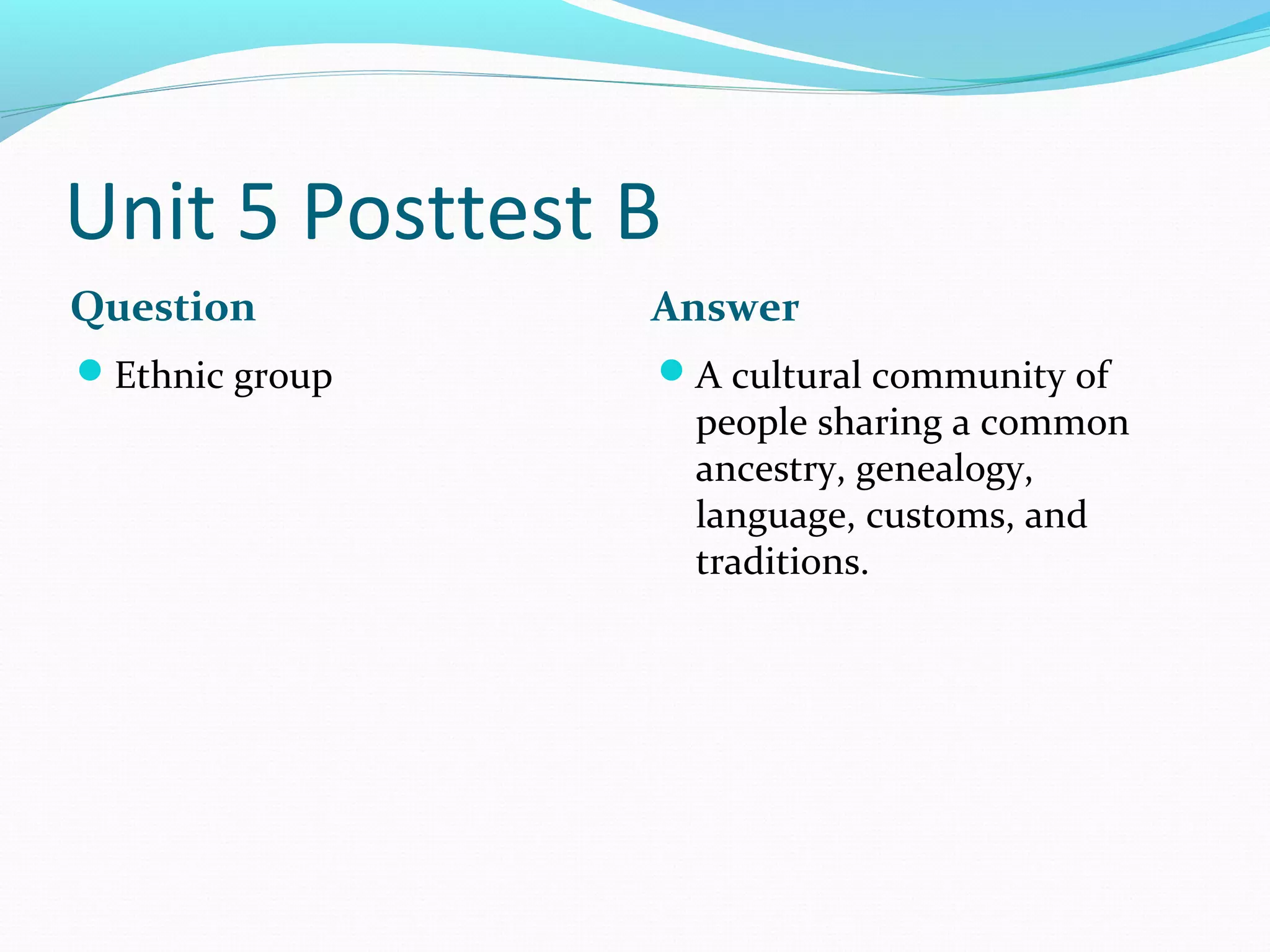
Ethnic group   A cultural community of
                    people sharing a common
                    ancestry, genealogy,
                    language, customs, and
                    traditions.
Unit 5 Posttest B
Question        Answer
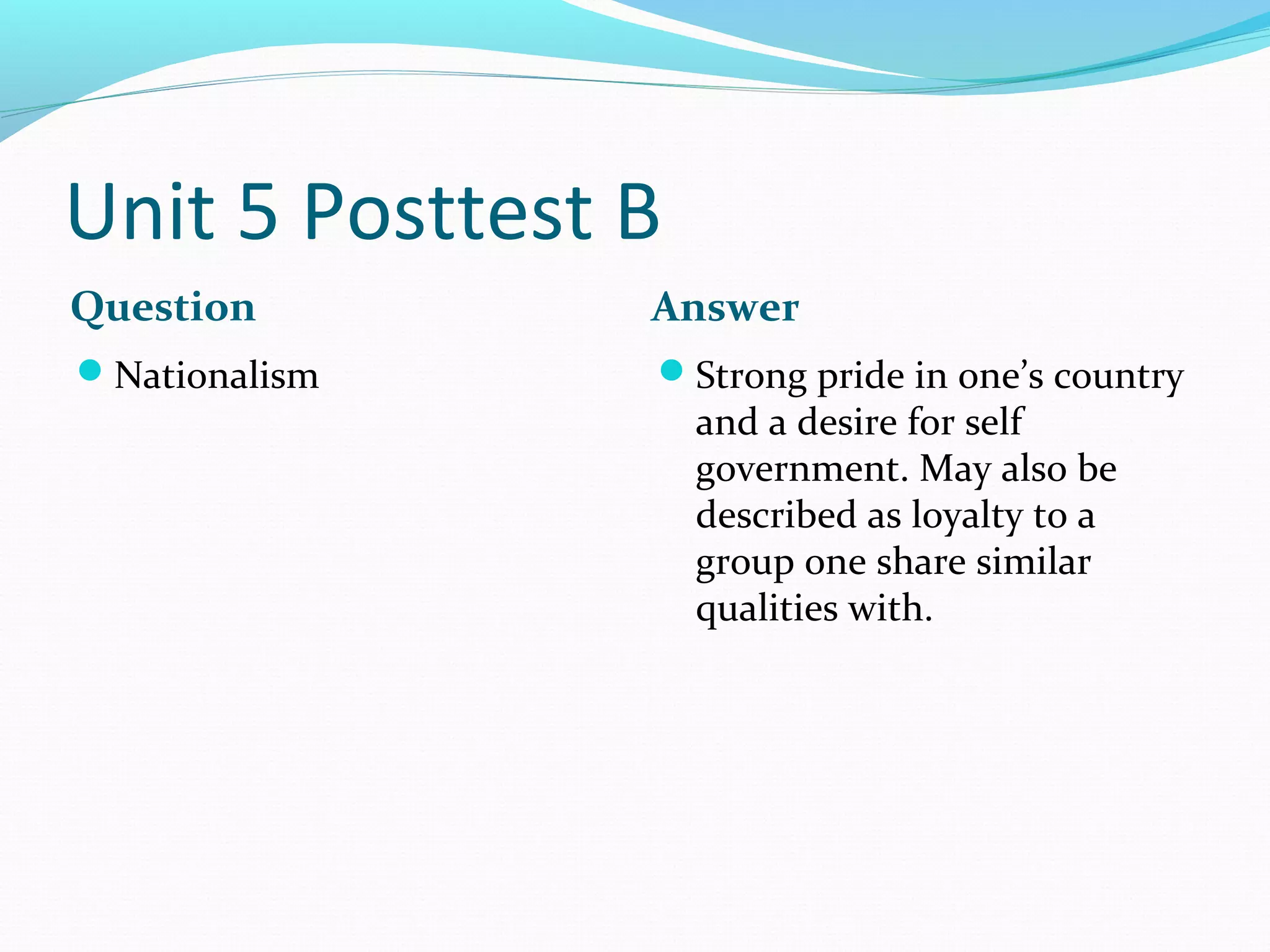
Nationalism    Strong pride in one’s country
                    and a desire for self
                    government. May also be
                    described as loyalty to a
                    group one share similar
                    qualities with.
Unit 5 Posttest B
Question        Answer
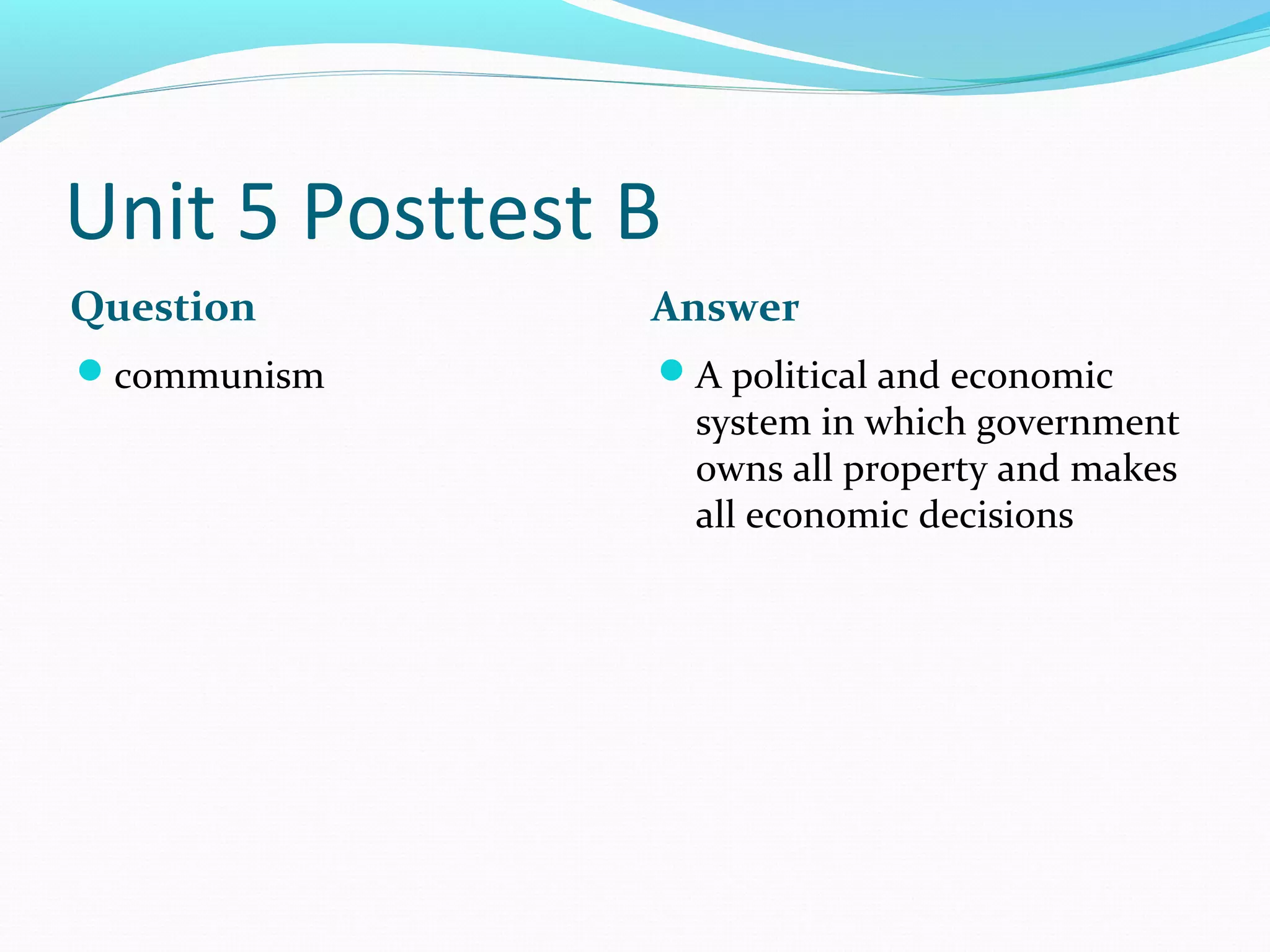
communism      A political and economic
                    system in which government
                    owns all property and makes
                    all economic decisions
Social Studies Department Website
http://classjump.com/E/ESMS/index.php

Unit 5 posttest b study guide answers

  • 2.
    Unit 5 PosttestB Question 1 Answer Independence movements in Nationalism India and Vietnam began with the idea of __________________, the idea that citizens of the country have the right to have their own government away from colonial rule.
  • 3.
    Unit 5 PosttestB Question 2 Answer Which piece of British Rowlett Act legislation, allowed the government to send Indians to jail without a trial?
  • 4.
    Unit 5 PosttestB Question 3 Answer After independence many Hindu’s and Muslims Indians were still unhappy because of fighting between _____________ and _________________.
  • 5.
    Unit 5 PosttestB Question Answer What country colonized France Vietnam?
  • 6.
    Unit 5 PosttestB Question Answer Gandhi believed in what Nonviolent form of protest?
  • 7.
    Unit 5 PosttestB Question Answer While a colony of France Indochina Vietnam, Cambodia and Laos were known as?
  • 8.
    Unit 5 PosttestB Question Answer Who led the movement for Ho Chi Minh independence in Vietnam?
  • 9.
    Unit 5 PosttestB Question Answer Who led the United States General Douglas MacArthur army occupation of Japan?
  • 10.
    Unit 5 PosttestB Question Answer The 1954 Geneva Conference Vietnam was divided at the had what impact on 17th parallel. The United States Vietnam? assisted South Vietnam as being democratic while the North wished to be communist.
  • 11.
    Unit 5 PosttestB Question Answer After the Japanese A Constitutional Monarchy surrendered and WWII in which is democratic the Pacific was over what type of government was established?
  • 12.
    Unit 5 PosttestB Question Answer (part a) What three events led to  The Great Leap Forward -The fewer freedoms for Chinese Great Leap Forward planned to citizens? Describe each of develop agriculture and these events in chronological industry. Mao believed that both had to grow to allow the order. other to grow. Industry could only prosper if the work force was well fed, while the agricultural workers needed industry to produce the modern tools needed for modernization.
  • 13.
    Unit 5 PosttestB Question Answer What three events led to The Cultural Revolution had fewer freedoms for Chinese a massive impact on China citizens? Describe each of from 1965 to 1968. The these events in chronological Cultural Revolution is the order. name given to Mao’s attempt to reassert his beliefs in China. The Cultural revolution led to a denouncement of old Chinese cultural ideas.
  • 14.
    Unit 5 PosttestB Question Answer What three events led to  Tiananmen Square was a massive demonstration for democratic fewer freedoms for Chinese reform, begun on Tiananmen citizens? Describe each of Square by Chinese students in April, 1989, was brutally repressed these events in chronological on June 3 and 4, 1989. Martial law order. was declared on May 20. The protesters demanded that the leadership resign, but the government answered on the nights of June 3 and 4 with troops and tanks, killing thousands to quell a "counter-revolutionary rebellion."
  • 15.
    Unit 5 PosttestB Question Answer Who was the leader of the Mao Ze Dong communist revolution in China?
  • 16.
    Unit 5 PosttestB Question Answer How did the U.S. assist Japan By providing funding for in recovering from WWII? industry, rebuilding, infrastructure and helping to establish a new government
  • 17.
    Unit 5 PosttestB Question Answer What policy led to the U.S. Containment becoming involved in both Vietnam and Korea?
  • 18.
    Unit 5 PosttestB Question Answer At the end of WWII Korea 38th was split at the Soviet Union occupied the __________________ and North (communist) which two countries The U.S. occupied the South occupied each region? (democratic)
  • 19.
    Unit 5 PosttestB Question Answer Nationalist groups in India British grew because of the desire to end ______________ rule of the country.
  • 20.
    Unit 5 PosttestB Question Answer India assisted the British in Independence WWI in the hopes of possibly gaining their _________________________.
  • 21.
    Unit 5 PosttestB Question Answer In the beginning the goal of Great Britain the Indian National congress was to achieve greater freedom from ____________________.
  • 22.
    Unit 5 PosttestB Question Answer India fought for World War II independence for many years but did not gain this independence until after _________________________ _____.
  • 23.
    Unit 5 PosttestB Question Answer Describe the Red Guard. A group of young people used by Mao Ze Dong to enforce his Cultural Revolution
  • 24.
    Unit 5 PosttestB Question Answer The disagreements between Cold War the U.S. and the Soviet Union as to what the world should look like after WWII became known as the _____________________.
  • 25.
    Unit 5 PosttestB Question Answer Explain the domino theory The domino theory stated and explain which wars it led that if one country in Asia to U.S. to enter. were to fall to communism the eventually all would fall like dominoes. Korea and Vietnam
  • 26.
    Unit 5 PosttestB Question Answer The communist promised to Boost the economy and do what in Vietnam after rapidly industrialize the WWII? country
  • 27.
    Unit 5 PosttestB Question Answer Why did the United States To contain communism become involved in the Korean and Vietnam War?
  • 28.
    Unit 5 PosttestB Question Answer How did Indians feel after They were outraged and witnessing or hearing about more focused upon achieving the Massacre at Amritsar? independence
  • 29.
    Unit 5 PosttestB Question Answer Ho Chi Minh was the leader Communist of what political party in Vietnam?
  • 30.
    Unit 5 PosttestB Question Answer Ethnic group A cultural community of people sharing a common ancestry, genealogy, language, customs, and traditions.
  • 31.
    Unit 5 PosttestB Question Answer Nationalism Strong pride in one’s country and a desire for self government. May also be described as loyalty to a group one share similar qualities with.
  • 32.
    Unit 5 PosttestB Question Answer communism A political and economic system in which government owns all property and makes all economic decisions
  • 33.
    Social Studies DepartmentWebsite http://classjump.com/E/ESMS/index.php