Unit 3 Notes
   There are 4 factors of production that influence
    economic growth within a country:
     Investment in Human Capital
     Investment in Capital Goods
     Natural Resources available
     Entrepreneurship


   The presence or absence of these 4 factors
    determine the country’s Gross Domestic Product
    for the year
   All of the skills, talents, education, and abilities
    that human workers possess---and the value that
    they bring to the marketplace
     Examples: computer/reading/writing/math
      skills, talents in music/sports/acting, ability to follow
      directions, ability to serve as group leader & cooperate
      with group members

   A country’s Literacy Rate impacts Human Capital-
    -the percent of the population over 15 that can
    read/write
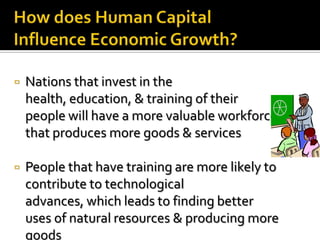
   Nations that invest in the
    health, education, & training of their
    people will have a more valuable workforce
    that produces more goods & services

   People that have training are more likely to
    contribute to technological
    advances, which leads to finding better
    uses of natural resources & producing more
    goods
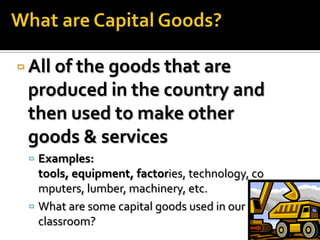
 All of the goods that are
 produced in the country and
 then used to make other
 goods & services
  Examples:
   tools, equipment, factories, technology, co
   mputers, lumber, machinery, etc.
  What are some capital goods used in our
   classroom?
 The more Capital Goods a
    country has = the more goods &
    services they are able to
    produce
   Money is NOT a capital good, but rather a
    medium of exchange!
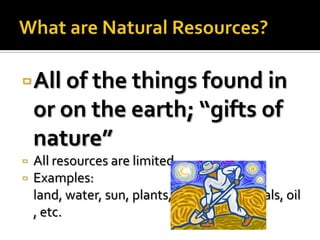
 All of the things found in
    or on the earth; “gifts of
    nature”
   All resources are limited
   Examples:
    land, water, sun, plants, time, air, minerals, oil
    , etc.
 Countries that have a lot of
 natural resources are able to
 use them to produce goods &
 services cheaper than a country
 that has to import natural
 resources
   Entrepreneurs have 2 characteristics that make them different from the rest of the labor force:


     1. innovative (have creative ideas)
     2. risk taker (use limited resources
           in an innovative way in hopes
           that people will buy the product)

   I


   t can be several things:
          Starting your own business
          Inventing something new
          Changing the way something was previously done so that it works better
 Entrepreneurship creates jobs
  and lessens unemployment
 Encourages people to take
  risks, and in doing so, they’ve
  created better healthcare,
  education, & welfare programs
   The more entrepreneurs a country has, the
    higher the country’s GDP will be…
   Economic growth in a country is measured by
    the country’s Gross Domestic Product (GDP)
    in one year
   GDP = the total amount of final goods and
    services produced in one year within a
    country
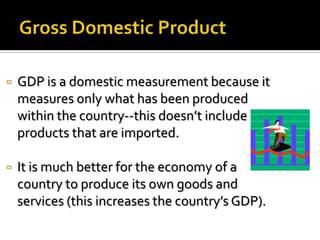
   GDP is a domestic measurement because it
    measures only what has been produced
    within the country--this doesn’t include
    products that are imported.

   It is much better for the economy of a
    country to produce its own goods and
    services (this increases the country’s GDP).
   Measuring the GDP each year can:
     Compare one country’s economy to another
     Check a country’s economic progress over time
     Show if the economy is growing or not
   The higher a country’s GDP = a better
    standard of living for the people within
    the country

   In order for a country to have an
    increasing GDP, it must invest in human
    capital through education & training, and
    it must produce goods that have value to
    be sold within the country or exported.
   To encourage economic growth and raise the living
    standards of its citizens, there must be investment in
    human capital and capital goods.
   Economic growth is measured by increases in real
    capital per GDP over time.
   How large a nation’s GDP can be is determined by the
    availability and quality of its natural, human, and
    capital resources.
   To increase economic growth and per capita GDP over
    time requires investments in both physical capital
    (factories, machines) and human capital
    (education, training, skills of labor force).

Factorsofproduction 111018195637-phpapp02[1]

  • 1.
  • 2.
    There are 4 factors of production that influence economic growth within a country:  Investment in Human Capital  Investment in Capital Goods  Natural Resources available  Entrepreneurship  The presence or absence of these 4 factors determine the country’s Gross Domestic Product for the year
  • 3.
    All of the skills, talents, education, and abilities that human workers possess---and the value that they bring to the marketplace  Examples: computer/reading/writing/math skills, talents in music/sports/acting, ability to follow directions, ability to serve as group leader & cooperate with group members  A country’s Literacy Rate impacts Human Capital- -the percent of the population over 15 that can read/write
  • 4.
    Nations that invest in the health, education, & training of their people will have a more valuable workforce that produces more goods & services  People that have training are more likely to contribute to technological advances, which leads to finding better uses of natural resources & producing more goods
  • 5.
     All ofthe goods that are produced in the country and then used to make other goods & services  Examples: tools, equipment, factories, technology, co mputers, lumber, machinery, etc.  What are some capital goods used in our classroom?
  • 6.
     The moreCapital Goods a country has = the more goods & services they are able to produce  Money is NOT a capital good, but rather a medium of exchange!
  • 7.
     All ofthe things found in or on the earth; “gifts of nature”  All resources are limited  Examples: land, water, sun, plants, time, air, minerals, oil , etc.
  • 8.
     Countries thathave a lot of natural resources are able to use them to produce goods & services cheaper than a country that has to import natural resources
  • 9.
    Entrepreneurs have 2 characteristics that make them different from the rest of the labor force:  1. innovative (have creative ideas)  2. risk taker (use limited resources in an innovative way in hopes that people will buy the product)  I  t can be several things:  Starting your own business  Inventing something new  Changing the way something was previously done so that it works better
  • 10.
     Entrepreneurship createsjobs and lessens unemployment  Encourages people to take risks, and in doing so, they’ve created better healthcare, education, & welfare programs  The more entrepreneurs a country has, the higher the country’s GDP will be…
  • 11.
    Economic growth in a country is measured by the country’s Gross Domestic Product (GDP) in one year  GDP = the total amount of final goods and services produced in one year within a country
  • 12.
    GDP is a domestic measurement because it measures only what has been produced within the country--this doesn’t include products that are imported.  It is much better for the economy of a country to produce its own goods and services (this increases the country’s GDP).
  • 13.
    Measuring the GDP each year can:  Compare one country’s economy to another  Check a country’s economic progress over time  Show if the economy is growing or not
  • 14.
    The higher a country’s GDP = a better standard of living for the people within the country  In order for a country to have an increasing GDP, it must invest in human capital through education & training, and it must produce goods that have value to be sold within the country or exported.
  • 15.
    To encourage economic growth and raise the living standards of its citizens, there must be investment in human capital and capital goods.  Economic growth is measured by increases in real capital per GDP over time.  How large a nation’s GDP can be is determined by the availability and quality of its natural, human, and capital resources.  To increase economic growth and per capita GDP over time requires investments in both physical capital (factories, machines) and human capital (education, training, skills of labor force).