War Propaganda:  A Visual Medium  Alan Leonard Beatriz Lopez Beth Laurenson Karen Hughes Gábor László-Fülöp
Propaganda as a visual medium: what it is and the techniques involved Origins of war propaganda: from 7000 BC to 1990 AD Creative and Technological Evolution, Continuity and Remediation in  the 20th Century World War I World War II Vietnam War The War on Terror: 2001 and beyond Hungarian Revolution Comparison The Plan
What is Propaganda? Propaganda is neutrally defined as a systematic form of purposeful persuasion that attempts to influence the emotions, attitudes, opinions, and actions of specified target audiences for ideological, political or commercial purposes through the controlled transmission of one-sided messages (which may or may not be factual) via mass and direct media channels.“ (Nelson 1996)  sent across in many and all types of media: radio, television, leaflets, posters, hoardings, books, film, government reports, news broadcasts and historical revision of any of the above
The Five Techniques Bandwagon: using numbers/popularity to gain support Testimonial: using the support of a high profile figure to gain support of others Transfer: linking the idea being sold to a person to give the argument momentum  (ie. linking 'red terror' and the figure of Ho Chi Mihn in the West to give the idea of ‘red terror’ support) Repetition: simply repeating a name/word/argument to gain support, to make it stick in the mind Emotional Words: using words /images/colours to evoke a specific feeling that will gain support for an argument
The Origins The Ancient World: Rome and Greece The Middle Ages: The Crusades and the 100 Years War The Renaissance: The Reformation and the 30 Years War The Age of Revolutions: American, French and Napoleonic  The Age of Total War: 20th Century Warfare
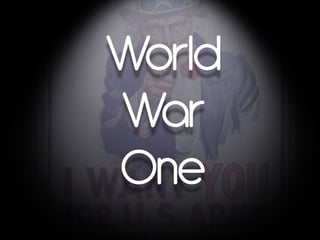
World War One One One
WWI Propaganda WWI use of Images for Propaganda Use of newspapers in WWI Morse code in WWI Posters and handouts
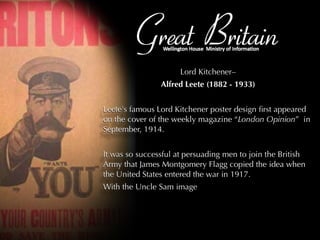
Great Britain Lord Kitchener–  Alfred Leete (1882 - 1933) Leete's famous Lord Kitchener poster design first appeared on the cover of the weekly magazine “ London Opinion ”  in September, 1914. It was so successful at persuading men to join the British Army that James Montgomery Flagg copied the idea when the United States entered the war in 1917. With the Uncle Sam image
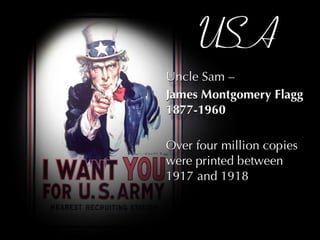
USA Uncle Sam –  James Montgomery Flagg 1877-1960  Over four million copies were printed between 1917 and 1918
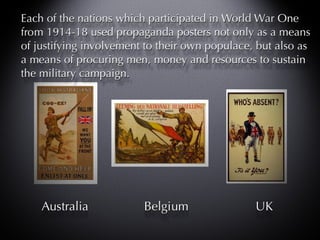
Each of the nations which participated in World War One from 1914-18 used propaganda posters not only as a means of justifying involvement to their own populace, but also as a means of procuring men, money and resources to sustain the military campaign. Australia Belgium UK
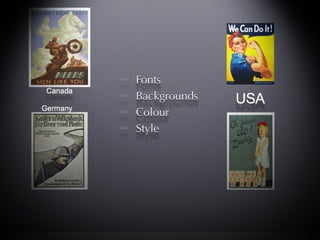
Fonts Backgrounds Colour Style USA Canada Germany
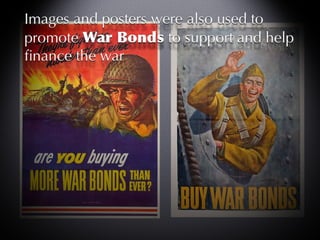
Images and posters were also used to promote  War Bonds  to support and help finance the war
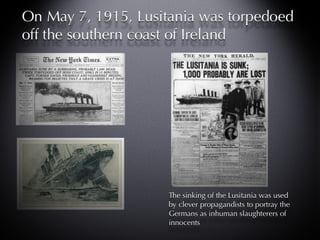
On May 7, 1915, Lusitania was torpedoed off the southern coast of Ireland The sinking of the Lusitania was used by clever propagandists to portray the Germans as inhuman slaughterers of innocents
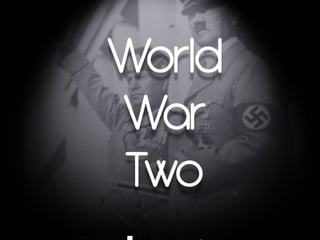
World War Two Two Two
World War II Addressed to people’s  emotions .  Newspapers and films were frequently used: however posters achieved a renaissance due to the fact that they could be put up anywhere.  This is known as the Visual culture. Another way to have an influence on people was radio. It was used for speeches such as Churchill’s ones, often in deep and direct voice and or voiced by celebrities of the time. Also appeared in the Hollywood industry and in children's cartoons.
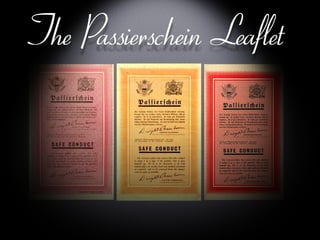
The Passierschein Leaflet
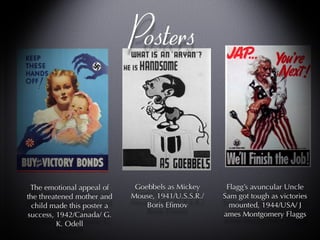
Posters Flagg’s avuncular Uncle Sam got tough as victories mounted, 1944/USA/ J ames Montgomery Flaggs Flagg’s avuncular Uncle Sam got tough as victories mounted, 1944/USA/ J ames Montgomery Flaggs Goebbels as Mickey Mouse, 1941/U.S.S.R./ Boris Efimov  The emotional appeal of the threatened mother and child made this poster a success, 1942/Canada/ G. K. Odell
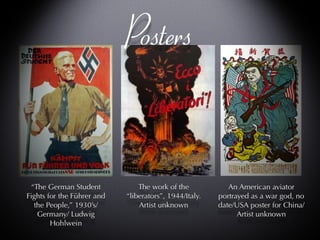
Posters An American aviator portrayed as a war god, no date/USA poster for China/ Artist unknown An American aviator portrayed as a war god, no date/USA poster for China/ Artist unknown The work of the “liberators”, 1944/Italy. Artist unknown “ The German Student Fights for the Führer and the People,” 1930’s/Germany/ Ludwig Hohlwein
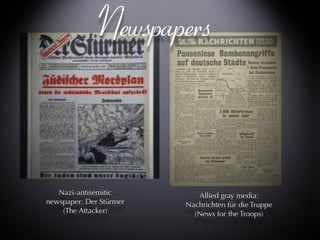
Newspapers Allied gray media: Nachrichten für die Truppe (News for the Troops) Nazi-antisemitic newspaper: Der Stürmer (The Attacker)
Radio RADIO PROGRAMS Mail Call! A letter from home Words at War Axis Sally RADIO STATIONS Radio Stuttgart Radio station Soldatensender West  Switzerland‘s National AM Radio Station Beromünster
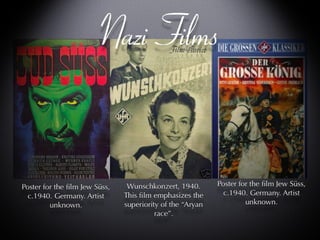
Nazi Films Poster for the film Jew Süss, c.1940. Germany. Artist unknown. Poster for the film Jew Süss, c.1940. Germany. Artist unknown. Wunschkonzert, 1940.  This film emphasizes the superiority of the “Aryan race”.  Poster for the film Jew Süss, c.1940. Germany. Artist unknown.
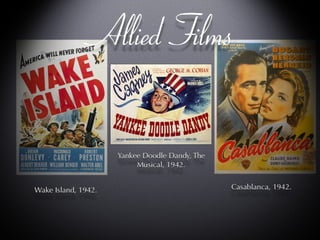
Allied Films Casablanca, 1942. Casablanca, 1942. Yankee Doodle Dandy, The Musical, 1942. Wake Island, 1942.
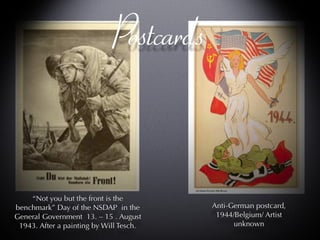
Postcards Anti-German postcard, 1944/Belgium/ Artist unknown “ Not you but the front is the benchmark” Day of the NSDAP  in the General Government  13. – 15 . August 1943. After a painting by Will Tesch.
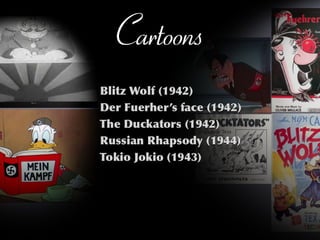
Cartoons
Vietnam War War
Vietnam War - Counter Propaganda 1955-1975 Print and Radio still accessible and  popular mediums Advent of mass television culture: the first ‘television’ war
Television and Photo-journalism Advent of unintentional propaganda: use of photographs and video footage captured by journalists for general media reporting purposes that have a natural emotional appeal note the change in the focus of the emotional content as the war progressed Movement away from hand-drawn images, sloganism and constructed posters towards simplistic live-action stills: evolution of the medium into digital form Using realism to appeal to the masses: defined break from the fantastical and whimsical images popular in WWI and WWII propaganda
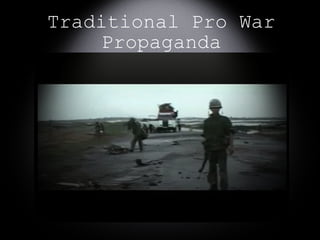
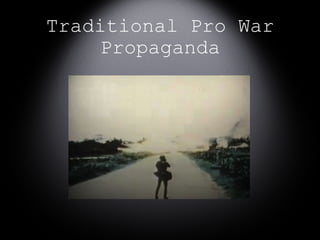
Traditional Pro War Propaganda
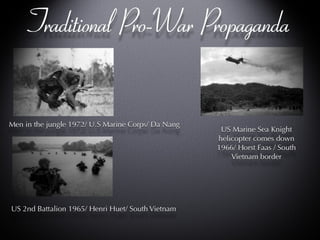
Traditional Pro-War Propaganda US Marine Sea Knight helicopter comes down 1966/ Horst Faas / South Vietnam border Men in the jungle 1972/ U.S Marine Corps/ Da Nang US 2nd Battalion 1965/ Henri Huet/ South Vietnam
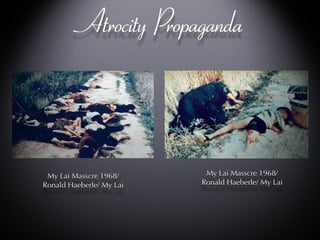
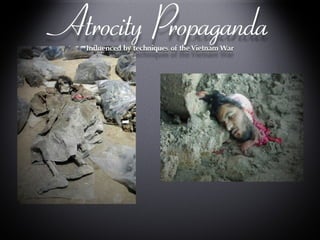
Atrocity Propaganda My Lai Masscre 1968/ Ronald Haeberle/ My Lai My Lai Masscre 1968/ Ronald Haeberle/ My Lai
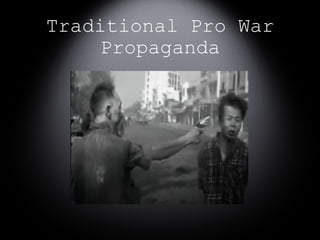
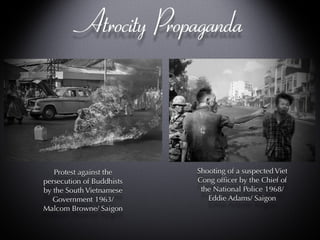
Atrocity Propaganda Shooting of a suspected Viet Cong officer by the Chief of the National Police 1968/ Eddie Adams/ Saigon Protest against the persecution of Buddhists by the South Vietnamese Government 1963/ Malcom Browne/ Saigon
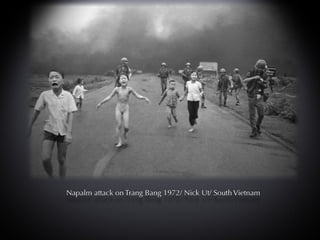
Napalm attack on Trang Bang 1972/ Nick Ut/ South Vietnam
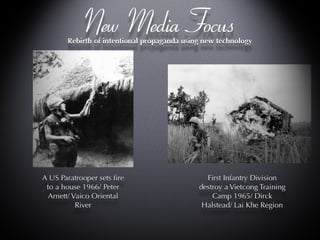
New Media Focus First Infantry Division destroy a Vietcong Training Camp 1965/ Dirck Halstead/ Lai Khe Region A US Paratrooper sets fire to a house 1966/ Peter Arnett/ Vaico Oriental River Rebirth of intentional propaganda using new technology
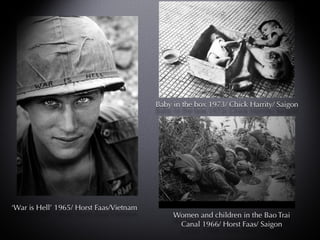
‘ War is Hell’ 1965/ Horst Faas/Vietnam Women and children in the Bao Trai Canal 1966/ Horst Faas/ Saigon
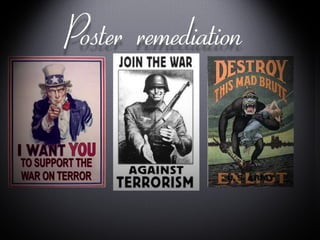
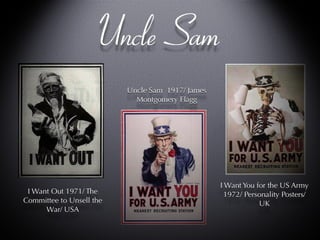
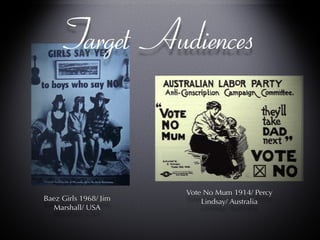
Posters Huge focus on the remediation of WWI and WWII poster content Images Fonts Colour schemes Layouts Awareness of target audiences: what is going to appeal to the viewer
Uncle Sam I Want You for the US Army 1972/ Personality Posters/ UK I Want You for the US Army 1972/ Personality Posters/ UK I Want Out 1971/ The Committee to Unsell the War/ USA Uncle Sam  1917/ James Montgomery Flagg
Target Audiences Vote No Mum 1914/ Percy Lindsay/ Australia Vote No Mum 1914/ Percy Lindsay/ Australia Baez Girls 1968/ Jim Marshall/ USA
War On Terror Terror Terror
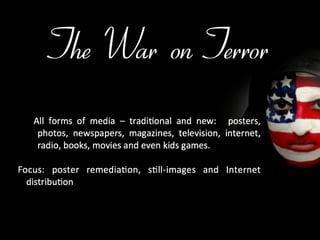
The War on Terror All forms of media – traditional and new:  posters, photos, newspapers, magazines, television, internet, radio, books, movies and even kids games. Focus: poster remediation, still-images and Internet distribution
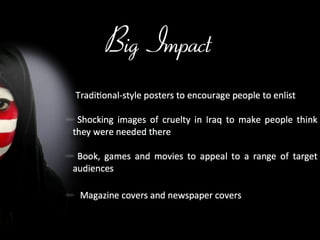
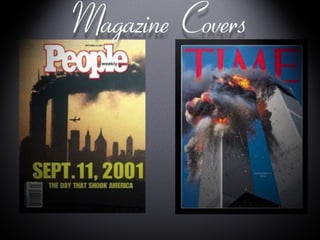
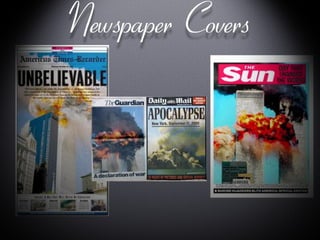
Big Impact Traditional-style posters to encourage people to enlist Shocking images of cruelty in Iraq to make people think they were needed there Book, games and movies to appeal to a range of target audiences  Magazine covers and newspaper covers
Poster remediation
Games, Books and Films
Atrocity Propaganda Influenced by techniques of the Vietnam War Influenced by techniques of the Vietnam War
Magazine Covers
Newspaper Covers
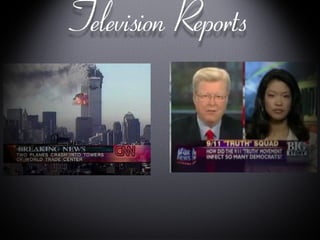
Television Reports
The Hungarian Revolution Revolution Revolution
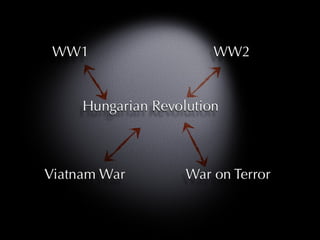
WW2 WW1 Viatnam War War on Terror
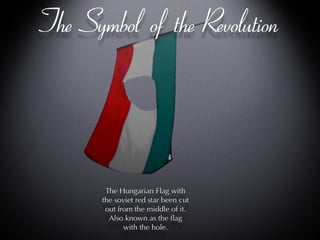
The Symbol of the Revolution The Hungarian Flag with the soviet red star been cut out from the middle of it. Also known as the flag with the hole.
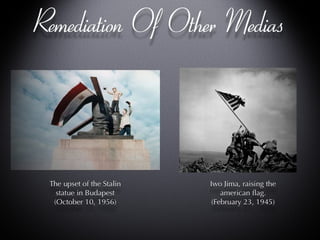
Remediation Of Other Medias The upset of the Stalin statue in Budapest (October 10, 1956) Iwo Jima, raising the american flag.  (February 23, 1945)
Abhor, T. 2010. Eleven Years After WTO: The Impact of Uprisings. Dialogic [Online]. 5 December. Available from:   http://dialogic.blogspot.co m / [Accessed 5 December 2010].  American Movie Classics Company 2010. War and Anti-War Films [Online].  Available from:  http://www.filmsite.org/warfilms2.html  [Accessed 26 November 2010].  Associated Press 2005. Vietnam war picture that touched a nation can still surprise. Sydney Morning Herald [Online]. 23 May. Available from:  http://www.smh.com.au/articles/2005/05/22/1116700595259.html?oneclick=true  [Accessed 23 November 2010]. BBC 2010. BBC World Wars In-Depth: Audio [Online]. Available from:  http://www.bbc.co.uk/history/worldwars/wwtwo/churchill_audio_01.shtml  [Accessed 26 November 2010].  Brainard, J 2008. Nazi Propaganda: a multimedia exhibit [Online]. Available from:  http://www.historywiz.org/nazi-mm-news.htm   [Accessed 26 November 2010]. CrimethInc. Workers' Collective 2010. Fighting in a New Terrain: What’s Changed Since the 20th Century [Online]. Available from:  http://crimethinc.com/texts/recentfeatures/terrain.php  [Accessed 1 December 2010].  Cunningham, S.B. 2002. The Idea of Propaganda: A Reconstruction. Westport:Praeger Publishers. Deutsche Welle 2007. German Expert on Nazi Film and Propaganda [Online]. Available from:  http://www.dw-world.de/dw/article/0,,2728383,00.html   [Accessed 26 November 2010]. D’Silva, R. 2010. Examples of Propaganda Techniques [Online]. Available from:  http://www.buzzle.com/articles/examples-of-propaganda-techniques.html   [Accessed 20 November 2010].  Duffy, M. 2009. Propaganda Posters: An Introduction [Online]. Available from:  http://www.firstworldwar.com/posters/index.htm  [Accessed 29 November 2010].  Jelsoft Enterprises 2010. The YBBS [Online]. Available from:  http://yourbbsucks.com/forum/index.php  [Accessed 4 December 2010].  Lerner, D. 1980. Paper bullets : great propaganda posters in full color, Axis & Allied countries World War II. New York, London: Chelsea House Publishers.  Lilian. 2010. The Vietnam War: 35 Years Later. Picspam [Online]. 22 May. Available from:  http://community.livejournal.com/ontd_political/6254930.html  [Accessed 23 November 2010]. Love, K. 2010. Five Things I Remember About 9-11. Kara’s Blog [Online]. 10 September. Available from:  http://kara.andrewandkara.com / [Accessed 1 December 2010].  Oak, M. 2010. Types of Propaganda Techniques [Online]. Available from:  http://www.buzzle.com/articles/types-of-propaganda-techniques.html  [Accessed 20 November 2010].  Old Time Radio Catalogue 2010. Mail Call: 45 Episodes [Online]. Available from:  http://www.otrcat.com/mail-call-p-1572.html  [Accessed 26 November 2010].  O'Shaughnessy, N.J. 2004. Politics and Propaganda: Weapons of Mass Seduction. Manchester: Manchester University Press.  Shah, A. 2003. Media, Propaganda and Vietnam [Online]. Available from:  http://www.globalissues.org/article/402/media-propaganda-and-vietnam  [Accessed 23 November 2010].  Simkin, J. 2010. Imperial War Museum [Online]. Available:  http://www.spartacus.schoolnet.co.uk /  [Accessed 29 November 2010].  Soules, M. 2007. Propaganda At War: Mass Media, Propaganda and Censorship [Online]. Available from:  http://www.media-studies.ca/articles/war_propaganda.htm  [Accessed 20 November 2010].  Taylor, P.M. 2003. Munitions of the Mind: a history of propaganda from the ancient world to the present day. Manchester: Manchester University Press.  Welch, D. 2010. BBC World Wars In-Depth: Nazi Propaganda [Online]. Available from:  http://www.bbc.co.uk/history/worldwars/wwtwo/nazi_propaganda_gallery.shtml   [Accessed  26 November 2010]. Sources

Multimeda studies (new)

  • 1.
    War Propaganda: A Visual Medium Alan Leonard Beatriz Lopez Beth Laurenson Karen Hughes Gábor László-Fülöp
  • 2.
    Propaganda as avisual medium: what it is and the techniques involved Origins of war propaganda: from 7000 BC to 1990 AD Creative and Technological Evolution, Continuity and Remediation in the 20th Century World War I World War II Vietnam War The War on Terror: 2001 and beyond Hungarian Revolution Comparison The Plan
  • 3.
    What is Propaganda?Propaganda is neutrally defined as a systematic form of purposeful persuasion that attempts to influence the emotions, attitudes, opinions, and actions of specified target audiences for ideological, political or commercial purposes through the controlled transmission of one-sided messages (which may or may not be factual) via mass and direct media channels.“ (Nelson 1996) sent across in many and all types of media: radio, television, leaflets, posters, hoardings, books, film, government reports, news broadcasts and historical revision of any of the above
  • 4.
    The Five TechniquesBandwagon: using numbers/popularity to gain support Testimonial: using the support of a high profile figure to gain support of others Transfer: linking the idea being sold to a person to give the argument momentum (ie. linking 'red terror' and the figure of Ho Chi Mihn in the West to give the idea of ‘red terror’ support) Repetition: simply repeating a name/word/argument to gain support, to make it stick in the mind Emotional Words: using words /images/colours to evoke a specific feeling that will gain support for an argument
  • 5.
    The Origins TheAncient World: Rome and Greece The Middle Ages: The Crusades and the 100 Years War The Renaissance: The Reformation and the 30 Years War The Age of Revolutions: American, French and Napoleonic The Age of Total War: 20th Century Warfare
  • 6.
  • 7.
    WWI Propaganda WWIuse of Images for Propaganda Use of newspapers in WWI Morse code in WWI Posters and handouts
  • 8.
    Great Britain LordKitchener– Alfred Leete (1882 - 1933) Leete's famous Lord Kitchener poster design first appeared on the cover of the weekly magazine “ London Opinion ” in September, 1914. It was so successful at persuading men to join the British Army that James Montgomery Flagg copied the idea when the United States entered the war in 1917. With the Uncle Sam image
  • 9.
    USA Uncle Sam– James Montgomery Flagg 1877-1960 Over four million copies were printed between 1917 and 1918
  • 10.
    Each of thenations which participated in World War One from 1914-18 used propaganda posters not only as a means of justifying involvement to their own populace, but also as a means of procuring men, money and resources to sustain the military campaign. Australia Belgium UK
  • 11.
    Fonts Backgrounds ColourStyle USA Canada Germany
  • 12.
    Images and posterswere also used to promote War Bonds to support and help finance the war
  • 13.
    On May 7,1915, Lusitania was torpedoed off the southern coast of Ireland The sinking of the Lusitania was used by clever propagandists to portray the Germans as inhuman slaughterers of innocents
  • 14.
  • 15.
    World War IIAddressed to people’s emotions . Newspapers and films were frequently used: however posters achieved a renaissance due to the fact that they could be put up anywhere. This is known as the Visual culture. Another way to have an influence on people was radio. It was used for speeches such as Churchill’s ones, often in deep and direct voice and or voiced by celebrities of the time. Also appeared in the Hollywood industry and in children's cartoons.
  • 16.
  • 17.
    Posters Flagg’s avuncularUncle Sam got tough as victories mounted, 1944/USA/ J ames Montgomery Flaggs Flagg’s avuncular Uncle Sam got tough as victories mounted, 1944/USA/ J ames Montgomery Flaggs Goebbels as Mickey Mouse, 1941/U.S.S.R./ Boris Efimov The emotional appeal of the threatened mother and child made this poster a success, 1942/Canada/ G. K. Odell
  • 18.
    Posters An Americanaviator portrayed as a war god, no date/USA poster for China/ Artist unknown An American aviator portrayed as a war god, no date/USA poster for China/ Artist unknown The work of the “liberators”, 1944/Italy. Artist unknown “ The German Student Fights for the Führer and the People,” 1930’s/Germany/ Ludwig Hohlwein
  • 19.
    Newspapers Allied graymedia: Nachrichten für die Truppe (News for the Troops) Nazi-antisemitic newspaper: Der Stürmer (The Attacker)
  • 20.
    Radio RADIO PROGRAMSMail Call! A letter from home Words at War Axis Sally RADIO STATIONS Radio Stuttgart Radio station Soldatensender West Switzerland‘s National AM Radio Station Beromünster
  • 21.
    Nazi Films Posterfor the film Jew Süss, c.1940. Germany. Artist unknown. Poster for the film Jew Süss, c.1940. Germany. Artist unknown. Wunschkonzert, 1940. This film emphasizes the superiority of the “Aryan race”. Poster for the film Jew Süss, c.1940. Germany. Artist unknown.
  • 22.
    Allied Films Casablanca,1942. Casablanca, 1942. Yankee Doodle Dandy, The Musical, 1942. Wake Island, 1942.
  • 23.
    Postcards Anti-German postcard,1944/Belgium/ Artist unknown “ Not you but the front is the benchmark” Day of the NSDAP in the General Government 13. – 15 . August 1943. After a painting by Will Tesch.
  • 24.
  • 25.
  • 26.
    Vietnam War -Counter Propaganda 1955-1975 Print and Radio still accessible and popular mediums Advent of mass television culture: the first ‘television’ war
  • 27.
    Television and Photo-journalismAdvent of unintentional propaganda: use of photographs and video footage captured by journalists for general media reporting purposes that have a natural emotional appeal note the change in the focus of the emotional content as the war progressed Movement away from hand-drawn images, sloganism and constructed posters towards simplistic live-action stills: evolution of the medium into digital form Using realism to appeal to the masses: defined break from the fantastical and whimsical images popular in WWI and WWII propaganda
  • 28.
  • 29.
  • 30.
  • 31.
    Traditional Pro-War PropagandaUS Marine Sea Knight helicopter comes down 1966/ Horst Faas / South Vietnam border Men in the jungle 1972/ U.S Marine Corps/ Da Nang US 2nd Battalion 1965/ Henri Huet/ South Vietnam
  • 32.
    Atrocity Propaganda MyLai Masscre 1968/ Ronald Haeberle/ My Lai My Lai Masscre 1968/ Ronald Haeberle/ My Lai
  • 33.
    Atrocity Propaganda Shootingof a suspected Viet Cong officer by the Chief of the National Police 1968/ Eddie Adams/ Saigon Protest against the persecution of Buddhists by the South Vietnamese Government 1963/ Malcom Browne/ Saigon
  • 34.
    Napalm attack onTrang Bang 1972/ Nick Ut/ South Vietnam
  • 35.
    New Media FocusFirst Infantry Division destroy a Vietcong Training Camp 1965/ Dirck Halstead/ Lai Khe Region A US Paratrooper sets fire to a house 1966/ Peter Arnett/ Vaico Oriental River Rebirth of intentional propaganda using new technology
  • 36.
    ‘ War isHell’ 1965/ Horst Faas/Vietnam Women and children in the Bao Trai Canal 1966/ Horst Faas/ Saigon
  • 37.
    Posters Huge focuson the remediation of WWI and WWII poster content Images Fonts Colour schemes Layouts Awareness of target audiences: what is going to appeal to the viewer
  • 38.
    Uncle Sam IWant You for the US Army 1972/ Personality Posters/ UK I Want You for the US Army 1972/ Personality Posters/ UK I Want Out 1971/ The Committee to Unsell the War/ USA Uncle Sam 1917/ James Montgomery Flagg
  • 39.
    Target Audiences VoteNo Mum 1914/ Percy Lindsay/ Australia Vote No Mum 1914/ Percy Lindsay/ Australia Baez Girls 1968/ Jim Marshall/ USA
  • 40.
    War On TerrorTerror Terror
  • 41.
    The War onTerror All forms of media – traditional and new: posters, photos, newspapers, magazines, television, internet, radio, books, movies and even kids games. Focus: poster remediation, still-images and Internet distribution
  • 42.
    Big Impact Traditional-styleposters to encourage people to enlist Shocking images of cruelty in Iraq to make people think they were needed there Book, games and movies to appeal to a range of target audiences Magazine covers and newspaper covers
  • 43.
  • 44.
  • 45.
    Atrocity Propaganda Influencedby techniques of the Vietnam War Influenced by techniques of the Vietnam War
  • 46.
  • 47.
  • 48.
  • 49.
    The Hungarian RevolutionRevolution Revolution
  • 50.
    WW2 WW1 ViatnamWar War on Terror
  • 51.
    The Symbol ofthe Revolution The Hungarian Flag with the soviet red star been cut out from the middle of it. Also known as the flag with the hole.
  • 52.
    Remediation Of OtherMedias The upset of the Stalin statue in Budapest (October 10, 1956) Iwo Jima, raising the american flag. (February 23, 1945)
  • 53.
    Abhor, T. 2010.Eleven Years After WTO: The Impact of Uprisings. Dialogic [Online]. 5 December. Available from: http://dialogic.blogspot.co m / [Accessed 5 December 2010]. American Movie Classics Company 2010. War and Anti-War Films [Online]. Available from: http://www.filmsite.org/warfilms2.html [Accessed 26 November 2010]. Associated Press 2005. Vietnam war picture that touched a nation can still surprise. Sydney Morning Herald [Online]. 23 May. Available from: http://www.smh.com.au/articles/2005/05/22/1116700595259.html?oneclick=true [Accessed 23 November 2010]. BBC 2010. BBC World Wars In-Depth: Audio [Online]. Available from: http://www.bbc.co.uk/history/worldwars/wwtwo/churchill_audio_01.shtml [Accessed 26 November 2010]. Brainard, J 2008. Nazi Propaganda: a multimedia exhibit [Online]. Available from: http://www.historywiz.org/nazi-mm-news.htm [Accessed 26 November 2010]. CrimethInc. Workers' Collective 2010. Fighting in a New Terrain: What’s Changed Since the 20th Century [Online]. Available from: http://crimethinc.com/texts/recentfeatures/terrain.php [Accessed 1 December 2010]. Cunningham, S.B. 2002. The Idea of Propaganda: A Reconstruction. Westport:Praeger Publishers. Deutsche Welle 2007. German Expert on Nazi Film and Propaganda [Online]. Available from: http://www.dw-world.de/dw/article/0,,2728383,00.html [Accessed 26 November 2010]. D’Silva, R. 2010. Examples of Propaganda Techniques [Online]. Available from: http://www.buzzle.com/articles/examples-of-propaganda-techniques.html [Accessed 20 November 2010]. Duffy, M. 2009. Propaganda Posters: An Introduction [Online]. Available from: http://www.firstworldwar.com/posters/index.htm [Accessed 29 November 2010]. Jelsoft Enterprises 2010. The YBBS [Online]. Available from: http://yourbbsucks.com/forum/index.php [Accessed 4 December 2010]. Lerner, D. 1980. Paper bullets : great propaganda posters in full color, Axis & Allied countries World War II. New York, London: Chelsea House Publishers. Lilian. 2010. The Vietnam War: 35 Years Later. Picspam [Online]. 22 May. Available from: http://community.livejournal.com/ontd_political/6254930.html [Accessed 23 November 2010]. Love, K. 2010. Five Things I Remember About 9-11. Kara’s Blog [Online]. 10 September. Available from: http://kara.andrewandkara.com / [Accessed 1 December 2010]. Oak, M. 2010. Types of Propaganda Techniques [Online]. Available from: http://www.buzzle.com/articles/types-of-propaganda-techniques.html [Accessed 20 November 2010]. Old Time Radio Catalogue 2010. Mail Call: 45 Episodes [Online]. Available from: http://www.otrcat.com/mail-call-p-1572.html [Accessed 26 November 2010]. O'Shaughnessy, N.J. 2004. Politics and Propaganda: Weapons of Mass Seduction. Manchester: Manchester University Press. Shah, A. 2003. Media, Propaganda and Vietnam [Online]. Available from: http://www.globalissues.org/article/402/media-propaganda-and-vietnam [Accessed 23 November 2010]. Simkin, J. 2010. Imperial War Museum [Online]. Available: http://www.spartacus.schoolnet.co.uk / [Accessed 29 November 2010]. Soules, M. 2007. Propaganda At War: Mass Media, Propaganda and Censorship [Online]. Available from: http://www.media-studies.ca/articles/war_propaganda.htm [Accessed 20 November 2010]. Taylor, P.M. 2003. Munitions of the Mind: a history of propaganda from the ancient world to the present day. Manchester: Manchester University Press. Welch, D. 2010. BBC World Wars In-Depth: Nazi Propaganda [Online]. Available from: http://www.bbc.co.uk/history/worldwars/wwtwo/nazi_propaganda_gallery.shtml [Accessed 26 November 2010]. Sources