Black Existentialism:
Frantz Fanon &
James Baldwin
HTH 1002 History of Though II
Kara Heitz
Black Existentialism
• Black existentialism
• Similar perspective as existentialists like Sartre
• But … focus not individual freedom but liberation
of all peoples of color
• Historical context:
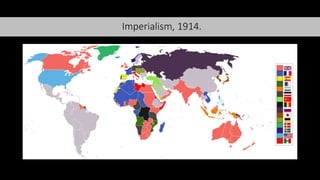
• Western colonialism & imperialism
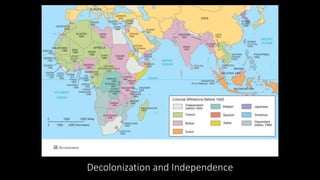
• Decolonization & independence struggles
• Civil Rights movement in US
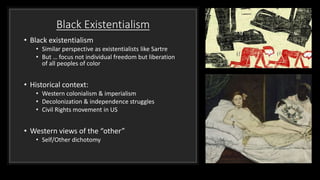
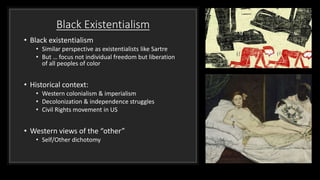
• Western views of the “other”
• Self/Other dichotomy
Imperialism, 1914.
Decolonization and Independence
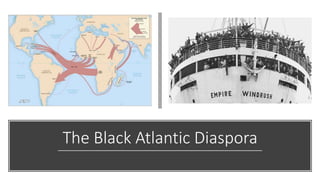
The Black Atlantic Diaspora
Black Existentialism
• Black existentialism
• Similar perspective as existentialists like Sartre
• But … focus not individual freedom but liberation
of all peoples of color
• Historical context:
• Western colonialism & imperialism
• Decolonization & independence struggles
• Civil Rights movement in US
• Western views of the “other”
• Self/Other dichotomy
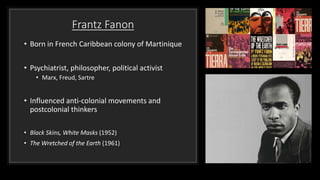
Frantz Fanon
• Born in French Caribbean colony of Martinique
• Psychiatrist, philosopher, political activist
• Marx, Freud, Sartre
• Influenced anti-colonial movements and
postcolonial thinkers
• Black Skins, White Masks (1952)
• The Wretched of the Earth (1961)
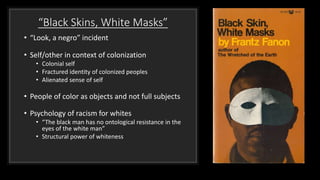
“Black Skins, White Masks”
• “Look, a negro” incident
• Self/other in context of colonization
• Colonial self
• Fractured identity of colonized peoples
• Alienated sense of self
• People of color as objects and not full subjects
• Psychology of racism for whites
• “The black man has no ontological resistance in the
eyes of the white man”
• Structural power of whiteness
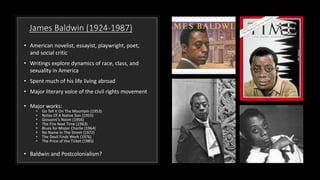
James Baldwin (1924-1987)
• American novelist, essayist, playwright, poet,
and social critic
• Writings explore dynamics of race, class, and
sexuality in America
• Spent much of his life living abroad
• Major literary voice of the civil rights movement
• Major works:
• Go Tell It On The Mountain (1953)
• Notes Of A Native Son (1955)
• Giovanni’s Room (1956)
• The Fire Next Time (1963)
• Blues for Mister Charlie (1964)
• No Name In The Street (1972)
• The Devil Finds Work (1976)
• The Price of the Ticket (1985)
• Baldwin and Postcolonialism?
“A Stranger in the Village”
• What are the villagers’ reactions to Baldwin as a black man?
Why do they react this way?
• “… there is a great difference between being the first white
man to be seen by Africans and being the first black man to
be seen by whites”
• “… It is one of the ironies of black-white relations that, by
means of what the white man imagines the black man to be,
the black man is enabled to know who the white man is”
• How does Baldwin use his experiences in the small Swiss
village to reflect on race in America?

14. fanon & baldwin

  • 1.
    Black Existentialism: Frantz Fanon& James Baldwin HTH 1002 History of Though II Kara Heitz
  • 2.
    Black Existentialism • Blackexistentialism • Similar perspective as existentialists like Sartre • But … focus not individual freedom but liberation of all peoples of color • Historical context: • Western colonialism & imperialism • Decolonization & independence struggles • Civil Rights movement in US • Western views of the “other” • Self/Other dichotomy
  • 3.
  • 4.
  • 5.
  • 6.
    Black Existentialism • Blackexistentialism • Similar perspective as existentialists like Sartre • But … focus not individual freedom but liberation of all peoples of color • Historical context: • Western colonialism & imperialism • Decolonization & independence struggles • Civil Rights movement in US • Western views of the “other” • Self/Other dichotomy
  • 7.
    Frantz Fanon • Bornin French Caribbean colony of Martinique • Psychiatrist, philosopher, political activist • Marx, Freud, Sartre • Influenced anti-colonial movements and postcolonial thinkers • Black Skins, White Masks (1952) • The Wretched of the Earth (1961)
  • 8.
    “Black Skins, WhiteMasks” • “Look, a negro” incident • Self/other in context of colonization • Colonial self • Fractured identity of colonized peoples • Alienated sense of self • People of color as objects and not full subjects • Psychology of racism for whites • “The black man has no ontological resistance in the eyes of the white man” • Structural power of whiteness
  • 9.
    James Baldwin (1924-1987) •American novelist, essayist, playwright, poet, and social critic • Writings explore dynamics of race, class, and sexuality in America • Spent much of his life living abroad • Major literary voice of the civil rights movement • Major works: • Go Tell It On The Mountain (1953) • Notes Of A Native Son (1955) • Giovanni’s Room (1956) • The Fire Next Time (1963) • Blues for Mister Charlie (1964) • No Name In The Street (1972) • The Devil Finds Work (1976) • The Price of the Ticket (1985) • Baldwin and Postcolonialism?
  • 10.
    “A Stranger inthe Village” • What are the villagers’ reactions to Baldwin as a black man? Why do they react this way? • “… there is a great difference between being the first white man to be seen by Africans and being the first black man to be seen by whites” • “… It is one of the ironies of black-white relations that, by means of what the white man imagines the black man to be, the black man is enabled to know who the white man is” • How does Baldwin use his experiences in the small Swiss village to reflect on race in America?