A NEW KIND OF
WAR
WWI Continues
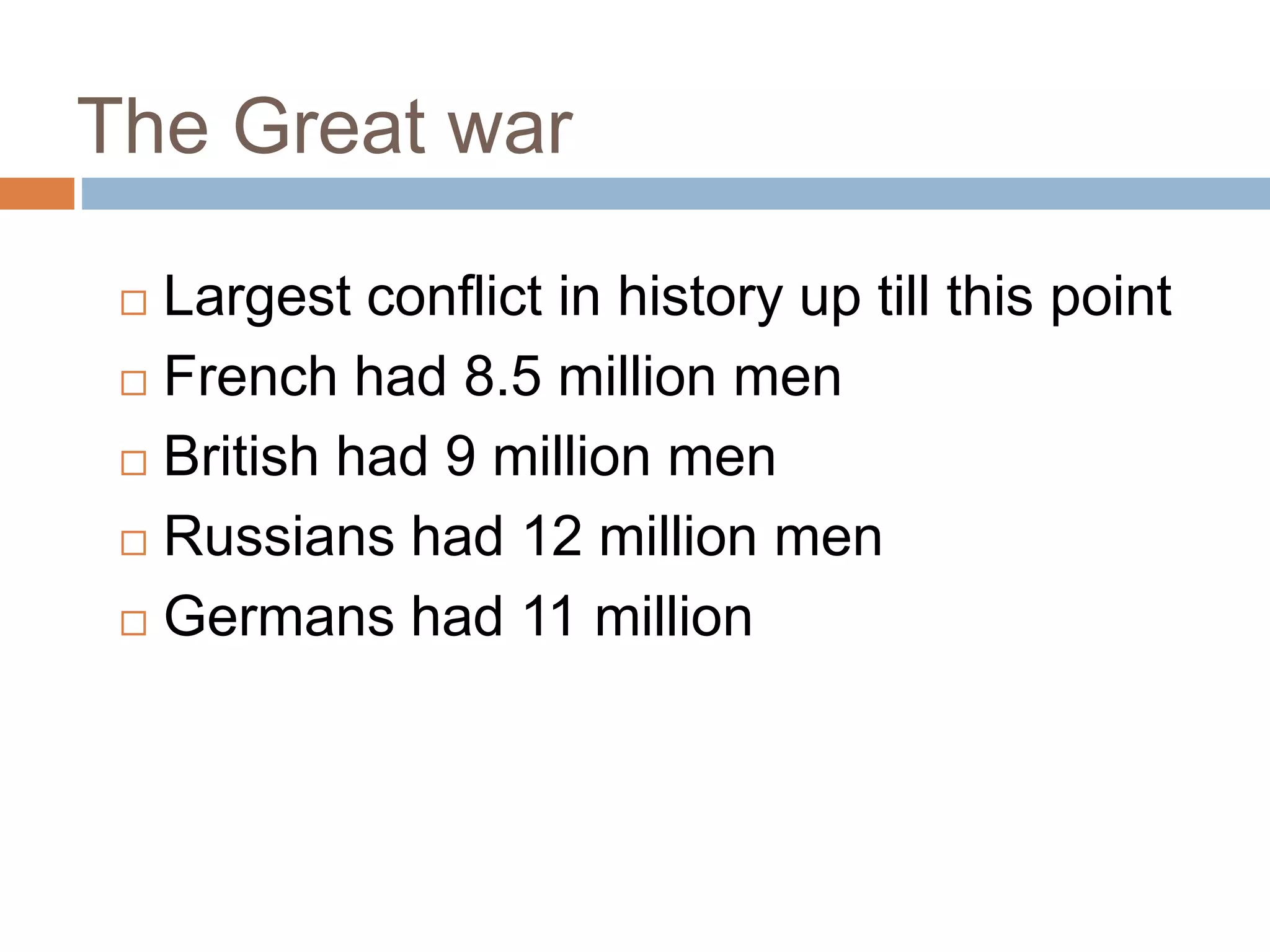
The Great war
 Largest conflict in history up till this point
 French had 8.5 million men
 British had 9 million men
 Russians had 12 million men
 Germans had 11 million
“One out of every four men
who went to war did not
come back again, and of
those who came back many
were maimed and blind and
some had gone insane.”
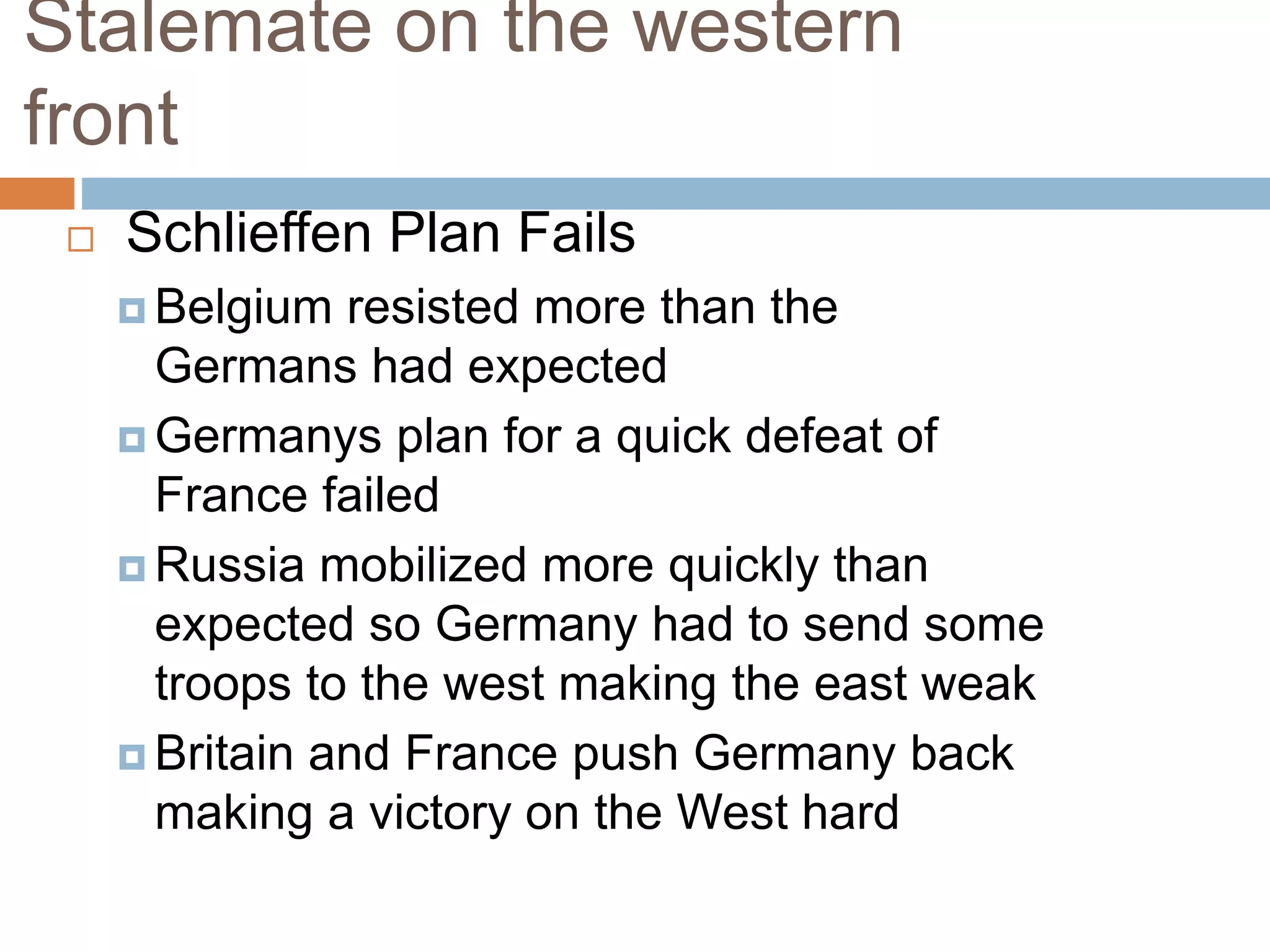
Stalemate on the western
front
 Schlieffen Plan Fails
 Belgium resisted more than the
Germans had expected
 Germanys plan for a quick defeat of
France failed
 Russia mobilized more quickly than
expected so Germany had to send some
troops to the west making the east weak
 Britain and France push Germany back
making a victory on the West hard
Technology of modern
warfare
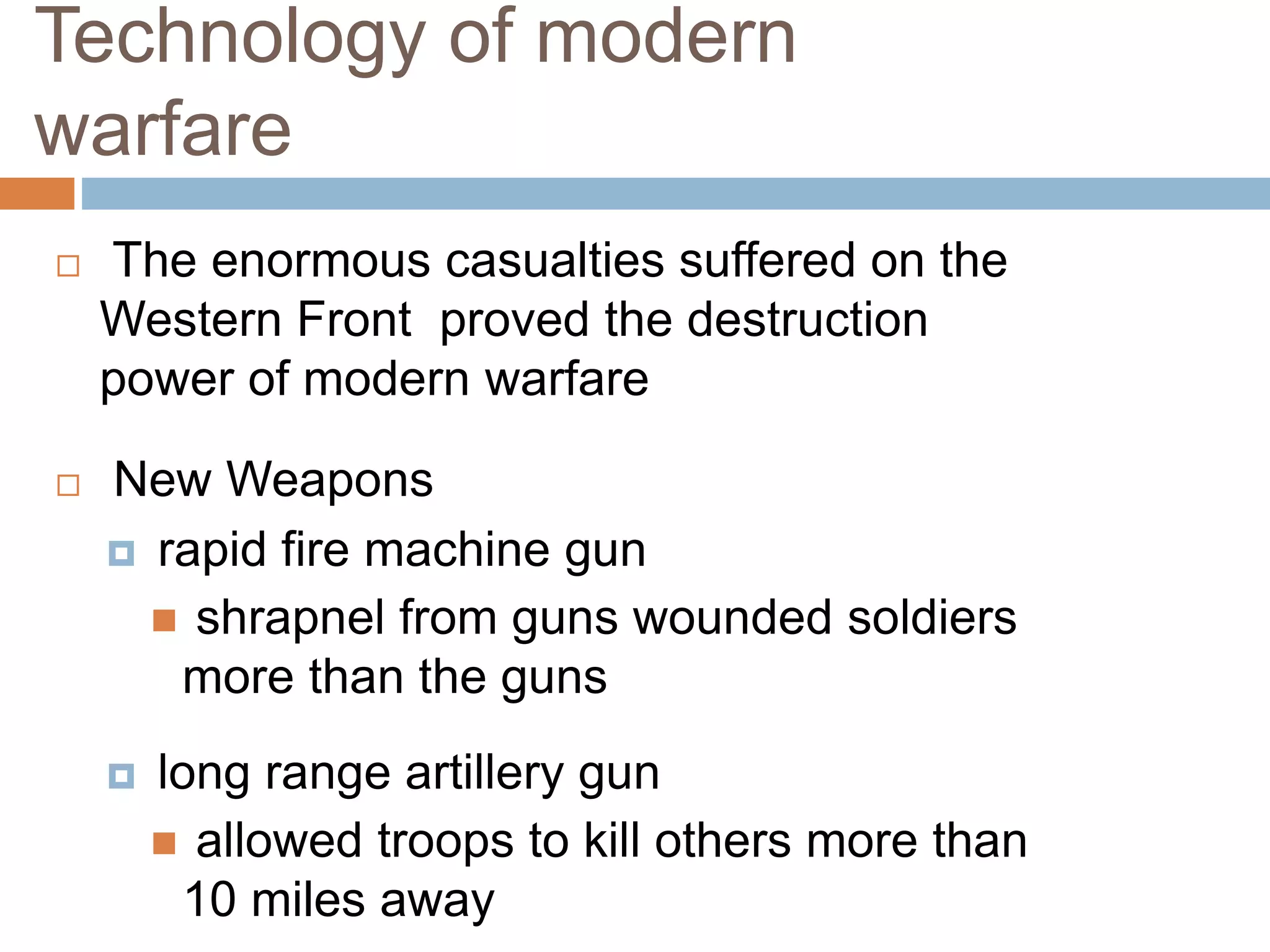
 The enormous casualties suffered on the
Western Front proved the destruction
power of modern warfare
 New Weapons
 rapid fire machine gun
 shrapnel from guns wounded soldiers
more than the guns
 long range artillery gun
 allowed troops to kill others more than
10 miles away
Technology of modern warfare
 Poison Gas
 uncertain weapon because shifting winds
could blow the gas back on the soldiers
 Aircraft, Tanks and Submarines
 1916 Britain introduced the first tank
 First planes were used to observe enemy
troop movements
 1915 Germany used zeppelins – large gas
filled balloons to bomb the English coast
Technology of modern
warfare
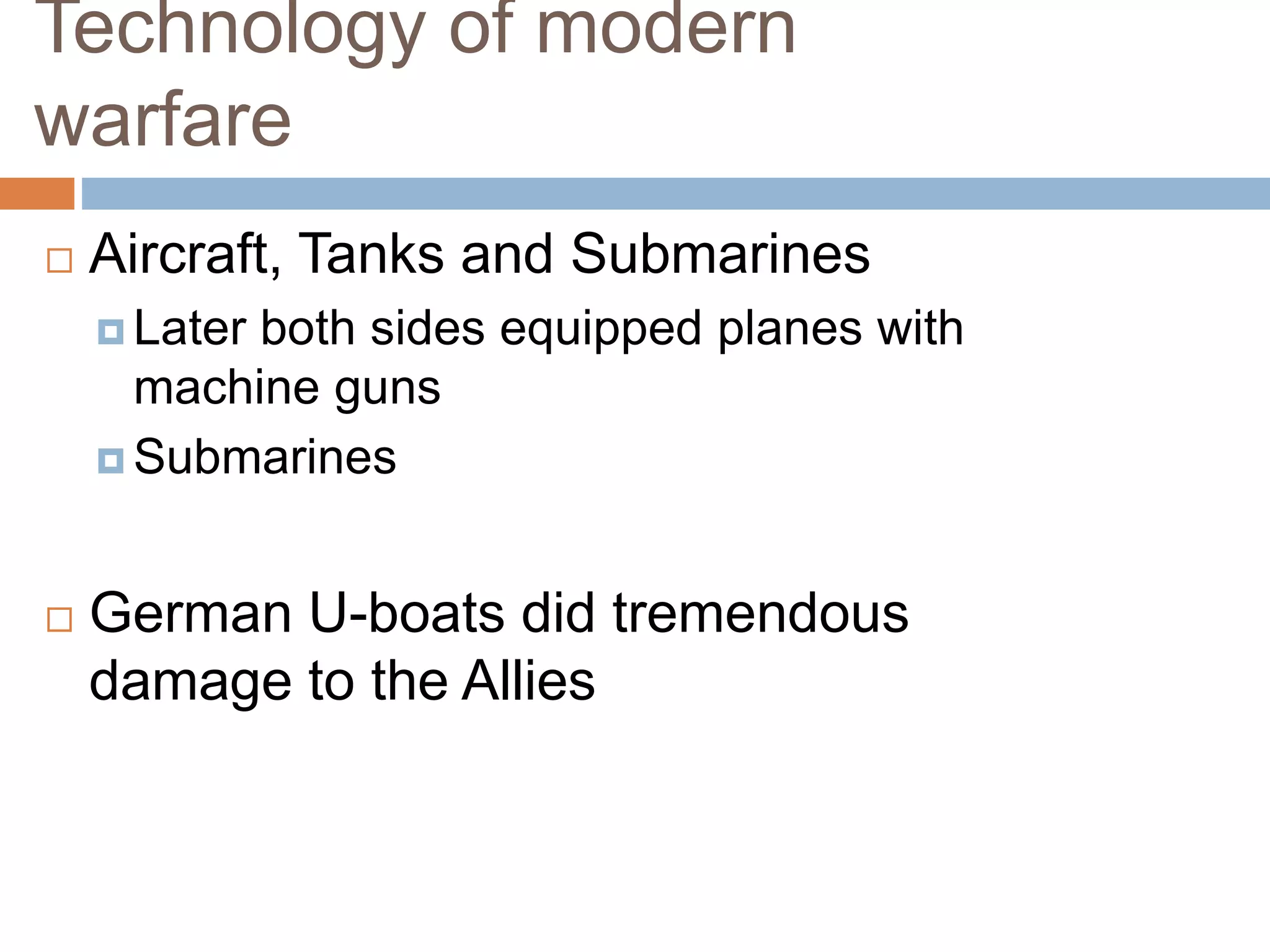
 Aircraft, Tanks and Submarines
 Later both sides equipped planes with
machine guns
 Submarines
 German U-boats did tremendous
damage to the Allies
Check for Understanding
What made World War I
much more deadly than
previous wars?
video
 Weapons used in WWI
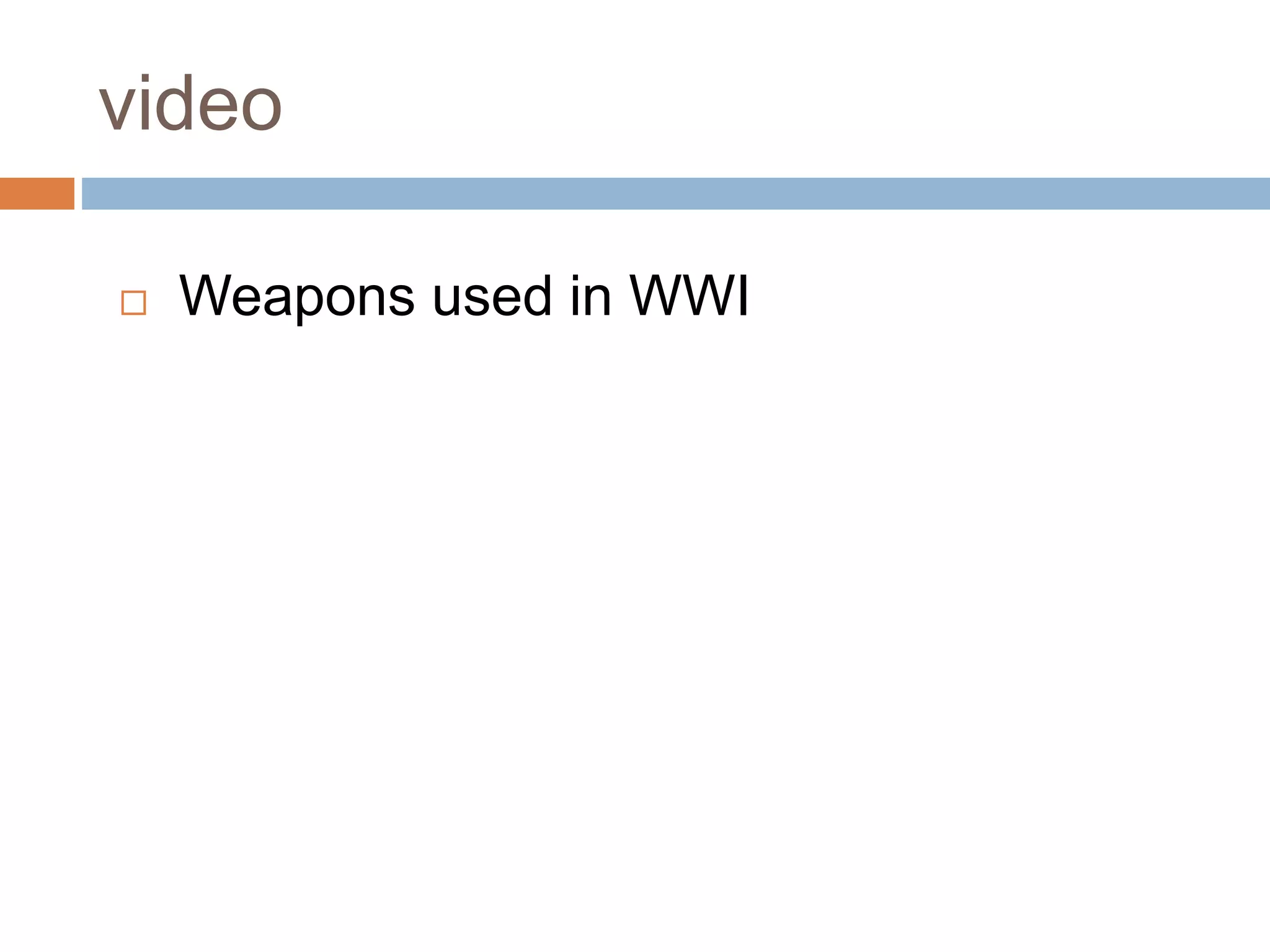
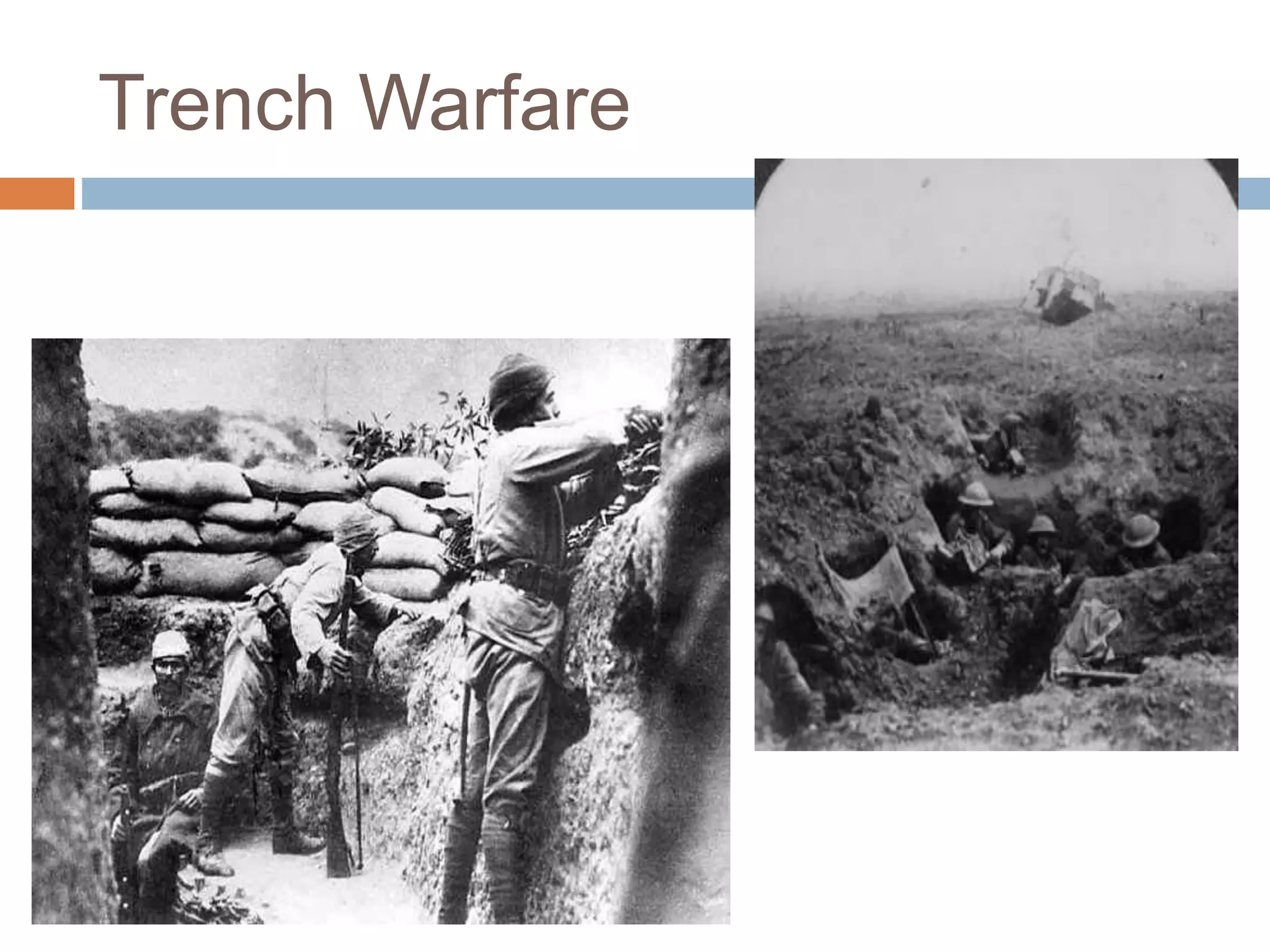
Trench warfare
 To protect themselves from gunfire each side dug
a series of trenches that extended for over 475
miles from Switzerland to the North Sea
 Between battles soldiers would live in the
trenches
 Water collected in them turning the soil into mud
 “Trenches were waist deep in mud and ice water
Trench Warfare
Trench Warfare
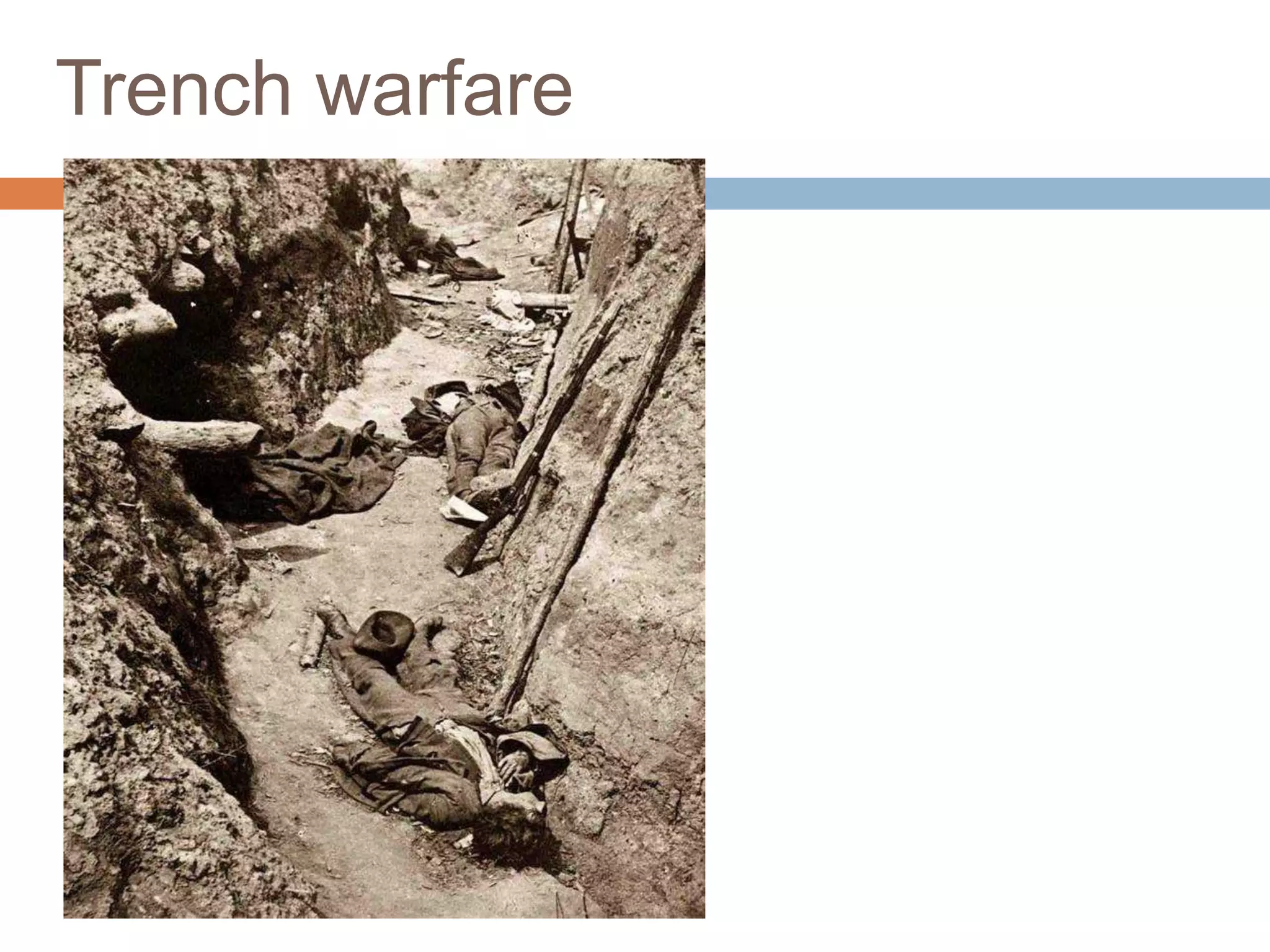
 Wet conditions encouraged diseases such
as trench foot which rotted away the foot’s
skin and usually led to amputation
 Rats invaded the trenches at night and
feasted on the dead bodies in the day
 The bottom of the trench was springy like a
mattress because of all the bodies
underneath
 At night when the stench was worse we tied
material around our mouths and noses
Trench warfare
video
 Trench Life in WWI
WEAPONS OF WAR
Total War and Propaganda Techniques
Today We Have…
 What Is Total War
 What Is Propaganda
 At the end you will answer:
 Is the Use of Propaganda Justified
During Wartime?
WWI = Total War
 By 1917 European societies were
falling apart under the strain of war
and it seemed to be dragging on with
no end in sight
 But the departure of one country and
the entry of another would soon
change the way things were going…
WWI = Total War
 Total War
 Waging a modern, mechanized war
meant channeling all of the nations
resources into the war
 Governments took stronger roles in
directing the economic and cultural
lives of people
WWI = Total War
 Economies Committed to War
Production
 Systems set up to recruit, arm,
transport and supply armies in the
millions
 Implemented conscription (the draft)
 Raised taxes and borrowed huge
amounts of money to pay the cost of
war
WWI – Total War
 Women Join In
 As men left to fight women took over
their jobs
 Worked in war industries,
manufacturing weapons and supplies,
became nurses
 War work gave women a new sense
of pride and confidence and
challenged the idea that women could
not handle the jobs men did
 Women support in the war effort
gained them their right to vote in 1920
WWI = Total War
 Total war also meant the use of
propaganda
 Spreading of ideas to promote a cause or
damage the opposing side
 Controlling public opinion
 Press was censored to keep casualty figures
and other discouraging news away from the
public
Objectives of Wartime Propaganda
 Recruitment of Soldiers (draft/volunteer)
 Financing the War Effort
 Eliminating dissent and Unifying the Country
 Conservation of Resources (food, oil, steel)
 Participation in home front organizations to
support the war effort
Wartime Propaganda
• Demonization
– Portraying the enemy as purely evil,
menacing, murderous, and aggressive.
– Propagandist attempts to remove all confusion
and ambiguity about whom the public should
hate
– Enemy may be portrayed as a hairy beast or
the devil himself
– More powerful when enemy can be blamed
for atrocities against women, children or other
innocents
Wartime Propaganda
• Name Calling
– Labels that encourage hatred of the enemy
that reinforce negative stereotypes and help
demonize the enemy
– Commies, Japs, Huns
Wartime Propaganda
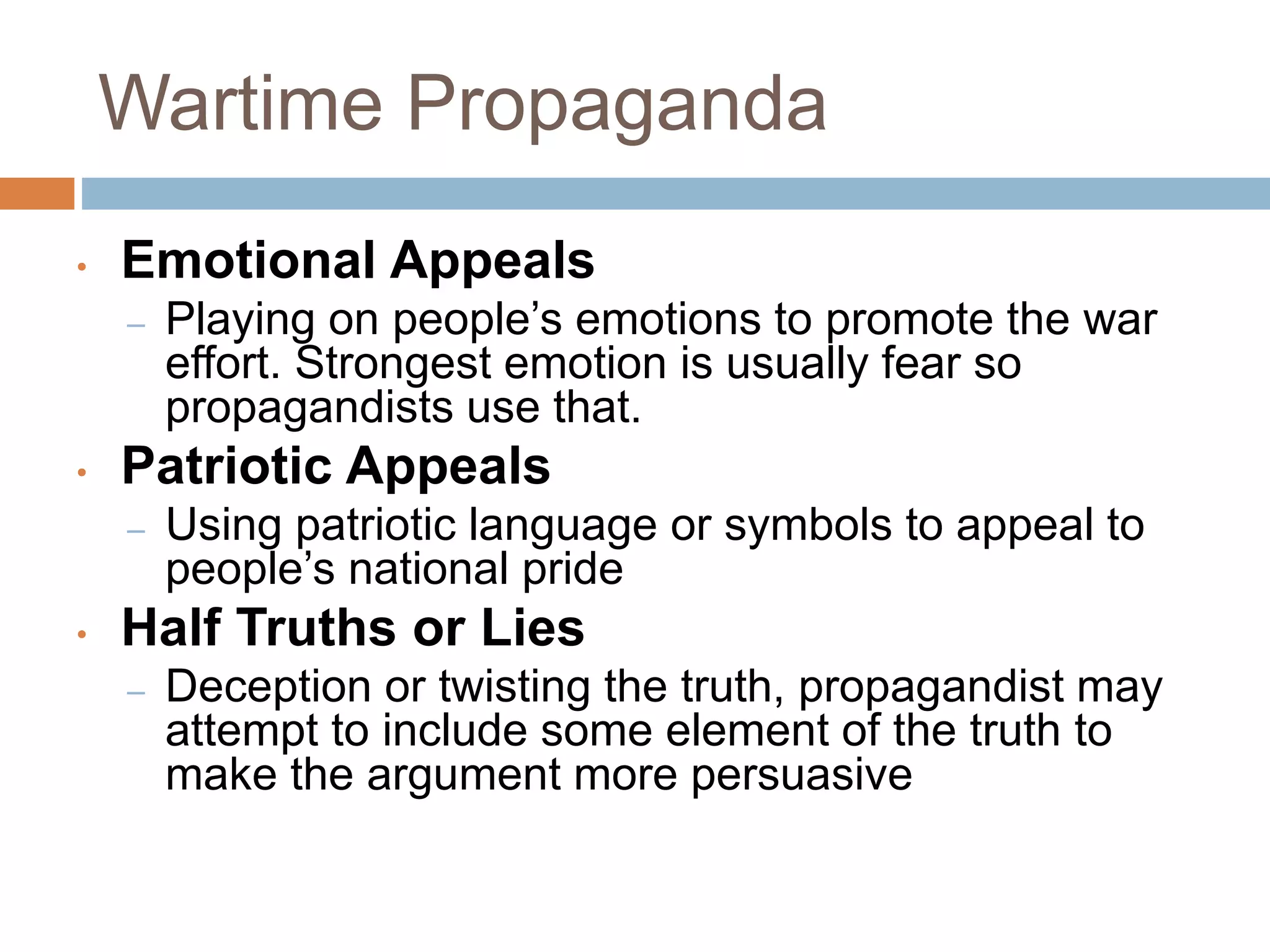
• Emotional Appeals
– Playing on people’s emotions to promote the war
effort. Strongest emotion is usually fear so
propagandists use that.
• Patriotic Appeals
– Using patriotic language or symbols to appeal to
people’s national pride
• Half Truths or Lies
– Deception or twisting the truth, propagandist may
attempt to include some element of the truth to
make the argument more persuasive
Wartime Propaganda
• Catchy Slogans
– Using memorable phrases to foster support for
war.
• Evocative Visual Symbols
– Using symbols that appeal to people’s emotions
– Flags, statues, mothers and children, enemy
uniforms
• Humor or Caricatures
– Capturing viewers attention through the use of
humor to promote the war effort
– Enemy is at the center of the joke
Looking at Propaganda
 Gallery Walk 
 With your group you will go
around the room looking at the
various propaganda posters
 Record the information in your
charts
 You will be at each poster for
about 10 minutes
 Be prepared to share your
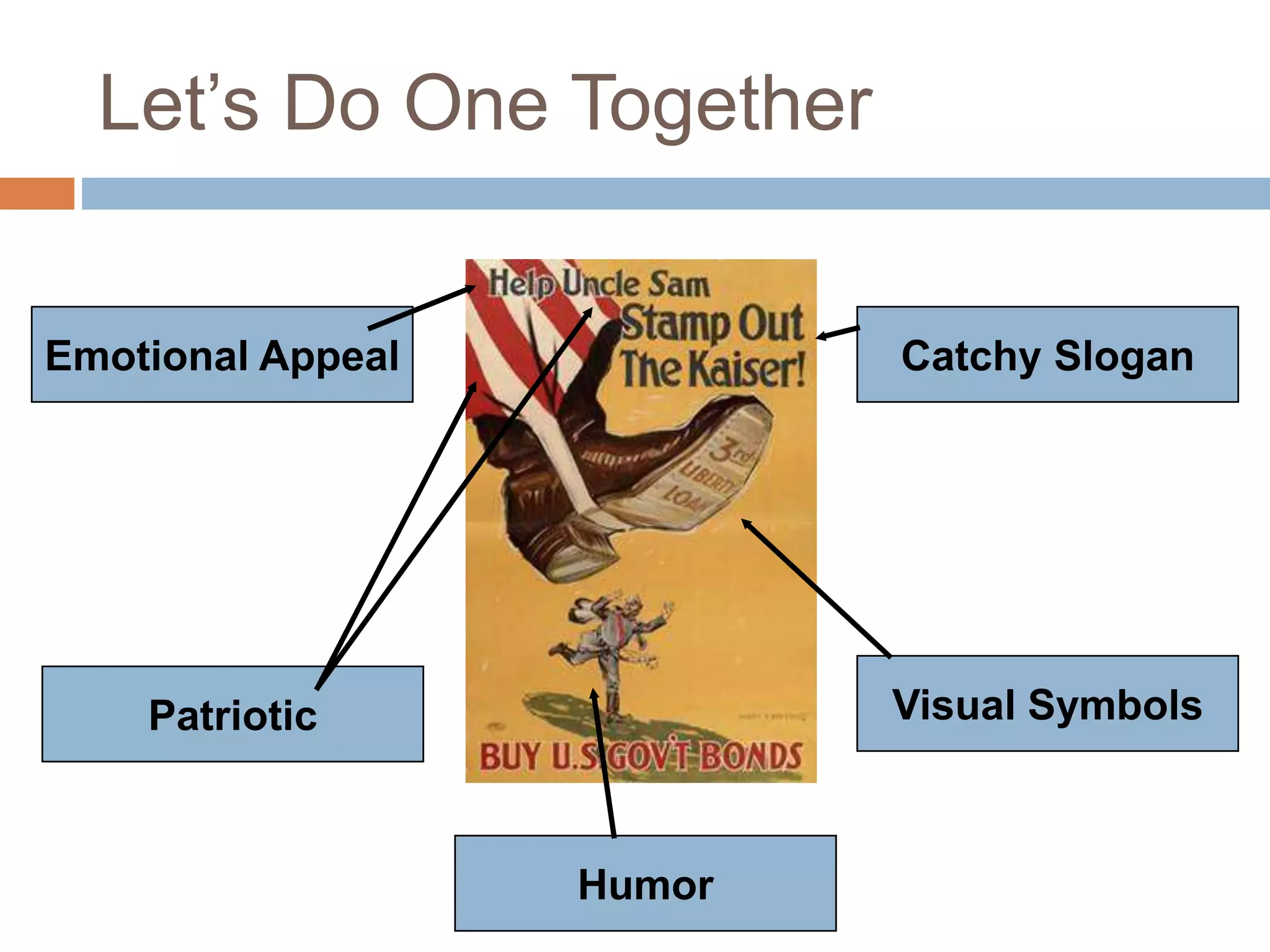
Let’s Do One Together
Emotional Appeal
Visual Symbols
Catchy Slogan
Patriotic
Humor

World History - Weapons of war

  • 1.
    A NEW KINDOF WAR WWI Continues
  • 2.
    The Great war Largest conflict in history up till this point  French had 8.5 million men  British had 9 million men  Russians had 12 million men  Germans had 11 million
  • 3.
    “One out ofevery four men who went to war did not come back again, and of those who came back many were maimed and blind and some had gone insane.”
  • 4.
    Stalemate on thewestern front  Schlieffen Plan Fails  Belgium resisted more than the Germans had expected  Germanys plan for a quick defeat of France failed  Russia mobilized more quickly than expected so Germany had to send some troops to the west making the east weak  Britain and France push Germany back making a victory on the West hard
  • 5.
    Technology of modern warfare The enormous casualties suffered on the Western Front proved the destruction power of modern warfare  New Weapons  rapid fire machine gun  shrapnel from guns wounded soldiers more than the guns  long range artillery gun  allowed troops to kill others more than 10 miles away
  • 6.
    Technology of modernwarfare  Poison Gas  uncertain weapon because shifting winds could blow the gas back on the soldiers  Aircraft, Tanks and Submarines  1916 Britain introduced the first tank  First planes were used to observe enemy troop movements  1915 Germany used zeppelins – large gas filled balloons to bomb the English coast
  • 7.
    Technology of modern warfare Aircraft, Tanks and Submarines  Later both sides equipped planes with machine guns  Submarines  German U-boats did tremendous damage to the Allies
  • 8.
    Check for Understanding Whatmade World War I much more deadly than previous wars?
  • 9.
  • 10.
    Trench warfare  Toprotect themselves from gunfire each side dug a series of trenches that extended for over 475 miles from Switzerland to the North Sea  Between battles soldiers would live in the trenches  Water collected in them turning the soil into mud  “Trenches were waist deep in mud and ice water
  • 11.
  • 12.
    Trench Warfare  Wetconditions encouraged diseases such as trench foot which rotted away the foot’s skin and usually led to amputation  Rats invaded the trenches at night and feasted on the dead bodies in the day  The bottom of the trench was springy like a mattress because of all the bodies underneath  At night when the stench was worse we tied material around our mouths and noses
  • 13.
  • 14.
  • 15.
    WEAPONS OF WAR TotalWar and Propaganda Techniques
  • 16.
    Today We Have… What Is Total War  What Is Propaganda  At the end you will answer:  Is the Use of Propaganda Justified During Wartime?
  • 17.
    WWI = TotalWar  By 1917 European societies were falling apart under the strain of war and it seemed to be dragging on with no end in sight  But the departure of one country and the entry of another would soon change the way things were going…
  • 18.
    WWI = TotalWar  Total War  Waging a modern, mechanized war meant channeling all of the nations resources into the war  Governments took stronger roles in directing the economic and cultural lives of people
  • 19.
    WWI = TotalWar  Economies Committed to War Production  Systems set up to recruit, arm, transport and supply armies in the millions  Implemented conscription (the draft)  Raised taxes and borrowed huge amounts of money to pay the cost of war
  • 20.
    WWI – TotalWar  Women Join In  As men left to fight women took over their jobs  Worked in war industries, manufacturing weapons and supplies, became nurses  War work gave women a new sense of pride and confidence and challenged the idea that women could not handle the jobs men did  Women support in the war effort gained them their right to vote in 1920
  • 21.
    WWI = TotalWar  Total war also meant the use of propaganda  Spreading of ideas to promote a cause or damage the opposing side  Controlling public opinion  Press was censored to keep casualty figures and other discouraging news away from the public
  • 22.
    Objectives of WartimePropaganda  Recruitment of Soldiers (draft/volunteer)  Financing the War Effort  Eliminating dissent and Unifying the Country  Conservation of Resources (food, oil, steel)  Participation in home front organizations to support the war effort
  • 23.
    Wartime Propaganda • Demonization –Portraying the enemy as purely evil, menacing, murderous, and aggressive. – Propagandist attempts to remove all confusion and ambiguity about whom the public should hate – Enemy may be portrayed as a hairy beast or the devil himself – More powerful when enemy can be blamed for atrocities against women, children or other innocents
  • 24.
    Wartime Propaganda • NameCalling – Labels that encourage hatred of the enemy that reinforce negative stereotypes and help demonize the enemy – Commies, Japs, Huns
  • 25.
    Wartime Propaganda • EmotionalAppeals – Playing on people’s emotions to promote the war effort. Strongest emotion is usually fear so propagandists use that. • Patriotic Appeals – Using patriotic language or symbols to appeal to people’s national pride • Half Truths or Lies – Deception or twisting the truth, propagandist may attempt to include some element of the truth to make the argument more persuasive
  • 26.
    Wartime Propaganda • CatchySlogans – Using memorable phrases to foster support for war. • Evocative Visual Symbols – Using symbols that appeal to people’s emotions – Flags, statues, mothers and children, enemy uniforms • Humor or Caricatures – Capturing viewers attention through the use of humor to promote the war effort – Enemy is at the center of the joke
  • 27.
    Looking at Propaganda Gallery Walk   With your group you will go around the room looking at the various propaganda posters  Record the information in your charts  You will be at each poster for about 10 minutes  Be prepared to share your
  • 28.
    Let’s Do OneTogether Emotional Appeal Visual Symbols Catchy Slogan Patriotic Humor