BORDER SECURITY USING WIRELESS
INTEGRATED NETWORK SENSONRS
SUBMITTED TO: RETHWAN FAIZ
SUBMITTED BY
1. PROGYA, PARMITA MAJUMDER.
ID: 15-28343-1
2. AVA, ARINTA FARZANA
ID: 15-28386-1
3. ROY, KARABI
ID:15-28432-1
4.MOSTAFA,MAHJABIN
ID:13-22907-1
5.SARKER ,ANINDYA
ID:13-23386-1
OVERVIEW
 WINS introduction.
 Evolution.
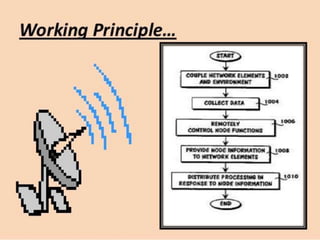
 Working principle.
 System Architecture.
 Node Architecture.
 Digital Signal Processing.
 Applications.
 Design Consideration & packaging
 Advantages & Disadvantages.
 Future Scope.
 Conclusion.
 Reference.
INTRODUCTION OF WINS
WINS:
Require a few microwatt of power to operate
so it is cheaper then the conventional radar
system.
It produce a less amount delay
to detect target and reasonably
faster.
EVOLUTION OF WINS
 WINS initiated in 1993
under defense advance
Research project agency
(DARPA) IN US.
 LWIM program began in1995.
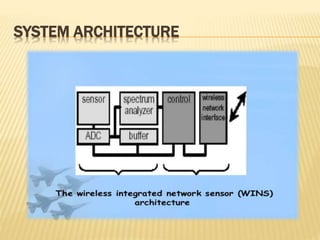
SYSTEM ARCHITECTURE
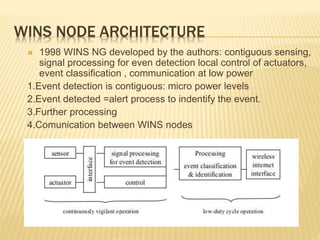
WINS NODE ARCHITECTURE
 1998 WINS NG developed by the authors: contiguous sensing,
signal processing for even detection local control of actuators,
event classification , communication at low power
1.Event detection is contiguous: micro power levels
2.Event detected =alert process to indentify the event.
3.Further processing
4.Comunication between WINS nodes
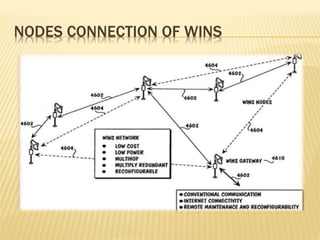
NODES CONNECTION OF WINS
DIGITAL SIGNAL PROCESSING
 If a stranger enters the borders , his foot-
steps will generate harmonic signals.
 If can be detector as a characteristics feature
in a signal power spectrum.
 The spectrum analyzer resolve the WINS
input data into a low resolution power
spectrum .
APPLICATIONS
 Environmental monitoring.
 Efficiency ,Safety, and Security.
 Cost and Quality control.
DESIGN CONSIDERATION & PACKAGING
 Reliability
 Energy: There are four way in which node consume energy
a. Sensing
b. Computation
c. Storing
d. Communicating
ADVANTAGES & DISADVANTAGES
Advantages:
 It avoid hell lot of wiring
 It can accommodate new devices at any time
 Its flexible to go through physical partition.
 It is very cheaper ,faster ,can be accessed in shorter distances ,having
less amount of delay and also power consumption is in the order of
microwatt.
Disadvantages:
 Its easy for hackers to hack it as we can’t control propagation of waves.
 Comparatively low speed of communication.
 Still costly at large.
FUTURE SCOPE
 To exploit redundancy
 To employ more efficient technique for fault
tolerance.
 To maximize the life time of sensor nodes.
 To provide efficient energy harvesting
techniques.
CONCLUSION
 Densely distributed sensor networks.
 Application specific networking architectures.
 Developments platforms are now available.
 The network is self monitoring and secure
REFFERENCES
 http://en.wikipedia.org/wiki/WINS.
 http://www.seminarsonly.com/electrical%20&
%20electronics/Border%20Security%20using
.php.
 WWW.GOOGLE.COM.
 D.B.leeson ‘ A simple model of osscilator
noise spectra’
Border security-using-wireless-integrated-network-sensors-1

Border security-using-wireless-integrated-network-sensors-1

  • 1.
    BORDER SECURITY USINGWIRELESS INTEGRATED NETWORK SENSONRS SUBMITTED TO: RETHWAN FAIZ
  • 2.
    SUBMITTED BY 1. PROGYA,PARMITA MAJUMDER. ID: 15-28343-1 2. AVA, ARINTA FARZANA ID: 15-28386-1 3. ROY, KARABI ID:15-28432-1 4.MOSTAFA,MAHJABIN ID:13-22907-1 5.SARKER ,ANINDYA ID:13-23386-1
  • 3.
    OVERVIEW  WINS introduction. Evolution.  Working principle.  System Architecture.  Node Architecture.  Digital Signal Processing.  Applications.  Design Consideration & packaging  Advantages & Disadvantages.  Future Scope.  Conclusion.  Reference.
  • 4.
    INTRODUCTION OF WINS WINS: Requirea few microwatt of power to operate so it is cheaper then the conventional radar system. It produce a less amount delay to detect target and reasonably faster.
  • 5.
    EVOLUTION OF WINS WINS initiated in 1993 under defense advance Research project agency (DARPA) IN US.  LWIM program began in1995.
  • 7.
  • 8.
    WINS NODE ARCHITECTURE 1998 WINS NG developed by the authors: contiguous sensing, signal processing for even detection local control of actuators, event classification , communication at low power 1.Event detection is contiguous: micro power levels 2.Event detected =alert process to indentify the event. 3.Further processing 4.Comunication between WINS nodes
  • 9.
  • 10.
    DIGITAL SIGNAL PROCESSING If a stranger enters the borders , his foot- steps will generate harmonic signals.  If can be detector as a characteristics feature in a signal power spectrum.  The spectrum analyzer resolve the WINS input data into a low resolution power spectrum .
  • 11.
    APPLICATIONS  Environmental monitoring. Efficiency ,Safety, and Security.  Cost and Quality control.
  • 12.
    DESIGN CONSIDERATION &PACKAGING  Reliability  Energy: There are four way in which node consume energy a. Sensing b. Computation c. Storing d. Communicating
  • 13.
    ADVANTAGES & DISADVANTAGES Advantages: It avoid hell lot of wiring  It can accommodate new devices at any time  Its flexible to go through physical partition.  It is very cheaper ,faster ,can be accessed in shorter distances ,having less amount of delay and also power consumption is in the order of microwatt. Disadvantages:  Its easy for hackers to hack it as we can’t control propagation of waves.  Comparatively low speed of communication.  Still costly at large.
  • 14.
    FUTURE SCOPE  Toexploit redundancy  To employ more efficient technique for fault tolerance.  To maximize the life time of sensor nodes.  To provide efficient energy harvesting techniques.
  • 15.
    CONCLUSION  Densely distributedsensor networks.  Application specific networking architectures.  Developments platforms are now available.  The network is self monitoring and secure
  • 16.