Seminar On “Generating NodesSeminar On “Generating Nodes
and clustering Energy Efficiencyand clustering Energy Efficiency
in WSN”in WSN”
Guided By :Guided By :
Mr.Rajiv Shanker Bal.Mr.Rajiv Shanker Bal.
Lecturer In MCALecturer In MCA
Presented By :Presented By :
Mrs. Swagtika Mohapatra.Mrs. Swagtika Mohapatra.
Regd. No : 1207206014Regd. No : 1207206014
Semester : 4thSemester : 4th
P.G. Department of Computer Science And Engineering
Ajay Binay Institute Of Technology
(An Affiliated College of Biju Patnaik University of Technology, Odisha)
Sector : I ,CDA , Markat Nagar ,Cuttack -753014
OutlineOutline
Introduction
A WSN is a collection of sensor nodes
(SNs) organized into a cooperative
network.
Sensor nodes comprises sensing
,processing, transmission,
mobilization, position finding system
and power units.
IntroductionIntroduction
Sensor Nodes (SN)capable of performing
some processing, gathering sensory
information and communicating with other
connected nodes in the network.
SNs are of two types
• normal SN : to sense the phenomena
• gateway SN: interfaces sensor network to
the external world.
The Sensors in WSN
The Sensors in WSN
Components of sensor
nodes
DESIGNING OF NODES
Each sensor node contains a nodeid that
provides node identification.
It also have an x and a y coordinate.
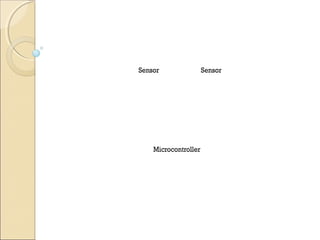
Sensor Sensor
Microcontroller
ADC
Current sensor structureTraditional sensor structure
Processing unit
(processor+
memory)
Processing unit
(+video coding
& analysis)
Sensing unit
(sensor+ADC)
Transceiver unit
Transceiver unit
(lower power)
Sensing unit
(sensor on chip)
Power
unit
Power
unit
(+
energy
harve-
sting)
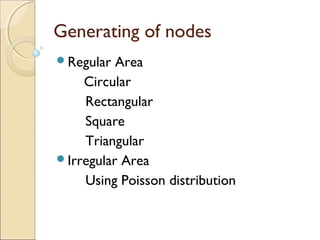
Generating of nodes
Regular Area
Circular
Rectangular
Square
Triangular
Irregular Area
Using Poisson distribution
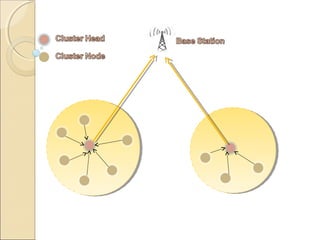
Clustered Architechure in WSN
Organizes the sensor nodes into clusters
Each cluster is governed by
a cluster-head
Only heads send messages
to a BS
Clustering:
Clustering is a good technique to reduce
energy consumption.
To support high scalability and better
data aggregation, sensor nodes are
often grouped into disjoint, non
overlapping subsets called clusters.
Clusters create hierarchical WSNs
which incorporate efficient utilization of
limited resources of sensor nodes and thus
extends network lifetime.
CH
Member
node
Cluster head
Each node first locates its neighbors (in
its enclosure region), then calculates its
weight which is based on its residual
energy and distance to its neighbors. The
largest weight node in a neighborhood
may become a Cluster Head(CH).
Advantages of clustering
a) Reducing the size of the routing table
by localizing the route setup within the
cluster.
b) Conserves communication bandwidth.
c) Prolonged battery life of individual
sensor.
d) No topology maintenance overhead.
e) Reduce rate of energy consumption
 
Cluster Head Capabilities
•Mobility:
CH can be stationary or mobile, limited
movement for betterment.
•Node types:
Nodes with more computation and
communication capabilities elected as CH.
•Role:
CHs relay the traffic, fuse or aggregate
the sensed data.
SELECTION CRITERIA FOR CH
•Initial Energy: It should be high
•Residual energy: after some rounds
selection based on this
•Energy Consumption rate
(Initial energy – residual energy ) per round
•Average energy of the network
PROPOSED MODEL FOR
CH SELECTION:
Step-1
Let we have a set S of n generated nodes .
S={s1,s2,…………sn}
step2 :
Calculate the distance of nodes from origin
Step 3 :
Finding out the node id having minimum distance from origin.
Step 4
Calculating the summation of distances for sensor nodes in the
cluster.
CH selection algorithm
Step-5 Enter base station distance from each sensor node.
Step-6 The node having minimum distance from BS is selected as
Cluster Head.
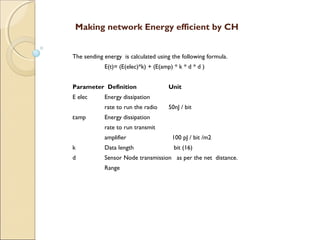
Making network Energy efficient by CH
The sending energy is calculated using the following formula.
E(t)= (E(elec)*k) + (E(amp) * k * d * d )
Parameter Definition Unit
E elec Energy dissipation
rate to run the radio 50nJ / bit
εamp Energy dissipation
rate to run transmit
amplifier 100 pJ / bit /m2
k Data length bit (16)
d Sensor Node transmission as per the net distance.
Range
CONCLUSION :
In clustering hierarchy, the cluster head decision is a
major challenge. If network is taken as a whole, then the
power consumption can be optimized by the rotation of this
cluster head inside the individual clusters. Energy conservation
is a significant concern in the WSNs.
In this proposed algorithm a new technique is
proposed to select CH among some of the wireless sensor
nodes based on net distance with base station. The
proposed technique aims to increase the lifetime of the whole
network, and to increase the number of nodes, which will
remain alive for the maximum period of time.

Abitseminar

  • 1.
    Seminar On “GeneratingNodesSeminar On “Generating Nodes and clustering Energy Efficiencyand clustering Energy Efficiency in WSN”in WSN” Guided By :Guided By : Mr.Rajiv Shanker Bal.Mr.Rajiv Shanker Bal. Lecturer In MCALecturer In MCA Presented By :Presented By : Mrs. Swagtika Mohapatra.Mrs. Swagtika Mohapatra. Regd. No : 1207206014Regd. No : 1207206014 Semester : 4thSemester : 4th P.G. Department of Computer Science And Engineering Ajay Binay Institute Of Technology (An Affiliated College of Biju Patnaik University of Technology, Odisha) Sector : I ,CDA , Markat Nagar ,Cuttack -753014
  • 2.
    OutlineOutline Introduction A WSN isa collection of sensor nodes (SNs) organized into a cooperative network. Sensor nodes comprises sensing ,processing, transmission, mobilization, position finding system and power units.
  • 3.
    IntroductionIntroduction Sensor Nodes (SN)capableof performing some processing, gathering sensory information and communicating with other connected nodes in the network. SNs are of two types • normal SN : to sense the phenomena • gateway SN: interfaces sensor network to the external world.
  • 4.
    The Sensors inWSN The Sensors in WSN
  • 5.
  • 6.
    DESIGNING OF NODES Eachsensor node contains a nodeid that provides node identification. It also have an x and a y coordinate.
  • 7.
  • 8.
    Current sensor structureTraditionalsensor structure Processing unit (processor+ memory) Processing unit (+video coding & analysis) Sensing unit (sensor+ADC) Transceiver unit Transceiver unit (lower power) Sensing unit (sensor on chip) Power unit Power unit (+ energy harve- sting)
  • 9.
    Generating of nodes RegularArea Circular Rectangular Square Triangular Irregular Area Using Poisson distribution
  • 10.
    Clustered Architechure inWSN Organizes the sensor nodes into clusters Each cluster is governed by a cluster-head Only heads send messages to a BS
  • 11.
    Clustering: Clustering is agood technique to reduce energy consumption. To support high scalability and better data aggregation, sensor nodes are often grouped into disjoint, non overlapping subsets called clusters. Clusters create hierarchical WSNs which incorporate efficient utilization of limited resources of sensor nodes and thus extends network lifetime.
  • 13.
  • 14.
    Cluster head Each nodefirst locates its neighbors (in its enclosure region), then calculates its weight which is based on its residual energy and distance to its neighbors. The largest weight node in a neighborhood may become a Cluster Head(CH).
  • 15.
    Advantages of clustering a)Reducing the size of the routing table by localizing the route setup within the cluster. b) Conserves communication bandwidth. c) Prolonged battery life of individual sensor. d) No topology maintenance overhead. e) Reduce rate of energy consumption  
  • 17.
    Cluster Head Capabilities •Mobility: CHcan be stationary or mobile, limited movement for betterment. •Node types: Nodes with more computation and communication capabilities elected as CH. •Role: CHs relay the traffic, fuse or aggregate the sensed data.
  • 18.
    SELECTION CRITERIA FORCH •Initial Energy: It should be high •Residual energy: after some rounds selection based on this •Energy Consumption rate (Initial energy – residual energy ) per round •Average energy of the network
  • 19.
    PROPOSED MODEL FOR CHSELECTION: Step-1 Let we have a set S of n generated nodes . S={s1,s2,…………sn} step2 : Calculate the distance of nodes from origin Step 3 : Finding out the node id having minimum distance from origin. Step 4 Calculating the summation of distances for sensor nodes in the cluster.
  • 20.
    CH selection algorithm Step-5Enter base station distance from each sensor node. Step-6 The node having minimum distance from BS is selected as Cluster Head.
  • 21.
    Making network Energyefficient by CH The sending energy is calculated using the following formula. E(t)= (E(elec)*k) + (E(amp) * k * d * d ) Parameter Definition Unit E elec Energy dissipation rate to run the radio 50nJ / bit εamp Energy dissipation rate to run transmit amplifier 100 pJ / bit /m2 k Data length bit (16) d Sensor Node transmission as per the net distance. Range
  • 26.
    CONCLUSION : In clusteringhierarchy, the cluster head decision is a major challenge. If network is taken as a whole, then the power consumption can be optimized by the rotation of this cluster head inside the individual clusters. Energy conservation is a significant concern in the WSNs. In this proposed algorithm a new technique is proposed to select CH among some of the wireless sensor nodes based on net distance with base station. The proposed technique aims to increase the lifetime of the whole network, and to increase the number of nodes, which will remain alive for the maximum period of time.