Lecture 1: Wireless Sensor Networks
Wireless Sensor Networks (WSNs)
2
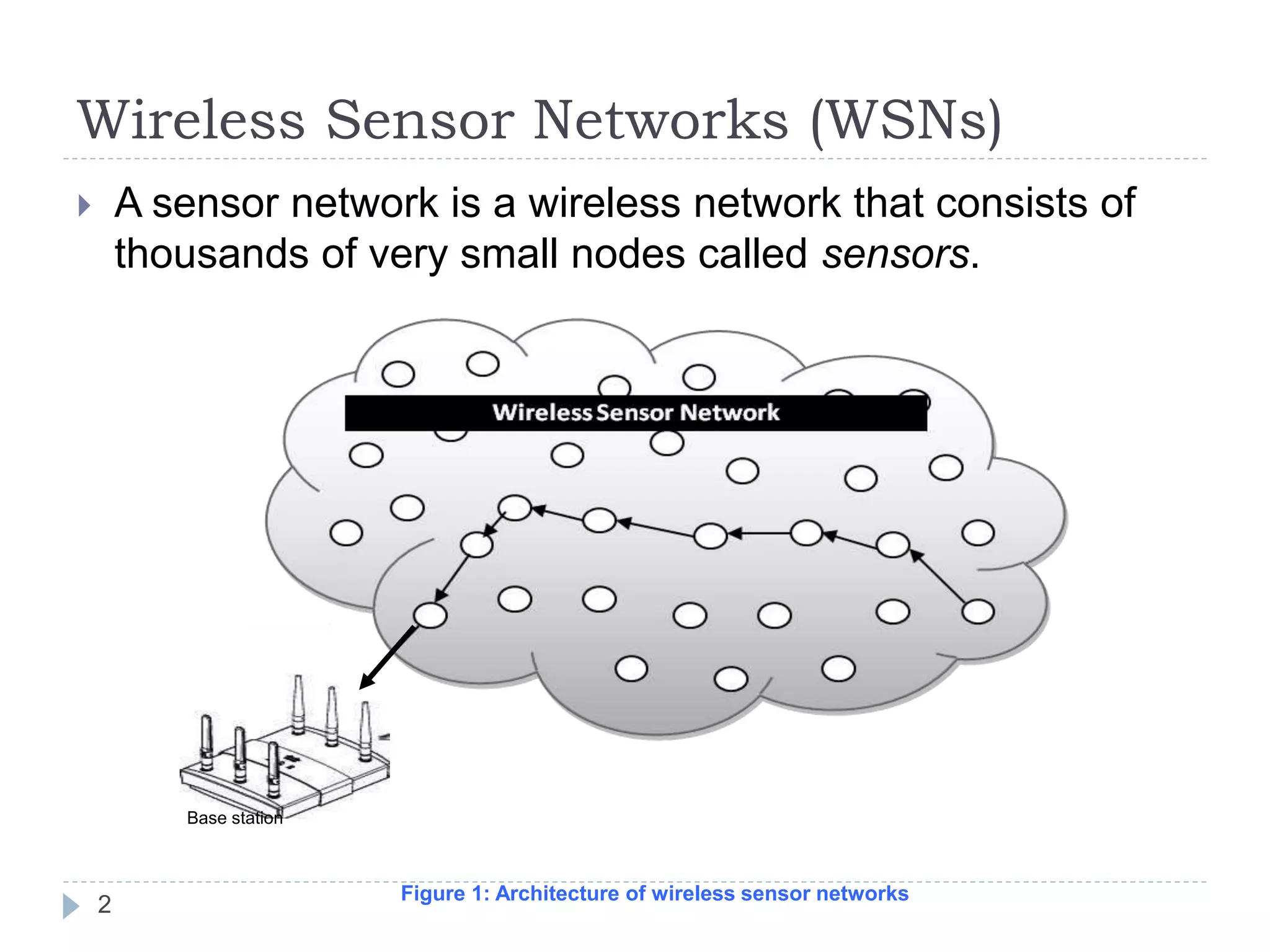
 A sensor network is a wireless network that consists of
thousands of very small nodes called sensors.
Base station
Figure 1: Architecture of wireless sensor networks
Wireless Sensor Networks (cont.)
3
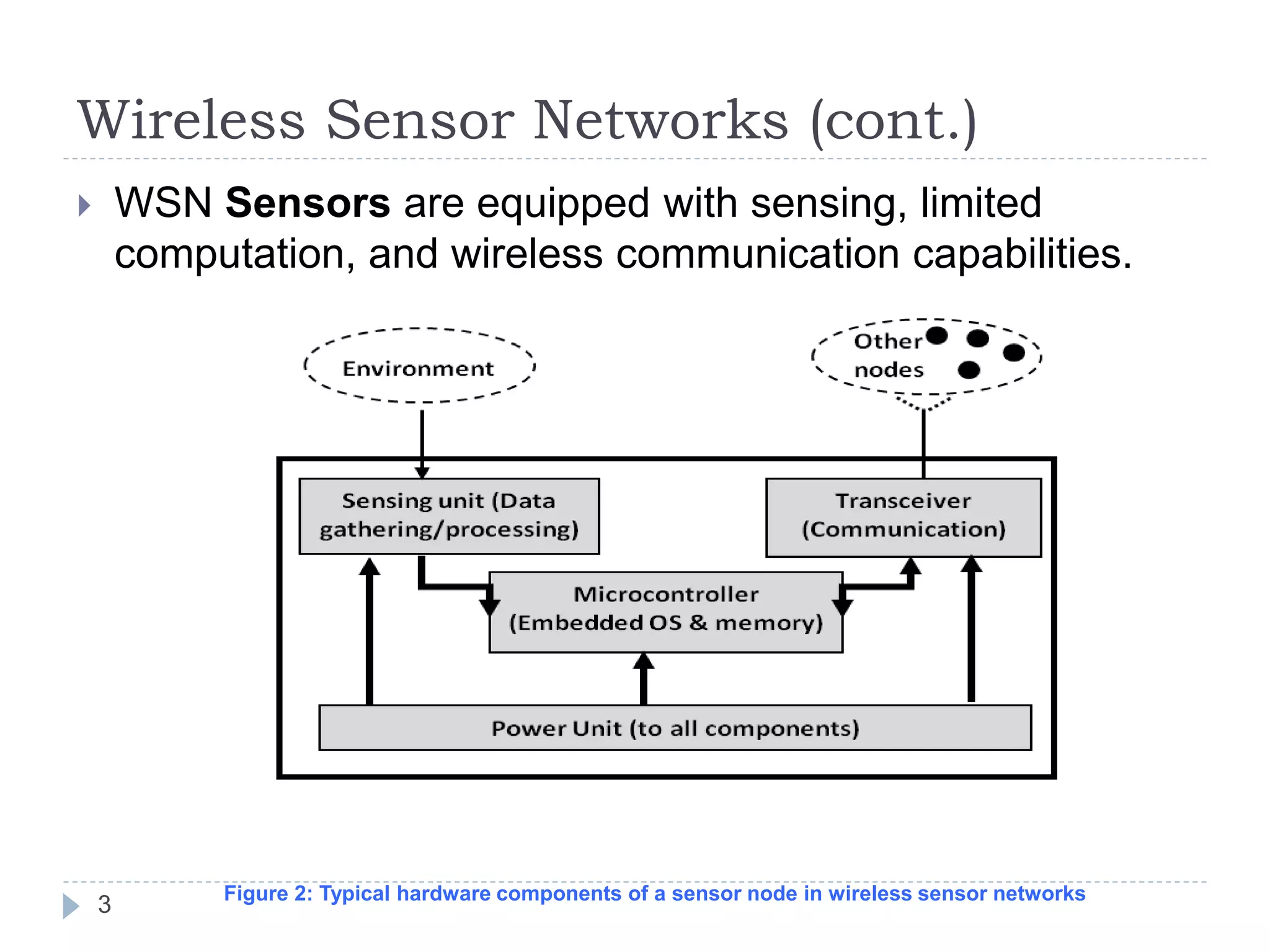
 WSN Sensors are equipped with sensing, limited
computation, and wireless communication capabilities.
Figure 2: Typical hardware components of a sensor node in wireless sensor networks
Introduction
 Wireless Sensor Networks are networks that
consists of sensors which are distributed in an ad
hoc manner.
 These sensors work with each other to sense
some physical phenomenon and then the
information gathered is processed to get relevant
results.
 Wireless sensor networks consists of protocols
and algorithms with self-organizing capabilities.
4 Introduction to Wireless Sensor Networks
Comparison with ad hoc
networks
 Wireless sensor networks mainly use broadcast
communication while ad hoc networks use point-to-point
communication.
 Unlike ad hoc networks wireless sensor networks are limited
by sensors limited power, energy and computational
capability.
 Sensor nodes may not have global ID because of the large
amount of overhead and large number of sensors.
5 Introduction to Wireless Sensor Networks
WSNs Applications
6
 WSNs have many advantages over traditional networking
techniques.
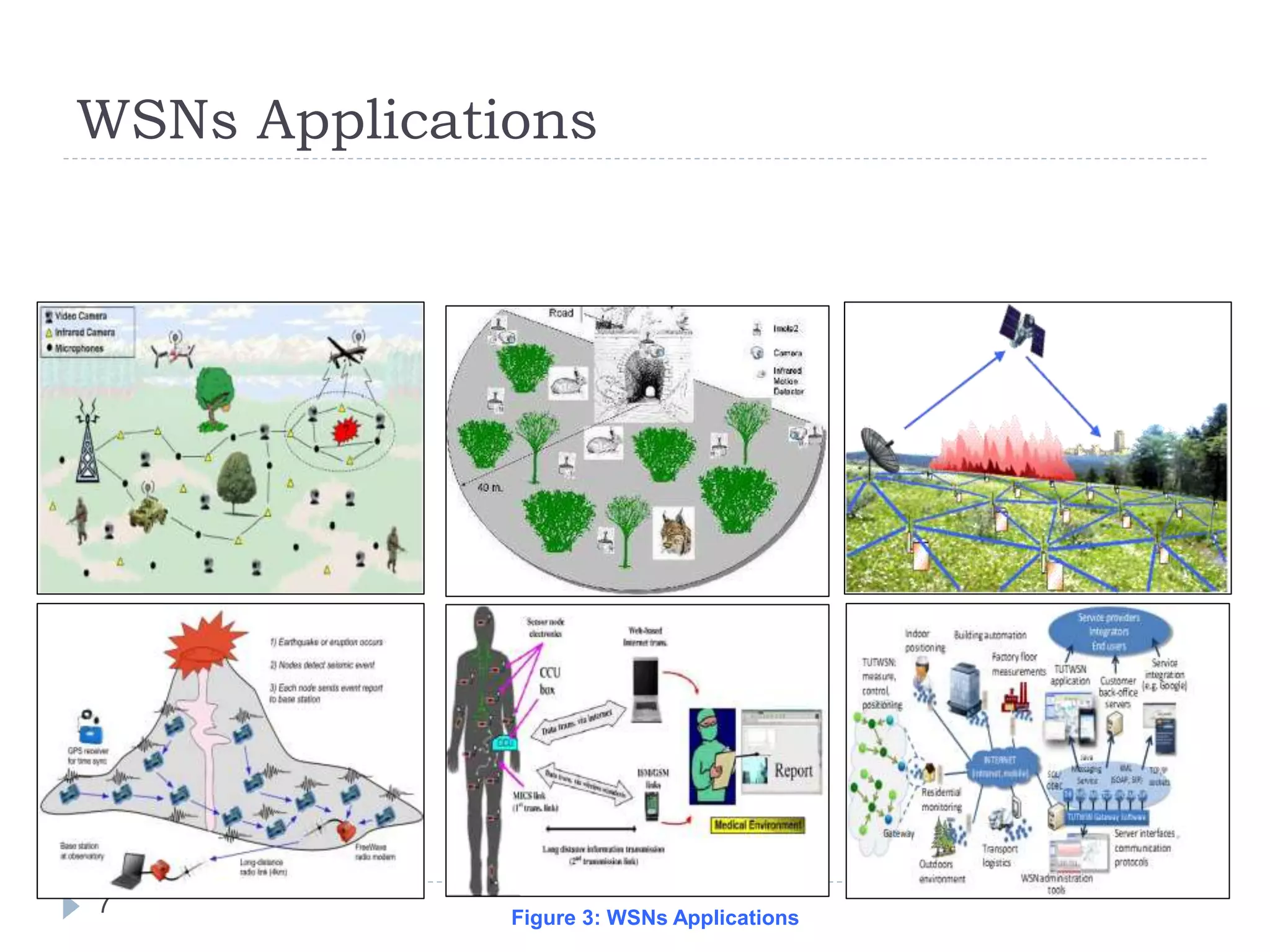
 They have an ever-increasing number of applications, such
as infrastructure protection and security, surveillance, health-
care, environment monitoring, food safety, intelligent
transportation, and smart energy.
WSNs Applications
7 Figure 3: WSNs Applications
Applications of Wireless Sensor
networks
The applications can be divided in three
categories:
1. Monitoring of objects.
2. Monitoring of an area.
3. Monitoring of both area and objects.
8 Introduction to Wireless Sensor Networks
Monitoring Area
 Environmental and Habitat Monitoring
 Precision Agriculture
 Indoor Climate Control
 Military Surveillance
 Treaty Verification
 Intelligent Alarms
9 Introduction to Wireless Sensor Networks
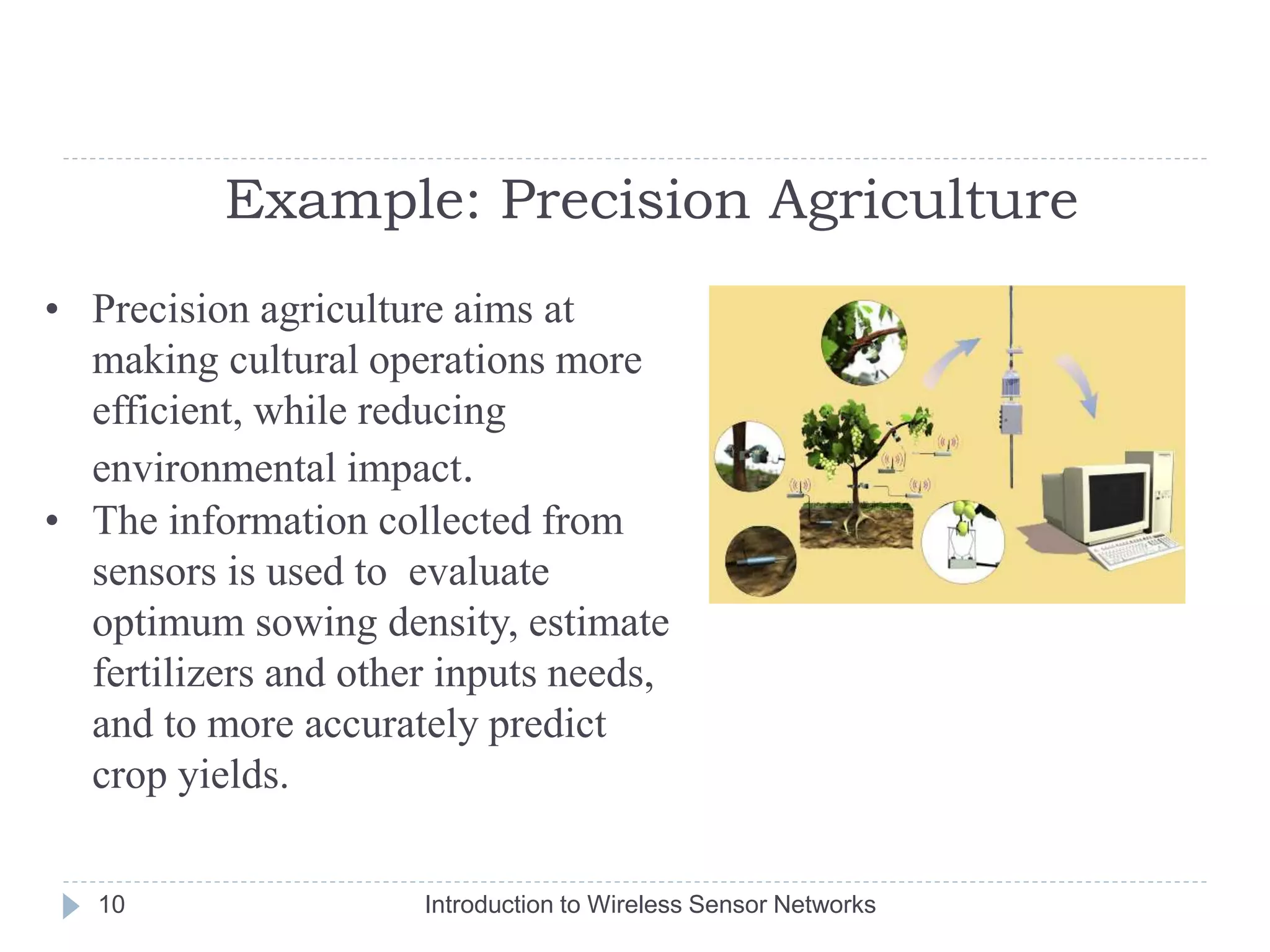
Example: Precision Agriculture
• Precision agriculture aims at
making cultural operations more
efficient, while reducing
environmental impact.
• The information collected from
sensors is used to evaluate
optimum sowing density, estimate
fertilizers and other inputs needs,
and to more accurately predict
crop yields.
10 Introduction to Wireless Sensor Networks
Monitoring Objects
 Structural Monitoring
 Eco-physiology
 Condition-based Maintenance
 Medical Diagnostics
 Urban terrain mapping
11 Introduction to Wireless Sensor Networks
Monitoring Interactions between
Objects and Space
 Wildlife Habitats
 Disaster Management
 Emergency Response
 Ubiquitous Computing
 Asset Tracking
 Health Care
 Manufacturing Process Flows
12 Introduction to Wireless Sensor Networks
Characteristics of Wireless Sensor Networks
 Wireless Sensor Networks mainly consists of
sensors. Sensors are -
 low power
 limited memory
 energy constrained due to their small size.
 Wireless networks can also be deployed in extreme
environmental conditions and may be prone to
enemy attacks.
 Although deployed in an ad hoc manner they need
to be self organized and self healing and can face
constant reconfiguration.
13 Introduction to Wireless Sensor Networks
Design Challenges
 Heterogeneity
 The devices deployed maybe of various types and
need to collaborate with each other.
 Distributed Processing
 The algorithms need to be centralized as the
processing is carried out on different nodes.
 Low Bandwidth Communication
 The data should be transferred efficiently between
sensors
14 Introduction to Wireless Sensor Networks
Continued..
 Large Scale Coordination
 The sensors need to coordinate with each other to
produce required results.
 Utilization of Sensors
 The sensors should be utilized in a ways that produce
the maximum performance and use less energy.
 Real Time Computation
 The computation should be done quickly as new data
is always being generated.
15 Introduction to Wireless Sensor Networks
Operational Challenges of Wireless Sensor
Networks
 Energy Efficiency
 Limited storage and computation
 Low bandwidth and high error rates
 Errors are common
 Wireless communication
 Noisy measurements
 Node failure are expected
 Scalability to a large number of sensor nodes
 Survivability in harsh environments
 Experiments are time- and space-intensive
16 Introduction to Wireless Sensor Networks
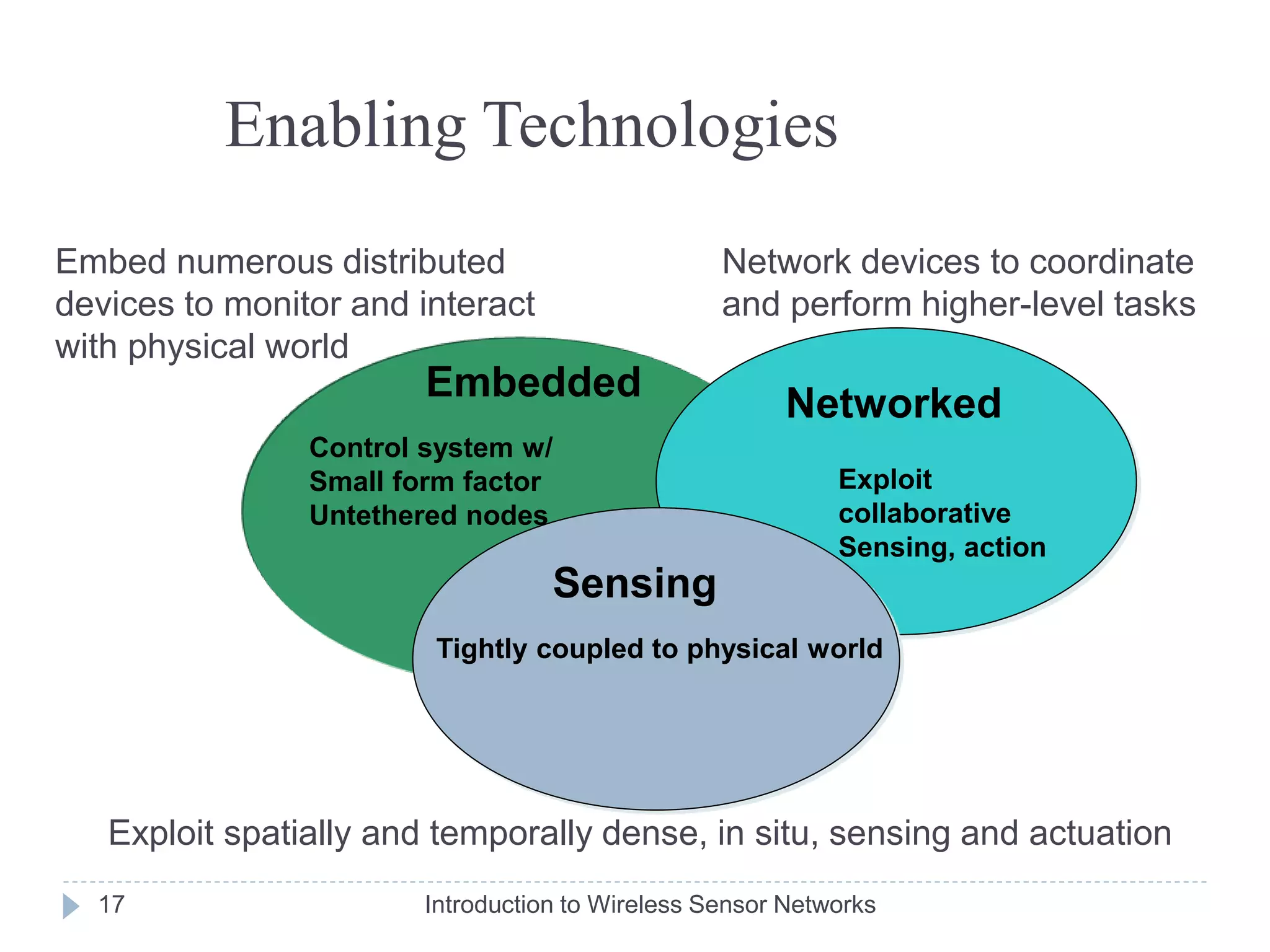
Enabling Technologies
Embedded
Networked
Sensing
Control system w/
Small form factor
Untethered nodes
Exploit
collaborative
Sensing, action
Tightly coupled to physical world
Embed numerous distributed
devices to monitor and interact
with physical world
Network devices to coordinate
and perform higher-level tasks
Exploit spatially and temporally dense, in situ, sensing and actuation
17 Introduction to Wireless Sensor Networks
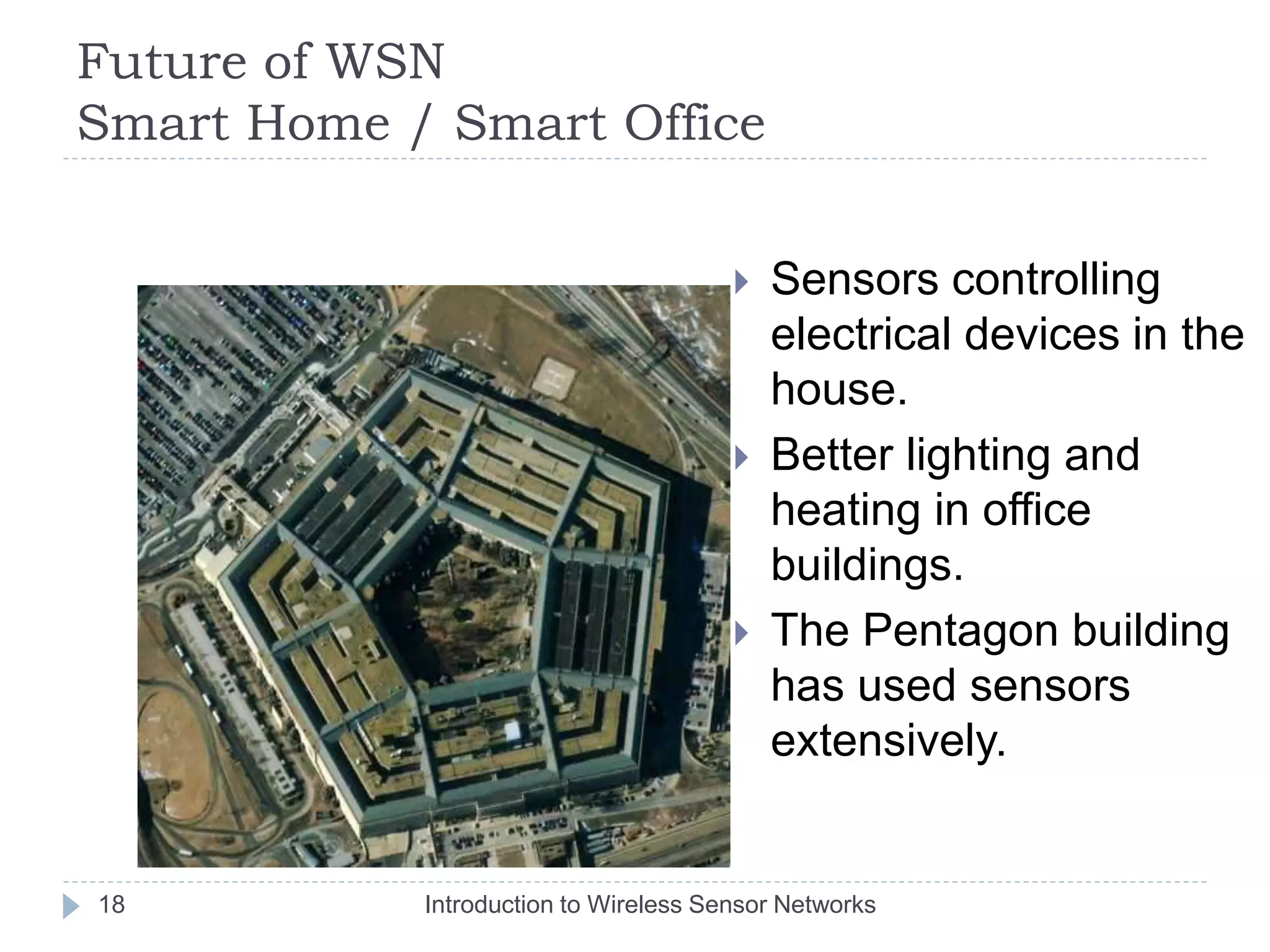
Future of WSN
Smart Home / Smart Office
 Sensors controlling
electrical devices in the
house.
 Better lighting and
heating in office
buildings.
 The Pentagon building
has used sensors
extensively.
18 Introduction to Wireless Sensor Networks
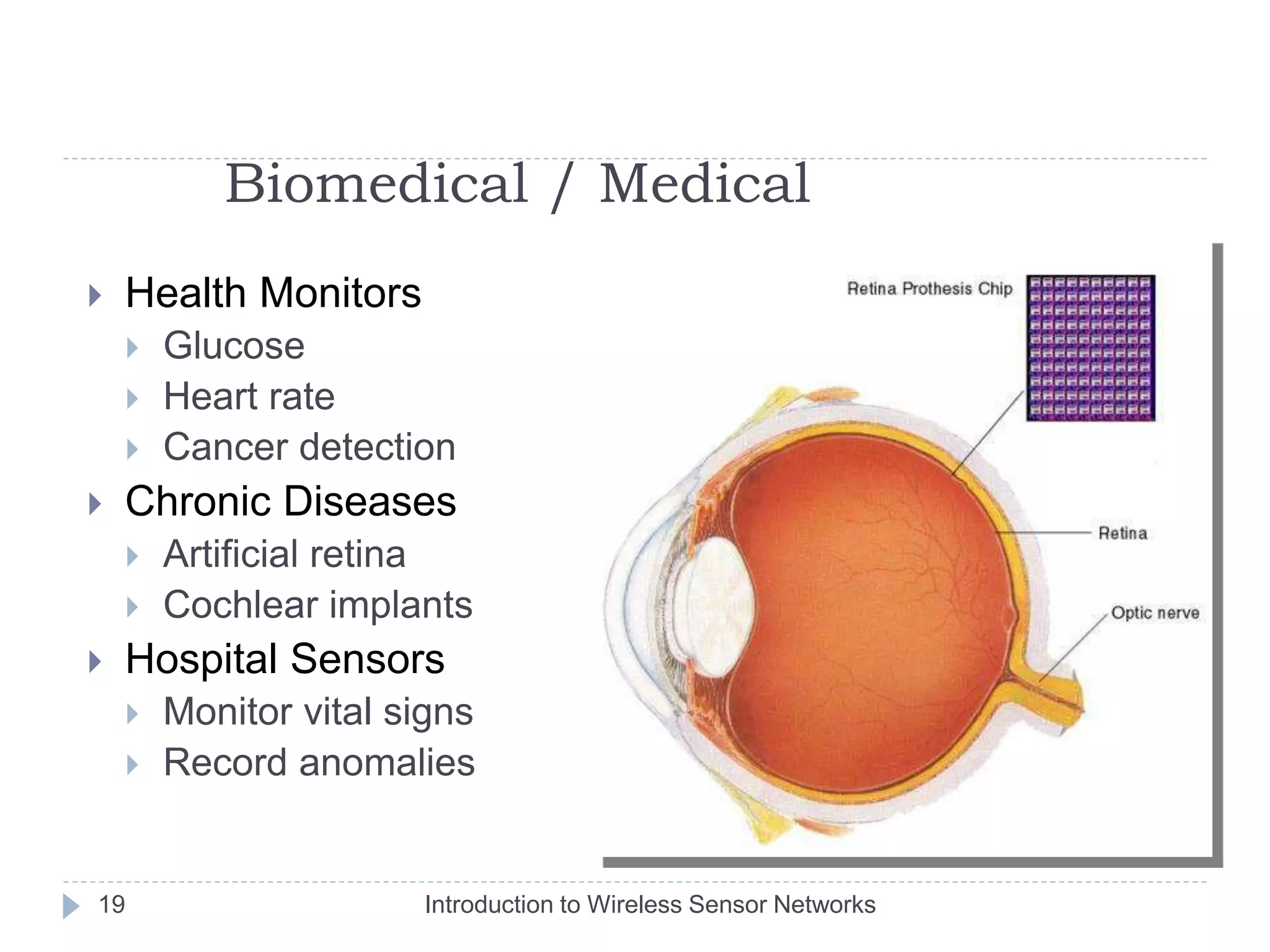
Biomedical / Medical
 Health Monitors
 Glucose
 Heart rate
 Cancer detection
 Chronic Diseases
 Artificial retina
 Cochlear implants
 Hospital Sensors
 Monitor vital signs
 Record anomalies
19 Introduction to Wireless Sensor Networks
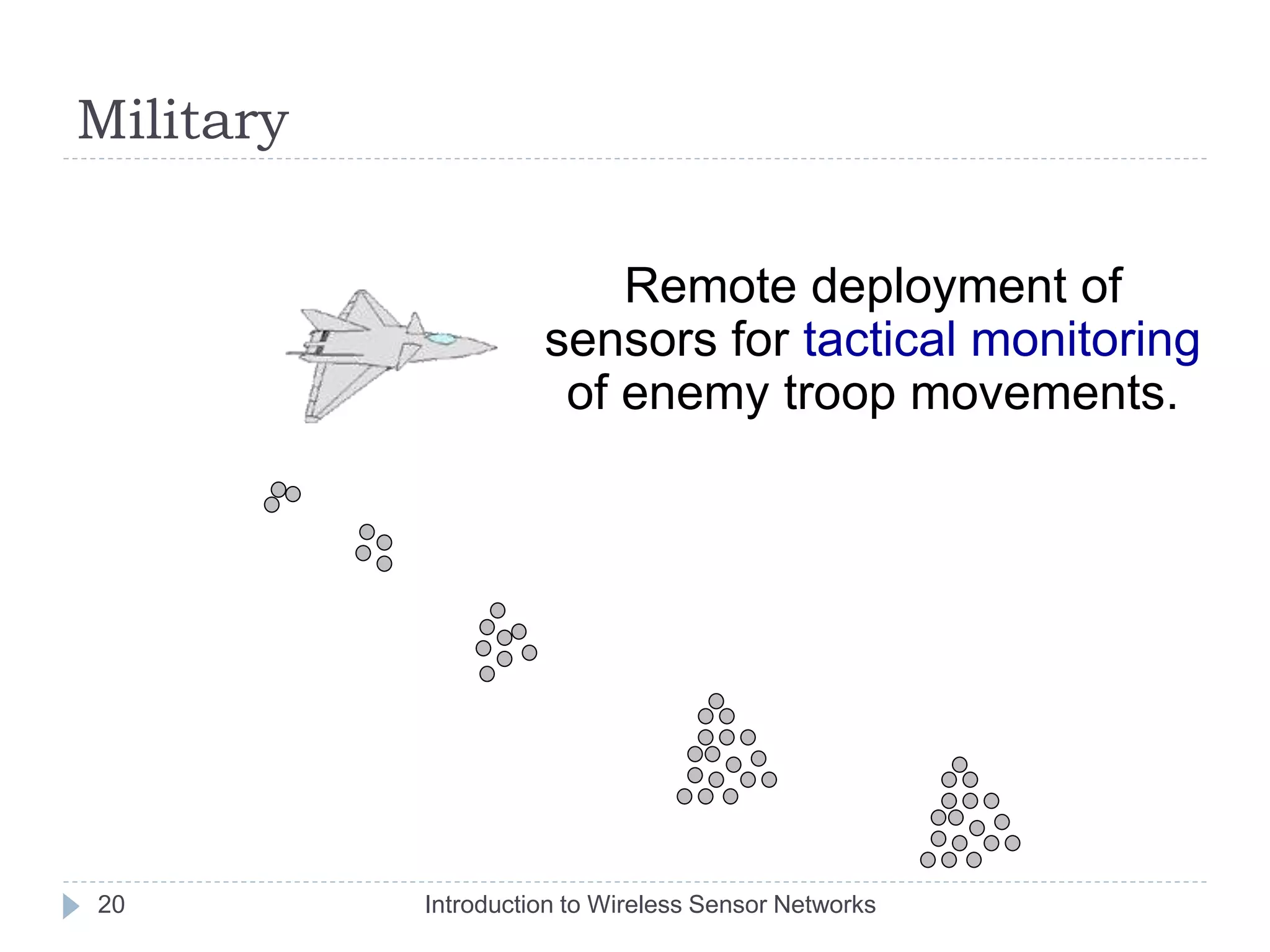
Military
Remote deployment of
sensors for tactical monitoring
of enemy troop movements.
20 Introduction to Wireless Sensor Networks
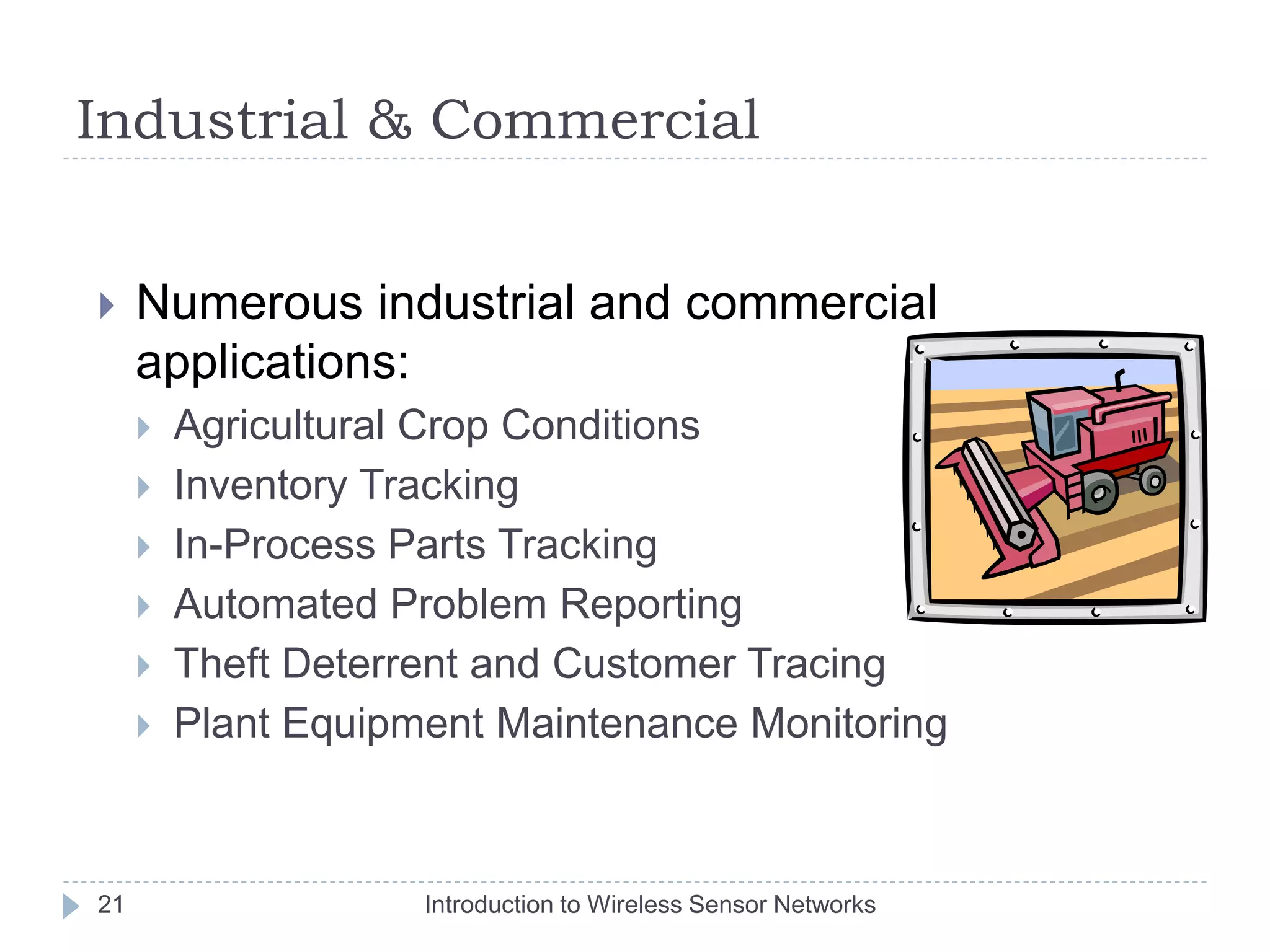
Industrial & Commercial
 Numerous industrial and commercial
applications:
 Agricultural Crop Conditions
 Inventory Tracking
 In-Process Parts Tracking
 Automated Problem Reporting
 Theft Deterrent and Customer Tracing
 Plant Equipment Maintenance Monitoring
21 Introduction to Wireless Sensor Networks
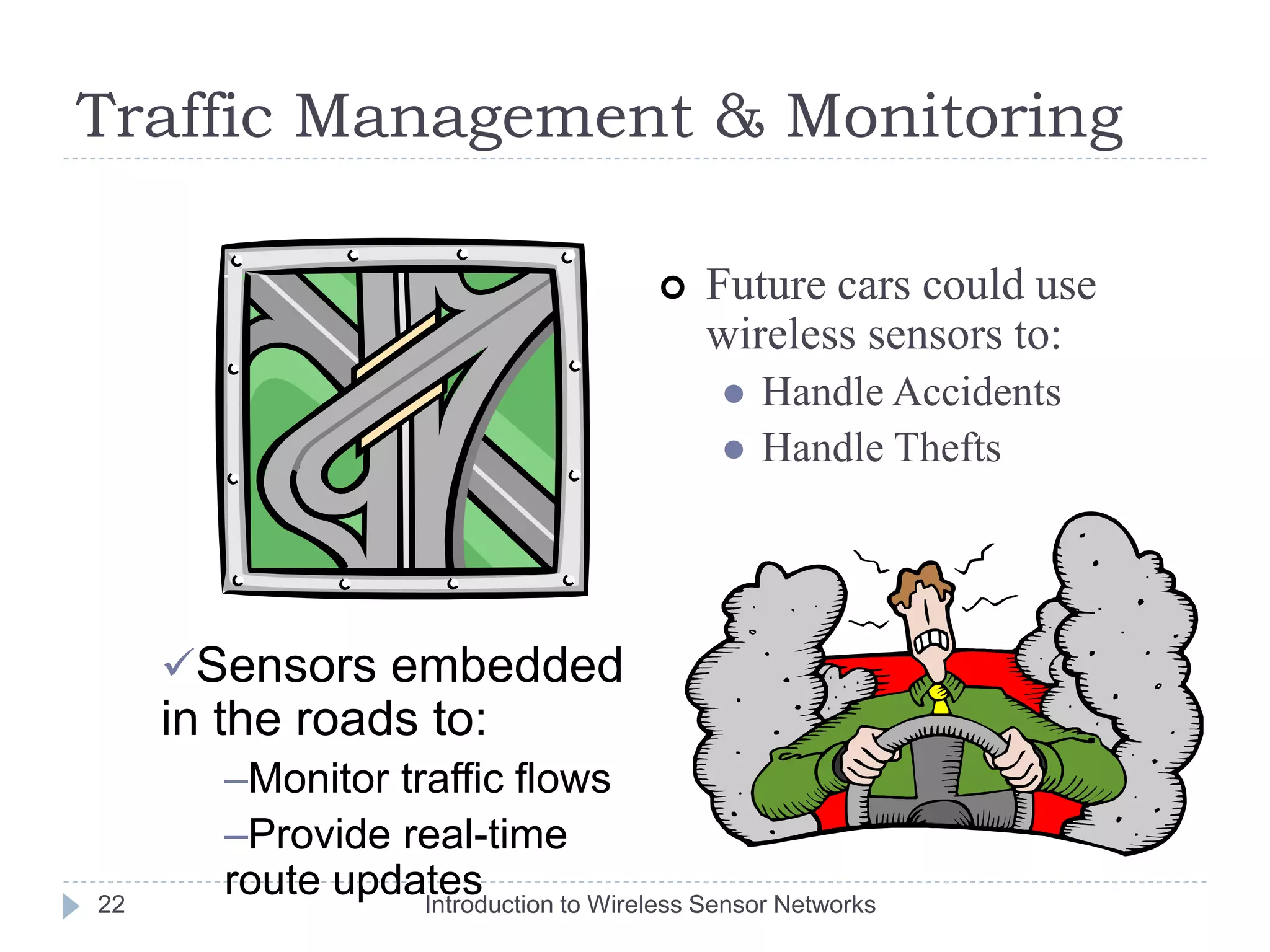
Traffic Management & Monitoring
 Future cars could use
wireless sensors to:
 Handle Accidents
 Handle Thefts
Sensors embedded
in the roads to:
–Monitor traffic flows
–Provide real-time
route updates
22 Introduction to Wireless Sensor Networks
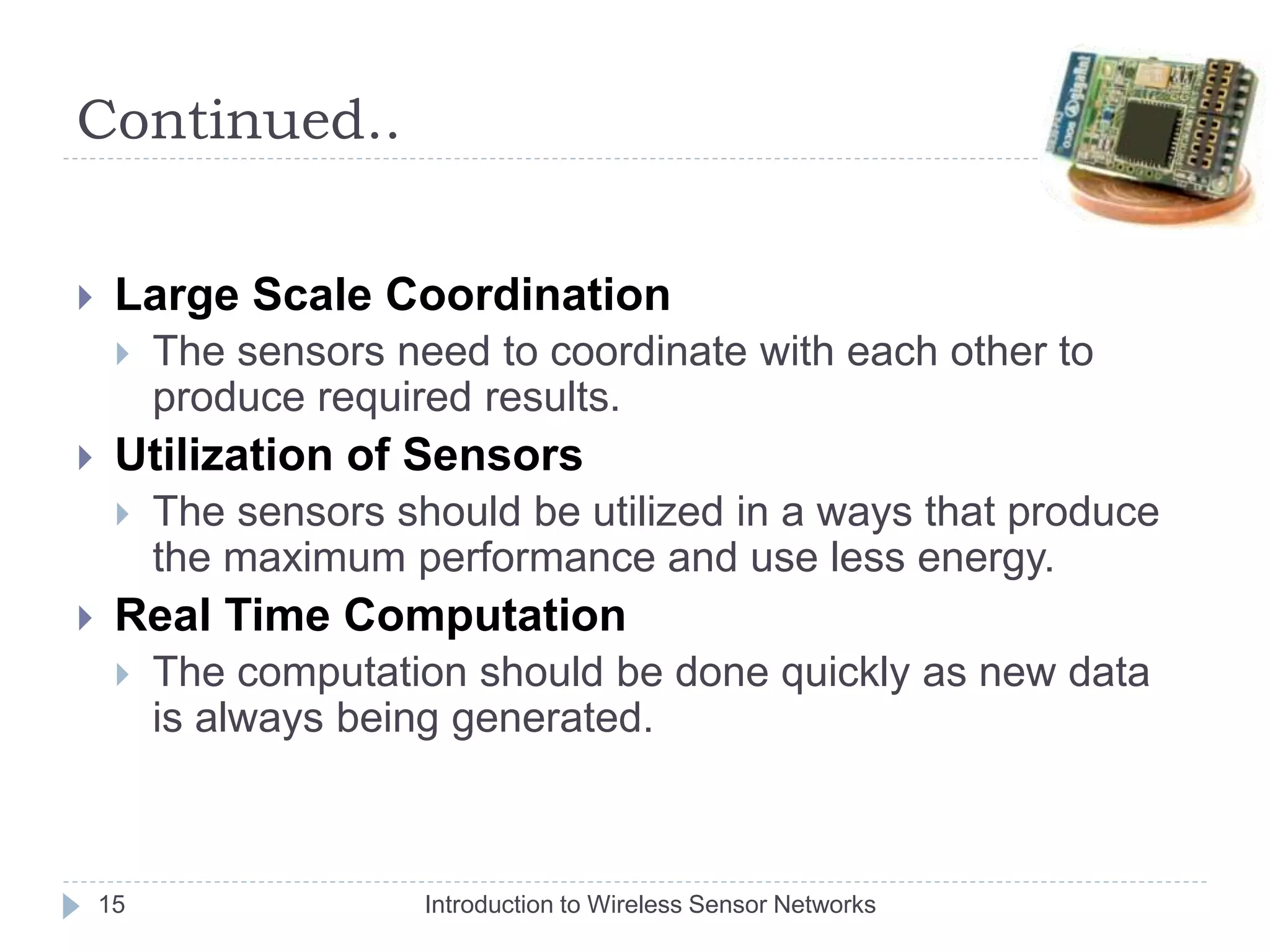
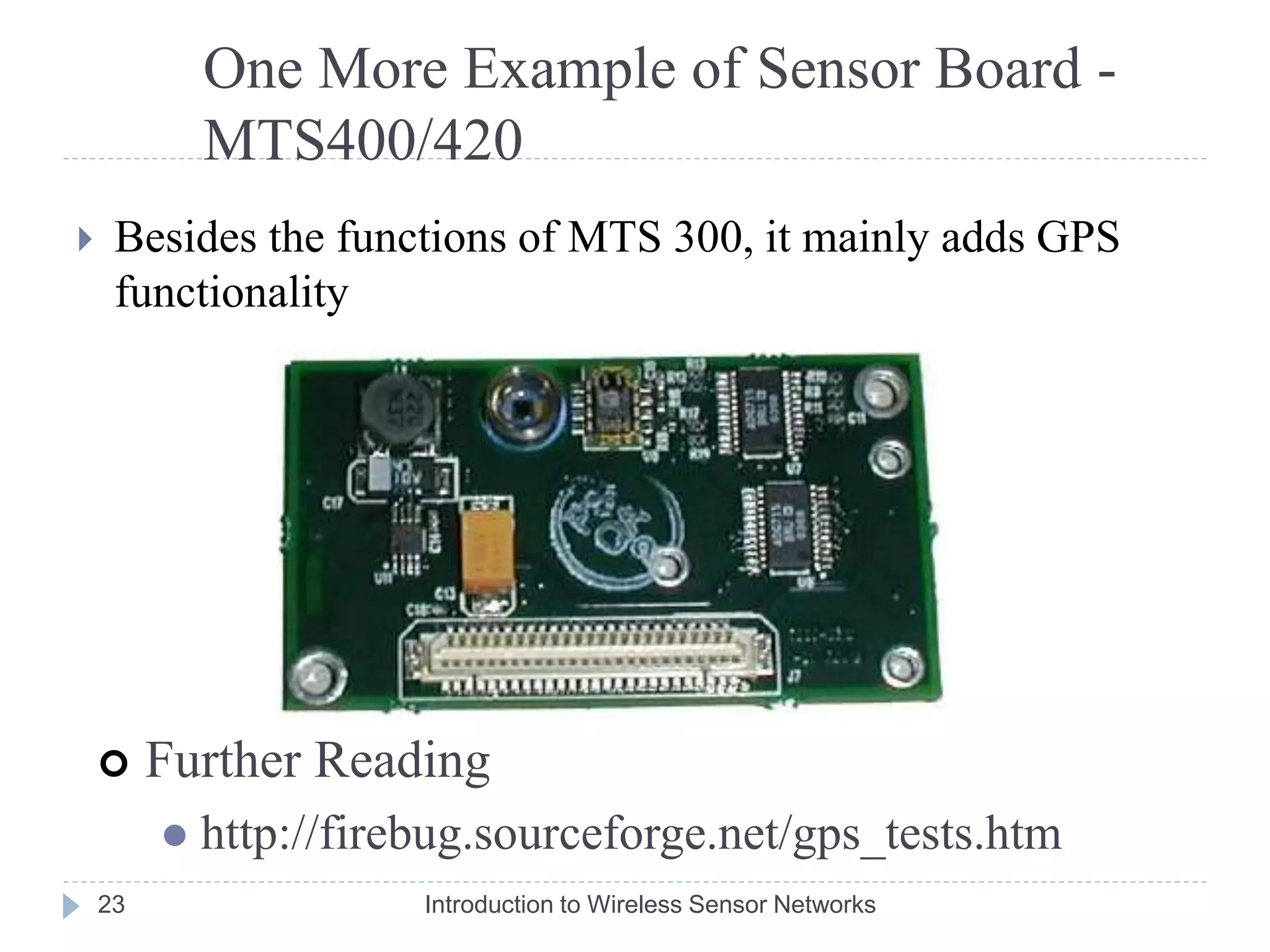
One More Example of Sensor Board -
MTS400/420
 Besides the functions of MTS 300, it mainly adds GPS
functionality
 Further Reading
 http://firebug.sourceforge.net/gps_tests.htm
23 Introduction to Wireless Sensor Networks
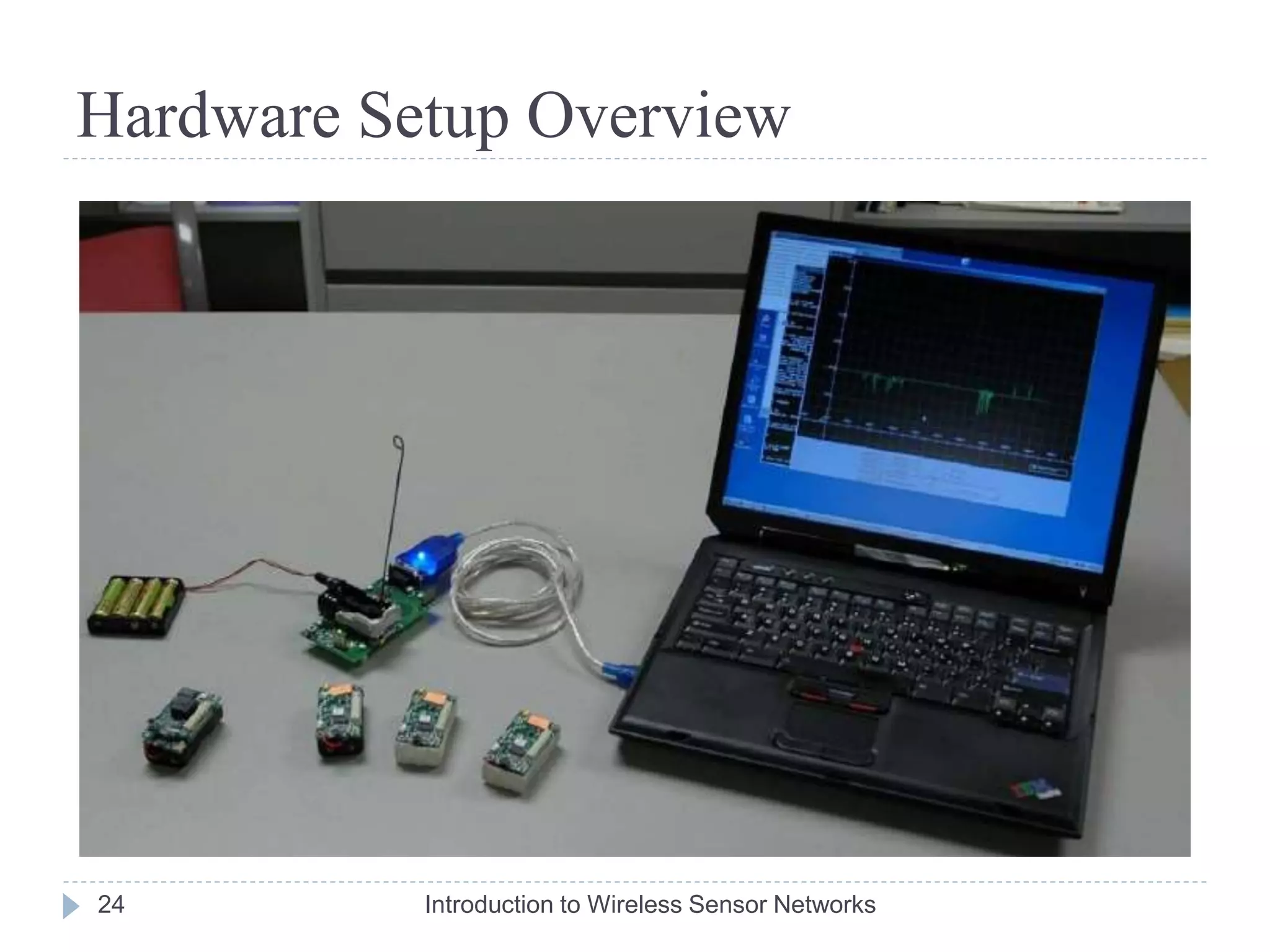
Hardware Setup Overview
24 Introduction to Wireless Sensor Networks
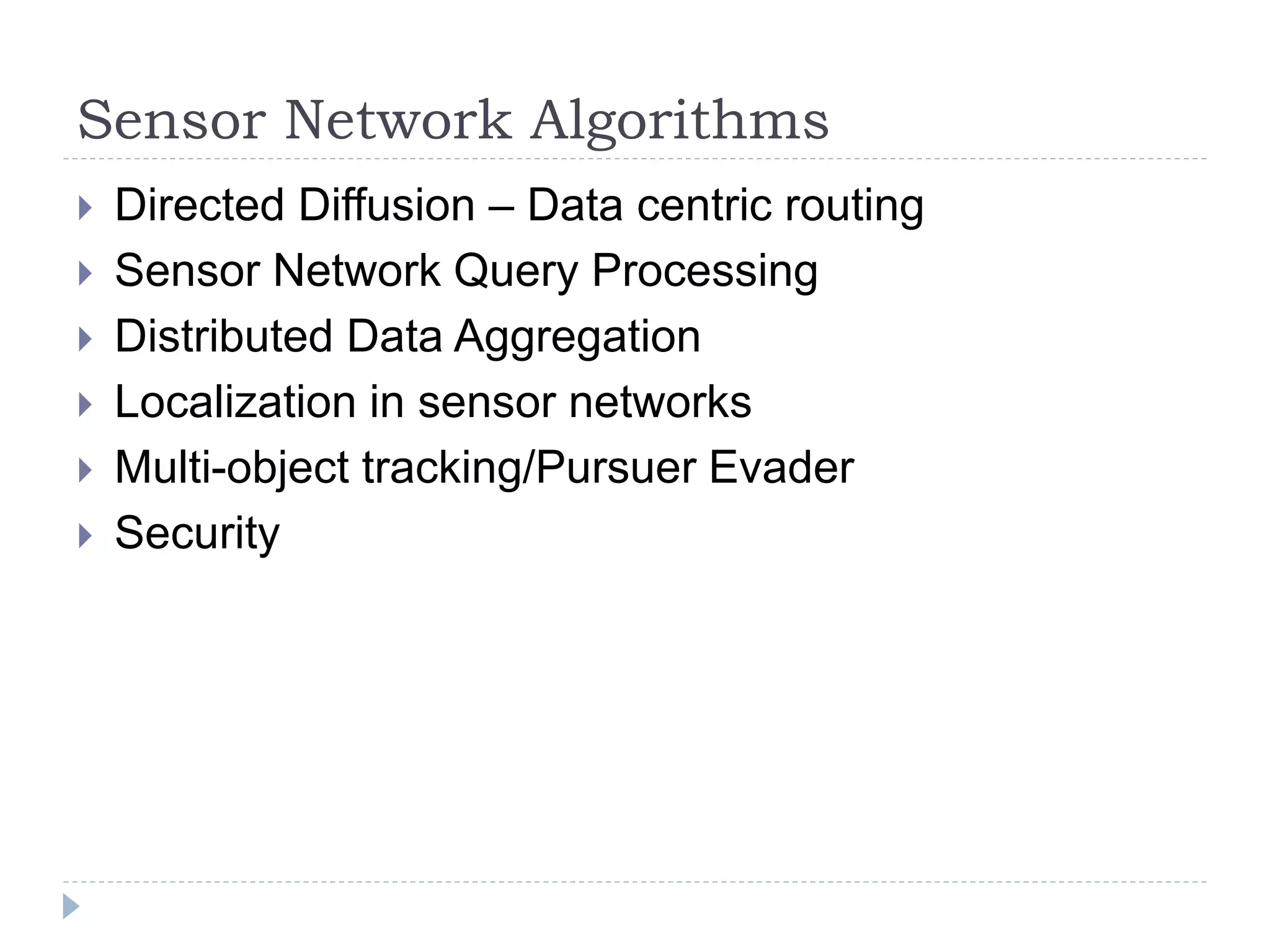
Sensor Network Algorithms
 Directed Diffusion – Data centric routing
 Sensor Network Query Processing
 Distributed Data Aggregation
 Localization in sensor networks
 Multi-object tracking/Pursuer Evader
 Security
Introduction to Wireless Sensor Networks
26
Source
www.cse.fau.edu/~jie/teaching/fall_2004_files/sensorslides1.ppt
http://web2.uwindsor.ca/courses/cs/aggarwal/cs60520/SeminarMaterial/WSN-
future.ppt
http://web.cecs.pdx.edu/~nbulusu/talks/grace-hopper.ppt
http://galaxy.cs.lamar.edu/~bsun/wsn/wsn.html
www.dsc.ufcg.edu.br/~maspohn/katia/introduction.ppt
http://computer.howstuffworks.com/mote1.htm
http://www.polastre.com/papers/polastre-thesis-final.pdf
Table of References

lecture_8-wsn.pptx

  • 1.
    Lecture 1: WirelessSensor Networks
  • 2.
    Wireless Sensor Networks(WSNs) 2  A sensor network is a wireless network that consists of thousands of very small nodes called sensors. Base station Figure 1: Architecture of wireless sensor networks
  • 3.
    Wireless Sensor Networks(cont.) 3  WSN Sensors are equipped with sensing, limited computation, and wireless communication capabilities. Figure 2: Typical hardware components of a sensor node in wireless sensor networks
  • 4.
    Introduction  Wireless SensorNetworks are networks that consists of sensors which are distributed in an ad hoc manner.  These sensors work with each other to sense some physical phenomenon and then the information gathered is processed to get relevant results.  Wireless sensor networks consists of protocols and algorithms with self-organizing capabilities. 4 Introduction to Wireless Sensor Networks
  • 5.
    Comparison with adhoc networks  Wireless sensor networks mainly use broadcast communication while ad hoc networks use point-to-point communication.  Unlike ad hoc networks wireless sensor networks are limited by sensors limited power, energy and computational capability.  Sensor nodes may not have global ID because of the large amount of overhead and large number of sensors. 5 Introduction to Wireless Sensor Networks
  • 6.
    WSNs Applications 6  WSNshave many advantages over traditional networking techniques.  They have an ever-increasing number of applications, such as infrastructure protection and security, surveillance, health- care, environment monitoring, food safety, intelligent transportation, and smart energy.
  • 7.
    WSNs Applications 7 Figure3: WSNs Applications
  • 8.
    Applications of WirelessSensor networks The applications can be divided in three categories: 1. Monitoring of objects. 2. Monitoring of an area. 3. Monitoring of both area and objects. 8 Introduction to Wireless Sensor Networks
  • 9.
    Monitoring Area  Environmentaland Habitat Monitoring  Precision Agriculture  Indoor Climate Control  Military Surveillance  Treaty Verification  Intelligent Alarms 9 Introduction to Wireless Sensor Networks
  • 10.
    Example: Precision Agriculture •Precision agriculture aims at making cultural operations more efficient, while reducing environmental impact. • The information collected from sensors is used to evaluate optimum sowing density, estimate fertilizers and other inputs needs, and to more accurately predict crop yields. 10 Introduction to Wireless Sensor Networks
  • 11.
    Monitoring Objects  StructuralMonitoring  Eco-physiology  Condition-based Maintenance  Medical Diagnostics  Urban terrain mapping 11 Introduction to Wireless Sensor Networks
  • 12.
    Monitoring Interactions between Objectsand Space  Wildlife Habitats  Disaster Management  Emergency Response  Ubiquitous Computing  Asset Tracking  Health Care  Manufacturing Process Flows 12 Introduction to Wireless Sensor Networks
  • 13.
    Characteristics of WirelessSensor Networks  Wireless Sensor Networks mainly consists of sensors. Sensors are -  low power  limited memory  energy constrained due to their small size.  Wireless networks can also be deployed in extreme environmental conditions and may be prone to enemy attacks.  Although deployed in an ad hoc manner they need to be self organized and self healing and can face constant reconfiguration. 13 Introduction to Wireless Sensor Networks
  • 14.
    Design Challenges  Heterogeneity The devices deployed maybe of various types and need to collaborate with each other.  Distributed Processing  The algorithms need to be centralized as the processing is carried out on different nodes.  Low Bandwidth Communication  The data should be transferred efficiently between sensors 14 Introduction to Wireless Sensor Networks
  • 15.
    Continued..  Large ScaleCoordination  The sensors need to coordinate with each other to produce required results.  Utilization of Sensors  The sensors should be utilized in a ways that produce the maximum performance and use less energy.  Real Time Computation  The computation should be done quickly as new data is always being generated. 15 Introduction to Wireless Sensor Networks
  • 16.
    Operational Challenges ofWireless Sensor Networks  Energy Efficiency  Limited storage and computation  Low bandwidth and high error rates  Errors are common  Wireless communication  Noisy measurements  Node failure are expected  Scalability to a large number of sensor nodes  Survivability in harsh environments  Experiments are time- and space-intensive 16 Introduction to Wireless Sensor Networks
  • 17.
    Enabling Technologies Embedded Networked Sensing Control systemw/ Small form factor Untethered nodes Exploit collaborative Sensing, action Tightly coupled to physical world Embed numerous distributed devices to monitor and interact with physical world Network devices to coordinate and perform higher-level tasks Exploit spatially and temporally dense, in situ, sensing and actuation 17 Introduction to Wireless Sensor Networks
  • 18.
    Future of WSN SmartHome / Smart Office  Sensors controlling electrical devices in the house.  Better lighting and heating in office buildings.  The Pentagon building has used sensors extensively. 18 Introduction to Wireless Sensor Networks
  • 19.
    Biomedical / Medical Health Monitors  Glucose  Heart rate  Cancer detection  Chronic Diseases  Artificial retina  Cochlear implants  Hospital Sensors  Monitor vital signs  Record anomalies 19 Introduction to Wireless Sensor Networks
  • 20.
    Military Remote deployment of sensorsfor tactical monitoring of enemy troop movements. 20 Introduction to Wireless Sensor Networks
  • 21.
    Industrial & Commercial Numerous industrial and commercial applications:  Agricultural Crop Conditions  Inventory Tracking  In-Process Parts Tracking  Automated Problem Reporting  Theft Deterrent and Customer Tracing  Plant Equipment Maintenance Monitoring 21 Introduction to Wireless Sensor Networks
  • 22.
    Traffic Management &Monitoring  Future cars could use wireless sensors to:  Handle Accidents  Handle Thefts Sensors embedded in the roads to: –Monitor traffic flows –Provide real-time route updates 22 Introduction to Wireless Sensor Networks
  • 23.
    One More Exampleof Sensor Board - MTS400/420  Besides the functions of MTS 300, it mainly adds GPS functionality  Further Reading  http://firebug.sourceforge.net/gps_tests.htm 23 Introduction to Wireless Sensor Networks
  • 24.
    Hardware Setup Overview 24Introduction to Wireless Sensor Networks
  • 25.
    Sensor Network Algorithms Directed Diffusion – Data centric routing  Sensor Network Query Processing  Distributed Data Aggregation  Localization in sensor networks  Multi-object tracking/Pursuer Evader  Security
  • 26.
    Introduction to WirelessSensor Networks 26 Source www.cse.fau.edu/~jie/teaching/fall_2004_files/sensorslides1.ppt http://web2.uwindsor.ca/courses/cs/aggarwal/cs60520/SeminarMaterial/WSN- future.ppt http://web.cecs.pdx.edu/~nbulusu/talks/grace-hopper.ppt http://galaxy.cs.lamar.edu/~bsun/wsn/wsn.html www.dsc.ufcg.edu.br/~maspohn/katia/introduction.ppt http://computer.howstuffworks.com/mote1.htm http://www.polastre.com/papers/polastre-thesis-final.pdf Table of References

Editor's Notes

  • #3 - (WSN) stands for wireless sensor network. - This technology involves deploying a large #number of inexpensive/small sensor nodes over the area of interest - The main function of sensor nodes is to monitor, record, and notify a specific condition to the BS - The collected data is transferred to the BS in multi-hop fashion from one node to another using broadcast communication.
  • #4 Sensors are mainly equipped with: A sensing unit: to sense the environmental parameters A microcontroller to perform the local data processing A wireless communication unit that allows node to communicate with other nodes, and A Power Unit or a battery: that empowers all components of the sensor node.
  • #7 There are many challenges related to this class of networks, such as limited resources of sensor nodes networking challenges how to perform routing and multihop communication with limited bandwidth, Topology changes, large no. of sensors - environmental challenges and application requirements As well as other networking challenges
  • #8 These pictures show some of the possible applications of WSNs. The earliest applications of WSNs were in military field for (surveillance and control). Later, they’re used for several civilian applications such as: habitat monitoring Forest fire detection and air pollution Underground, seismological, and Volcano Monitoring Body sensor networks and Several medical applications they can also be integrated into many smart systems such as “smart cities”: For structural health monitoring, traffic detection, and many other