Get Abstracts Accepted:
Demystifying Conference Abstract Writing
Shungo SUZUKI
PhD student / J-SLARF student chair
Email: s.suzuki@lancaster.ac.uk
Website: https://shungosuzuki.wordpress.com/
Twitter: @shungosuzuki
7th March, 2019 at Lancaster University
New Café – Session 37
1
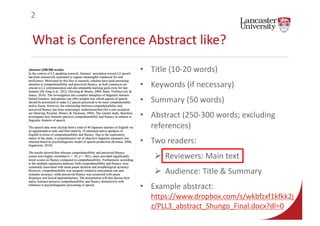
What is Conference Abstract like?
• Title (10-20 words)
• Keywords (if necessary)
• Summary (50 words)
• Abstract (250-300 words; excluding
references)
• Two readers:
Ø Reviewers: Main text
Ø Audience: Title & Summary
• Example abstract:
https://www.dropbox.com/s/wkbfzxf1kfkk2j
z/PLL3_abstract_Shungo_Final.docx?dl=0
2
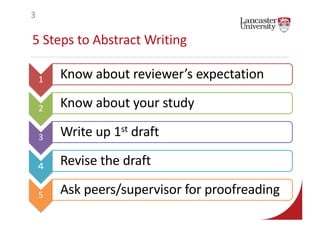
5 Steps to Abstract Writing
3
1 Know about reviewer’s expectation
2 Know about your study
3 Write up 1st draft
Revise the draft
5 Ask peers/supervisor for proofreading
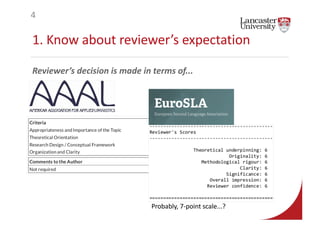
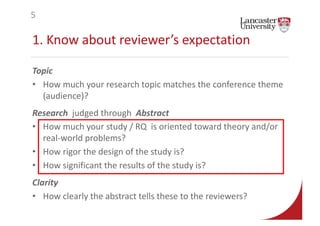
1. Know about reviewer’s expectation
Reviewer’s decision is made in terms of...
4
Probably, 7-point scale...?
1. Know about reviewer’s expectation
Topic
• How much your research topic matches the conference theme
(audience)?
Research judged through Abstract
• How much your study / RQ is oriented toward theory and/or
real-world problems?
• How rigor the design of the study is?
• How significant the results of the study is?
Clarity
• How clearly the abstract tells these to the reviewers?
5
Components of Conference Abstract
Background of Study
• Introduction (Topic)
• Literature Review
– What has been already known?
• Statement of Problems
– Any gaps or inconsistency?
– Any methodological shortcomings?
• Research Question
6
Let reviewers easily understand (a) what your study addresses
& (b) how important your RQ is.
Trigger Qs for Literature Review
• What do we already know in the research area?
• What are the characteristics of the key concepts/factors/variables?
• What are the relationships between the key
concepts/factors/variables?
• What are the existing theories?
• Where are the gaps and inconsistencies in our knowledge and
understanding?
• What views need to be further tested?
• What current research designs or methods seem unsatisfactory?
• What evidence is lacking/inconclusive/contradictory/too limited?
• What contribution is your research expected to make?
7
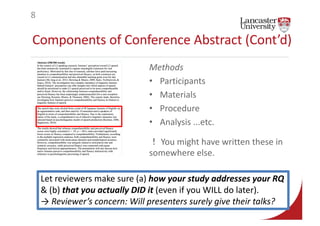
Components of Conference Abstract (Cont’d)
Methods
• Participants
• Materials
• Procedure
• Analysis ...etc.
You might have written these in
somewhere else.
8
Let reviewers make sure (a) how your study addresses your RQ
& (b) that you actually DID it (even if you WILL do later).
→ Reviewer’s concern: Will presenters surely give their talks?
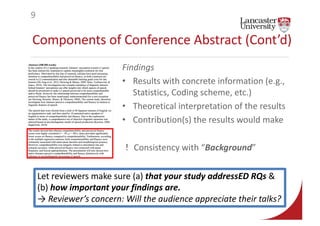
Components of Conference Abstract (Cont’d)
Findings
• Results with concrete information (e.g.,
Statistics, Coding scheme, etc.)
• Theoretical interpretation of the results
• Contribution(s) the results would make
Consistency with “Background”
9
Let reviewers make sure (a) that your study addressED RQs &
(b) how important your findings are.
→ Reviewer’s concern: Will the audience appreciate their talks?
2. Know about your study
Starting point of your research
• Can be personal experience, BUT useful for Introduction
Key findings
• Must correspond to the Results as well as RQs
Strengths
• Theoretical contributions? (Discussion & SoP)
• Methodological advances? (Discussion & SoP)
• What problems these strengths can address? (SoP)
Weaknesses
• Should be neutrally mentioned in the talk, but NOT in the
abstract due to the wordcount.
11
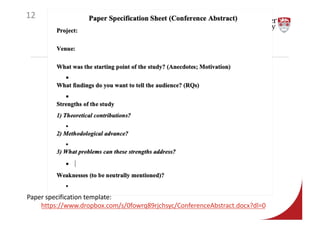
12
Paper specification template:
https://www.dropbox.com/s/0fowrq89rjchsyc/ConferenceAbstract.docx?dl=0
3. Write up 1st draft
• Brainstorming: Just list information as much as possible
– Without what to write, you CAN’T write.
• Write each information in one or two sentences
• Put them in the EXPECTED order (cf. Components of Abstract)
• Wordcount estimates
– Background: 100 words
– Methods: 100 words
– Findings: 100 words
– BUT...it depends on the strengths/highlights of your study.
14
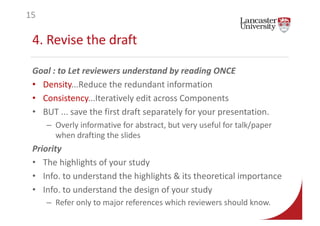
4. Revise the draft
Goal : to Let reviewers understand by reading ONCE
• Density...Reduce the redundant information
• Consistency...Iteratively edit across Components
• BUT ... save the first draft separately for your presentation.
– Overly informative for abstract, but very useful for talk/paper
when drafting the slides
Priority
• The highlights of your study
• Info. to understand the highlights & its theoretical importance
• Info. to understand the design of your study
– Refer only to major references which reviewers should know.
15
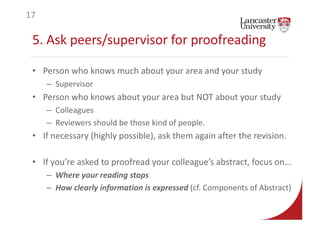
5. Ask peers/supervisor for proofreading
• Person who knows much about your area and your study
– Supervisor
• Person who knows about your area but NOT about your study
– Colleagues
– Reviewers should be those kind of people.
• If necessary (highly possible), ask them again after the revision.
• If you’re asked to proofread your colleague’s abstract, focus on...
– Where your reading stops
– How clearly information is expressed (cf. Components of Abstract)
17
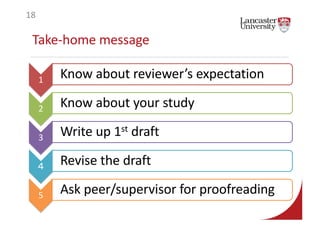
Take-home message
18
1 Know about reviewer’s expectation
2 Know about your study
3 Write up 1st draft
Revise the draft
5 Ask peer/supervisor for proofreading
One more thing...
• Science is one particular kind of communication of knowledge
only done by DISSEMINATION.
• Conference presentation is the starting point for early
researchers and also even top researchers.
• Giving presentation can be tough, but ...
It is always YOU who can share your research with our field.
19
Thank you for your attention!
Website: https://shungosuzuki.wordpress.com/
E-mail: s.suzuki@lancaster.ac.uk
Twitter: @shungosuzuki
20

Get Abstracts Accepted: Demystifying Conference Abstract Writing

  • 1.
    Get Abstracts Accepted: DemystifyingConference Abstract Writing Shungo SUZUKI PhD student / J-SLARF student chair Email: s.suzuki@lancaster.ac.uk Website: https://shungosuzuki.wordpress.com/ Twitter: @shungosuzuki 7th March, 2019 at Lancaster University New Café – Session 37 1
  • 2.
    What is ConferenceAbstract like? • Title (10-20 words) • Keywords (if necessary) • Summary (50 words) • Abstract (250-300 words; excluding references) • Two readers: Ø Reviewers: Main text Ø Audience: Title & Summary • Example abstract: https://www.dropbox.com/s/wkbfzxf1kfkk2j z/PLL3_abstract_Shungo_Final.docx?dl=0 2
  • 3.
    5 Steps toAbstract Writing 3 1 Know about reviewer’s expectation 2 Know about your study 3 Write up 1st draft Revise the draft 5 Ask peers/supervisor for proofreading
  • 4.
    1. Know aboutreviewer’s expectation Reviewer’s decision is made in terms of... 4 Probably, 7-point scale...?
  • 5.
    1. Know aboutreviewer’s expectation Topic • How much your research topic matches the conference theme (audience)? Research judged through Abstract • How much your study / RQ is oriented toward theory and/or real-world problems? • How rigor the design of the study is? • How significant the results of the study is? Clarity • How clearly the abstract tells these to the reviewers? 5
  • 6.
    Components of ConferenceAbstract Background of Study • Introduction (Topic) • Literature Review – What has been already known? • Statement of Problems – Any gaps or inconsistency? – Any methodological shortcomings? • Research Question 6 Let reviewers easily understand (a) what your study addresses & (b) how important your RQ is.
  • 7.
    Trigger Qs forLiterature Review • What do we already know in the research area? • What are the characteristics of the key concepts/factors/variables? • What are the relationships between the key concepts/factors/variables? • What are the existing theories? • Where are the gaps and inconsistencies in our knowledge and understanding? • What views need to be further tested? • What current research designs or methods seem unsatisfactory? • What evidence is lacking/inconclusive/contradictory/too limited? • What contribution is your research expected to make? 7
  • 8.
    Components of ConferenceAbstract (Cont’d) Methods • Participants • Materials • Procedure • Analysis ...etc. You might have written these in somewhere else. 8 Let reviewers make sure (a) how your study addresses your RQ & (b) that you actually DID it (even if you WILL do later). → Reviewer’s concern: Will presenters surely give their talks?
  • 9.
    Components of ConferenceAbstract (Cont’d) Findings • Results with concrete information (e.g., Statistics, Coding scheme, etc.) • Theoretical interpretation of the results • Contribution(s) the results would make Consistency with “Background” 9 Let reviewers make sure (a) that your study addressED RQs & (b) how important your findings are. → Reviewer’s concern: Will the audience appreciate their talks?
  • 10.
    2. Know aboutyour study Starting point of your research • Can be personal experience, BUT useful for Introduction Key findings • Must correspond to the Results as well as RQs Strengths • Theoretical contributions? (Discussion & SoP) • Methodological advances? (Discussion & SoP) • What problems these strengths can address? (SoP) Weaknesses • Should be neutrally mentioned in the talk, but NOT in the abstract due to the wordcount. 11
  • 11.
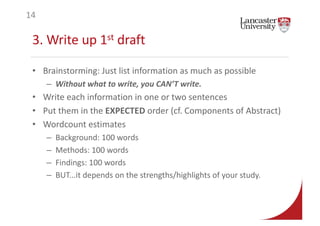
  • 12.
    3. Write up1st draft • Brainstorming: Just list information as much as possible – Without what to write, you CAN’T write. • Write each information in one or two sentences • Put them in the EXPECTED order (cf. Components of Abstract) • Wordcount estimates – Background: 100 words – Methods: 100 words – Findings: 100 words – BUT...it depends on the strengths/highlights of your study. 14
  • 13.
    4. Revise thedraft Goal : to Let reviewers understand by reading ONCE • Density...Reduce the redundant information • Consistency...Iteratively edit across Components • BUT ... save the first draft separately for your presentation. – Overly informative for abstract, but very useful for talk/paper when drafting the slides Priority • The highlights of your study • Info. to understand the highlights & its theoretical importance • Info. to understand the design of your study – Refer only to major references which reviewers should know. 15
  • 14.
    5. Ask peers/supervisorfor proofreading • Person who knows much about your area and your study – Supervisor • Person who knows about your area but NOT about your study – Colleagues – Reviewers should be those kind of people. • If necessary (highly possible), ask them again after the revision. • If you’re asked to proofread your colleague’s abstract, focus on... – Where your reading stops – How clearly information is expressed (cf. Components of Abstract) 17
  • 15.
    Take-home message 18 1 Knowabout reviewer’s expectation 2 Know about your study 3 Write up 1st draft Revise the draft 5 Ask peer/supervisor for proofreading
  • 16.
    One more thing... •Science is one particular kind of communication of knowledge only done by DISSEMINATION. • Conference presentation is the starting point for early researchers and also even top researchers. • Giving presentation can be tough, but ... It is always YOU who can share your research with our field. 19
  • 17.
    Thank you foryour attention! Website: https://shungosuzuki.wordpress.com/ E-mail: s.suzuki@lancaster.ac.uk Twitter: @shungosuzuki 20