How to Write a Technical Report Dr C. P. Jobling (C.P.Jobling@Swansea.ac.uk)
Summary This presentation describes the standard structure of a a lab report and provides a methodology for successfully producing such a report. It Includes a description of the generic structure of a report and variations on this theme. Also considers issues such as numbering, sign posting, citing and references. Includes suggestions for further reading.
Introduction Will present how to write a technical report Covers the following standard technical report sections Summary Introduction Theory Method Results Discussion of Results Conclusions Is itself structured in this way!
Introduction (Content) Defines the generic features of a technical report. Gives the specific requirements for lab reports, design documents and dissertations. Presents a methodology for writing a report. Describes signposting, captioning, quoting, citing, and referencing. Provides references that can be used for further reading.
Introduction (Contents) Theory Method Results Discussion of Results Conclusions References
Theory Why write? Theory theory Standard structure Variations on a theme Background knowledge
Why write? Students Must Write Technical Reports Lab reports Group reports Presentations Blogs and wiki pages Web sites Technical papers Project poster Project dissertation
Theory theory Technical reports have a standard structure Technical reports may not be read “cover to cover” Standard sections have evolved to same information to be extracted from document in different levels of detail! (some) Repetition and signposting is good. Section labelling, figure and table captioning, equations, references and citations.
The Standard Structure Summary of the report Purpose, approach, main findings  in brief  ( ½  – 1 page) Introduction To the  presentation  rather than the subject. Purpose of study Methodology Results Main findings & conclusions Introduction to the presentation itself
The Standard Structure Conclusions Purpose of study Methodology Results Main findings & conclusions Further work References All  the sources used and  cited  in the body of the report. Appendices Supplementary or more detailed information that supports or expands the report (possibly for reference).
Front and End Matter Give further structure and information to the report Front matter Table of Contents Table of Figures Table of Tables Abbreviations End matter Glossary Index Should be automatically generated whenever possible
Variations on a Theme Different reports will have different structures E.g. Lab report Dissertation Software design Document Refer to  references  for general guidelines Follow your publisher’s  or institution’s guidelines for specific cases
Lab Report Structure As standard + Theory Method or Experimental Procedure Results Discussion of Results It is acceptable to use “mini reports” if separation of Theory/Method/Results and Discussion would otherwise make structure awkward.
Dissertation As Standard + Background  and/or  Literature Review Method Results Discussion Detailed Front and End Matter E.g. Table of contents Table of figures Appendices
Software Design Document Standard report + Background Analysis High-level design Low level design Implementation Acceptance test results
Background Knowledge Purpose is to define what was known about the subject covered in the report before the work was done “ If I have seen further it is by standing on the shoulders of giants.” [Newton, 1675]
Theory in a Lab Report Background  is what is known or assumed Sets context for specifying what results there will be and context for their discussion. States what is expected from the experiment or study May (should?) include properly cited evidence of wider reading than contents of lecture notes, lab script. You  can  cite the script where the script provides sufficient detail. You  must  include development of formulae that are  not given in the script  that you will later rely on in the discussion!
Background for a Dissertation Assumptions Basic “textbook” knowledge of the field State of the art prior to the work Detailed discussion of any of the available technical literature text books journal articles conference proceedings web sites that added to your knowledge of the field.
Background for a Software Design Document Review of existing solutions Review of related software systems Justification for choice of programming languages and frameworks Design methodologies Non functional specifications
Theory (Review) Why write? Theory theory Standard structure Variations on a theme Background knowledge
Introduction (Contents) Theory Method Results Discussion of Results Conclusions References
Method Method of writing a report Repetition is good! How to repeat yourself Signposting Numbering Citations and References Writing a method
How to write a report Start in the middle You have done the work so you know what your approach was. You have the results so you just have to write them up! Ensure that you understand the background, write it up and use it to evaluate the results. Gather your references and ensure that they are cited in the background sections and other sections as appropriate. Write the conclusions and the introduction (in that order) Write the summary
Repetition is Good! Form of technical report has developed to allow different classes of readers to make use of the materials in different ways: Only summary may be read by a researcher looking for information or a manager seeking an “executive summary”. Only conclusions or introduction may be read by someone interested in the subject but only wanting to adopt the main findings. The whole document may be read by someone wishing to follow-up on the work published. It is important that each part tells the same story at the appropriate level of detail. Repetition  and  signposts  help the reader who is not reading the document sequentially.
How to Repeat Yourself Say what you  will say  ( in brief ) in the Summary Say what you  will say  ( in more detail ) in the introduction Say what you  have to say  ( in full in the body ) with signposting Say what you  have said  ( in the conclusions ) Emphasise the good bits in an extended abstract or executive summary
How to Signpost Open each section with a statement of context: In the [last section] we …. In [this section] we now … Close each section with a statement of context: In this [section] we …. In the [next section] we will … Provide cross references  As we saw in [a previous section] … As we will show in [a later section] …
Numbering Numbering important parts of the report helps with signposting Figure 2 shows …. Better than the figure on page 3 shows Things that should usually be numbered Parts, Chapters and Sections Figures and Tables Equations Things that can be numbered Citations
Number Sections It is easier to use signposting if you label your sections and subsections. Dissertation or larger document Part I Chapter 1. Section 1.1 Sub section 1.1.1 Report or shorter document Section 1 Subsection 1.1 Sub-subsection 1.1.1 Word processors can make section labelling automatic and cross-referencing semi-automatic.  Learn to use those features. Local rules often override general guidelines
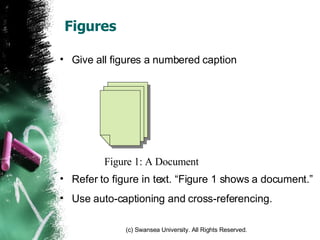
Figures Give all figures a numbered caption Refer to figure in text. “Figure 1 shows a document.” Use auto-captioning and cross-referencing. Figure 1: A Document
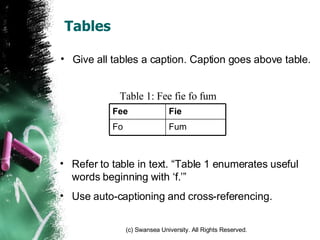
Tables Give all tables a caption. Caption goes above table. Table 1: Fee fie fo fum Refer to table in text. “Table 1 enumerates useful words beginning with ‘f.’” Use auto-captioning and cross-referencing. Fum Fo Fie Fee
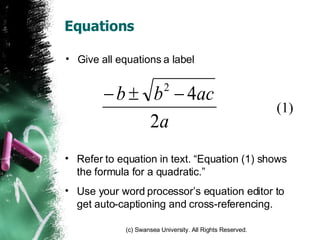
Equations Give all equations a label Refer to equation in text. “Equation (1) shows the formula for a quadratic.” Use your word processor’s equation editor to get auto-captioning and cross-referencing. (1)
Citations and References Why cite at all? A rich reference list is considered evidence of wider reading. Critical appraisal of the references with citations in the body of the report is evidence of your understanding of the materials and how your work builds on from them. Your cited sources provide a frame of reference against which you can evaluate your report’s contribution to human knowledge
Citations Two main styles: Numeric According to Shakespeare [1] winter’s discontent is now made glorious by “this son of York”. “ Now is our winter of discontent made glorious summer by this son of York” [1]. Symbolic According to Shakespeare [1597] winter’s discontent is now made glorious by “this son of York”. “ Now is our winter of discontent made glorious summer by this son of York” [Shakespeare, 1597].
Referencing Numeric Style [1] William Shakespeare,  Richard III  (Act I, Scene I), Quarto 1, 1597. Easy to use if references do not have to be sorted Difficult to maintain if references need to be presented as a sorted list. Symbolic (Harvard) Style Shakespeare, William 1597.  Richard III  (Act I, Scene I), Quarto 1. Easy to maintain a sorted list of references. More verbose when citing.
Referencing Technical Report References at end of document Poor support for “End notes” in some word processors Different publications often have different styles Consider use of a bibliographic database and citing tool to automate citing and formatting of references.
Quoting Never quote documents without citing sources. Copy-and-paste of large amounts of text, even with quotation marks and full attribution is considered plagiarism. If you like what someone had to say on a subject, rewrite it in your own words!
URLs With more of the world’s knowledge accessible via the Internet it is unrealistic to ban URLs from reference lists. Do not rely solely on hyperlinks to present URLs A paper report will not be read on a browser! Cite them like any other resource Cite them as you would a book or article. Use as much detail as possible: [1] William Shakespeare,  Richard III . Online at URL: http://www.gutenberg.org/catalog/world/readfile?fk_files=53 (Project Gutenberg., 2002)
References and Further Reading In academic circles, the  References  section could contain a  complete   list  of  all  sources  cited  in the body of the report. Other sources that you have read and that have helped inform your work but which you have  not cited  should be included in a  Bibliography  or a  Further Reading  section. References are  essential  to understanding your work. Bibliographies are sources that were useful to you and therefore  may be useful  to your readers.
Writing a Method You are  reporting  what you did so use past tense! Do not quote from the lab script:  Wrong : “take measurements of  x  and record results in your lab book” Right : “we took measurements of  x  and recorded the results in our lab book”
Don’t rewrite the instructions! It is acceptable to refer to the instructions if you did not divert from the suggested method.  But cite the original source We performed  x  as suggested on Section y (page 2) of the lab handout [2].
Passive Voice? Some publishers prefer and objective tone and “passive voice” “ Measurements were taken of x and the results were recorded in a lab book” You and your readers may find this a bit awkward Use it if you have to!
Method (Review) Method of writing a report Repetition is good! How to repeat yourself Signposting Numbering Citations and References Writing a method
Introduction (Contents) Theory Method Results Discussion of Results Conclusions References
Results Results section presents your findings. Use tables, figures and equations as appropriate. Textual commentary is needed to tie results to method. Provide explanation if necessary. Usually easiest section to write (if you recorded the results carefully!)
Introduction (Contents) Theory Method Results Discussion of Results Conclusions References
Discussion of Results Compare results to expected results Account for any differences Experimental procedure wrong Accuracy of measurements Differences may point to inaccuracies in the theory section and may point to future work. “ This result can be explained by experimental error” is  not  an explanation!  Be honest, a result that does not match the theory is itself a useful result! If there are questions in the lab script, they should be answered in this section.
Introduction (Contents) Theory Method Results Discussion of Results Conclusions References
Conclusions Remind the reader of what you were trying to achieve. Outline the theory, method, results and discussion Attempt to tie together the theory, results and discussion. Highlight the places where the theory was correct Highlight the places where the theory was incorrect Make suggestions for further work. Ensure that the conclusions stands alone because it may be the only part to be read!
Conclusions In this presentation we have: Described the structure of a technical report Presented the main sections of a lab report Provided a methodology for approaching the writing of a lab report. Given guidelines on topics such as numbering, sign posting, quoting and citing.
Introduction (Contents) Theory Method Results Discussion of Results Conclusions References
References Shakespeare, William 1597.  Richard III  (Act I, Scene I), Quarto 1. Online at URL: http://www.gutenberg.org/catalog/world/readfile?fk_files=53 (Project Gutenberg., 2002) Newton, Sir Isaac,  1675.   Letter to Robert Hooke, February 5.  As quoted online at URL: http://www.quotationspage.com/quotes/Isaac_Newton/ (The Quotationspage.com)
Further Reading Barrass, Robert 2002.  Scientists Must Write: A Guide to Better Writing for Scientists and Engineers.  Routlege Study Guides, Routledge Falmer. ISBN: 0415269962 . [In the Library T11>Bar] Rosenberg, Barry 2005.  Spring into Writing for Engineers and Scientists,  Addison Wesley.ISBN: 0131498630. Technical Writing,  Library Call Number T11 . University of Wales Swansea, Student Services Web Site,  Study Skills .
Summary Theory Method Results Discussion of Results Conclusions References

How to Write a Technical Report

  • 1.
    How to Writea Technical Report Dr C. P. Jobling (C.P.Jobling@Swansea.ac.uk)
  • 2.
    Summary This presentationdescribes the standard structure of a a lab report and provides a methodology for successfully producing such a report. It Includes a description of the generic structure of a report and variations on this theme. Also considers issues such as numbering, sign posting, citing and references. Includes suggestions for further reading.
  • 3.
    Introduction Will presenthow to write a technical report Covers the following standard technical report sections Summary Introduction Theory Method Results Discussion of Results Conclusions Is itself structured in this way!
  • 4.
    Introduction (Content) Definesthe generic features of a technical report. Gives the specific requirements for lab reports, design documents and dissertations. Presents a methodology for writing a report. Describes signposting, captioning, quoting, citing, and referencing. Provides references that can be used for further reading.
  • 5.
    Introduction (Contents) TheoryMethod Results Discussion of Results Conclusions References
  • 6.
    Introduction (Contents) TheoryMethod Results Discussion of Results Conclusions References
  • 7.
    Theory Why write?Theory theory Standard structure Variations on a theme Background knowledge
  • 8.
    Why write? StudentsMust Write Technical Reports Lab reports Group reports Presentations Blogs and wiki pages Web sites Technical papers Project poster Project dissertation
  • 9.
    Theory theory Technicalreports have a standard structure Technical reports may not be read “cover to cover” Standard sections have evolved to same information to be extracted from document in different levels of detail! (some) Repetition and signposting is good. Section labelling, figure and table captioning, equations, references and citations.
  • 10.
    The Standard StructureSummary of the report Purpose, approach, main findings in brief ( ½ – 1 page) Introduction To the presentation rather than the subject. Purpose of study Methodology Results Main findings & conclusions Introduction to the presentation itself
  • 11.
    The Standard StructureConclusions Purpose of study Methodology Results Main findings & conclusions Further work References All the sources used and cited in the body of the report. Appendices Supplementary or more detailed information that supports or expands the report (possibly for reference).
  • 12.
    Front and EndMatter Give further structure and information to the report Front matter Table of Contents Table of Figures Table of Tables Abbreviations End matter Glossary Index Should be automatically generated whenever possible
  • 13.
    Variations on aTheme Different reports will have different structures E.g. Lab report Dissertation Software design Document Refer to references for general guidelines Follow your publisher’s or institution’s guidelines for specific cases
  • 14.
    Lab Report StructureAs standard + Theory Method or Experimental Procedure Results Discussion of Results It is acceptable to use “mini reports” if separation of Theory/Method/Results and Discussion would otherwise make structure awkward.
  • 15.
    Dissertation As Standard+ Background and/or Literature Review Method Results Discussion Detailed Front and End Matter E.g. Table of contents Table of figures Appendices
  • 16.
    Software Design DocumentStandard report + Background Analysis High-level design Low level design Implementation Acceptance test results
  • 17.
    Background Knowledge Purposeis to define what was known about the subject covered in the report before the work was done “ If I have seen further it is by standing on the shoulders of giants.” [Newton, 1675]
  • 18.
    Theory in aLab Report Background is what is known or assumed Sets context for specifying what results there will be and context for their discussion. States what is expected from the experiment or study May (should?) include properly cited evidence of wider reading than contents of lecture notes, lab script. You can cite the script where the script provides sufficient detail. You must include development of formulae that are not given in the script that you will later rely on in the discussion!
  • 19.
    Background for aDissertation Assumptions Basic “textbook” knowledge of the field State of the art prior to the work Detailed discussion of any of the available technical literature text books journal articles conference proceedings web sites that added to your knowledge of the field.
  • 20.
    Background for aSoftware Design Document Review of existing solutions Review of related software systems Justification for choice of programming languages and frameworks Design methodologies Non functional specifications
  • 21.
    Theory (Review) Whywrite? Theory theory Standard structure Variations on a theme Background knowledge
  • 22.
    Introduction (Contents) TheoryMethod Results Discussion of Results Conclusions References
  • 23.
    Method Method ofwriting a report Repetition is good! How to repeat yourself Signposting Numbering Citations and References Writing a method
  • 24.
    How to writea report Start in the middle You have done the work so you know what your approach was. You have the results so you just have to write them up! Ensure that you understand the background, write it up and use it to evaluate the results. Gather your references and ensure that they are cited in the background sections and other sections as appropriate. Write the conclusions and the introduction (in that order) Write the summary
  • 25.
    Repetition is Good!Form of technical report has developed to allow different classes of readers to make use of the materials in different ways: Only summary may be read by a researcher looking for information or a manager seeking an “executive summary”. Only conclusions or introduction may be read by someone interested in the subject but only wanting to adopt the main findings. The whole document may be read by someone wishing to follow-up on the work published. It is important that each part tells the same story at the appropriate level of detail. Repetition and signposts help the reader who is not reading the document sequentially.
  • 26.
    How to RepeatYourself Say what you will say ( in brief ) in the Summary Say what you will say ( in more detail ) in the introduction Say what you have to say ( in full in the body ) with signposting Say what you have said ( in the conclusions ) Emphasise the good bits in an extended abstract or executive summary
  • 27.
    How to SignpostOpen each section with a statement of context: In the [last section] we …. In [this section] we now … Close each section with a statement of context: In this [section] we …. In the [next section] we will … Provide cross references As we saw in [a previous section] … As we will show in [a later section] …
  • 28.
    Numbering Numbering importantparts of the report helps with signposting Figure 2 shows …. Better than the figure on page 3 shows Things that should usually be numbered Parts, Chapters and Sections Figures and Tables Equations Things that can be numbered Citations
  • 29.
    Number Sections Itis easier to use signposting if you label your sections and subsections. Dissertation or larger document Part I Chapter 1. Section 1.1 Sub section 1.1.1 Report or shorter document Section 1 Subsection 1.1 Sub-subsection 1.1.1 Word processors can make section labelling automatic and cross-referencing semi-automatic. Learn to use those features. Local rules often override general guidelines
  • 30.
    Figures Give allfigures a numbered caption Refer to figure in text. “Figure 1 shows a document.” Use auto-captioning and cross-referencing. Figure 1: A Document
  • 31.
    Tables Give alltables a caption. Caption goes above table. Table 1: Fee fie fo fum Refer to table in text. “Table 1 enumerates useful words beginning with ‘f.’” Use auto-captioning and cross-referencing. Fum Fo Fie Fee
  • 32.
    Equations Give allequations a label Refer to equation in text. “Equation (1) shows the formula for a quadratic.” Use your word processor’s equation editor to get auto-captioning and cross-referencing. (1)
  • 33.
    Citations and ReferencesWhy cite at all? A rich reference list is considered evidence of wider reading. Critical appraisal of the references with citations in the body of the report is evidence of your understanding of the materials and how your work builds on from them. Your cited sources provide a frame of reference against which you can evaluate your report’s contribution to human knowledge
  • 34.
    Citations Two mainstyles: Numeric According to Shakespeare [1] winter’s discontent is now made glorious by “this son of York”. “ Now is our winter of discontent made glorious summer by this son of York” [1]. Symbolic According to Shakespeare [1597] winter’s discontent is now made glorious by “this son of York”. “ Now is our winter of discontent made glorious summer by this son of York” [Shakespeare, 1597].
  • 35.
    Referencing Numeric Style[1] William Shakespeare, Richard III (Act I, Scene I), Quarto 1, 1597. Easy to use if references do not have to be sorted Difficult to maintain if references need to be presented as a sorted list. Symbolic (Harvard) Style Shakespeare, William 1597. Richard III (Act I, Scene I), Quarto 1. Easy to maintain a sorted list of references. More verbose when citing.
  • 36.
    Referencing Technical ReportReferences at end of document Poor support for “End notes” in some word processors Different publications often have different styles Consider use of a bibliographic database and citing tool to automate citing and formatting of references.
  • 37.
    Quoting Never quotedocuments without citing sources. Copy-and-paste of large amounts of text, even with quotation marks and full attribution is considered plagiarism. If you like what someone had to say on a subject, rewrite it in your own words!
  • 38.
    URLs With moreof the world’s knowledge accessible via the Internet it is unrealistic to ban URLs from reference lists. Do not rely solely on hyperlinks to present URLs A paper report will not be read on a browser! Cite them like any other resource Cite them as you would a book or article. Use as much detail as possible: [1] William Shakespeare, Richard III . Online at URL: http://www.gutenberg.org/catalog/world/readfile?fk_files=53 (Project Gutenberg., 2002)
  • 39.
    References and FurtherReading In academic circles, the References section could contain a complete list of all sources cited in the body of the report. Other sources that you have read and that have helped inform your work but which you have not cited should be included in a Bibliography or a Further Reading section. References are essential to understanding your work. Bibliographies are sources that were useful to you and therefore may be useful to your readers.
  • 40.
    Writing a MethodYou are reporting what you did so use past tense! Do not quote from the lab script: Wrong : “take measurements of x and record results in your lab book” Right : “we took measurements of x and recorded the results in our lab book”
  • 41.
    Don’t rewrite theinstructions! It is acceptable to refer to the instructions if you did not divert from the suggested method. But cite the original source We performed x as suggested on Section y (page 2) of the lab handout [2].
  • 42.
    Passive Voice? Somepublishers prefer and objective tone and “passive voice” “ Measurements were taken of x and the results were recorded in a lab book” You and your readers may find this a bit awkward Use it if you have to!
  • 43.
    Method (Review) Methodof writing a report Repetition is good! How to repeat yourself Signposting Numbering Citations and References Writing a method
  • 44.
    Introduction (Contents) TheoryMethod Results Discussion of Results Conclusions References
  • 45.
    Results Results sectionpresents your findings. Use tables, figures and equations as appropriate. Textual commentary is needed to tie results to method. Provide explanation if necessary. Usually easiest section to write (if you recorded the results carefully!)
  • 46.
    Introduction (Contents) TheoryMethod Results Discussion of Results Conclusions References
  • 47.
    Discussion of ResultsCompare results to expected results Account for any differences Experimental procedure wrong Accuracy of measurements Differences may point to inaccuracies in the theory section and may point to future work. “ This result can be explained by experimental error” is not an explanation! Be honest, a result that does not match the theory is itself a useful result! If there are questions in the lab script, they should be answered in this section.
  • 48.
    Introduction (Contents) TheoryMethod Results Discussion of Results Conclusions References
  • 49.
    Conclusions Remind thereader of what you were trying to achieve. Outline the theory, method, results and discussion Attempt to tie together the theory, results and discussion. Highlight the places where the theory was correct Highlight the places where the theory was incorrect Make suggestions for further work. Ensure that the conclusions stands alone because it may be the only part to be read!
  • 50.
    Conclusions In thispresentation we have: Described the structure of a technical report Presented the main sections of a lab report Provided a methodology for approaching the writing of a lab report. Given guidelines on topics such as numbering, sign posting, quoting and citing.
  • 51.
    Introduction (Contents) TheoryMethod Results Discussion of Results Conclusions References
  • 52.
    References Shakespeare, William1597. Richard III (Act I, Scene I), Quarto 1. Online at URL: http://www.gutenberg.org/catalog/world/readfile?fk_files=53 (Project Gutenberg., 2002) Newton, Sir Isaac, 1675. Letter to Robert Hooke, February 5. As quoted online at URL: http://www.quotationspage.com/quotes/Isaac_Newton/ (The Quotationspage.com)
  • 53.
    Further Reading Barrass,Robert 2002. Scientists Must Write: A Guide to Better Writing for Scientists and Engineers. Routlege Study Guides, Routledge Falmer. ISBN: 0415269962 . [In the Library T11>Bar] Rosenberg, Barry 2005. Spring into Writing for Engineers and Scientists, Addison Wesley.ISBN: 0131498630. Technical Writing, Library Call Number T11 . University of Wales Swansea, Student Services Web Site, Study Skills .
  • 54.
    Summary Theory MethodResults Discussion of Results Conclusions References