Do and Don’ts of research
Key elements to Academic writing
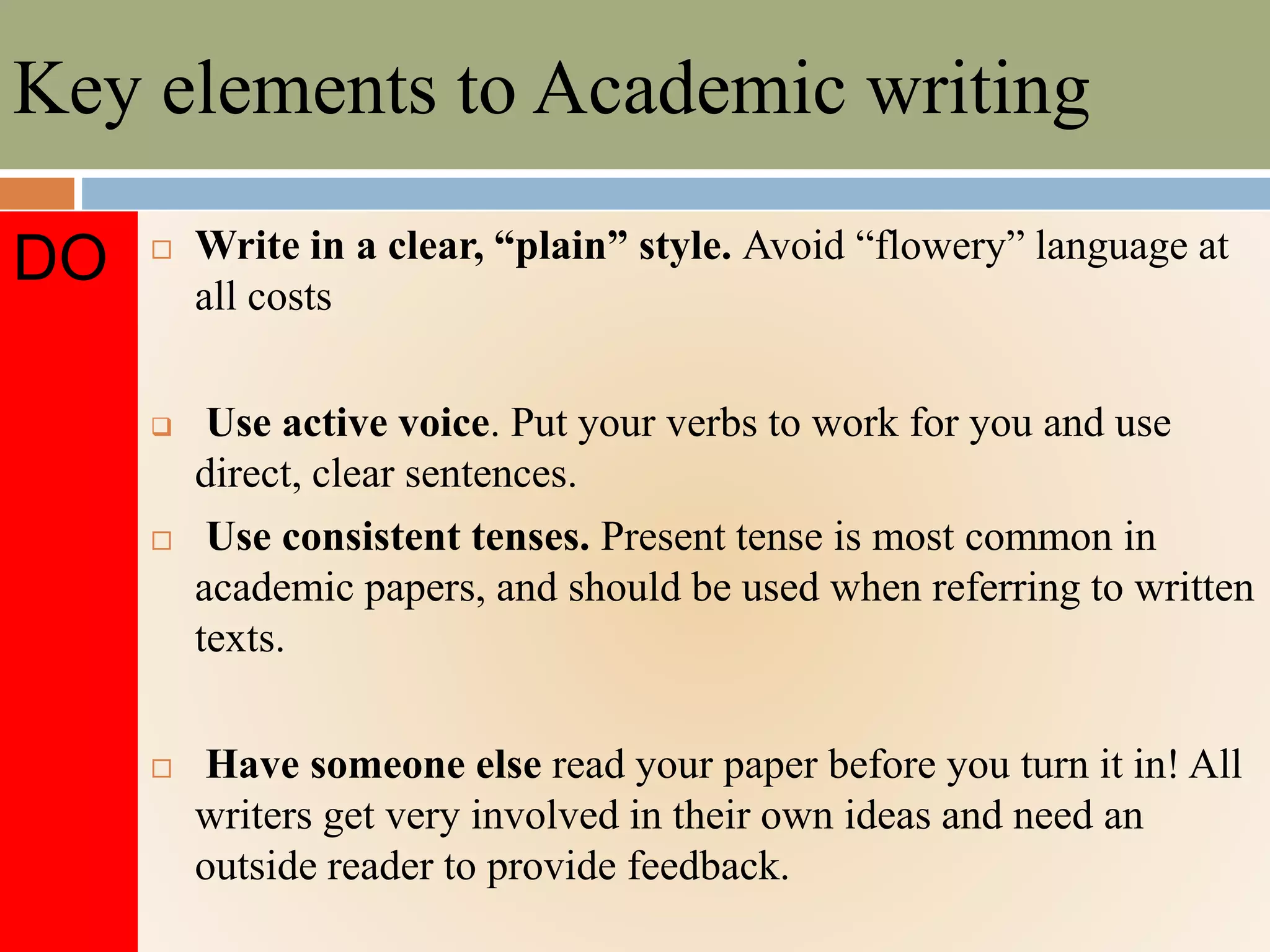
 Write in a clear, “plain” style. Avoid “flowery” language at
all costs
 Use active voice. Put your verbs to work for you and use
direct, clear sentences.
 Use consistent tenses. Present tense is most common in
academic papers, and should be used when referring to written
texts.
 Have someone else read your paper before you turn it in! All
writers get very involved in their own ideas and need an
outside reader to provide feedback.
DO
Key elements to Academic writing
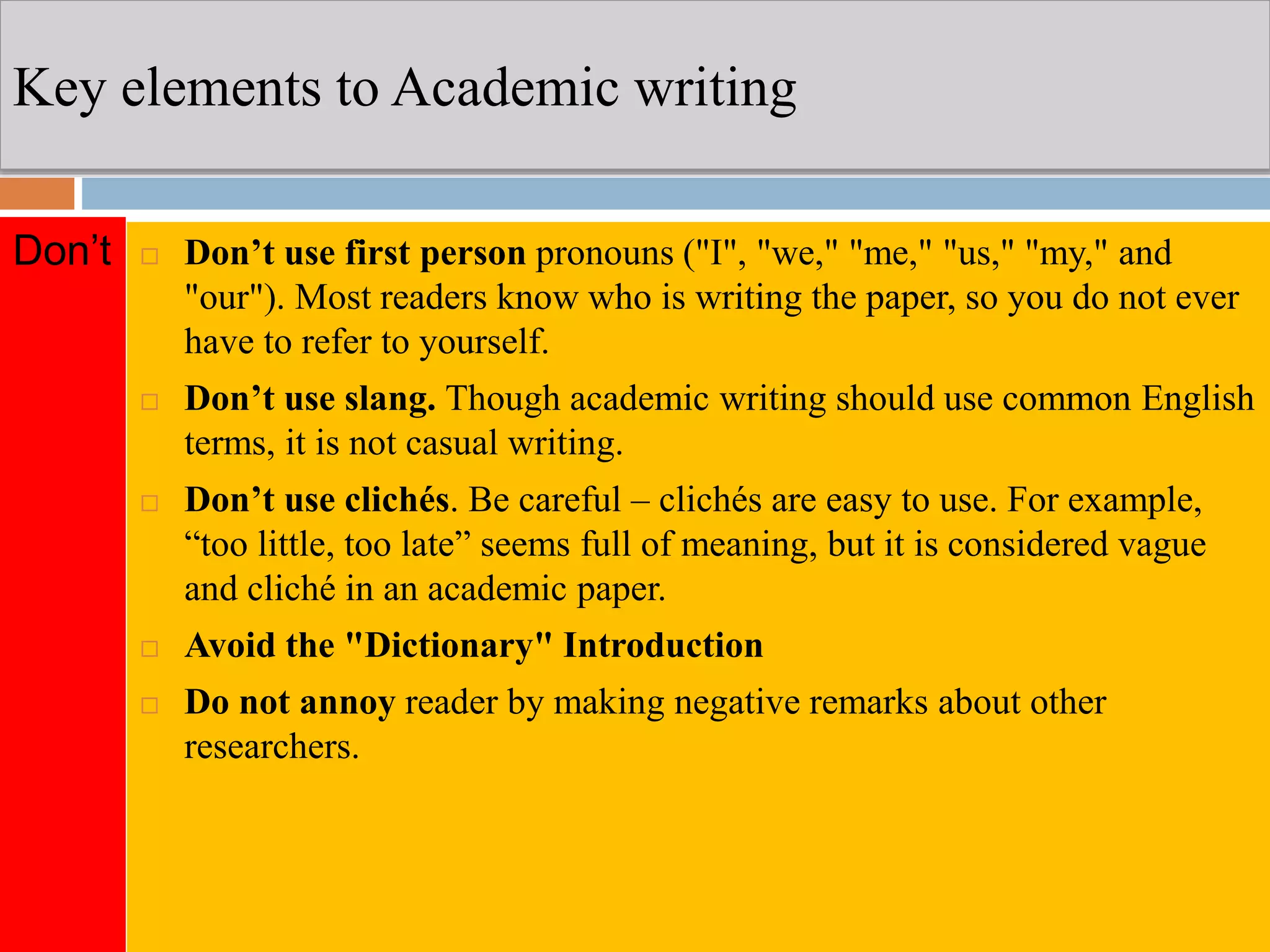
 Don’t use first person pronouns ("I", "we," "me," "us," "my," and
"our"). Most readers know who is writing the paper, so you do not ever
have to refer to yourself.
 Don’t use slang. Though academic writing should use common English
terms, it is not casual writing.
 Don’t use clichés. Be careful – clichés are easy to use. For example,
“too little, too late” seems full of meaning, but it is considered vague
and cliché in an academic paper.
 Avoid the "Dictionary" Introduction
 Do not annoy reader by making negative remarks about other
researchers.
Don’t
Don’ts
 Do not use too many abbreviations; they shorten the text but
make it more difficult to read because the reader has to
repeatedly think about what each means.
• Never start a sentence with an abbreviation.
• Do not start sentences with conjunctions (and, but, or).
• Do not use superlatives unless they appear in direct quotes
from other sources.
Identifying a Topic
The formulation of a research
problem is the first and most
important step of the research
process. A research problem is like
the foundation of a building.
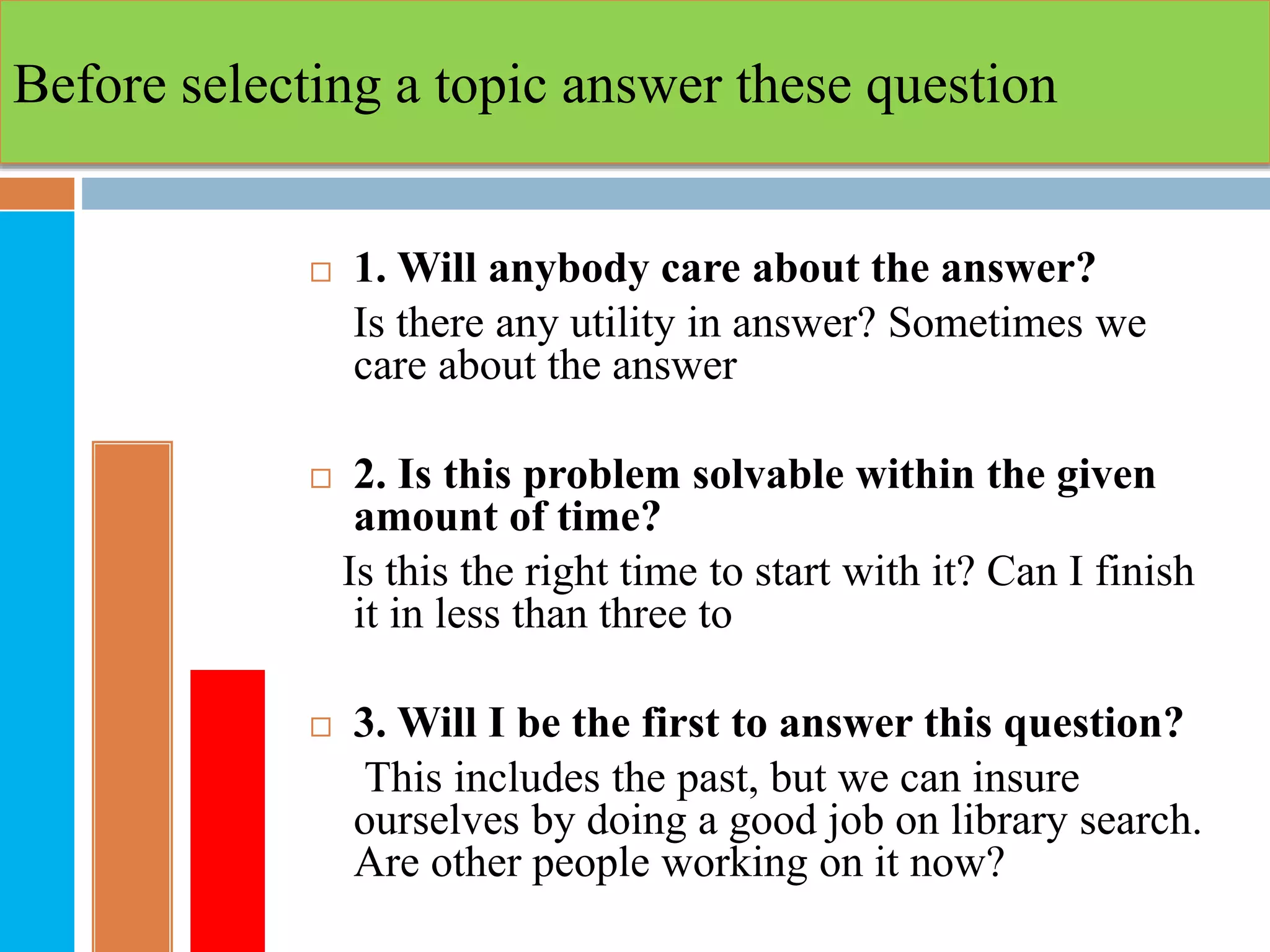
Before selecting a topic answer these question
 1. Will anybody care about the answer?
Is there any utility in answer? Sometimes we
care about the answer
 2. Is this problem solvable within the given
amount of time?
Is this the right time to start with it? Can I finish
it in less than three to
 3. Will I be the first to answer this question?
This includes the past, but we can insure
ourselves by doing a good job on library search.
Are other people working on it now?
4. Do I have good tools to address this question?
What makes me think I will be
successful?
 “Because I’m smarter than
others”(Bad)
 “Because I’m a hard
worker”(Better)
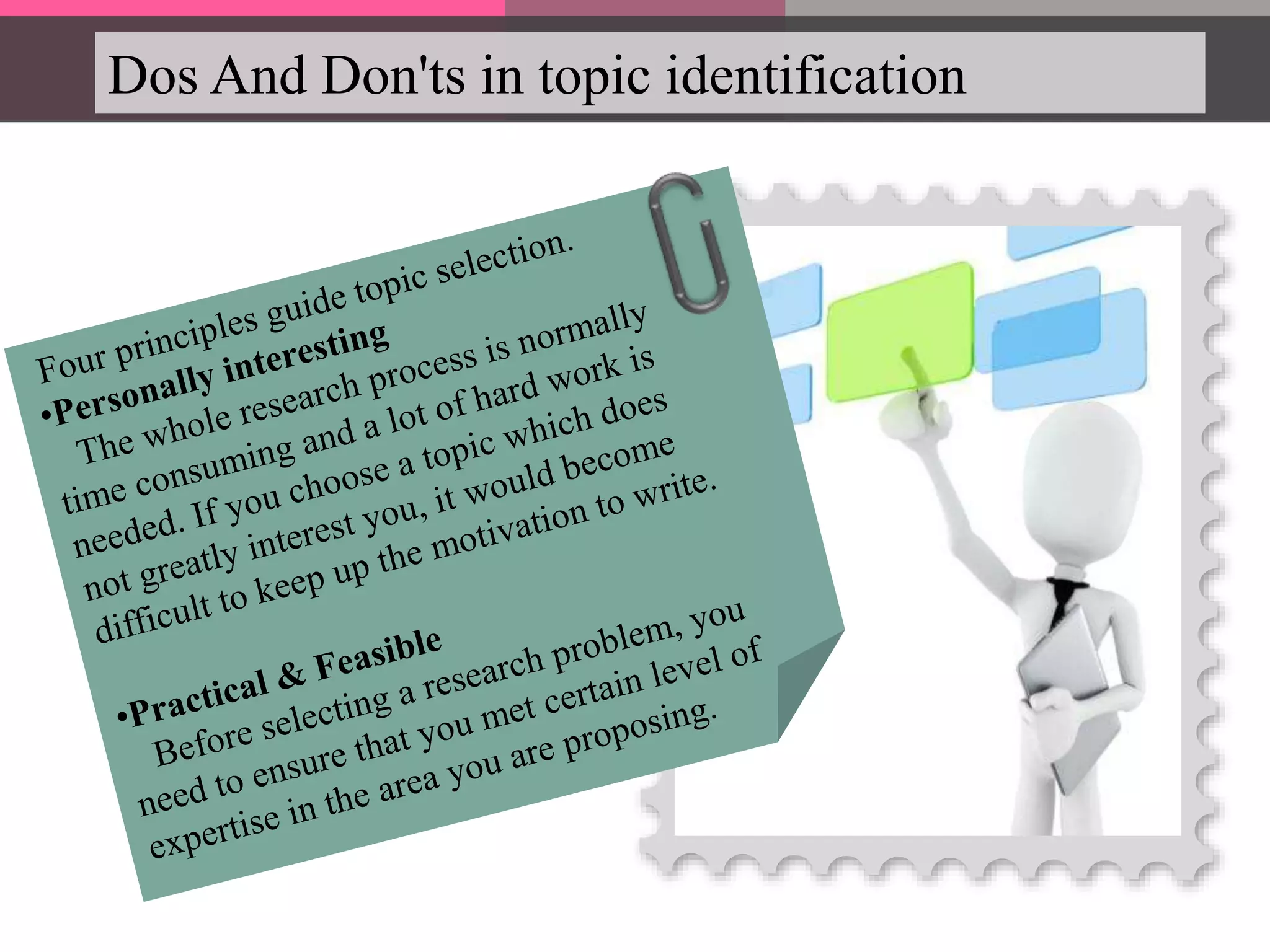
Dos And Don'ts in topic identification
Personal + Practical/Feasible + Important + Ethical
= A good topic!
That is why we say that the heart of every research
is the problem.
Literature review
Literature review
 Literature review is an organizational pattern and
combines both summary and synthesis.
 A summary is a recap of the important information,
but a synthesis is a re-organization, or a reshuffling,
of that information in a way that informs how you are
planning to investigate a research problem.
 Give a new interpretation of old material or combine
new with old interpretations.
Keep in mind these issues.
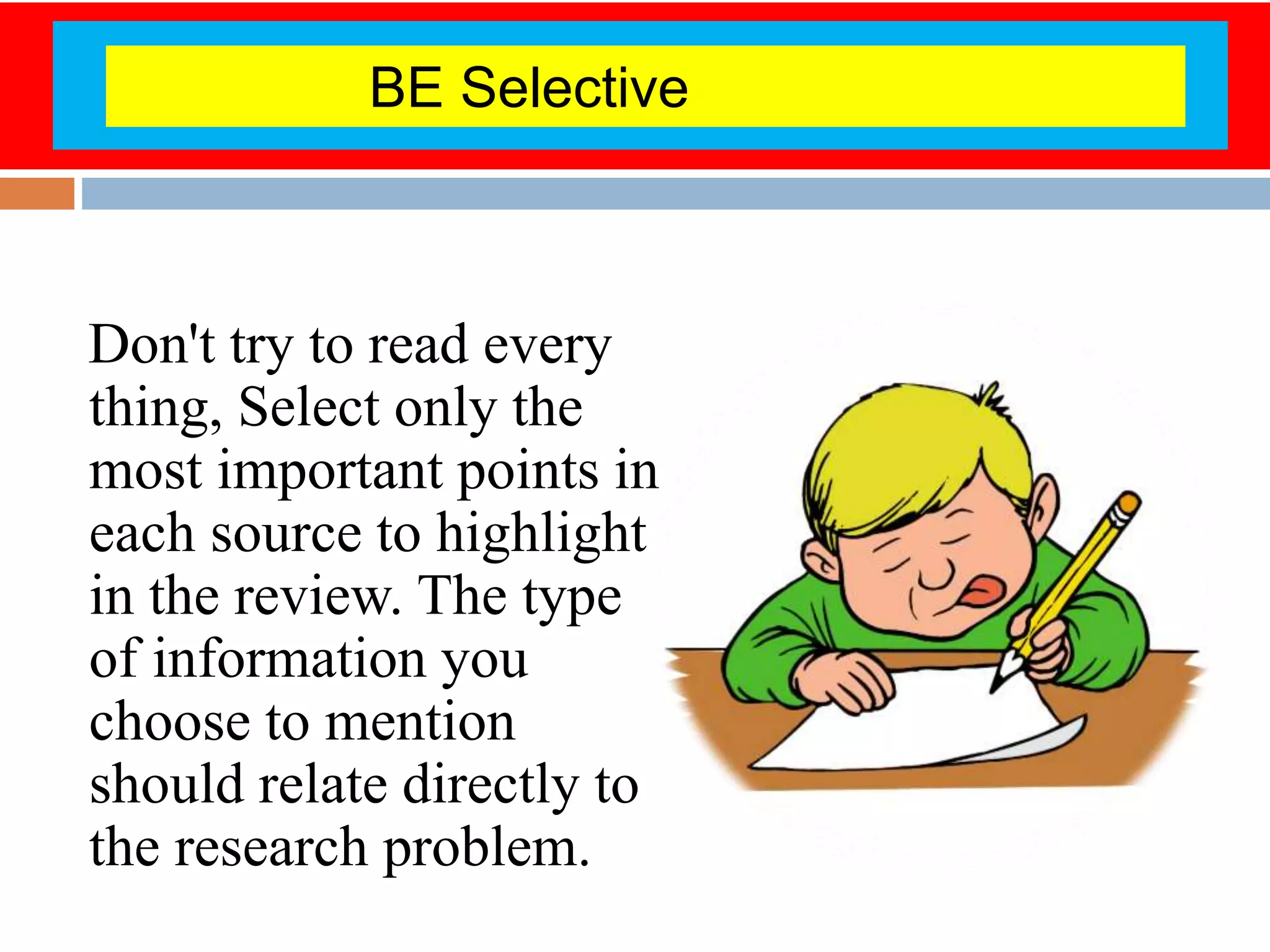
Don't try to read every
thing, Select only the
most important points in
each source to highlight
in the review. The type
of information you
choose to mention
should relate directly to
the research problem.
BE Selective
Some more Dos and Don’ts in L.R
DOs Don’ts
•Do organize your literature review so that
there is smooth change between various
studies cited.
•Don’t use a study simply because you
have it
•Do demonstrate the relationships between
the works you are citing.
•Don’t simply summarize one study after
another without demonstrating a
connection between issues/ findings
Don’t forget to proof read for grammar
and spelling errors
 Avoid using bullet points
(page 46)
TIP
Dos and Don’ts in Methodology
Does
•Ask your supervisor.
•Clearly define your methods.
Unreliable methods produce unreliable
results, which will affect the outcome of
your entire research.
Don’ts
Openly advertise your incentive
While it’s tempting to yell out that participants will
receive a $20 gift card if they just spend a little
time answering some questions, resist this urge.
People whose ears perk up for this kind of hook are
often likely to want to finish as quickly as possible
and probably won’t give you the kind of thoughtful
feedback you’re seeking.(www.ivoryresearch.com/writing-a-dissertation-methodology
http://www.catalystnyc.com/)
An effectively written methodology section should:
 Introduce the overall methodological
approach for investigating your research
problem.
Is your study qualitative or quantitative or a
combination of both (mixed method)?
Indicate how the approach fits the overall
research design.
 Your methods should have a clear connection with your
research problem. In other words, make sure that your
methods will actually address the problem. One of the
most common deficiencies found in research papers is that
the proposed methodology is not suitable to achieving the
stated objective of your paper.
Data collection
 Data collection is the systematic
approach to gathering and measuring
information from a variety of sources to
get a complete and accurate picture of an
area of interest..(http://searchcio.techtarget.com/)
Describe the specific methods of data collection you are
going to use.
Will you use
statistical
analysis.
How you intend to analyze your results.
 The present study is descriptive in nature. For
conducting the research, data have been collected
from both primary and secondary sources. The
primary data have been collected through a
structured questionnaire with a Likert type 5
point scale and applying a simple random
sampling method in selecting respondents.
Respondents of the study were 100 personal care
product manufacturers in Malaysia. Statistical
Package of Social Sciences (SPSS) was used for
analyzing the data.
 Are there any practical limitations that could affect
your research process.
Describe potential limitations.
The methodology section of your paper should be
thorough but to the point. Do not provide any
background information that doesn’t directly help the
reader to understand why a particular method was
chosen.
Problems to Avoid
Problems to avoid
Remember that you are not writing a how-to guide
about a particular method. You should make the
assumption that readers possess a basic understanding
of how to investigate the research problem on their own
and, therefore, you do not have to go into great detail
about specific methodological procedures. The focus
should be on how you applied a method, not on the
mechanics of doing a method.
Result
The results section is where you report the
findings of your study based upon the
methodology you applied to gather information.
Result
•Organize the layout of the results
section in the same way you structured
the research questions in your research
project.
•This will make it easier for the readers
to follow your results.
Organize the layout (Dos)
Use of the past tense when referring to
your results
Example;
The literature is very useful to gain additional insight and add
knowledge for this conceptual paper. The literature enables to
provide results on the role of green innovation and green
promotion as a marketing strategy. Based on the literature, it
was found that other than green innovation and green
promotion, marketing mix comprises of product, pricing,
distribution and promotion also applied as a green marketing
strategy. Following an exhaustive review, it can be concluded
that, the green marketing strategy contributes to the firms’
profitability, competitive advantage and encourage a greener
pattern of consumption among consumers.
Don’ts
• Things not
do in
result
Discussing or interpreting your resultsIgnoring negative resultsrepeating the same information more than once.Confusing figures with tables.
Conclusion
 The conclusion is intended to help the
reader understand why your research
should matter to them after they have
finished reading the paper. A
conclusion is not merely a summary,
but a synthesis of key points and, where
you recommend new areas for future
research
Identifying how a gap in the literature has been
addressed
It should
consider
 The conclusion can
be where you
describe how a
previously identified
gap in the literature
[described in your
literature review
section] has been
filled by your
research
 Demonstrating the importance of your ideas.
The conclusion offers you the opportunity to
elaborate on the impact and significance of your
findings.
Relates the finding to those of similar studies.
Things to
Avoid
 Failure to be concise
The conclusion section should be
concise and to the point. Conclusions
that are too lengthy often have
unnecessary information in them. The
conclusion is not the place for details
about your methodology or results.
Things to
Avoid
 Failure to comment on larger, more
significant issues
In the introduction, your task was to
move from general to specific [your
research problem]. However, in the
conclusion, your task is to move from a
specific discussion [your research
problem] back to a general discussion.
Do and donts Of the research

Do and donts Of the research

  • 1.
    Do and Don’tsof research
  • 2.
    Key elements toAcademic writing  Write in a clear, “plain” style. Avoid “flowery” language at all costs  Use active voice. Put your verbs to work for you and use direct, clear sentences.  Use consistent tenses. Present tense is most common in academic papers, and should be used when referring to written texts.  Have someone else read your paper before you turn it in! All writers get very involved in their own ideas and need an outside reader to provide feedback. DO
  • 3.
    Key elements toAcademic writing  Don’t use first person pronouns ("I", "we," "me," "us," "my," and "our"). Most readers know who is writing the paper, so you do not ever have to refer to yourself.  Don’t use slang. Though academic writing should use common English terms, it is not casual writing.  Don’t use clichés. Be careful – clichés are easy to use. For example, “too little, too late” seems full of meaning, but it is considered vague and cliché in an academic paper.  Avoid the "Dictionary" Introduction  Do not annoy reader by making negative remarks about other researchers. Don’t
  • 4.
    Don’ts  Do notuse too many abbreviations; they shorten the text but make it more difficult to read because the reader has to repeatedly think about what each means. • Never start a sentence with an abbreviation. • Do not start sentences with conjunctions (and, but, or). • Do not use superlatives unless they appear in direct quotes from other sources.
  • 5.
    Identifying a Topic Theformulation of a research problem is the first and most important step of the research process. A research problem is like the foundation of a building.
  • 6.
    Before selecting atopic answer these question  1. Will anybody care about the answer? Is there any utility in answer? Sometimes we care about the answer  2. Is this problem solvable within the given amount of time? Is this the right time to start with it? Can I finish it in less than three to  3. Will I be the first to answer this question? This includes the past, but we can insure ourselves by doing a good job on library search. Are other people working on it now?
  • 7.
    4. Do Ihave good tools to address this question? What makes me think I will be successful?  “Because I’m smarter than others”(Bad)  “Because I’m a hard worker”(Better)
  • 8.
    Dos And Don'tsin topic identification
  • 9.
    Dos And Don'tsin topic identification
  • 10.
    Personal + Practical/Feasible+ Important + Ethical = A good topic! That is why we say that the heart of every research is the problem.
  • 11.
  • 12.
    Literature review  Literaturereview is an organizational pattern and combines both summary and synthesis.  A summary is a recap of the important information, but a synthesis is a re-organization, or a reshuffling, of that information in a way that informs how you are planning to investigate a research problem.  Give a new interpretation of old material or combine new with old interpretations.
  • 13.
    Keep in mindthese issues.
  • 14.
    Don't try toread every thing, Select only the most important points in each source to highlight in the review. The type of information you choose to mention should relate directly to the research problem. BE Selective
  • 15.
    Some more Dosand Don’ts in L.R DOs Don’ts •Do organize your literature review so that there is smooth change between various studies cited. •Don’t use a study simply because you have it •Do demonstrate the relationships between the works you are citing. •Don’t simply summarize one study after another without demonstrating a connection between issues/ findings Don’t forget to proof read for grammar and spelling errors
  • 16.
     Avoid usingbullet points (page 46) TIP
  • 17.
    Dos and Don’tsin Methodology
  • 18.
    Does •Ask your supervisor. •Clearlydefine your methods. Unreliable methods produce unreliable results, which will affect the outcome of your entire research.
  • 19.
    Don’ts Openly advertise yourincentive While it’s tempting to yell out that participants will receive a $20 gift card if they just spend a little time answering some questions, resist this urge. People whose ears perk up for this kind of hook are often likely to want to finish as quickly as possible and probably won’t give you the kind of thoughtful feedback you’re seeking.(www.ivoryresearch.com/writing-a-dissertation-methodology http://www.catalystnyc.com/)
  • 20.
    An effectively writtenmethodology section should:  Introduce the overall methodological approach for investigating your research problem. Is your study qualitative or quantitative or a combination of both (mixed method)?
  • 21.
    Indicate how theapproach fits the overall research design.  Your methods should have a clear connection with your research problem. In other words, make sure that your methods will actually address the problem. One of the most common deficiencies found in research papers is that the proposed methodology is not suitable to achieving the stated objective of your paper.
  • 22.
  • 23.
     Data collectionis the systematic approach to gathering and measuring information from a variety of sources to get a complete and accurate picture of an area of interest..(http://searchcio.techtarget.com/)
  • 24.
    Describe the specificmethods of data collection you are going to use.
  • 25.
    Will you use statistical analysis. Howyou intend to analyze your results.
  • 26.
     The presentstudy is descriptive in nature. For conducting the research, data have been collected from both primary and secondary sources. The primary data have been collected through a structured questionnaire with a Likert type 5 point scale and applying a simple random sampling method in selecting respondents. Respondents of the study were 100 personal care product manufacturers in Malaysia. Statistical Package of Social Sciences (SPSS) was used for analyzing the data.
  • 27.
     Are thereany practical limitations that could affect your research process. Describe potential limitations.
  • 28.
    The methodology sectionof your paper should be thorough but to the point. Do not provide any background information that doesn’t directly help the reader to understand why a particular method was chosen. Problems to Avoid
  • 29.
    Problems to avoid Rememberthat you are not writing a how-to guide about a particular method. You should make the assumption that readers possess a basic understanding of how to investigate the research problem on their own and, therefore, you do not have to go into great detail about specific methodological procedures. The focus should be on how you applied a method, not on the mechanics of doing a method.
  • 30.
  • 31.
    The results sectionis where you report the findings of your study based upon the methodology you applied to gather information. Result
  • 32.
    •Organize the layoutof the results section in the same way you structured the research questions in your research project. •This will make it easier for the readers to follow your results. Organize the layout (Dos)
  • 33.
    Use of thepast tense when referring to your results Example; The literature is very useful to gain additional insight and add knowledge for this conceptual paper. The literature enables to provide results on the role of green innovation and green promotion as a marketing strategy. Based on the literature, it was found that other than green innovation and green promotion, marketing mix comprises of product, pricing, distribution and promotion also applied as a green marketing strategy. Following an exhaustive review, it can be concluded that, the green marketing strategy contributes to the firms’ profitability, competitive advantage and encourage a greener pattern of consumption among consumers.
  • 34.
  • 35.
    Discussing or interpretingyour resultsIgnoring negative resultsrepeating the same information more than once.Confusing figures with tables.
  • 36.
  • 37.
     The conclusionis intended to help the reader understand why your research should matter to them after they have finished reading the paper. A conclusion is not merely a summary, but a synthesis of key points and, where you recommend new areas for future research
  • 38.
    Identifying how agap in the literature has been addressed It should consider  The conclusion can be where you describe how a previously identified gap in the literature [described in your literature review section] has been filled by your research
  • 39.
     Demonstrating theimportance of your ideas. The conclusion offers you the opportunity to elaborate on the impact and significance of your findings.
  • 40.
    Relates the findingto those of similar studies.
  • 41.
    Things to Avoid  Failureto be concise The conclusion section should be concise and to the point. Conclusions that are too lengthy often have unnecessary information in them. The conclusion is not the place for details about your methodology or results.
  • 42.
    Things to Avoid  Failureto comment on larger, more significant issues In the introduction, your task was to move from general to specific [your research problem]. However, in the conclusion, your task is to move from a specific discussion [your research problem] back to a general discussion.

Editor's Notes

  • #3 This study is one of the million 1; Writing is a tool used to convey the story, it is not the story itself.  She made a negative evaluation of his physical appearance. =She thought he was ugly.
  • #4 Avoid the "Dictionary" Introduction Giving the dictionary definition of words related to the research problem may appear appropriate because it is important to define specific terminology that readers may be unfamilar with. However, anyone can look a word up in the dictionary and a general dictionary is not a particularly authoritative source because it doesn't take into account the context of your topic and doesn't offer particularly detailed information. Also, placed in the context of a particular discipline, a term or concept may have a different meaning than what is found in a general dictionary. If you feel that you must seek out an authoritative definition, use a subject specific dictionary or encylopedia Slang allows a person to become creative in the use of language. Some people use slang in order to communicate with each other informally. Similarly, people using slang are able to identify other members of their subculture easily.
  • #13 To synthesize is to combine two or more elements to form a new whole. In the literature review, the “elements” are the findings of the literature you gather and read; the “new whole” is the conclusion you draw from those findings
  • #19 Your project supervisor will be used to advising students on each chapter of their dissertation, including the methodology. They will be able to help you identify potential flaws in your choices and point you in the right direction of key resources.