Determining the Research Design
Objectives

   To identify a research problem
   To assess the availability of information
   To develop a theoretical framework
   To write a research proposal
Overview of Research Design

   Identify research problem
   Determine purpose of the research
   Develop theoretical framework
   Define research question/hypothesis
   Define terms
   Identify limitations of study
   Decide methodology
   Determine expected outcome
Identifying a research problem

   Read literature, reflect and discuss, identify gaps

   Generate list of interesting potential questions

   Check literature, have questions been answered already?

   Test feasibility

   Eliminate impractical questions?

   Does a suitable problem exist?
Availability of Data

   Search literature in relevant libraries and
    databases.
   Search official statistics and industry
    publications
   Search company or business data
   Conduct surveys
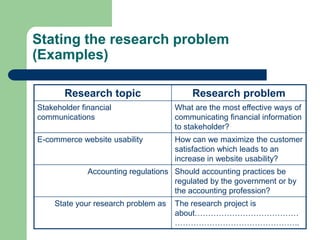
Stating the research problem
(Examples)

       Research topic                     Research problem
Stakeholder financial                What are the most effective ways of
communications                       communicating financial information
                                     to stakeholder?
E-commerce website usability         How can we maximize the customer
                                     satisfaction which leads to an
                                     increase in website usability?
              Accounting regulations Should accounting practices be
                                     regulated by the government or by
                                     the accounting profession?
    State your research problem as   The research project is
                                     about…………………………………
                                     ………………………………………..
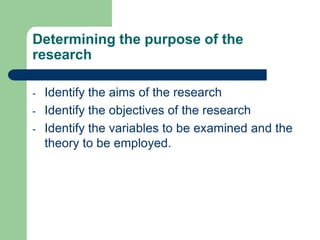
Determining the purpose of the
research

-   Identify the aims of the research
-   Identify the objectives of the research
-   Identify the variables to be examined and the
    theory to be employed.
Developing theoretical framework

   It is a collection of theories and models from
    the literature which underpins research
    study.
   It explains the research questions or
    hypothesis.
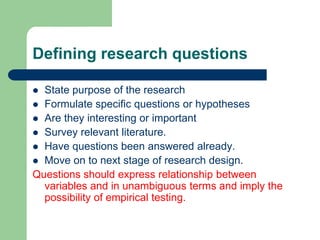
Defining research questions

 State purpose of the research
 Formulate specific questions or hypotheses
 Are they interesting or important
 Survey relevant literature.
 Have questions been answered already.
 Move on to next stage of research design.
Questions should express relationship between
  variables and in unambiguous terms and imply the
  possibility of empirical testing.
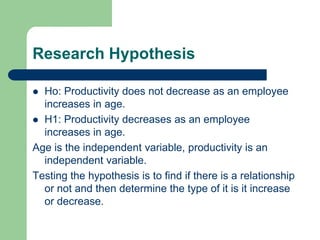
Research Hypothesis

 Ho: Productivity does not decrease as an employee
  increases in age.
 H1: Productivity decreases as an employee
  increases in age.
Age is the independent variable, productivity is an
  independent variable.
Testing the hypothesis is to find if there is a relationship
  or not and then determine the type of it is it increase
  or decrease.
Defining Terms


   Define each term when first used.

   Ensure the consistency in using terms.
Identify limitations and delimitations

   Limitation indentifies potential weaknesses in
    the research.

   Delimitation explains how the scope of the
    study is focused on one particular area. As
    you may confine your interviews to
    employees in only one company, or your
    postal questionnaire to a particular
    geographical area.
Deciding the methodology

   Quantitative

   Qualitative

   Experiment
Principles of good research &
   Research proposal guide
Principles of Good Research
The following factors are common to all good
  pieces of research


   There is a clear statement of research aims, which defines the research
    question.
   There is an information sheet for participants, which sets out clearly
    what the research is about, what it will involve and consent is obtained
    in writing on a consent form prior to research beginning.

   The methodology is appropriate to the research question. So, if the
    research is into people’s perceptions, a more qualitative, unstructured
    interview may be appropriate. If the research aims to identify the scale
    of a problem or need, a more quantitative, randomised, statistical
    sample survey may be more appropriate. Good research can often use
    a combination of methodologies, which complement one another.
Principles of Good Research (con.)


•    The research should be carried out in an unbiased fashion. As
     far as possible the researcher should not influence the results of
     the research in any way. If this is likely, it needs to be addressed
     explicitly and systematically.
•    From the beginning, the research should have appropriate and
     sufficient resources in terms of people, time, transport, money
     etc. allocated to it.
    The people conducting the research should be trained in
     research and research methods and this training should provide:
    Knowledge around appropriate information gathering
     techniques.
    An understanding of research issues.
    An understanding of the research area
Principles of Good Research (con.)


•   Those involved in designing, conducting, analysing and
    supervising the research should have a full understanding of the
    subject area.

•   In some instances, it helps if the researcher has experience of
    working in the area. However, this can also be a negative
    factor, as sometimes research benefits from the fresh eyes and
    ears of an outsider, which may lead to less bias.

•   All research should be ethical and not harmful in any way to the
    participants.
Research Proposal Guide
1.Background


   Why is this research important?
   What other studies have there been in this area?
   How will this research add to knowledge in this area?
   What do you want to find out?
   What is the main question you wish to answer?
   What are the specific questions you will ask to
    address the main question?
Research Proposal Guide (con.)
              How will you do your research?


   Will you be doing this research on your own or with others?
   Have you provided full details of anyone else you intend to carry out this
    research with, including fieldworkers?
   Who are you targeting in this research?
   How many people do you intend to interview or
   read through?
   Where will the research take place?
   Will participants be clearly and fully informed of the purpose
   of the research study?
   How will you do this?
   How will participants be clear about the expectations of the
   researcher?
   Do you have an information sheet and a consent form for
   participants?
   Supervisory arrangements - how do you intend your research to be supervised
    and monitored and by whom? Who will be funding your research?
Research Proposal Guide (con.)

Timetable

   When will your research start and finish?
   Are there particular stages to the research - e.g. piloting, then
    main research?
   If so, what are they?
   Is the timetable realistic?
   Is it influenced by external constraints or deadlines?
   How will you provide regular updates and progress reports and
    to whom will you provide them?
Research Proposal Guide (con.)

Methodology


What is the main method you will use to carry
  out the research - e.g. questionnaire, face-to-
  face interviews, focus groups, paper reviews
  etc.?
 How will you select your sample?
 How will you collect your data?
 How will you analyze your data?
Research Proposal Guide (con.)
Ethical Issues


   Is there any potential risk or harm to participants or yourself?

   If so, what are the potential risks and what do you intend to do to
    reduce them?
   Do you need to obtain informed consent?
   Where informed consent is unable to be provided, what will you
    do?
   How will your research comply with equal opportunities?
Research Proposal Guide (con.)
Data Protection

   Will you be using recording or video equipment?
   How will you make sense of or analyse the data?
   How will the data be stored?
   For how long will the data be stored?
   How will it be disposed of?
   How will you ensure confidentiality and anonymity of data?
   Who will have ultimate ownership of the data?
   Are you or do you need to be registered under the Data
    Protection Act 1998?

Writing research proposal

  • 1.
  • 2.
    Objectives  To identify a research problem  To assess the availability of information  To develop a theoretical framework  To write a research proposal
  • 3.
    Overview of ResearchDesign  Identify research problem  Determine purpose of the research  Develop theoretical framework  Define research question/hypothesis  Define terms  Identify limitations of study  Decide methodology  Determine expected outcome
  • 4.
    Identifying a researchproblem  Read literature, reflect and discuss, identify gaps  Generate list of interesting potential questions  Check literature, have questions been answered already?  Test feasibility  Eliminate impractical questions?  Does a suitable problem exist?
  • 5.
    Availability of Data  Search literature in relevant libraries and databases.  Search official statistics and industry publications  Search company or business data  Conduct surveys
  • 6.
    Stating the researchproblem (Examples) Research topic Research problem Stakeholder financial What are the most effective ways of communications communicating financial information to stakeholder? E-commerce website usability How can we maximize the customer satisfaction which leads to an increase in website usability? Accounting regulations Should accounting practices be regulated by the government or by the accounting profession? State your research problem as The research project is about………………………………… ………………………………………..
  • 7.
    Determining the purposeof the research - Identify the aims of the research - Identify the objectives of the research - Identify the variables to be examined and the theory to be employed.
  • 8.
    Developing theoretical framework  It is a collection of theories and models from the literature which underpins research study.  It explains the research questions or hypothesis.
  • 9.
    Defining research questions State purpose of the research  Formulate specific questions or hypotheses  Are they interesting or important  Survey relevant literature.  Have questions been answered already.  Move on to next stage of research design. Questions should express relationship between variables and in unambiguous terms and imply the possibility of empirical testing.
  • 10.
    Research Hypothesis  Ho:Productivity does not decrease as an employee increases in age.  H1: Productivity decreases as an employee increases in age. Age is the independent variable, productivity is an independent variable. Testing the hypothesis is to find if there is a relationship or not and then determine the type of it is it increase or decrease.
  • 11.
    Defining Terms  Define each term when first used.  Ensure the consistency in using terms.
  • 12.
    Identify limitations anddelimitations  Limitation indentifies potential weaknesses in the research.  Delimitation explains how the scope of the study is focused on one particular area. As you may confine your interviews to employees in only one company, or your postal questionnaire to a particular geographical area.
  • 13.
    Deciding the methodology  Quantitative  Qualitative  Experiment
  • 14.
    Principles of goodresearch & Research proposal guide
  • 15.
    Principles of GoodResearch The following factors are common to all good pieces of research  There is a clear statement of research aims, which defines the research question.  There is an information sheet for participants, which sets out clearly what the research is about, what it will involve and consent is obtained in writing on a consent form prior to research beginning.  The methodology is appropriate to the research question. So, if the research is into people’s perceptions, a more qualitative, unstructured interview may be appropriate. If the research aims to identify the scale of a problem or need, a more quantitative, randomised, statistical sample survey may be more appropriate. Good research can often use a combination of methodologies, which complement one another.
  • 16.
    Principles of GoodResearch (con.) • The research should be carried out in an unbiased fashion. As far as possible the researcher should not influence the results of the research in any way. If this is likely, it needs to be addressed explicitly and systematically. • From the beginning, the research should have appropriate and sufficient resources in terms of people, time, transport, money etc. allocated to it.  The people conducting the research should be trained in research and research methods and this training should provide:  Knowledge around appropriate information gathering techniques.  An understanding of research issues.  An understanding of the research area
  • 17.
    Principles of GoodResearch (con.) • Those involved in designing, conducting, analysing and supervising the research should have a full understanding of the subject area. • In some instances, it helps if the researcher has experience of working in the area. However, this can also be a negative factor, as sometimes research benefits from the fresh eyes and ears of an outsider, which may lead to less bias. • All research should be ethical and not harmful in any way to the participants.
  • 18.
    Research Proposal Guide 1.Background  Why is this research important?  What other studies have there been in this area?  How will this research add to knowledge in this area?  What do you want to find out?  What is the main question you wish to answer?  What are the specific questions you will ask to address the main question?
  • 19.
    Research Proposal Guide(con.) How will you do your research?  Will you be doing this research on your own or with others?  Have you provided full details of anyone else you intend to carry out this research with, including fieldworkers?  Who are you targeting in this research?  How many people do you intend to interview or  read through?  Where will the research take place?  Will participants be clearly and fully informed of the purpose  of the research study?  How will you do this?  How will participants be clear about the expectations of the  researcher?  Do you have an information sheet and a consent form for  participants?  Supervisory arrangements - how do you intend your research to be supervised and monitored and by whom? Who will be funding your research?
  • 20.
    Research Proposal Guide(con.) Timetable  When will your research start and finish?  Are there particular stages to the research - e.g. piloting, then main research?  If so, what are they?  Is the timetable realistic?  Is it influenced by external constraints or deadlines?  How will you provide regular updates and progress reports and to whom will you provide them?
  • 21.
    Research Proposal Guide(con.) Methodology What is the main method you will use to carry out the research - e.g. questionnaire, face-to- face interviews, focus groups, paper reviews etc.?  How will you select your sample?  How will you collect your data?  How will you analyze your data?
  • 22.
    Research Proposal Guide(con.) Ethical Issues  Is there any potential risk or harm to participants or yourself?  If so, what are the potential risks and what do you intend to do to reduce them?  Do you need to obtain informed consent?  Where informed consent is unable to be provided, what will you do?  How will your research comply with equal opportunities?
  • 23.
    Research Proposal Guide(con.) Data Protection  Will you be using recording or video equipment?  How will you make sense of or analyse the data?  How will the data be stored?  For how long will the data be stored?  How will it be disposed of?  How will you ensure confidentiality and anonymity of data?  Who will have ultimate ownership of the data?  Are you or do you need to be registered under the Data Protection Act 1998?