WRITING A RESEARCH PROJECT PROPOSAL
Professor Divya Upadhyaya Joshi
Director UGC-HRDC
Kumaun University,Nainital,Uttarakhand-263001
Contact: divyauj@gmail.com
Introduction
 Imperative that faculty members in HEI /researchers be able to
formulate and write a research proposal(RP)
 Submit the RP to a funding agency for financial support for their
research
 Most funding agencies in India require the researcher to submit
a proposal in a prescribed format.
 Major funding agencies include UGC,ICSSR,DST,ICHR,CSIR,etc
Elements of a proposal
A proposal generally has the following elements:
 Project Title
 Introduction
 Statement of problem
 Research Question
 Origin of the research problem
 Inter - disciplinary relevance
 Review of literature (Status of R & D )
 International & National
 Significance of study
 Objectives of study
 Methodology
 Time Plan
 Budget
 References & Bibliography
*Could include Hypothesis
Preparing a Project Proposal
 The sequence of the material in the project proposal
varies according to the different prescribed formats
of the funding agencies
 Most agencies are asking for online submission
 Prepare the proposal very carefully in a word
document and then start uploading online
 Always check,revise and edit several times before
submitting
 Be very careful about language and typos
Cover Page (For off-line
submissions & HRDC assignments)
The cover page should include :
 Name of funding agency and category of
project
 Title of proposed work
 Name , designation and affiliation of
researcher
 Address for correspondence/contact
including E-mail
 Year of submission
Choosing a Topic
 In choosing a topic, reflect on what really
interests you.
 The contemporary relevance of the topic
chosen for research.
 Before you finalize the topic, decide what is
practically possible in terms of the primary
and secondary data which would provide the
basis for the work.
 Explore the topic or theme by a specific
review of literature. Read journals, books,
research papers and articles related to the
topic you have chosen.
 Use focal group discussions or brainstorming
sessions
The Title
• Clear and designed to attract attention
• As short as possible
• A definite assertive statement rather than a question
• Specific, yet inclusive of scope/geographic location of
a project
• Should include key terms that readily identify the
scope and nature of the study
• Avoid using ambiguous or confusing words
• If necessary, break your title up into a title and subtitle
• Should not contain abbreviations or jargon
Introduction
 Introduction
 include a statement of the problem as an
expansion of the title with focus on a stated
goal.
 pose the research question
 Outline/define the basic concepts and theories
relating to the work
 Origin of the Problem: explain what the
genesis of the specific problem you propose to
study is
 Where, when ,how the problem manifests
itself/is located
Interdisciplinery relevance
 At two levels : what you have taken &
what you propose to give?
 How anticipated results will contribute to
body of knowledgeresearch in other
disciplines
 Any other linkages with other
disciplines-methods,models,theoretical
precepts that you may have taken.
Review of Relevant Literature
(Status of research )
 Available in books, research journals, project reports,
dissertations, etc.
 Getting acquainted with the current knowledge (at
national and international level) in the area of study
 Acquaints you with the research methodology,
methods, the tools and techniques which have proved
to be useful in similar research works
 When writing review of each discussed work you state
briefly the major findings of the said work,and sum up
by very briefly by reviewing it
Significance of Study
 Clarifies the research gap that exists in the
given area of study and how the proposed work
will fill it
 Should show that you do understand what
work has been done in the area in the past,
and where your proposed research fits in with
this work
 Explain clearly how existing findings relate to
the specific questions that you are asking
 Applied relevance/perceived benefits
Objective(s)
 State clearly and in specific terms what the
specific objective(s) of your research is
 Assertive sentences , not questions
 You can break the one major objective down
into a limited set of objectives for clarity
 Avoid positing any grandiose/impractical
objectives in generalised terms
 State only the objectives of your proposed
work
Suitability of methods
 Be very clear and specific about the research
methods you plan to use. Study any methods you
propose to use thoroughly.
 Your study may follow any one research design
/combination of more than one
design(exploratory/descriptive/experimental/
analytical, etc) depending on its suitability for your
work.
 You can use qualitative/quantitative/mixed methods-
triangulation
Time Plan
 This section should include a general
outline of the dates and time to be spent
on various aspects of the proposal. (Plan
of work)
 Total time can be divided into phases,&
the plan presented in tabular or
graphical form
 Avoid naming exact months /year unless
your work so requires
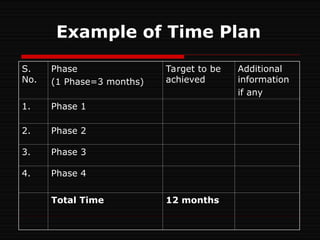
Example of Time Plan
S.
No.
Phase
(1 Phase=3 months)
Target to be
achieved
Additional
information
if any
1. Phase 1
2. Phase 2
3. Phase 3
4. Phase 4
Total Time 12 months
Financial Assistance required
 Frame the budget according to your work plan under the
given heads, matching the methods already given by you
 You should be clear about (& able to justify) why you need the
proposed amount under a given head
 Do not ask for large amounts for books/journals/equipment in a
minor RP
 In a major RP if asking for any big equipment/software, make
sure that equipment is already not available in your institution.
Collaborate where you can.
 Buy relevant latest software for data analysis both quantitative
and qualitative. Will make your proposal very sound and
contemporary.
Referencing
 Give citations/references throughout your
proposal
 Use any/required style of referencing/citation in
use in your discipline. For eg. in English
Literature follow the MLA style Guide
 You have to include a Bibliography: List the
works relevant to the proposed research work
including all the literature you have already
surveyed for preparing the proposal
 Difference between References and Bibliography
should be understood
Referencing/Citation
Citation systems
Broadly speaking, there are two citation
systems:
1.Note systems
 Note systems involve the use of sequential
numbers in the text which refer to either
footnotes (notes at the end of the page) or
endnotes (a note on a separate page at the
end of the paper) which gives the source
detail.
 In the humanities, many authors use
footnotes or endnotes to supply anecdotal
information. In this way, what looks like a
citation is actually supplementary material,
or suggestions for further reading.
Parenthetical Referencing
2.Parenthetical referencing is where full or
partial, in-text citations are enclosed
within parentheses and embedded in the
paragraph, as opposed to the footnote
style.
 The list of the citations with complete
bibliographical references may be
included in an end section sorted
alphabetically by author's last name.
 This end section may be known as:
References /Works cited
Draft, revise and edit
 Written works require several revisions to
initial draft
 The draft should be thoroughly checked for
consistency, errors, omissions and inclusivity
(e.g. figures, captions, references).
 Several revisions are usually necessary
before the draft can become the
proposal/report or manuscript.
Course Assignment:
Simple format for beginners
1. Title
2. Introduction(Statement of Problem, Origin of Research
Problem, Research Question)
3. Literature Review(Rudimentary) & Significance of Research
4. Objectives
5. Proposed Methods
6. Budget
7. Time Plan
8. References
9. Bibliography

Research {Proposal for research and development

  • 1.
    WRITING A RESEARCHPROJECT PROPOSAL Professor Divya Upadhyaya Joshi Director UGC-HRDC Kumaun University,Nainital,Uttarakhand-263001 Contact: divyauj@gmail.com
  • 2.
    Introduction  Imperative thatfaculty members in HEI /researchers be able to formulate and write a research proposal(RP)  Submit the RP to a funding agency for financial support for their research  Most funding agencies in India require the researcher to submit a proposal in a prescribed format.  Major funding agencies include UGC,ICSSR,DST,ICHR,CSIR,etc
  • 3.
    Elements of aproposal A proposal generally has the following elements:  Project Title  Introduction  Statement of problem  Research Question  Origin of the research problem  Inter - disciplinary relevance  Review of literature (Status of R & D )  International & National  Significance of study  Objectives of study  Methodology  Time Plan  Budget  References & Bibliography *Could include Hypothesis
  • 4.
    Preparing a ProjectProposal  The sequence of the material in the project proposal varies according to the different prescribed formats of the funding agencies  Most agencies are asking for online submission  Prepare the proposal very carefully in a word document and then start uploading online  Always check,revise and edit several times before submitting  Be very careful about language and typos
  • 5.
    Cover Page (Foroff-line submissions & HRDC assignments) The cover page should include :  Name of funding agency and category of project  Title of proposed work  Name , designation and affiliation of researcher  Address for correspondence/contact including E-mail  Year of submission
  • 6.
    Choosing a Topic In choosing a topic, reflect on what really interests you.  The contemporary relevance of the topic chosen for research.  Before you finalize the topic, decide what is practically possible in terms of the primary and secondary data which would provide the basis for the work.  Explore the topic or theme by a specific review of literature. Read journals, books, research papers and articles related to the topic you have chosen.  Use focal group discussions or brainstorming sessions
  • 7.
    The Title • Clearand designed to attract attention • As short as possible • A definite assertive statement rather than a question • Specific, yet inclusive of scope/geographic location of a project • Should include key terms that readily identify the scope and nature of the study • Avoid using ambiguous or confusing words • If necessary, break your title up into a title and subtitle • Should not contain abbreviations or jargon
  • 8.
    Introduction  Introduction  includea statement of the problem as an expansion of the title with focus on a stated goal.  pose the research question  Outline/define the basic concepts and theories relating to the work  Origin of the Problem: explain what the genesis of the specific problem you propose to study is  Where, when ,how the problem manifests itself/is located
  • 9.
    Interdisciplinery relevance  Attwo levels : what you have taken & what you propose to give?  How anticipated results will contribute to body of knowledgeresearch in other disciplines  Any other linkages with other disciplines-methods,models,theoretical precepts that you may have taken.
  • 10.
    Review of RelevantLiterature (Status of research )  Available in books, research journals, project reports, dissertations, etc.  Getting acquainted with the current knowledge (at national and international level) in the area of study  Acquaints you with the research methodology, methods, the tools and techniques which have proved to be useful in similar research works  When writing review of each discussed work you state briefly the major findings of the said work,and sum up by very briefly by reviewing it
  • 11.
    Significance of Study Clarifies the research gap that exists in the given area of study and how the proposed work will fill it  Should show that you do understand what work has been done in the area in the past, and where your proposed research fits in with this work  Explain clearly how existing findings relate to the specific questions that you are asking  Applied relevance/perceived benefits
  • 12.
    Objective(s)  State clearlyand in specific terms what the specific objective(s) of your research is  Assertive sentences , not questions  You can break the one major objective down into a limited set of objectives for clarity  Avoid positing any grandiose/impractical objectives in generalised terms  State only the objectives of your proposed work
  • 13.
    Suitability of methods Be very clear and specific about the research methods you plan to use. Study any methods you propose to use thoroughly.  Your study may follow any one research design /combination of more than one design(exploratory/descriptive/experimental/ analytical, etc) depending on its suitability for your work.  You can use qualitative/quantitative/mixed methods- triangulation
  • 14.
    Time Plan  Thissection should include a general outline of the dates and time to be spent on various aspects of the proposal. (Plan of work)  Total time can be divided into phases,& the plan presented in tabular or graphical form  Avoid naming exact months /year unless your work so requires
  • 15.
    Example of TimePlan S. No. Phase (1 Phase=3 months) Target to be achieved Additional information if any 1. Phase 1 2. Phase 2 3. Phase 3 4. Phase 4 Total Time 12 months
  • 16.
    Financial Assistance required Frame the budget according to your work plan under the given heads, matching the methods already given by you  You should be clear about (& able to justify) why you need the proposed amount under a given head  Do not ask for large amounts for books/journals/equipment in a minor RP  In a major RP if asking for any big equipment/software, make sure that equipment is already not available in your institution. Collaborate where you can.  Buy relevant latest software for data analysis both quantitative and qualitative. Will make your proposal very sound and contemporary.
  • 17.
    Referencing  Give citations/referencesthroughout your proposal  Use any/required style of referencing/citation in use in your discipline. For eg. in English Literature follow the MLA style Guide  You have to include a Bibliography: List the works relevant to the proposed research work including all the literature you have already surveyed for preparing the proposal  Difference between References and Bibliography should be understood
  • 18.
    Referencing/Citation Citation systems Broadly speaking,there are two citation systems: 1.Note systems  Note systems involve the use of sequential numbers in the text which refer to either footnotes (notes at the end of the page) or endnotes (a note on a separate page at the end of the paper) which gives the source detail.  In the humanities, many authors use footnotes or endnotes to supply anecdotal information. In this way, what looks like a citation is actually supplementary material, or suggestions for further reading.
  • 19.
    Parenthetical Referencing 2.Parenthetical referencingis where full or partial, in-text citations are enclosed within parentheses and embedded in the paragraph, as opposed to the footnote style.  The list of the citations with complete bibliographical references may be included in an end section sorted alphabetically by author's last name.  This end section may be known as: References /Works cited
  • 20.
    Draft, revise andedit  Written works require several revisions to initial draft  The draft should be thoroughly checked for consistency, errors, omissions and inclusivity (e.g. figures, captions, references).  Several revisions are usually necessary before the draft can become the proposal/report or manuscript.
  • 21.
    Course Assignment: Simple formatfor beginners 1. Title 2. Introduction(Statement of Problem, Origin of Research Problem, Research Question) 3. Literature Review(Rudimentary) & Significance of Research 4. Objectives 5. Proposed Methods 6. Budget 7. Time Plan 8. References 9. Bibliography