RESEARCH 101
  This is a self-paced tutorial to provide you with the necessary
  skills to find and use information and to evaluate and use it
  wisely for writing research papers and essays.


You will learn how to answer this question:
1. How do I write and cite my paper?
Writing and Citing
Now that you have gathered and evaluated your search results, you are ready
to start writing your assignment.


• This final step, which will include many drafts of your
 paper, will incorporate your findings and cite the sources
 you used. After completing this section you will be able to:
  • Better understand the writing process
  • Properly cite your sources
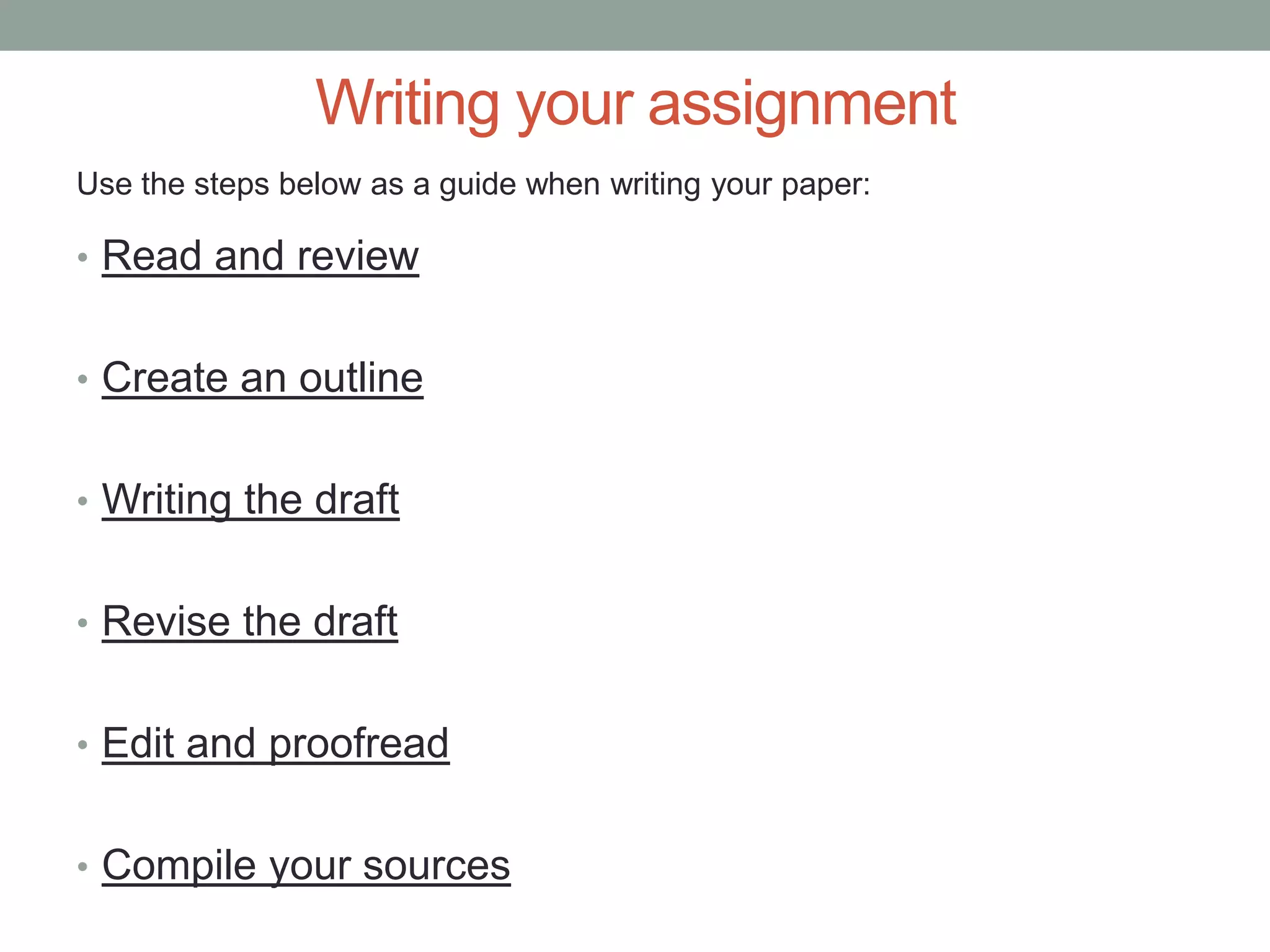
Writing your assignment
Use the steps below as a guide when writing your paper:

• Read and review


• Create an outline


• Writing the draft


• Revise the draft


• Edit and proofread


• Compile your sources
Read and Review
• Before creating an outline, make sure you understand
 what you will be writing about. Read, review, and take
 notes on the information you compiled, start gathering
 your thoughts and formulate ideas you would like to
 present in your assignment.
Create an outline
• Use this step to roughly organize your thoughts that will
 give direction to your assignment. Group your ideas and
 your notes on various aspects of your topic. Your outline
 should include:

  • Introduction: main ideas, context, research question or thesis
  • Body: support for each main idea, answer to research question
  • Conclusion: summary of main ideas, recommendations for further
   research, how your research question or thesis can be applied,
   your opinions
Writing the draft
• In your first draft, you are looking for a flow of ideas:


  • Write non-stop using your outline as a guide. Do not worry about
   grammar or spelling at this point.

  • See if you have a logical progression of ideas or arguments and
   enough supporting material
Revise the draft
• Keep re-writing until you are satisfied with the logical flow
 of your statements and your ideas are presented clearly
 and concisely. Make sure:

  • Language and tone are appropriate


  • All ambiguous and technical terms are defined


  • Each argument or statement is supported by relevant information
Edit your draft
• Now you are ready to focus on the grammar, spelling, and
 style of your paper. Proofread for:

 • Spelling mistakes


 • Grammatical errors


 • Use active verbs rather than passive verbs


 • Make sure every sentence has a purpose and is meaningful.
Compile your sources
• Create a works cited page - a list of all the sources you
 have used in preparing your assignment.

• It is written according to a standard format, at
 Northwestern College we use the MLA (Modern Language
 Association) format.


      More about citing your sources in the next section
Citing your sources
This is an essential part of the academic writing process.

• Why cite?


• When to cite


• How to cite


• MLA style guide


• Plagiarism
Why cite?
• It is important to acknowledge the work and ideas of
 others that you have used or have influenced your
 thoughts. Citing sources is:

  • Fundamental in academia


  • Allows readers (and instructors) to follow up on your sources


  • Adds credibility to your statements, opinions, ideas


  • Demonstrates depth of research
When to cite
• Always cite your sources when you use someone's exact
 words (quote) or ideas (paraphrase) found in books,
 articles, interviews, movies, websites, anywhere.

• Or when you cite facts, statistics, events, dates, concepts
 that are not common knowledge.
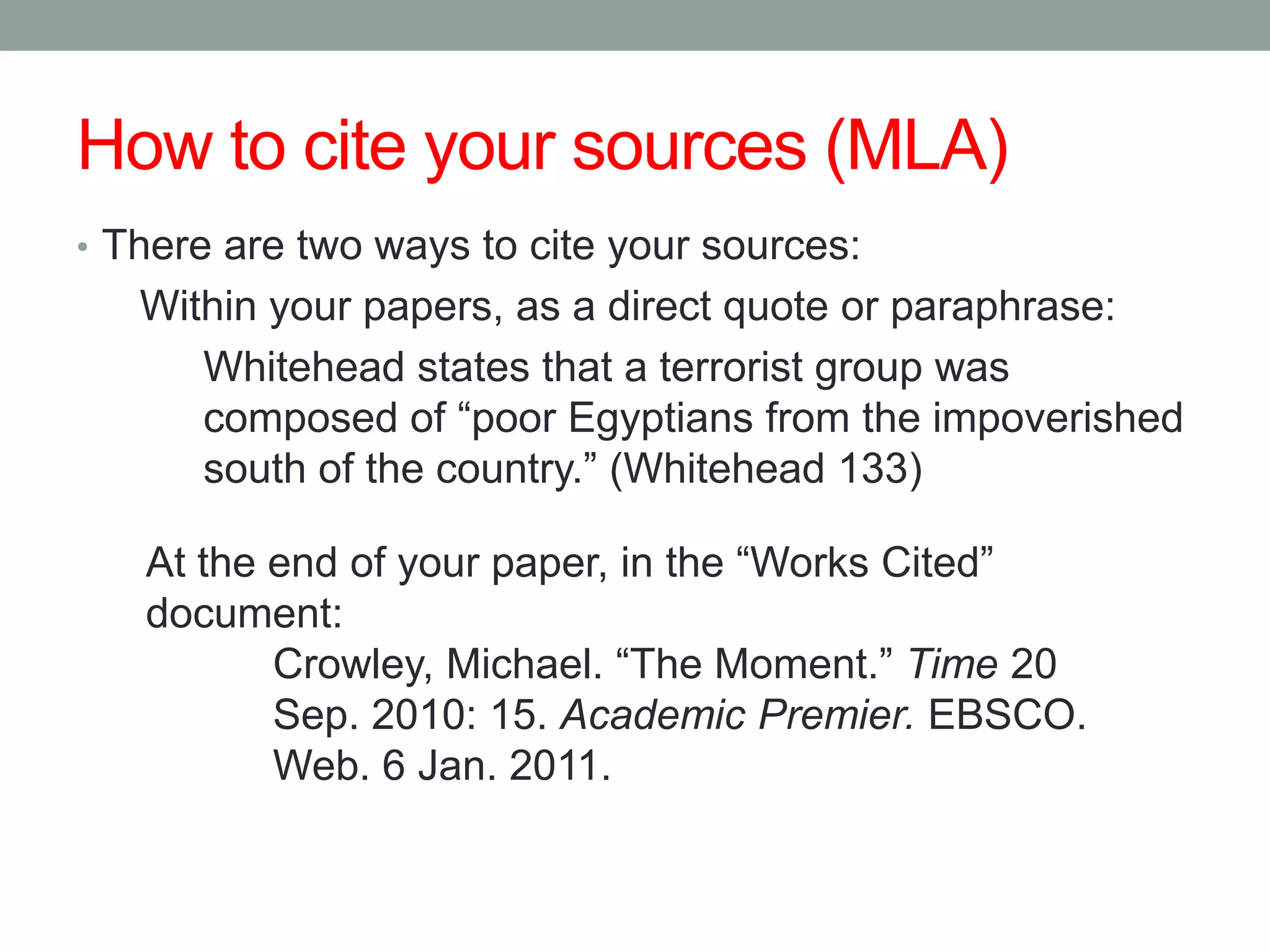
How to cite your sources (MLA)
• There are two ways to cite your sources:
   Within your papers, as a direct quote or paraphrase:
      Whitehead states that a terrorist group was
      composed of “poor Egyptians from the impoverished
      south of the country.” (Whitehead 133)

   At the end of your paper, in the “Works Cited”
   document:
          Crowley, Michael. “The Moment.” Time 20
          Sep. 2010: 15. Academic Premier. EBSCO.
          Web. 6 Jan. 2011.
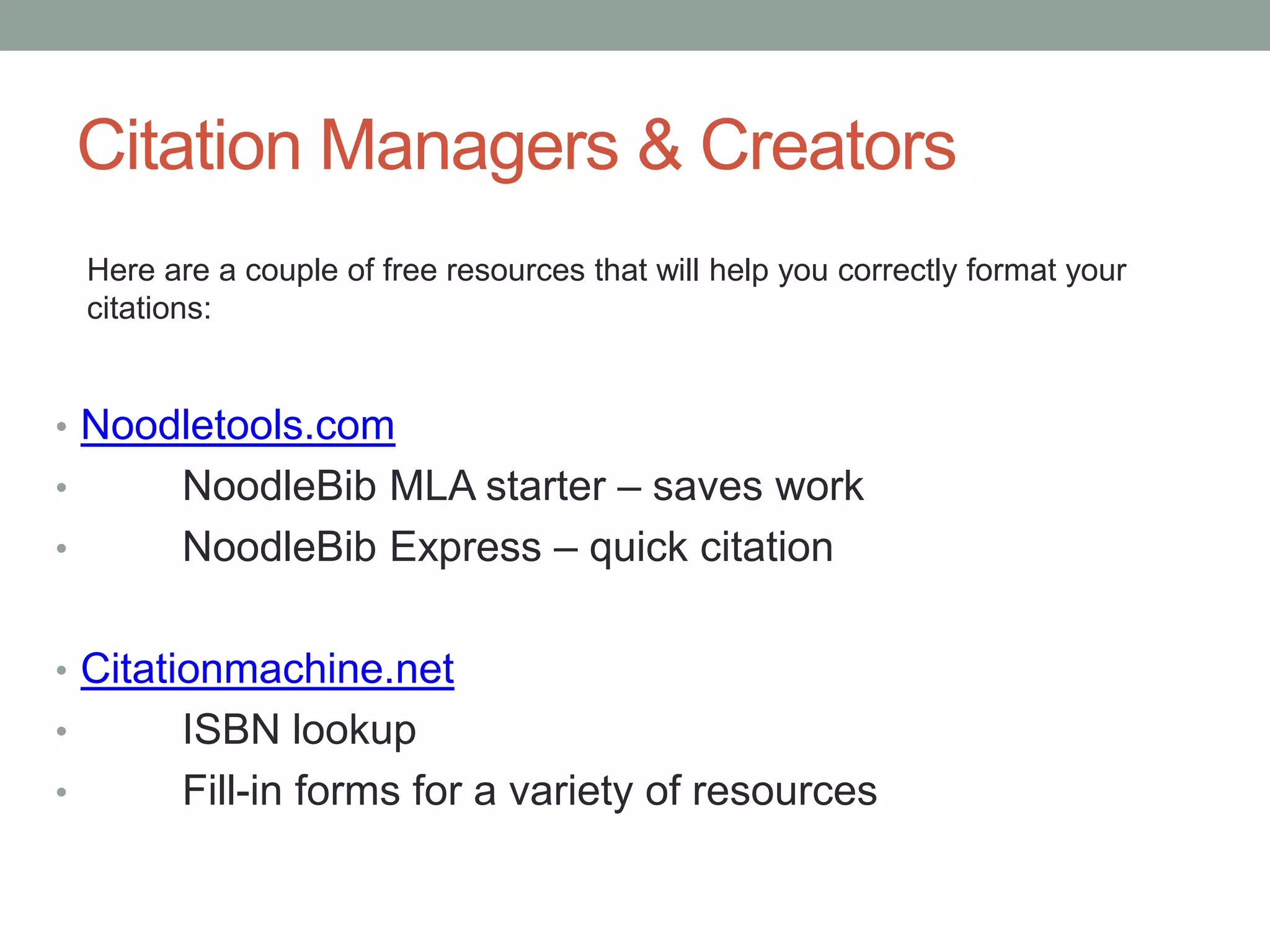
Citation Managers & Creators
    Here are a couple of free resources that will help you correctly format your
    citations:


• Noodletools.com
•         NoodleBib MLA starter – saves work
•         NoodleBib Express – quick citation

• Citationmachine.net
•         ISBN lookup
•         Fill-in forms for a variety of resources
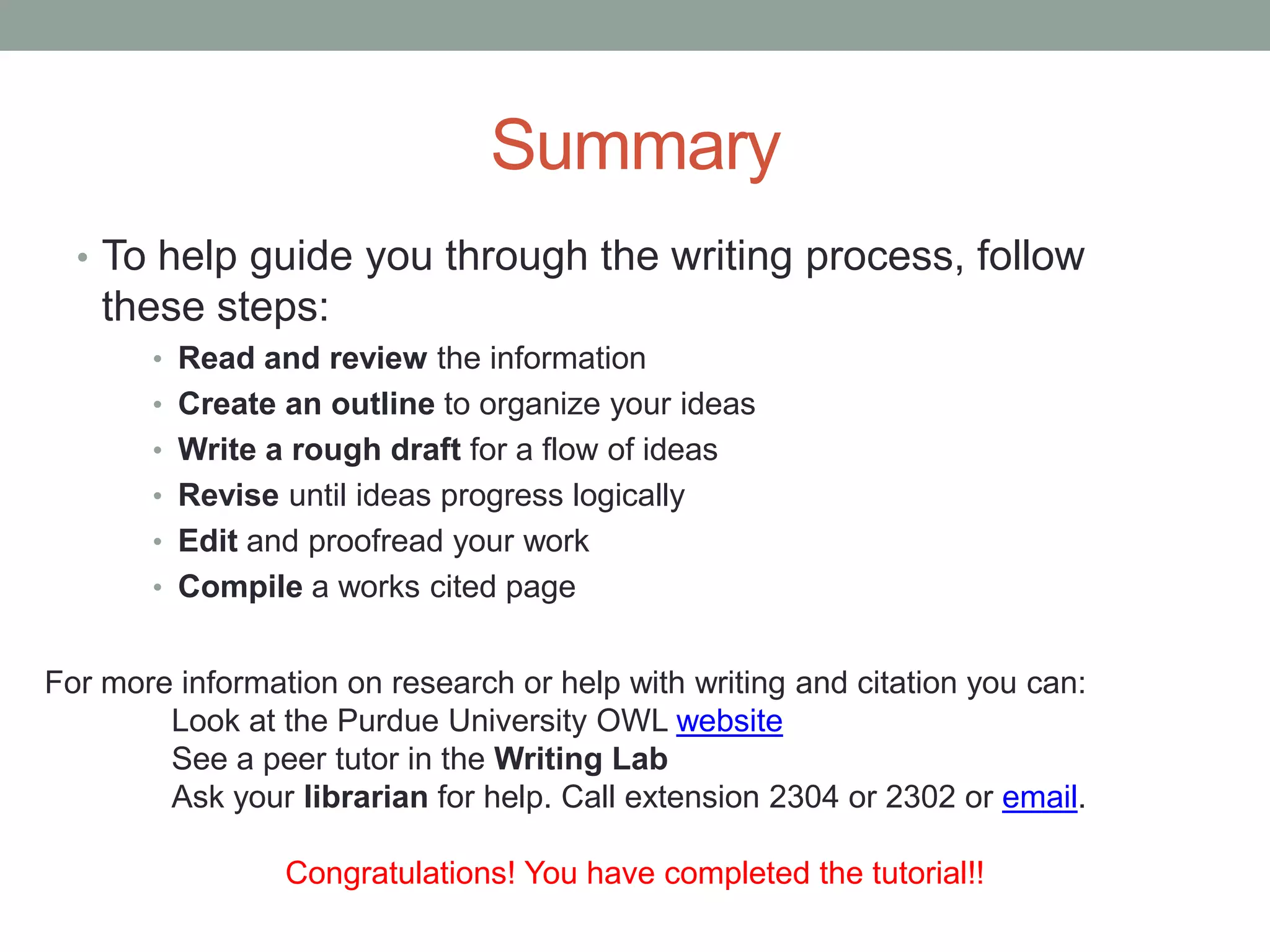
Summary
  • To help guide you through the writing process, follow
    these steps:
       • Read and review the information
       • Create an outline to organize your ideas
       • Write a rough draft for a flow of ideas
       • Revise until ideas progress logically
       • Edit and proofread your work
       • Compile a works cited page


For more information on research or help with writing and citation you can:
        Look at the Purdue University OWL website
        See a peer tutor in the Writing Lab
        Ask your librarian for help. Call extension 2304 or 2302 or email.

                 Congratulations! You have completed the tutorial!!

Writing and citing

  • 1.
    RESEARCH 101 This is a self-paced tutorial to provide you with the necessary skills to find and use information and to evaluate and use it wisely for writing research papers and essays. You will learn how to answer this question: 1. How do I write and cite my paper?
  • 2.
    Writing and Citing Nowthat you have gathered and evaluated your search results, you are ready to start writing your assignment. • This final step, which will include many drafts of your paper, will incorporate your findings and cite the sources you used. After completing this section you will be able to: • Better understand the writing process • Properly cite your sources
  • 3.
    Writing your assignment Usethe steps below as a guide when writing your paper: • Read and review • Create an outline • Writing the draft • Revise the draft • Edit and proofread • Compile your sources
  • 4.
    Read and Review •Before creating an outline, make sure you understand what you will be writing about. Read, review, and take notes on the information you compiled, start gathering your thoughts and formulate ideas you would like to present in your assignment.
  • 5.
    Create an outline •Use this step to roughly organize your thoughts that will give direction to your assignment. Group your ideas and your notes on various aspects of your topic. Your outline should include: • Introduction: main ideas, context, research question or thesis • Body: support for each main idea, answer to research question • Conclusion: summary of main ideas, recommendations for further research, how your research question or thesis can be applied, your opinions
  • 6.
    Writing the draft •In your first draft, you are looking for a flow of ideas: • Write non-stop using your outline as a guide. Do not worry about grammar or spelling at this point. • See if you have a logical progression of ideas or arguments and enough supporting material
  • 7.
    Revise the draft •Keep re-writing until you are satisfied with the logical flow of your statements and your ideas are presented clearly and concisely. Make sure: • Language and tone are appropriate • All ambiguous and technical terms are defined • Each argument or statement is supported by relevant information
  • 8.
    Edit your draft •Now you are ready to focus on the grammar, spelling, and style of your paper. Proofread for: • Spelling mistakes • Grammatical errors • Use active verbs rather than passive verbs • Make sure every sentence has a purpose and is meaningful.
  • 9.
    Compile your sources •Create a works cited page - a list of all the sources you have used in preparing your assignment. • It is written according to a standard format, at Northwestern College we use the MLA (Modern Language Association) format. More about citing your sources in the next section
  • 10.
    Citing your sources Thisis an essential part of the academic writing process. • Why cite? • When to cite • How to cite • MLA style guide • Plagiarism
  • 11.
    Why cite? • Itis important to acknowledge the work and ideas of others that you have used or have influenced your thoughts. Citing sources is: • Fundamental in academia • Allows readers (and instructors) to follow up on your sources • Adds credibility to your statements, opinions, ideas • Demonstrates depth of research
  • 12.
    When to cite •Always cite your sources when you use someone's exact words (quote) or ideas (paraphrase) found in books, articles, interviews, movies, websites, anywhere. • Or when you cite facts, statistics, events, dates, concepts that are not common knowledge.
  • 13.
    How to citeyour sources (MLA) • There are two ways to cite your sources: Within your papers, as a direct quote or paraphrase: Whitehead states that a terrorist group was composed of “poor Egyptians from the impoverished south of the country.” (Whitehead 133) At the end of your paper, in the “Works Cited” document: Crowley, Michael. “The Moment.” Time 20 Sep. 2010: 15. Academic Premier. EBSCO. Web. 6 Jan. 2011.
  • 14.
    Citation Managers &Creators Here are a couple of free resources that will help you correctly format your citations: • Noodletools.com • NoodleBib MLA starter – saves work • NoodleBib Express – quick citation • Citationmachine.net • ISBN lookup • Fill-in forms for a variety of resources
  • 15.
    Summary •To help guide you through the writing process, follow these steps: • Read and review the information • Create an outline to organize your ideas • Write a rough draft for a flow of ideas • Revise until ideas progress logically • Edit and proofread your work • Compile a works cited page For more information on research or help with writing and citation you can: Look at the Purdue University OWL website See a peer tutor in the Writing Lab Ask your librarian for help. Call extension 2304 or 2302 or email. Congratulations! You have completed the tutorial!!