Student-Led Conferences
(Simultaneous Conferences
with Multiple Families)
Text Reference:
Implementing Student-Led Conferences
Presenter:
Mathew J. Zagami, Education Consultant
CITE
Essential Questions?
 What is the purpose of traditional parent-
teacher conferences?
 What are some of the advantages and
disadvantages of these conferences?
 Whose work is being discussed at these
meetings?
 Who is discussing this work?
Essential Questions
 Are traditional Parent-Teacher Conferences outdated?
(Same as when you were a child?)
 Is there a better way to communicate with families at
conferences? (From who do you think the families
would prefer to hear from—their child or the
teacher?)
 Can we increase student responsibility for learning? (Is
responsibility related to motivation?)
What are Student-Led
Conferences?
A conference with the family in which the student leads a
discussion of his/her work and a review of his/her
portfolio.
 The classroom teacher goes from being the leader
of the conference to becoming a facilitator.
 Student goes from non-participant or passive
observer to leader of the conference.
 Families become more actively engaged in discussions
with their child rather than the teacher.
 Support teachers go from non-participant to making
sure that work samples are included in portfolio and
available for conferences.
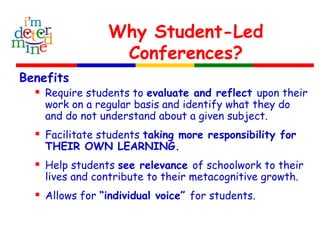
Why Student-Led
Conferences?
Benefits
 Require students to evaluate and reflect upon their
work on a regular basis and identify what they do
and do not understand about a given subject.
 Facilitate students taking more responsibility for
THEIR OWN LEARNING.
 Help students see relevance of schoolwork to their
lives and contribute to their metacognitive growth.
 Allows for “individual voice” for students.
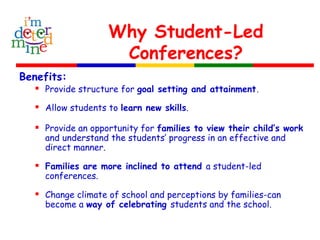
Why Student-Led
Conferences?
Benefits:
 Provide structure for goal setting and attainment.
 Allow students to learn new skills.
 Provide an opportunity for families to view their child’s work
and understand the students’ progress in an effective and
direct manner.
 Families are more inclined to attend a student-led
conferences.
 Change climate of school and perceptions by families-can
become a way of celebrating students and the school.
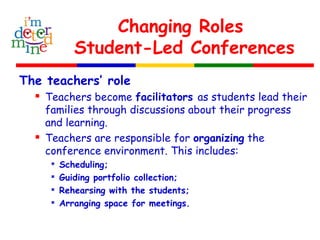
Changing Roles
Student-Led Conferences
The teachers’ role
 Teachers become facilitators as students lead their
families through discussions about their progress
and learning.
 Teachers are responsible for organizing the
conference environment. This includes:

Scheduling;

Guiding portfolio collection;

Rehearsing with the students;

Arranging space for meetings.
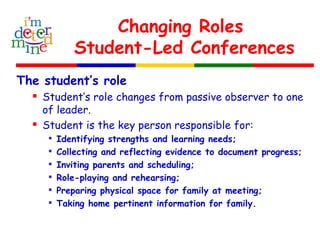
Changing Roles
Student-Led Conferences
The student’s role
 Student’s role changes from passive observer to one
of leader.
 Student is the key person responsible for:

Identifying strengths and learning needs;

Collecting and reflecting evidence to document progress;

Inviting parents and scheduling;

Role-playing and rehearsing;

Preparing physical space for family at meeting;

Taking home pertinent information for family.
Changing Roles
Student-Led Conferences
The family’s role
 Families become partners in learning.
 Families’ responsibilities include:

Providing reinforcement, encouragement and
praise;

Asking probing questions;

Listening and spending time with their child;

Seeing what school is like through the “eyes of
their child”.
Changing Roles
Student-Led Conferences
The administrator’s role
 Administrative support is essential.
 Administrators must:

Encourage innovation;

Facilitate scheduling;

Provide time and training necessary for
teachers to learn about the concept;

Educate parents about student-led
conferences.
Changing Roles
Student-Led Conferences
The co-curricular and support teachers’ roles
 It is critical that information from these
classes be included.
 Co-curricular teachers’ roles include:

Making sure work is included in portfolio;

Helping to design portfolio;

Planning exhibits and performances of student
work;

Promoting student self-evaluation.
What Do Portfolios Include?
 Agenda/organizer
 Student work/samples (evaluation)
 Goal sheets (academic and behavioral)
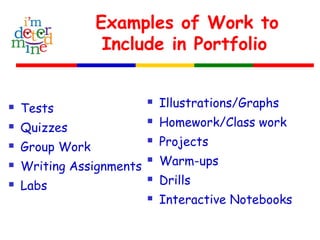
Examples of Work to
Include in Portfolio
 Tests
 Quizzes
 Group Work
 Writing Assignments
 Labs
 Illustrations/Graphs
 Homework/Class work
 Projects
 Warm-ups
 Drills
 Interactive Notebooks
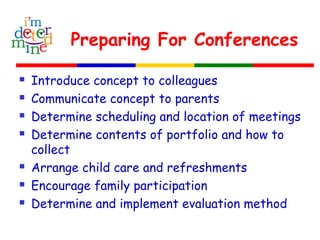
Preparing For Conferences
 Introduce concept to colleagues
 Communicate concept to parents
 Determine scheduling and location of meetings
 Determine contents of portfolio and how to
collect
 Arrange child care and refreshments
 Encourage family participation
 Determine and implement evaluation method
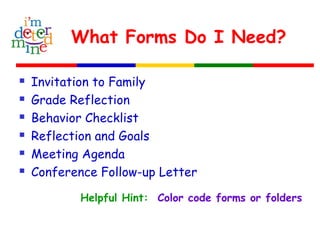
What Forms Do I Need?
 Invitation to Family
 Grade Reflection
 Behavior Checklist
 Reflection and Goals
 Meeting Agenda
 Conference Follow-up Letter
Helpful Hint: Color code forms or folders
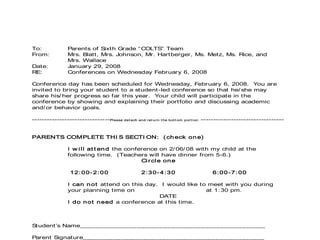
To: Parents of Sixth Grade “COLTS” Team
From: Mrs. Blatt, Mrs. Johnson, Mr. Hartberger, Ms. Metz, Ms. Rice, and
Mrs. Wallace
Date: January 29, 2008
RE: Conferences on Wednesday February 6, 2008
Conference day has been scheduled for Wednesday, February 6, 2008. You are
invited to bring your student to a student-led conference so that he/ she may
share his/ her progress so far this year. Your child will participate in the
conference by showing and explaining their portfolio and discussing academic
and/ or behavior goals.
-------------------------------Please det ach and ret urn t he bot t om port i on ---------------------------------
PARENTS COMPLETE THI S SECTI ON: ( check one)
I w ill at t end the conference on 2/ 06/ 08 with my child at the
following time. (Teachers will have dinner from 5-6.)
Circle one
12:00-2:00 2:30-4:30 6:00-7:00
I can not attend on this day. I would like to meet with you during
your planning time on at 1:30 pm.
DATE
I do not need a conference at this time.
Student’s Name_________________________________________________
Parent Signature________________________________________________
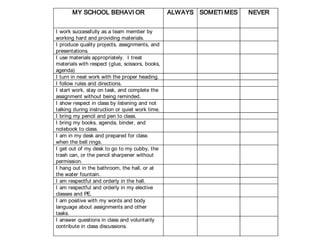
MY SCHOOL BEHAVI OR ALWAYS SOMETI MES NEVER
I work successfully as a team member by
working hard and providing materials.
I produce quality projects, assignments, and
presentations.
I use materials appropriately. I treat
materials with respect (glue, scissors, books,
agenda)
I turn in neat work with the proper heading.
I follow rules and directions.
I start work, stay on task, and complete the
assignment without being reminded.
I show respect in class by listening and not
talking during instruction or quiet work time.
I bring my pencil and pen to class.
I bring my books, agenda, binder, and
notebook to class.
I am in my desk and prepared for class
when the bell rings.
I get out of my desk to go to my cubby, the
trash can, or the pencil sharpener without
permission.
I hang out in the bathroom, the hall, or at
the water fountain.
I am respectful and orderly in the hall.
I am respectful and orderly in my elective
classes and PE.
I am positive with my words and body
language about assignments and other
tasks.
I answer questions in class and voluntarily
contribute in class discussions.
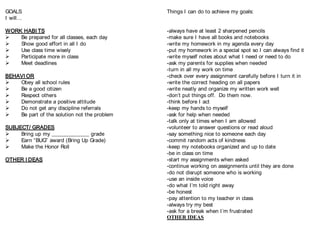
GOALS
I will…
WORK HABI TS
 Be prepared for all classes, each day
 Show good effort in all I do
 Use class time wisely
 Participate more in class
 Meet deadlines
BEHAVI OR
 Obey all school rules
 Be a good citizen
 Respect others
 Demonstrate a positive attitude
 Do not get any discipline referrals
 Be part of the solution not the problem
SUBJECT/ GRADES
 Bring up my _____________ grade
 Earn “BUG” award (Bring Up Grade)
 Make the Honor Roll
OTHER I DEAS
Things I can do to achieve my goals:
-always have at least 2 sharpened pencils
-make sure I have all books and notebooks
-write my homework in my agenda every day
-put my homework in a special spot so I can always find it
-write myself notes about what I need or need to do
-ask my parents for supplies when needed
-turn in all my work on time
-check over every assignment carefully before I turn it in
-write the correct heading on all papers
-write neatly and organize my written work well
-don’t put things off. Do them now.
-think before I act
-keep my hands to myself
-ask for help when needed
-talk only at times when I am allowed
-volunteer to answer questions or read aloud
-say something nice to someone each day
-commit random acts of kindness
-keep my notebooks organized and up to date
-be in class on time
-start my assignments when asked
-continue working on assignments until they are done
-do not disrupt someone who is working
-use an inside voice
-do what I’m told right away
-be honest
-pay attention to my teacher in class
-always try my best
-ask for a break when I’m frustrated
OTHER IDEAS
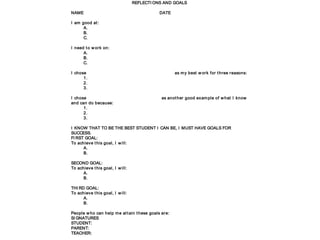
REFLECTI ONS AND GOALS
NAME DATE
I am good at :
A.
B.
C.
I need to work on:
A.
B.
C.
I chose as my best w ork for three reasons:
1.
2.
3.
I chose as another good example of what I know
and can do because:
1.
2.
3.
I KNOW THAT TO BE THE BEST STUDENT I CAN BE, I MUST HAVE GOALS FOR
SUCCESS.
FI RST GOAL:
To achieve this goal, I will:
A.
B.
SECOND GOAL:
To achieve this goal, I will:
A.
B.
THI RD GOAL:
To achieve this goal, I will:
A.
B.
People w ho can help me attain these goals are:
SI GNATURES
STUDENT:
PARENT:
TEACHER:
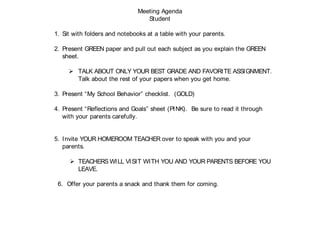
Meeting Agenda
Student
1. Sit with folders and notebooks at a table with your parents.
2. Present GREEN paper and pull out each subject as you explain the GREEN
sheet.
 TALK ABOUT ONLY YOUR BEST GRADE AND FAVORITE ASSIGNMENT.
Talk about the rest of your papers when you get home.
3. Present “My School Behavior” checklist. (GOLD)
4. Present “Reflections and Goals” sheet (PINK). Be sure to read it through
with your parents carefully.
5. Invite YOUR HOMEROOM TEACHER over to speak with you and your
parents.
 TEACHERS WILL VISIT WITH YOU AND YOUR PARENTS BEFORE YOU
LEAVE.
6. Offer your parents a snack and thank them for coming.
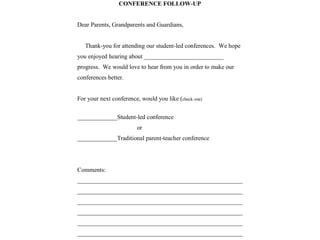
CONFERENCE FOLLOW-UP
Dear Parents, Grandparents and Guardians,
Thank-you for attending our student-led conferences. We hope
you enjoyed hearing about __________________________
progress. We would love to hear from you in order to make our
conferences better.
For your next conference, would you like (check one)
_____________Student-led conference
or
_____________Traditional parent-teacher conference
Comments:
______________________________________________________
______________________________________________________
______________________________________________________
______________________________________________________
______________________________________________________
______________________________________________________
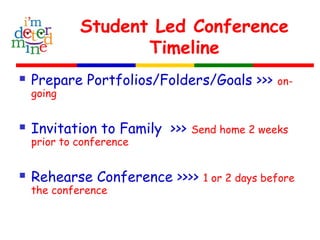
Student Led Conference
Timeline
 Prepare Portfolios/Folders/Goals >>> on-
going
 Invitation to Family >>> Send home 2 weeks
prior to conference
 Rehearse Conference >>>> 1 or 2 days before
the conference
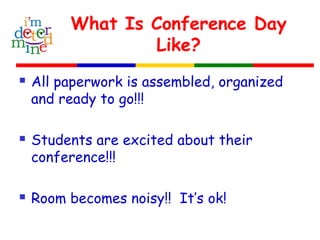
What Is Conference Day
Like?
 All paperwork is assembled, organized
and ready to go!!!
 Students are excited about their
conference!!!
 Room becomes noisy!! It’s ok!
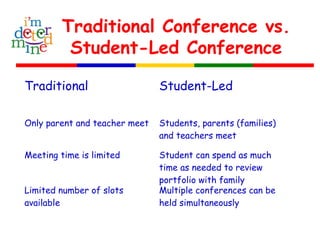
Traditional Conference vs.
Student-Led Conference
Traditional Student-Led
Only parent and teacher meet Students, parents (families)
and teachers meet
Meeting time is limited Student can spend as much
time as needed to review
portfolio with family
Limited number of slots
available
Multiple conferences can be
held simultaneously
Student-Led Conferences-
Let’s Review
 What is the purpose?
 What are some of the advantages of these
conferences?
 What are some of the disadvantages to these
conferences?
 Whose work is being discussed at the meeting?
 Who is discussing this work?
Other Possibilities:
 Individual conferences (especially for
very young students)
 Presentation or showcase conferences
 Portfolio nights
 At home student-led conferences
 Electronic student-led conferences

Student-Led Conferences, Professional Development for Teachers

  • 1.
    Student-Led Conferences (Simultaneous Conferences withMultiple Families) Text Reference: Implementing Student-Led Conferences Presenter: Mathew J. Zagami, Education Consultant CITE
  • 2.
    Essential Questions?  Whatis the purpose of traditional parent- teacher conferences?  What are some of the advantages and disadvantages of these conferences?  Whose work is being discussed at these meetings?  Who is discussing this work?
  • 3.
    Essential Questions  Aretraditional Parent-Teacher Conferences outdated? (Same as when you were a child?)  Is there a better way to communicate with families at conferences? (From who do you think the families would prefer to hear from—their child or the teacher?)  Can we increase student responsibility for learning? (Is responsibility related to motivation?)
  • 4.
    What are Student-Led Conferences? Aconference with the family in which the student leads a discussion of his/her work and a review of his/her portfolio.  The classroom teacher goes from being the leader of the conference to becoming a facilitator.  Student goes from non-participant or passive observer to leader of the conference.  Families become more actively engaged in discussions with their child rather than the teacher.  Support teachers go from non-participant to making sure that work samples are included in portfolio and available for conferences.
  • 5.
    Why Student-Led Conferences? Benefits  Requirestudents to evaluate and reflect upon their work on a regular basis and identify what they do and do not understand about a given subject.  Facilitate students taking more responsibility for THEIR OWN LEARNING.  Help students see relevance of schoolwork to their lives and contribute to their metacognitive growth.  Allows for “individual voice” for students.
  • 6.
    Why Student-Led Conferences? Benefits:  Providestructure for goal setting and attainment.  Allow students to learn new skills.  Provide an opportunity for families to view their child’s work and understand the students’ progress in an effective and direct manner.  Families are more inclined to attend a student-led conferences.  Change climate of school and perceptions by families-can become a way of celebrating students and the school.
  • 7.
    Changing Roles Student-Led Conferences Theteachers’ role  Teachers become facilitators as students lead their families through discussions about their progress and learning.  Teachers are responsible for organizing the conference environment. This includes:  Scheduling;  Guiding portfolio collection;  Rehearsing with the students;  Arranging space for meetings.
  • 8.
    Changing Roles Student-Led Conferences Thestudent’s role  Student’s role changes from passive observer to one of leader.  Student is the key person responsible for:  Identifying strengths and learning needs;  Collecting and reflecting evidence to document progress;  Inviting parents and scheduling;  Role-playing and rehearsing;  Preparing physical space for family at meeting;  Taking home pertinent information for family.
  • 9.
    Changing Roles Student-Led Conferences Thefamily’s role  Families become partners in learning.  Families’ responsibilities include:  Providing reinforcement, encouragement and praise;  Asking probing questions;  Listening and spending time with their child;  Seeing what school is like through the “eyes of their child”.
  • 10.
    Changing Roles Student-Led Conferences Theadministrator’s role  Administrative support is essential.  Administrators must:  Encourage innovation;  Facilitate scheduling;  Provide time and training necessary for teachers to learn about the concept;  Educate parents about student-led conferences.
  • 11.
    Changing Roles Student-Led Conferences Theco-curricular and support teachers’ roles  It is critical that information from these classes be included.  Co-curricular teachers’ roles include:  Making sure work is included in portfolio;  Helping to design portfolio;  Planning exhibits and performances of student work;  Promoting student self-evaluation.
  • 12.
    What Do PortfoliosInclude?  Agenda/organizer  Student work/samples (evaluation)  Goal sheets (academic and behavioral)
  • 13.
    Examples of Workto Include in Portfolio  Tests  Quizzes  Group Work  Writing Assignments  Labs  Illustrations/Graphs  Homework/Class work  Projects  Warm-ups  Drills  Interactive Notebooks
  • 14.
    Preparing For Conferences Introduce concept to colleagues  Communicate concept to parents  Determine scheduling and location of meetings  Determine contents of portfolio and how to collect  Arrange child care and refreshments  Encourage family participation  Determine and implement evaluation method
  • 15.
    What Forms DoI Need?  Invitation to Family  Grade Reflection  Behavior Checklist  Reflection and Goals  Meeting Agenda  Conference Follow-up Letter Helpful Hint: Color code forms or folders
  • 16.
    To: Parents ofSixth Grade “COLTS” Team From: Mrs. Blatt, Mrs. Johnson, Mr. Hartberger, Ms. Metz, Ms. Rice, and Mrs. Wallace Date: January 29, 2008 RE: Conferences on Wednesday February 6, 2008 Conference day has been scheduled for Wednesday, February 6, 2008. You are invited to bring your student to a student-led conference so that he/ she may share his/ her progress so far this year. Your child will participate in the conference by showing and explaining their portfolio and discussing academic and/ or behavior goals. -------------------------------Please det ach and ret urn t he bot t om port i on --------------------------------- PARENTS COMPLETE THI S SECTI ON: ( check one) I w ill at t end the conference on 2/ 06/ 08 with my child at the following time. (Teachers will have dinner from 5-6.) Circle one 12:00-2:00 2:30-4:30 6:00-7:00 I can not attend on this day. I would like to meet with you during your planning time on at 1:30 pm. DATE I do not need a conference at this time. Student’s Name_________________________________________________ Parent Signature________________________________________________
  • 17.
    MY SCHOOL BEHAVIOR ALWAYS SOMETI MES NEVER I work successfully as a team member by working hard and providing materials. I produce quality projects, assignments, and presentations. I use materials appropriately. I treat materials with respect (glue, scissors, books, agenda) I turn in neat work with the proper heading. I follow rules and directions. I start work, stay on task, and complete the assignment without being reminded. I show respect in class by listening and not talking during instruction or quiet work time. I bring my pencil and pen to class. I bring my books, agenda, binder, and notebook to class. I am in my desk and prepared for class when the bell rings. I get out of my desk to go to my cubby, the trash can, or the pencil sharpener without permission. I hang out in the bathroom, the hall, or at the water fountain. I am respectful and orderly in the hall. I am respectful and orderly in my elective classes and PE. I am positive with my words and body language about assignments and other tasks. I answer questions in class and voluntarily contribute in class discussions.
  • 18.
    GOALS I will… WORK HABITS  Be prepared for all classes, each day  Show good effort in all I do  Use class time wisely  Participate more in class  Meet deadlines BEHAVI OR  Obey all school rules  Be a good citizen  Respect others  Demonstrate a positive attitude  Do not get any discipline referrals  Be part of the solution not the problem SUBJECT/ GRADES  Bring up my _____________ grade  Earn “BUG” award (Bring Up Grade)  Make the Honor Roll OTHER I DEAS Things I can do to achieve my goals: -always have at least 2 sharpened pencils -make sure I have all books and notebooks -write my homework in my agenda every day -put my homework in a special spot so I can always find it -write myself notes about what I need or need to do -ask my parents for supplies when needed -turn in all my work on time -check over every assignment carefully before I turn it in -write the correct heading on all papers -write neatly and organize my written work well -don’t put things off. Do them now. -think before I act -keep my hands to myself -ask for help when needed -talk only at times when I am allowed -volunteer to answer questions or read aloud -say something nice to someone each day -commit random acts of kindness -keep my notebooks organized and up to date -be in class on time -start my assignments when asked -continue working on assignments until they are done -do not disrupt someone who is working -use an inside voice -do what I’m told right away -be honest -pay attention to my teacher in class -always try my best -ask for a break when I’m frustrated OTHER IDEAS
  • 19.
    REFLECTI ONS ANDGOALS NAME DATE I am good at : A. B. C. I need to work on: A. B. C. I chose as my best w ork for three reasons: 1. 2. 3. I chose as another good example of what I know and can do because: 1. 2. 3. I KNOW THAT TO BE THE BEST STUDENT I CAN BE, I MUST HAVE GOALS FOR SUCCESS. FI RST GOAL: To achieve this goal, I will: A. B. SECOND GOAL: To achieve this goal, I will: A. B. THI RD GOAL: To achieve this goal, I will: A. B. People w ho can help me attain these goals are: SI GNATURES STUDENT: PARENT: TEACHER:
  • 20.
    Meeting Agenda Student 1. Sitwith folders and notebooks at a table with your parents. 2. Present GREEN paper and pull out each subject as you explain the GREEN sheet.  TALK ABOUT ONLY YOUR BEST GRADE AND FAVORITE ASSIGNMENT. Talk about the rest of your papers when you get home. 3. Present “My School Behavior” checklist. (GOLD) 4. Present “Reflections and Goals” sheet (PINK). Be sure to read it through with your parents carefully. 5. Invite YOUR HOMEROOM TEACHER over to speak with you and your parents.  TEACHERS WILL VISIT WITH YOU AND YOUR PARENTS BEFORE YOU LEAVE. 6. Offer your parents a snack and thank them for coming.
  • 21.
    CONFERENCE FOLLOW-UP Dear Parents,Grandparents and Guardians, Thank-you for attending our student-led conferences. We hope you enjoyed hearing about __________________________ progress. We would love to hear from you in order to make our conferences better. For your next conference, would you like (check one) _____________Student-led conference or _____________Traditional parent-teacher conference Comments: ______________________________________________________ ______________________________________________________ ______________________________________________________ ______________________________________________________ ______________________________________________________ ______________________________________________________
  • 22.
    Student Led Conference Timeline Prepare Portfolios/Folders/Goals >>> on- going  Invitation to Family >>> Send home 2 weeks prior to conference  Rehearse Conference >>>> 1 or 2 days before the conference
  • 23.
    What Is ConferenceDay Like?  All paperwork is assembled, organized and ready to go!!!  Students are excited about their conference!!!  Room becomes noisy!! It’s ok!
  • 24.
    Traditional Conference vs. Student-LedConference Traditional Student-Led Only parent and teacher meet Students, parents (families) and teachers meet Meeting time is limited Student can spend as much time as needed to review portfolio with family Limited number of slots available Multiple conferences can be held simultaneously
  • 25.
    Student-Led Conferences- Let’s Review What is the purpose?  What are some of the advantages of these conferences?  What are some of the disadvantages to these conferences?  Whose work is being discussed at the meeting?  Who is discussing this work?
  • 26.
    Other Possibilities:  Individualconferences (especially for very young students)  Presentation or showcase conferences  Portfolio nights  At home student-led conferences  Electronic student-led conferences