Writing for the Web
You have my complete attention
         for 8 seconds
Everything has changed
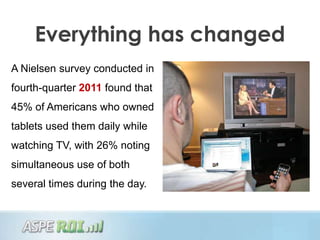
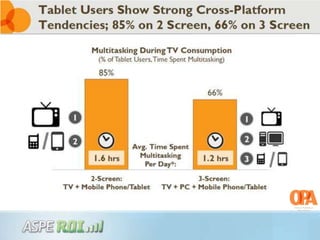
A Nielsen survey conducted in
fourth-quarter 2011 found that
45% of Americans who owned
tablets used them daily while
watching TV, with 26% noting
simultaneous use of both
several times during the day.
Everything continues to evolve

New research from Nielsen found that 88 percent of
U.S. tablet owners use their devices while they watch
television.


86% of smartphone owners say they use their phones
as a second screen at least some of the time.
Are you paying attention?

• Have you checked your email since this
  webinar started?

• How long do you wait before you look at your
  phone after it vibrates during a meeting?

• Do you have this webinar minimized?
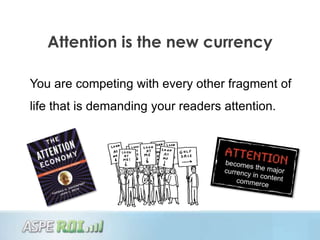
Attention is the new currency

You are competing with every other fragment of
life that is demanding your readers attention.
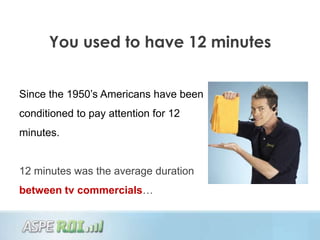
You used to have 12 minutes


Since the 1950‟s Americans have been
conditioned to pay attention for 12
minutes.


12 minutes was the average duration
between tv commercials…
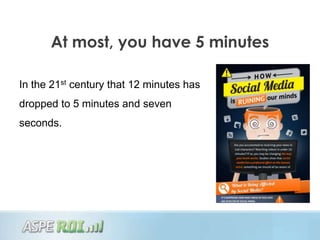
At most, you have 5 minutes

In the 21st century that 12 minutes has
dropped to 5 minutes and seven
seconds.
Nobody reads the whole page


An Associated Press survey conducted in January of
2012 found that the percentage of page views that last
less than 4 seconds was 17%, while views over 10
minutes was 4%.
Content Curation

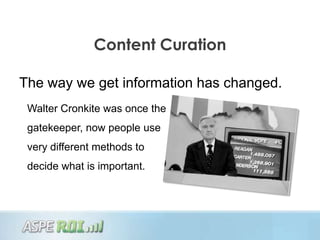
The way we get information has changed.
 Walter Cronkite was once the
 gatekeeper, now people use
 very different methods to
 decide what is important.
Content Curation

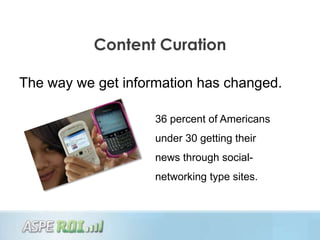
The way we get information has changed.

                    36 percent of Americans
                    under 30 getting their
                    news through social-
                    networking type sites.
Crowdsourced News
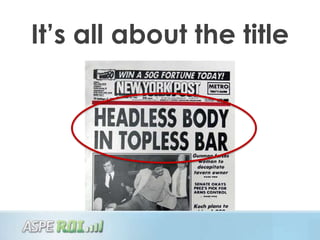
It’s all about the title
                     part 1


A good title can make the difference between
being found or not.

Research in the US showed that it accounted
for 30% of a user‟s decision of which result to
click on.
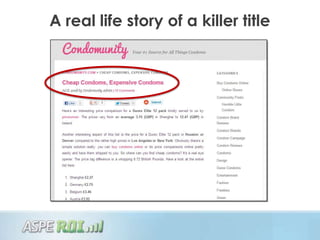
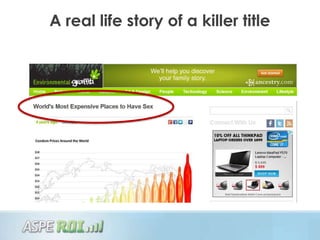
A real life story of a killer title
A real life story of
   a killer title
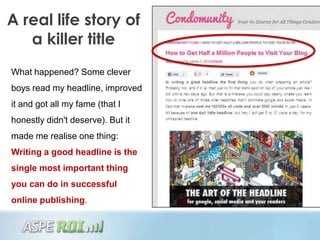
What happened? Some clever
boys read my headline, improved
it and got all my fame (that I
honestly didn't deserve). But it
made me realise one thing:
Writing a good headline is the
single most important thing
you can do in successful
online publishing.
It’s all about the title
                    part 2


You have first think about clickability.

Nothing can happen until you get your reader
to notice your headline.
It’s all about the title
                    part 2

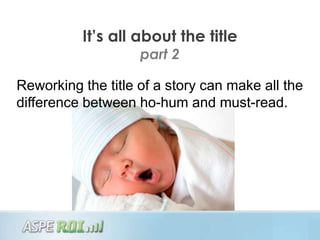
Reworking the title of a story can make all the
difference between ho-hum and must-read.
How to write better titles
Avoid puns
How to write better titles
Avoid puns
Don’t be too short. Rarely (almost never) use
short, verb-less labels as main titles for stories. They fail
to tell the story.
Write better titles
Avoid puns
Don’t be too short.
Be controversial. There‟s no better guarantee of catching
a reader‟s attention than to stir up a little controversy. Be
bold, dare to incite a little indignation, or get the pulse
racing just a bit. Don‟t be moronic about it though. You
don‟t need to incite a riot.
Write better titles
Avoid puns
Don’t be too short.
Be controversial.
Tell stories people can relate to. Create a
headline, title or slogan that tells a story people can
immediately recognize and relate to, and they may just
start telling your story for you.
Write better titles
Avoid puns
Don’t be too short.
Be controversial.
Tell stories people can relate to.
Use hot keywords like Apple and Al Jazeera (instead
of Hardware and Qatar TV Channel). People love to
read stories about topics they‟re interested in. Some
trends endure longer than others, whilst some are short
lived – but if you‟re writing about a hot topic, be sure to
drop in those keywords to whet your reader‟s appetite.
How to write better titles
Use plain English. Search engines don‟t understand
metaphors, puns, or other forms of wordplay, and
people don‟t use them when searching for information
– use plain English.
How to write better titles
Use plain English.
Explain your headline with your subheadings. Add a
h2 headline which is a sentence explaining your h1
headline. Example: h1 – „SEO Training Raleigh‟, h2 –
„We‟re the first professional search engine optimization
company in Raleigh offering training services‟.
They’ve clicked! Now what?

Google Analytic‟s Conversion University: Recent

research suggests that users decide to stay
or leave your site in 8 seconds or less — in
that short amount of time, headlines are the
one piece of copy that users will actually
read.
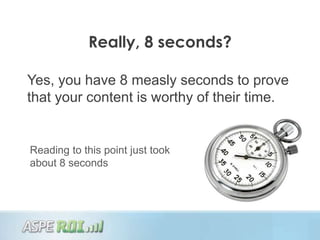
Really, 8 seconds?

Yes, you have 8 measly seconds to prove
that your content is worthy of their time.


Reading to this point just took
about 8 seconds
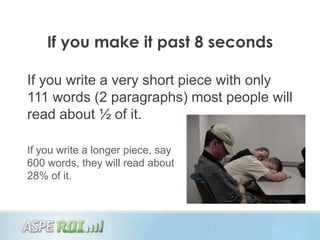
If you make it past 8 seconds

If you write a very short piece with only
111 words (2 paragraphs) most people will
read about ½ of it.

If you write a longer piece, say
600 words, they will read about
28% of it.
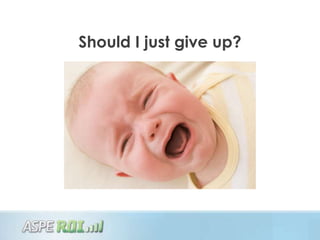
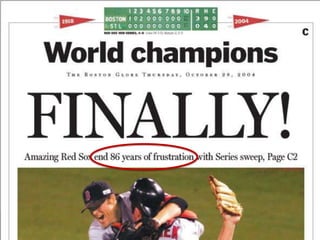
Should I just give up?
No, don’t give up

Every word needs to draw in your reader
with the promise of something even better is
coming next.


Edit, edit, edit. Then edit some more.
No, don’t give up

The only way to make an impact is to put out
a stream of high quality content on a
regular schedule.


Ask yourself before you publish
something, “would I share this?”
Content Creation

Writing for the web is about existing within a
complex and vibrant ecosystem where the
best content rises to the top in a meritocracy.


Okay, that‟s not actually the case, but great
content has a huge advantage.
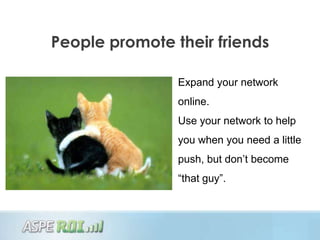
People promote their friends

                Expand your network
                online.
                Use your network to help
                you when you need a little
                push, but don‟t become
                “that guy”.
Content Creation

From a pure SEO perspective, don‟t bother
publishing a page with less than 250 words
on it.


If you‟re writing over 800 words, make sure
you stay focused.
Learning while doing

There are great tools available for writers
who need some guidance when it comes to
writing tight, focused, optimized content for
the web.


                     scribeseo.com
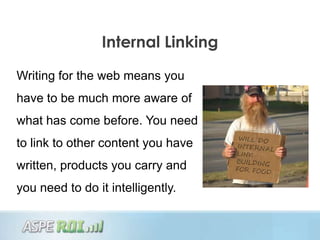
Internal Linking

Writing for the web means you
have to be much more aware of
what has come before. You need
to link to other content you have
written, products you carry and
you need to do it intelligently.
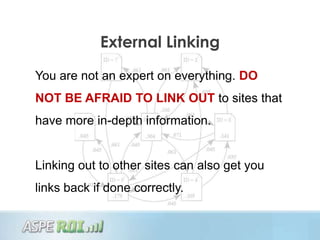
External Linking

You are not an expert on everything. DO
NOT BE AFRAID TO LINK OUT to sites that
have more in-depth information.


Linking out to other sites can also get you
links back if done correctly.
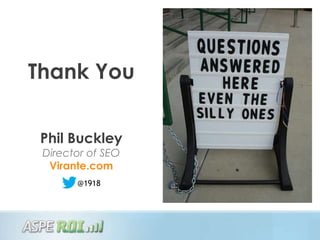
Thank You


 Phil Buckley
 Director of SEO
  Virante.com
       @1918

Writing for the Web

  • 1.
    Writing for theWeb You have my complete attention for 8 seconds
  • 2.
    Everything has changed ANielsen survey conducted in fourth-quarter 2011 found that 45% of Americans who owned tablets used them daily while watching TV, with 26% noting simultaneous use of both several times during the day.
  • 3.
    Everything continues toevolve New research from Nielsen found that 88 percent of U.S. tablet owners use their devices while they watch television. 86% of smartphone owners say they use their phones as a second screen at least some of the time.
  • 5.
    Are you payingattention? • Have you checked your email since this webinar started? • How long do you wait before you look at your phone after it vibrates during a meeting? • Do you have this webinar minimized?
  • 6.
    Attention is thenew currency You are competing with every other fragment of life that is demanding your readers attention.
  • 7.
    You used tohave 12 minutes Since the 1950‟s Americans have been conditioned to pay attention for 12 minutes. 12 minutes was the average duration between tv commercials…
  • 8.
    At most, youhave 5 minutes In the 21st century that 12 minutes has dropped to 5 minutes and seven seconds.
  • 9.
    Nobody reads thewhole page An Associated Press survey conducted in January of 2012 found that the percentage of page views that last less than 4 seconds was 17%, while views over 10 minutes was 4%.
  • 10.
    Content Curation The waywe get information has changed. Walter Cronkite was once the gatekeeper, now people use very different methods to decide what is important.
  • 11.
    Content Curation The waywe get information has changed. 36 percent of Americans under 30 getting their news through social- networking type sites.
  • 12.
  • 13.
  • 14.
    It’s all aboutthe title part 1 A good title can make the difference between being found or not. Research in the US showed that it accounted for 30% of a user‟s decision of which result to click on.
  • 15.
    A real lifestory of a killer title
  • 16.
    A real lifestory of a killer title
  • 17.
    A real lifestory of a killer title What happened? Some clever boys read my headline, improved it and got all my fame (that I honestly didn't deserve). But it made me realise one thing: Writing a good headline is the single most important thing you can do in successful online publishing.
  • 18.
    It’s all aboutthe title part 2 You have first think about clickability. Nothing can happen until you get your reader to notice your headline.
  • 19.
    It’s all aboutthe title part 2 Reworking the title of a story can make all the difference between ho-hum and must-read.
  • 23.
    How to writebetter titles Avoid puns
  • 24.
    How to writebetter titles Avoid puns Don’t be too short. Rarely (almost never) use short, verb-less labels as main titles for stories. They fail to tell the story.
  • 25.
    Write better titles Avoidpuns Don’t be too short. Be controversial. There‟s no better guarantee of catching a reader‟s attention than to stir up a little controversy. Be bold, dare to incite a little indignation, or get the pulse racing just a bit. Don‟t be moronic about it though. You don‟t need to incite a riot.
  • 26.
    Write better titles Avoidpuns Don’t be too short. Be controversial. Tell stories people can relate to. Create a headline, title or slogan that tells a story people can immediately recognize and relate to, and they may just start telling your story for you.
  • 27.
    Write better titles Avoidpuns Don’t be too short. Be controversial. Tell stories people can relate to. Use hot keywords like Apple and Al Jazeera (instead of Hardware and Qatar TV Channel). People love to read stories about topics they‟re interested in. Some trends endure longer than others, whilst some are short lived – but if you‟re writing about a hot topic, be sure to drop in those keywords to whet your reader‟s appetite.
  • 28.
    How to writebetter titles Use plain English. Search engines don‟t understand metaphors, puns, or other forms of wordplay, and people don‟t use them when searching for information – use plain English.
  • 29.
    How to writebetter titles Use plain English. Explain your headline with your subheadings. Add a h2 headline which is a sentence explaining your h1 headline. Example: h1 – „SEO Training Raleigh‟, h2 – „We‟re the first professional search engine optimization company in Raleigh offering training services‟.
  • 30.
    They’ve clicked! Nowwhat? Google Analytic‟s Conversion University: Recent research suggests that users decide to stay or leave your site in 8 seconds or less — in that short amount of time, headlines are the one piece of copy that users will actually read.
  • 31.
    Really, 8 seconds? Yes,you have 8 measly seconds to prove that your content is worthy of their time. Reading to this point just took about 8 seconds
  • 32.
    If you makeit past 8 seconds If you write a very short piece with only 111 words (2 paragraphs) most people will read about ½ of it. If you write a longer piece, say 600 words, they will read about 28% of it.
  • 33.
    Should I justgive up?
  • 34.
    No, don’t giveup Every word needs to draw in your reader with the promise of something even better is coming next. Edit, edit, edit. Then edit some more.
  • 35.
    No, don’t giveup The only way to make an impact is to put out a stream of high quality content on a regular schedule. Ask yourself before you publish something, “would I share this?”
  • 36.
    Content Creation Writing forthe web is about existing within a complex and vibrant ecosystem where the best content rises to the top in a meritocracy. Okay, that‟s not actually the case, but great content has a huge advantage.
  • 37.
    People promote theirfriends Expand your network online. Use your network to help you when you need a little push, but don‟t become “that guy”.
  • 38.
    Content Creation From apure SEO perspective, don‟t bother publishing a page with less than 250 words on it. If you‟re writing over 800 words, make sure you stay focused.
  • 39.
    Learning while doing Thereare great tools available for writers who need some guidance when it comes to writing tight, focused, optimized content for the web. scribeseo.com
  • 40.
    Internal Linking Writing forthe web means you have to be much more aware of what has come before. You need to link to other content you have written, products you carry and you need to do it intelligently.
  • 41.
    External Linking You arenot an expert on everything. DO NOT BE AFRAID TO LINK OUT to sites that have more in-depth information. Linking out to other sites can also get you links back if done correctly.
  • 42.
    Thank You PhilBuckley Director of SEO Virante.com @1918

Editor's Notes

  • #5 A June 2012 tablet study by the Online Publishers Association reveals that tablet adoption continues to skyrocket, now up to 31% of respondents — and a surprising 74% use the device daily.http://onlinepubs.ehclients.com/images/pdf/MMF-OPA_--_Portrait_of_Tablet_User-Wave_2_--_Jun12_%28Public%29.pdf
  • #7 Attract attention by being significant – dont bore themMake use of emotion provoking keywords – make them feel againSustain attention by being scan-able – remember, people scan they do not read.
  • #9 Lloyds TSB Insurance study from 2008: http://www.insurance.lloydstsb.com/personal/general/mediacentre/homehazards_pr.aspHow Social Media is Ruining our minds Infographic available at http://assistedlivingtoday.com/p/resources/social-media-is-ruining-our-minds-infographic/
  • #12 http://pewinternet.org/Media-Mentions/2011/The-Filter-Bubble.aspx
  • #13 But much more than just news. It’s social proof that something is worth reading!
  • #18 Original article: http://condomunity.com/cheap-condoms-expensive-condoms/2008/07/08/BetterHeadlline at EG: http://www.environmentalgraffiti.com/green-living/worlds-most-expensive-places-to-have-sex/1405Follow-up: http://condomunity.com/headline-writing-google-social-media-readers/2008/08/14/
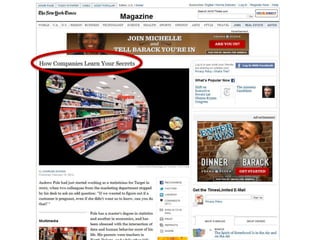
  • #20 Original NY Times piece: http://www.nytimes.com/2012/02/19/magazine/shopping-habits.html?pagewanted=all
  • #21 http://www.nytimes.com/2012/02/19/magazine/shopping-habits.html?pagewanted=all
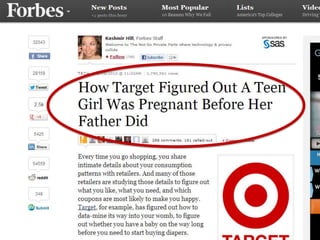
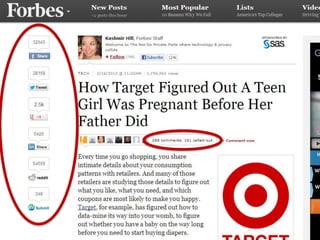
  • #22 http://www.forbes.com/sites/kashmirhill/2012/02/16/how-target-figured-out-a-teen-girl-was-pregnant-before-her-father-did/
  • #23 http://www.forbes.com/sites/kashmirhill/2012/02/16/how-target-figured-out-a-teen-girl-was-pregnant-before-her-father-did/
  • #33 Source: HaraldWeinreich, HartmutObendorf, Eelco Herder, and Matthias Mayer: “Not Quite the Average: An Empirical Study of Web Use,” in the ACM Transactions on the Web, vol. 2, no. 1 (February 2008), article #5.