Developer Grade SEOPhil BuckleyTwitter: @1918
<presentation><meta name="author" content= "Phil Buckley" /><meta name= "description" content= "Developer Grade SEO" /><meta name= "keywords" content= "web development, SEO, canonicalization, .htaccess, validation, html5, clean code, ajax, Google, semantic markup" />
Is this you?
Mind map of the SEO process
Why can’t we all just get along
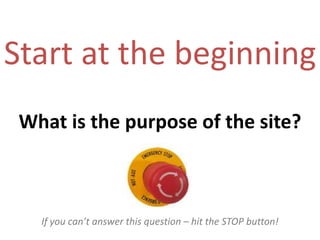
Start at the beginningWhat is the purpose of the site?If you can’t answer this question – hit the STOP button!
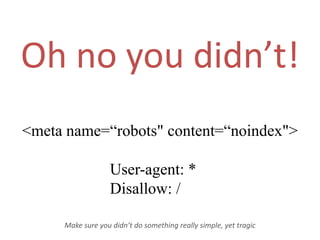
Oh no you didn’t!<meta name=“robots" content=“noindex">User-agent: * Disallow: /Make sure you didn’t do something really simple, yet tragic
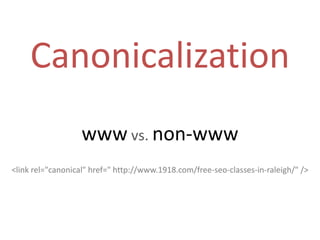
Canonicalizationwwwvs.non-www<link rel="canonical" href=" http://www.1918.com/free-seo-classes-in-raleigh/" />
.htaccess# universal www canonicalization# remove www prefix for all urlsRewriteEngine OnRewriteBase / RewriteCond %{HTTP_HOST} !^1918\.com$ [NC] RewriteRule ^(.*)$ http://1918.com/$1 [R=301,L]
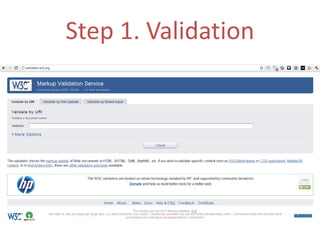
Step 1. Validation
What is the current standard?XHTML 1.1 became a W3C Recommendation on May 31, 2001.CSS 2 became a W3C Recommendation on June 7, 2011.<?xml version="1.0" encoding="UTF-8"?> <!DOCTYPE html PUBLIC "-//W3C//DTD XHTML 1.1//EN"       	"http://www.w3.org/TR/xhtml11/DTD/xhtml11.dtd"> <html version="-//W3C//DTD XHTML 1.1//EN" xmlns="http://www.w3.org/1999/xhtml" xml:lang="en" 	xmlns:xsi="http://www.w3.org/2001/XMLSchema-instance" 	xsi:schemaLocation="http://www.w3.org/1999/xhtml		http://www.w3.org/MarkUp/SCHEMA/xhtml11.xsd" > <head> 	<title>Virtual Library</title> </head> <body> 	<p>Content is <a href="http://example.org/">good</a>.</p> </body> </html>
What about HTML5?
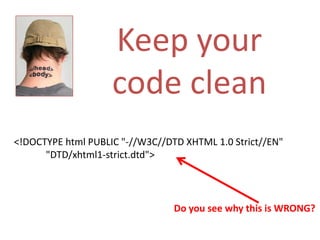
Keep your code clean<!DOCTYPE html PUBLIC "-//W3C//DTD XHTML 1.0 Strict//EN" 	"DTD/xhtml1-strict.dtd">Do you see why this is WRONG?
Elementary Don’ts<a href=“foo.html”>click here</a><imgsrc=“bar.jpg” alt=“” /><title>home</title>Missed opportunityUnforgivableMissed opportunity
Divitis
Cured
Do you style your markup this beautifully?What is a search signal?
Do you love the unix command prompt?
How to think like a robot
What about my awesome web 2.0 ajaxiness?
How are you writing your ajax?<a href=“#”>Click Me</a><a href=“javascript:someFunction(‘somepage.html#parameter=1’)”>
The Hijax ApproachNo javascript? You get this<a href=“somepage.html?parameter=1”onclick=“someFunction(‘somepage.html#parameter=1’); return false”>Got javascript? You get thisThis doesn’t work if you are trying to serve dynamic content
How Google wants you to write your ajaxThey want AJAX content crawlable without executing JavaScript<a href=“http://example.com/page?query#!state”>Special Hash Fragmenthttp://example.com/page?query&_escaped_fragment_=state
RDFa, Rich Snippets, Microdata & other delights<div itemscopeitemtype="http://data-vocabulary.org/Person"> My name is <span itemprop="name">Bob Smith</span> but people call me <span itemprop="nickname">Smithy</span>. Here is my home page: <a href="http://www.example.com" itemprop="url">www.example.com</a> I live in Albuquerque, NM and work as an <span itemprop="title">engineer</span> at <span itemprop="affiliation">ACME Corp</span>. </div>
The Semantic Web is a "web of data" that facilitates machines to understand the semantics, or meaning, of information on the World Wide Web. It extends the network of hyperlinked human-readable web pages by inserting machine-readable metadata about pages and how they are related to each other, enabling automated agents to access the Web more intelligently and perform tasks on behalf of users.
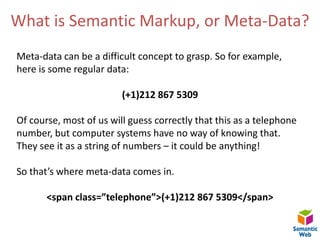
What is Semantic Markup, or Meta-Data?Meta-data can be a difficult concept to grasp. So for example, here is some regular data:(+1)212 867 5309Of course, most of us will guess correctly that this as a telephone number, but computer systems have no way of knowing that. They see it as a string of numbers – it could be anything! So that’s where meta-data comes in.<span class=”telephone”>(+1)212 867 5309</span>
Wait, didn’t Google say something else a few years ago?
Opportunity to build it right into the template
Elementary Do’sAuthor metaPublished date metaTaken from Danny Sullivan’s Daggle.com blog site
Meta data can make a big impact in search resultsTaken from a Google search for Danny Sullivan
How SEO’s and Developers will be in the future
F.A.Q.Do I have to do this stuff to rank well?No.Would my time be better spent doing other SEO tasks?Possibly.If I ask my development team to do this they’ll punch me in the face!Possibly.
</presentation><thankyou>Phil Buckley1918phil@1918.com</thankyou>

Developer Grade SEO - part II

  • 1.
    Developer Grade SEOPhilBuckleyTwitter: @1918
  • 2.
    <presentation><meta name="author" content="Phil Buckley" /><meta name= "description" content= "Developer Grade SEO" /><meta name= "keywords" content= "web development, SEO, canonicalization, .htaccess, validation, html5, clean code, ajax, Google, semantic markup" />
  • 4.
  • 5.
    Mind map ofthe SEO process
  • 6.
    Why can’t weall just get along
  • 7.
    Start at thebeginningWhat is the purpose of the site?If you can’t answer this question – hit the STOP button!
  • 8.
    Oh no youdidn’t!<meta name=“robots" content=“noindex">User-agent: * Disallow: /Make sure you didn’t do something really simple, yet tragic
  • 9.
    Canonicalizationwwwvs.non-www<link rel="canonical" href="http://www.1918.com/free-seo-classes-in-raleigh/" />
  • 10.
    .htaccess# universal wwwcanonicalization# remove www prefix for all urlsRewriteEngine OnRewriteBase / RewriteCond %{HTTP_HOST} !^1918\.com$ [NC] RewriteRule ^(.*)$ http://1918.com/$1 [R=301,L]
  • 11.
  • 13.
    What is thecurrent standard?XHTML 1.1 became a W3C Recommendation on May 31, 2001.CSS 2 became a W3C Recommendation on June 7, 2011.<?xml version="1.0" encoding="UTF-8"?> <!DOCTYPE html PUBLIC "-//W3C//DTD XHTML 1.1//EN" "http://www.w3.org/TR/xhtml11/DTD/xhtml11.dtd"> <html version="-//W3C//DTD XHTML 1.1//EN" xmlns="http://www.w3.org/1999/xhtml" xml:lang="en" xmlns:xsi="http://www.w3.org/2001/XMLSchema-instance" xsi:schemaLocation="http://www.w3.org/1999/xhtml http://www.w3.org/MarkUp/SCHEMA/xhtml11.xsd" > <head> <title>Virtual Library</title> </head> <body> <p>Content is <a href="http://example.org/">good</a>.</p> </body> </html>
  • 14.
  • 15.
    Keep your codeclean<!DOCTYPE html PUBLIC "-//W3C//DTD XHTML 1.0 Strict//EN" "DTD/xhtml1-strict.dtd">Do you see why this is WRONG?
  • 16.
    Elementary Don’ts<a href=“foo.html”>clickhere</a><imgsrc=“bar.jpg” alt=“” /><title>home</title>Missed opportunityUnforgivableMissed opportunity
  • 17.
  • 18.
  • 19.
    Do you styleyour markup this beautifully?What is a search signal?
  • 20.
    Do you lovethe unix command prompt?
  • 21.
    How to thinklike a robot
  • 22.
    What about myawesome web 2.0 ajaxiness?
  • 23.
    How are youwriting your ajax?<a href=“#”>Click Me</a><a href=“javascript:someFunction(‘somepage.html#parameter=1’)”>
  • 24.
    The Hijax ApproachNojavascript? You get this<a href=“somepage.html?parameter=1”onclick=“someFunction(‘somepage.html#parameter=1’); return false”>Got javascript? You get thisThis doesn’t work if you are trying to serve dynamic content
  • 25.
    How Google wantsyou to write your ajaxThey want AJAX content crawlable without executing JavaScript<a href=“http://example.com/page?query#!state”>Special Hash Fragmenthttp://example.com/page?query&_escaped_fragment_=state
  • 26.
    RDFa, Rich Snippets,Microdata & other delights<div itemscopeitemtype="http://data-vocabulary.org/Person"> My name is <span itemprop="name">Bob Smith</span> but people call me <span itemprop="nickname">Smithy</span>. Here is my home page: <a href="http://www.example.com" itemprop="url">www.example.com</a> I live in Albuquerque, NM and work as an <span itemprop="title">engineer</span> at <span itemprop="affiliation">ACME Corp</span>. </div>
  • 27.
    The Semantic Webis a "web of data" that facilitates machines to understand the semantics, or meaning, of information on the World Wide Web. It extends the network of hyperlinked human-readable web pages by inserting machine-readable metadata about pages and how they are related to each other, enabling automated agents to access the Web more intelligently and perform tasks on behalf of users.
  • 28.
    What is SemanticMarkup, or Meta-Data?Meta-data can be a difficult concept to grasp. So for example, here is some regular data:(+1)212 867 5309Of course, most of us will guess correctly that this as a telephone number, but computer systems have no way of knowing that. They see it as a string of numbers – it could be anything! So that’s where meta-data comes in.<span class=”telephone”>(+1)212 867 5309</span>
  • 32.
    Wait, didn’t Googlesay something else a few years ago?
  • 33.
    Opportunity to buildit right into the template
  • 34.
    Elementary Do’sAuthor metaPublisheddate metaTaken from Danny Sullivan’s Daggle.com blog site
  • 35.
    Meta data canmake a big impact in search resultsTaken from a Google search for Danny Sullivan
  • 36.
    How SEO’s andDevelopers will be in the future
  • 37.
    F.A.Q.Do I haveto do this stuff to rank well?No.Would my time be better spent doing other SEO tasks?Possibly.If I ask my development team to do this they’ll punch me in the face!Possibly.
  • 38.