


ENGLISH ASSIGNMENT
SUBMITTED BY:
MOHIT RANA-(BTBM/13/213)
SUKRITI SINGH-(BTBM/13/242)
SECTION D SEM 3
KEYA AGARWAL-(BTF/13/102)
SECTION F SEM 3
WEB BASED WRITING
Web Based
Writ ing.
WEB BASED WRITING
 It is a technique that should be followed for
effectively delivering the webpage content to the
end user.
 Though there is no fixed technique, there might
be few variations but the basic style remains the
same across most of the websites.
HOW BETTER WRITING IMPROVES
YOUR SITE.
What can writers and editors do?
• Testing has shown that you can improve the usability of
your webpages by 159% simply through better writing!
• Clear, concise text makes it easier for people to use your
site and get to the information that matters most to them.
• No flashy redesigns required.
……. Think before you write.
WEB BASED MEDIUMS OF
COMMUNICATION
 Social networks and user-generated content sites :-
 Such as Facebook and user generated content sites
like flicker and YouTube provide a variety of
communication tools, including user comments and
personal profiles for brief messages. Many companies
now host their own social networking sites, where
product users and interact with eachother.
Blogs
 Able to update contents quickly and easily.
 Saves lot of time
 Bloggers can publish information to vast audiences
with relatively little efforts.
FACTS TO CONSIDER FOR WEB
WRITING -THE WEB IS NOT THE SAME
AS PAPERSome facts about reading and the Web…
• 79% of people scan webpages, instead of
read them.
• Reading on a computer screen is 25%
slower than reading on paper.
• Computer screens have about 10% the
resolution of paper.
KNOW YOUR
AUDIENCE
• It is the same as your print audience.
• Look at your current data – where does your traffic
come from?
• Who visits your site, for how long, what do they look
at most?
Know your audience!
WHAT IS THE VOICE OR CONTENT OF YOUR
WRITING ?
• Voice is the expression of your company or site through images,
graphics, typeface, colors, content selection, and words.
• The website’s voice communicates what your brand is all about.
• A strong, consistent voice sets your site apart from the
competition.
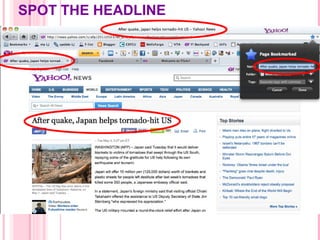
SPOT THE HEADLINE
TIPS FOR WRITING WEB HEADLINES
1. Give people a reason to click
• Why is your work worth anyone’s attention and time.
• It must explain in some way why they should click on you
• If you can’t work out a value proposition and express it clearly in a
headline, it might be worth editing your piece.
• Promise a BIG, powerful benefit to your customers.
2. Think creative
• For example at the book store: first of all, you are attracted by the
bright cover and then you pick it up and look at the table of
contents.
• They don't read ALL your pages. They jump from headline
to headline. And only if a headline catch's their interest,
they start to read the information under it.
3. It should probably mention what the piece is
about
Its always worth stating.
It’s surprising many fascinating pieces have incredibly
vague headlines.
Anyone who finds you through search because they’re
looking for the thing you’re talking about is almost
certainly going to be lost if you don’t mention it in the
headline
4. Don’t make promises you can’t keep
Make sure people know they can trust what they’re
clicking on. No one likes feeling disappointed, and people
aren’t going to share things that create those feelings.
OTHER IMPORTANT TIPS
• Use verbs that are strong, active, fresh, and accurate
• Front-load the most relevant info
• Make sure the headline can stand alone, without a tease,
subhead, photo, or even the article
• Choose clarity over cleverness
• Keep global audience in mind
• Include relevant search keywords
WRITE TEXT TO ATTRACT SEARCH
ENGINES
 Your web pages should be written to attract
search engines, not people.
 Why? Because if search engines do not rank your
page well, the only visitors you will receive are
those you give your link to directly, or from
websites that link back to yours. To accomplish
this objective, identify keyword phrases of 2-3
words the keywords that relate to your business
and use them in the text you write.
AVOID OVERUSE OF PUNCTUATION
 Do not add gratuitous punctuation as in:
 We're the Best!!!
 We're Exciting!!!
 Buy from Us!!!“
 The same goes for commas and semicolons. They
make sentences harder to read and may turn
people away.
USE SHORT SENTENCES
• Long sentences are harder to read. Break them
up into shorter ones.
• Write only one idea per paragraph
• Web pages need to be concise and to-the-point.
• People don't read web pages, they scan them, so
having short, meaty paragraphs is better than
long rambling ones.
•   
• Use lists instead of paragraphs
• Lists are easier to scan than paragraphs,
especially if you keep them short.
• Include sub-headings in web page content
• Use action words whenever possible
• Avoid the passive voice.
• Write what you would say to them if you were talking
on the phone.
• For example, instead of:
An acknowledgement of the order will be issued via an
e-mail message when payment is completed.
Use:
You will receive an email from us confirming your
order.
Write links that work
• Please remember not  to use "click here" for your
links.
"Click here" says nothing – it doesn't reach out and
grab your readers and make them want  to click on the
link.
• According to the W3C Quality Assurance Team, links
should:
• be brief and meaningful
• provide information even when read out of context
• explain what the link offers
• not deal with the mechanics of the site
• not be a verb phrase
Make your links part of the text
 Links are another way web readers scan pages.
 They stand out from normal text, and provide more
cues as to what the page is about.
 Make sure that the text for your links indicates where
the links will lead your website visitors.
• Key Facts First
• Employ the inverted-pyramid model of writing, based
on journalistic style, in which the most important
information is featured first, followed by decreasingly
significant information.
• Put conclusions at the beginning
Think of an inverted pyramid when you write. Get to
the point in the first paragraph, then expand upon it.
• Advantage???
• One advantage of this strategy is if content is too long,
it’s easier just to cut from the bottom rather than try
to delete passages throughout.
• Say It Straight
• Chant your new mantra: SWYM, MWYS. (Say what
you mean, mean what you say.) Objectivity equals
authority; avoid marketese, promotional excess,
hyperbole — whatever you want to call it. If people
trust you to be evenhanded in your writing style, they
will trust you.
• Also, be literal, not figurative: If, in a heading for a
sports story, you use metaphorical language like curse
instead of something more concrete like “losing
streak,” you lose the opportunity for search
optimization.
• Define your goal
Before you write anything, ask yourself:
WHY am I writing this
WHAT is my main message
WHO am I talking to?
HOW do I want them to respond.
Hey, no kidding. How DO you want them to respond?
This is how you increase conversion rates! When
people have made it to the bottom of the wonderful
page you created, give them someplace relevant to go!
Don’t make them scroll back to the top.
Post content regularly
• In order to both keep your existing audience happy
and at the same time grow your readership, you
should post new content regularly.
• Make sure you take enough time to brainstorm about
topics and to do your research. Depending on your
resources, schedule two, three, or more regular
publications per week.
• An easy way to get up your number of articles is by
allowing guest posts. As long as you keep the overall
quality high, your audience probably doesn’t care
about who has written the articles.
FRONT LOAD CONTENT
• Use subheadings. Because users will skim read, it’s a
good idea to use subheadings so that they can find
relevant content quickly.
• Be concise. Use bullet points, clear and simple language
which is not long winded. .
• Front-load content. This means that you put the
conclusion for what you are trying to say first. This helps
users get a jist of what is on the page and hopefully it will
capture their imagination.
• There is nothing worse then reading a few paragraphs
and realizing the page you are on is completely irrelevant
WHAT IS A GOOD KEYWORD?
• A keyword is a word or short phrase people will use to
search for your article.
• Keywords are usually “everyday language” not insider jargon or
marketing hype.
• Spell out keywords because people don’t search for abbreviations.
Thank you…

Web based writing - English Asignment

  • 1.
    ENGLISH ASSIGNMENT SUBMITTED BY: MOHITRANA-(BTBM/13/213) SUKRITI SINGH-(BTBM/13/242) SECTION D SEM 3 KEYA AGARWAL-(BTF/13/102) SECTION F SEM 3
  • 2.
    WEB BASED WRITING WebBased Writ ing.
  • 3.
    WEB BASED WRITING It is a technique that should be followed for effectively delivering the webpage content to the end user.  Though there is no fixed technique, there might be few variations but the basic style remains the same across most of the websites.
  • 4.
    HOW BETTER WRITINGIMPROVES YOUR SITE. What can writers and editors do? • Testing has shown that you can improve the usability of your webpages by 159% simply through better writing! • Clear, concise text makes it easier for people to use your site and get to the information that matters most to them. • No flashy redesigns required. ……. Think before you write.
  • 5.
    WEB BASED MEDIUMSOF COMMUNICATION  Social networks and user-generated content sites :-  Such as Facebook and user generated content sites like flicker and YouTube provide a variety of communication tools, including user comments and personal profiles for brief messages. Many companies now host their own social networking sites, where product users and interact with eachother.
  • 6.
    Blogs  Able toupdate contents quickly and easily.  Saves lot of time  Bloggers can publish information to vast audiences with relatively little efforts.
  • 7.
    FACTS TO CONSIDERFOR WEB WRITING -THE WEB IS NOT THE SAME AS PAPERSome facts about reading and the Web… • 79% of people scan webpages, instead of read them. • Reading on a computer screen is 25% slower than reading on paper. • Computer screens have about 10% the resolution of paper.
  • 8.
    KNOW YOUR AUDIENCE • Itis the same as your print audience. • Look at your current data – where does your traffic come from? • Who visits your site, for how long, what do they look at most? Know your audience!
  • 9.
    WHAT IS THEVOICE OR CONTENT OF YOUR WRITING ? • Voice is the expression of your company or site through images, graphics, typeface, colors, content selection, and words. • The website’s voice communicates what your brand is all about. • A strong, consistent voice sets your site apart from the competition.
  • 11.
  • 12.
    TIPS FOR WRITINGWEB HEADLINES 1. Give people a reason to click • Why is your work worth anyone’s attention and time. • It must explain in some way why they should click on you • If you can’t work out a value proposition and express it clearly in a headline, it might be worth editing your piece. • Promise a BIG, powerful benefit to your customers. 2. Think creative • For example at the book store: first of all, you are attracted by the bright cover and then you pick it up and look at the table of contents. • They don't read ALL your pages. They jump from headline to headline. And only if a headline catch's their interest, they start to read the information under it.
  • 13.
    3. It shouldprobably mention what the piece is about Its always worth stating. It’s surprising many fascinating pieces have incredibly vague headlines. Anyone who finds you through search because they’re looking for the thing you’re talking about is almost certainly going to be lost if you don’t mention it in the headline 4. Don’t make promises you can’t keep Make sure people know they can trust what they’re clicking on. No one likes feeling disappointed, and people aren’t going to share things that create those feelings.
  • 14.
    OTHER IMPORTANT TIPS •Use verbs that are strong, active, fresh, and accurate • Front-load the most relevant info • Make sure the headline can stand alone, without a tease, subhead, photo, or even the article • Choose clarity over cleverness • Keep global audience in mind • Include relevant search keywords
  • 15.
    WRITE TEXT TOATTRACT SEARCH ENGINES  Your web pages should be written to attract search engines, not people.  Why? Because if search engines do not rank your page well, the only visitors you will receive are those you give your link to directly, or from websites that link back to yours. To accomplish this objective, identify keyword phrases of 2-3 words the keywords that relate to your business and use them in the text you write.
  • 16.
    AVOID OVERUSE OFPUNCTUATION  Do not add gratuitous punctuation as in:  We're the Best!!!  We're Exciting!!!  Buy from Us!!!“  The same goes for commas and semicolons. They make sentences harder to read and may turn people away.
  • 17.
    USE SHORT SENTENCES •Long sentences are harder to read. Break them up into shorter ones. • Write only one idea per paragraph • Web pages need to be concise and to-the-point. • People don't read web pages, they scan them, so having short, meaty paragraphs is better than long rambling ones. •    • Use lists instead of paragraphs • Lists are easier to scan than paragraphs, especially if you keep them short.
  • 18.
    • Include sub-headingsin web page content • Use action words whenever possible • Avoid the passive voice. • Write what you would say to them if you were talking on the phone. • For example, instead of: An acknowledgement of the order will be issued via an e-mail message when payment is completed. Use: You will receive an email from us confirming your order.
  • 19.
    Write links thatwork • Please remember not  to use "click here" for your links. "Click here" says nothing – it doesn't reach out and grab your readers and make them want  to click on the link. • According to the W3C Quality Assurance Team, links should: • be brief and meaningful • provide information even when read out of context • explain what the link offers • not deal with the mechanics of the site • not be a verb phrase
  • 20.
    Make your linkspart of the text  Links are another way web readers scan pages.  They stand out from normal text, and provide more cues as to what the page is about.  Make sure that the text for your links indicates where the links will lead your website visitors.
  • 21.
    • Key FactsFirst • Employ the inverted-pyramid model of writing, based on journalistic style, in which the most important information is featured first, followed by decreasingly significant information. • Put conclusions at the beginning Think of an inverted pyramid when you write. Get to the point in the first paragraph, then expand upon it. • Advantage??? • One advantage of this strategy is if content is too long, it’s easier just to cut from the bottom rather than try to delete passages throughout.
  • 22.
    • Say ItStraight • Chant your new mantra: SWYM, MWYS. (Say what you mean, mean what you say.) Objectivity equals authority; avoid marketese, promotional excess, hyperbole — whatever you want to call it. If people trust you to be evenhanded in your writing style, they will trust you. • Also, be literal, not figurative: If, in a heading for a sports story, you use metaphorical language like curse instead of something more concrete like “losing streak,” you lose the opportunity for search optimization.
  • 23.
    • Define yourgoal Before you write anything, ask yourself: WHY am I writing this WHAT is my main message WHO am I talking to? HOW do I want them to respond. Hey, no kidding. How DO you want them to respond? This is how you increase conversion rates! When people have made it to the bottom of the wonderful page you created, give them someplace relevant to go! Don’t make them scroll back to the top.
  • 24.
    Post content regularly •In order to both keep your existing audience happy and at the same time grow your readership, you should post new content regularly. • Make sure you take enough time to brainstorm about topics and to do your research. Depending on your resources, schedule two, three, or more regular publications per week. • An easy way to get up your number of articles is by allowing guest posts. As long as you keep the overall quality high, your audience probably doesn’t care about who has written the articles.
  • 25.
    FRONT LOAD CONTENT •Use subheadings. Because users will skim read, it’s a good idea to use subheadings so that they can find relevant content quickly. • Be concise. Use bullet points, clear and simple language which is not long winded. . • Front-load content. This means that you put the conclusion for what you are trying to say first. This helps users get a jist of what is on the page and hopefully it will capture their imagination. • There is nothing worse then reading a few paragraphs and realizing the page you are on is completely irrelevant
  • 26.
    WHAT IS AGOOD KEYWORD? • A keyword is a word or short phrase people will use to search for your article. • Keywords are usually “everyday language” not insider jargon or marketing hype. • Spell out keywords because people don’t search for abbreviations.
  • 30.

Editor's Notes

  • #5 Bullet 1 from Nielsen Norman Group, experts on human-centered design, researching UI since early 1990s