Reader-Centric Publications
Workshop
How to create content that helps you succeed by working for those who
look for it, read it, and use it
Agenda
• Introduction
• Principles of effective content
• Your top-priority audiences
• General best practices
• Headlines and links
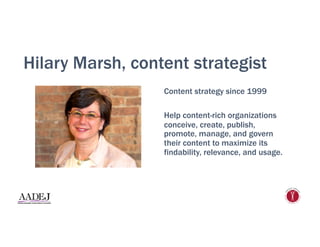
Hilary Marsh, content strategist
Content strategy since 1999
Help content-rich organizations
conceive, create, publish,
promote, manage, and govern
their content to maximize its
findability, relevance, and usage.
Purpose of this workshop
• Understand the basic
principles of reader-centric
writing
• Make your content
•  more engaging
•  easier to read
•  easier to discover, engage with, and
act on
Principles of reader-centric
writing
Effective writing
•  Sounds like the organization
•  Has a goal
•  Uses the active voice
•  Is specific
•  Is focused on the reader, NOT on your
organization
Ultimate goal
Audience centric
Business sensitive
Content
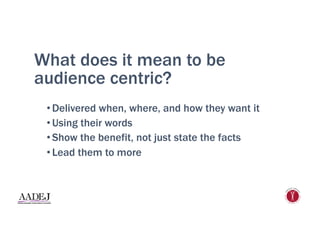
What does it mean to be
audience centric?
• Delivered when, where, and how they want it
• Using their words
• Show the benefit, not just state the facts
• Lead them to more
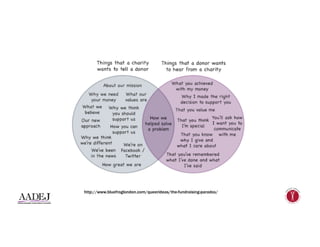
http://www.bluefroglondon.com/queerideas/the-fundraising-paradox/
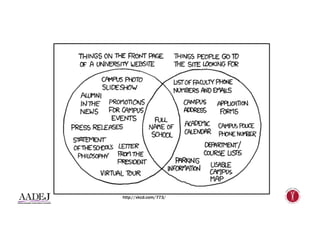
http://xkcd.com/773/
h"ps://www.etsy.com/lis1ng/104303814/anais-­‐nin-­‐quote-­‐le"erpress-­‐poster-­‐12	
  
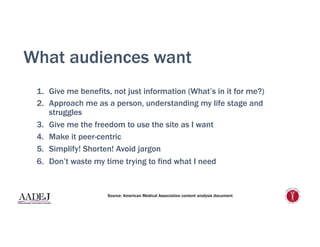
What audiences want
1.  Give me benefits, not just information (What’s in it for me?)
2.  Approach me as a person, understanding my life stage and
struggles
3.  Give me the freedom to use the site as I want
4.  Make it peer-centric
5.  Simplify! Shorten! Avoid jargon
6.  Don’t waste my time trying to find what I need
Source: American Medical Association content analysis document
“Users don’t care about your
org chart”
--Lou Rosenfeld
Author, Information Architecture for the World Wide Web
What does it mean to be
business sensitive?
• Is created to meet an explicit business goal
• Written in the organization’s voice
• Crafted in partnership with subject matter
experts
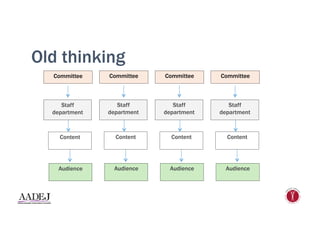
Old thinking
Committee
Staff
department
Content
Audience
Committee
Staff
department
Content
Audience
Committee
Staff
department
Content
Audience
Committee
Staff
department
Content
Audience
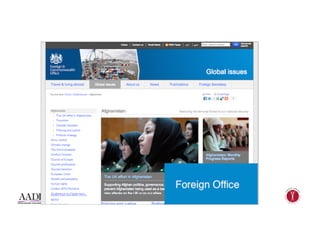
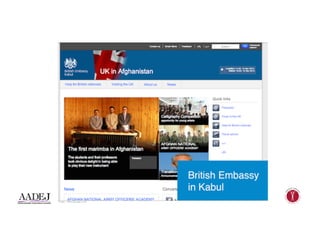
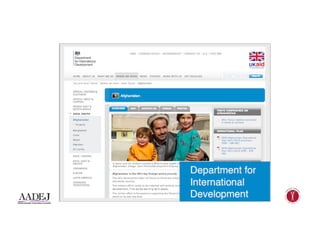
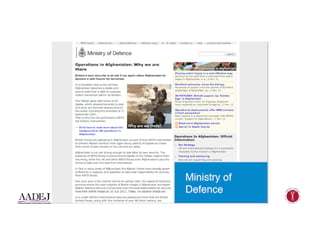
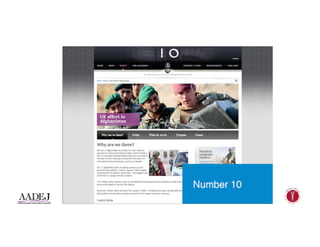
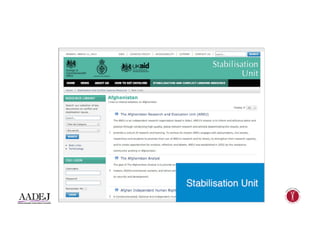
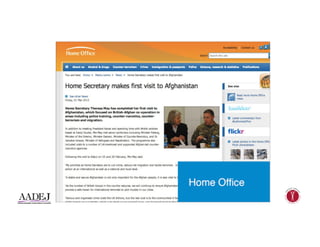
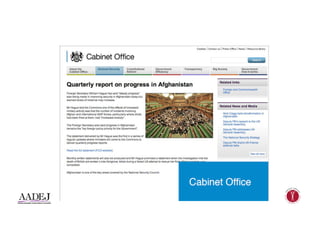
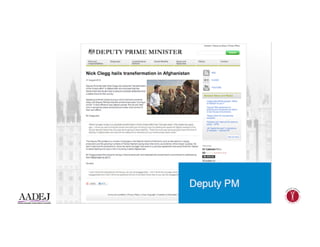
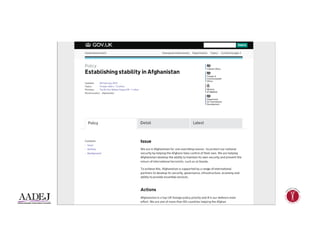
“What’s the government’s
policy on Afghanistan?”
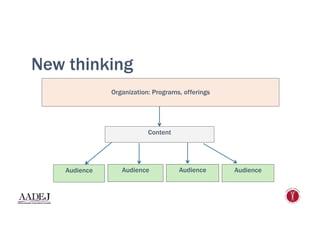
Organization: Programs, offerings
Audience
Content
Audience Audience Audience
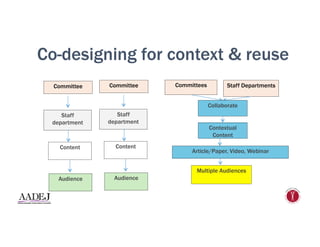
New thinking
Committees Staff Departments
Multiple Audiences
Collaborate
Contextual
Content
Co-designing for context & reuse
Article/Paper, Video, Webinar
Committee
Staff
department
Content
Audience
Committee
Staff
department
Content
Audience
Working together for
member satisfaction
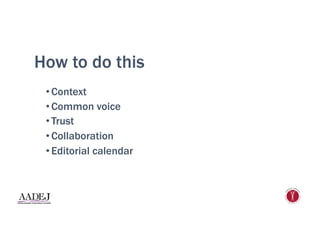
How to do this
• Context
• Common voice
• Trust
• Collaboration
• Editorial calendar
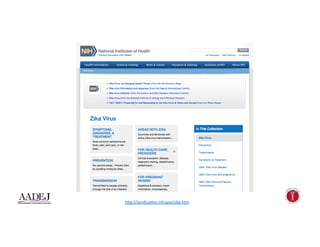
h"p://syndica1on.nih.gov/zika.htm	
  
What does it mean to deliver a
message?
Watch these versions of the same information
(2 clips from http://www.nbc.com/chicago-med/episode-guide/season-1/
bound/106 – to parents, patient)
Who are you talking to?
Write for the people who read and use your content
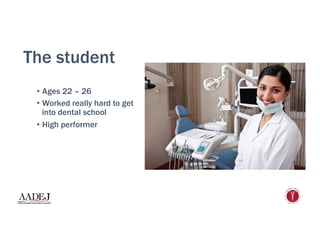
The student
•  Ages 22 – 26
•  Worked really hard to get
into dental school
•  High performer
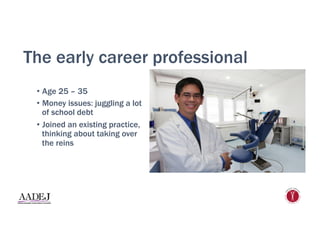
The early career professional
•  Age 25 – 35
•  Money issues: juggling a lot
of school debt
•  Joined an existing practice,
thinking about taking over
the reins
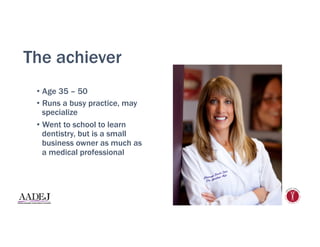
The achiever
•  Age 35 – 50
•  Runs a busy practice, may
specialize
•  Went to school to learn
dentistry, but is a small
business owner as much as
a medical professional
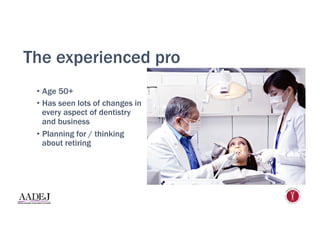
The experienced pro
•  Age 50+
•  Has seen lots of changes in
every aspect of dentistry
and business
•  Planning for / thinking
about retiring
What do you know about them?
•  What are they already experts in?
•  What don’t they know now?
•  What keeps them up at night?
•  How tech-savvy are they?
•  What do they read?
•  What do they do outside of work?
What are their content needs?*
Exercise 1
* Not topics, but style, pace, channels, timing
Best practices
Smart online content…
• Is like a conversation
• Answers people’s questions
• Lets readers “grab and go”
– Ginny Redish, Letting Go of the Words
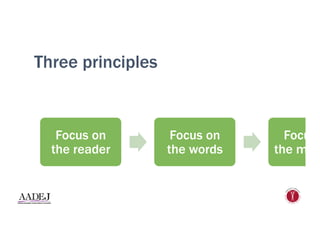
Three principles
Focus on
the reader
Focus on
the words
Focus
the med
Reader-centered content…
• Has a goal
• Helps the reader do a task
• Is specific
• Is focused on the reader, NOT on the
organization
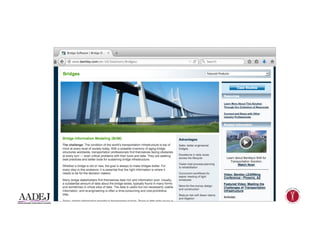
What is the goal of this page?
Buy the product?
Get budget to buy the product?
Learn how to use the product?
The page must explicitly address the goal
The goal will translate to measures of success
Without those measures, it’s impossible to know whether it’s
working
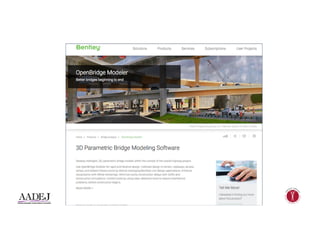
Identify goals for your content
•  Each piece of content should have a clear, well-defined focus
•  Don’t try to squeeze too much into one article
•  Think about what you want the user to take away from the
article
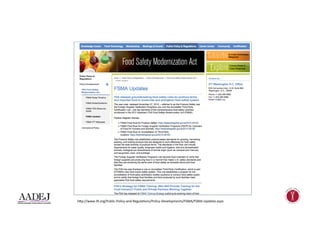
h"p://www.iD.org/Public-­‐Policy-­‐and-­‐Regula1ons/Policy-­‐Developments/FSMA/FSMA-­‐Updates.aspx	
  
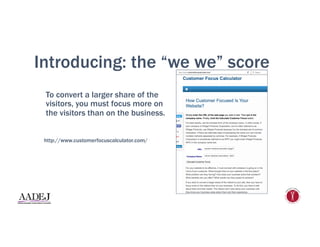
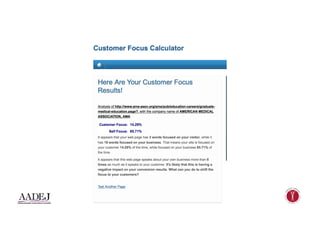
Introducing: the “we we” score
To convert a larger share of the
visitors, you must focus more on
the visitors than on the business.
http://www.customerfocuscalculator.com/
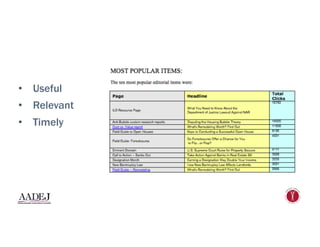
•  Useful
•  Relevant
•  Timely
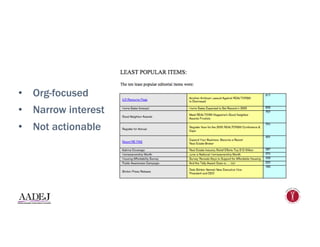
•  Org-focused
•  Narrow interest
•  Not actionable
Planning for successful conversations
•  What do I want to achieve from this content?
•  Who am I talking to?
•  What brings those people to my site or app? What are their
top tasks? Top questions? Conversations they want to start?
•  Make sure your goals are specific, measurable, and focused
on what you want your site visitors to do.
- Ginny Redish, Content as Conversation
Write for the space
•  Avoid long paragraphs or other heavy blocks of text
•  Write half as much as conventional writing – people read 25
percent more slowly online
•  Use bullet points, subheadings, and other visual cues to
make information more manageable
•  Keep sentences short – ideally, no more than 15 words
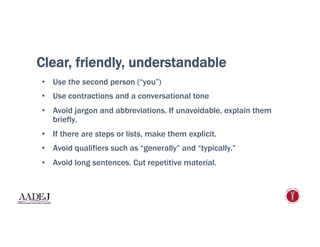
Clear, friendly, understandable
•  Use the second person (“you”)
•  Use contractions and a conversational tone
•  Avoid jargon and abbreviations. If unavoidable, explain them
briefly.
•  If there are steps or lists, make them explicit.
•  Avoid qualifiers such as “generally” and “typically.”
•  Avoid long sentences. Cut repetitive material.
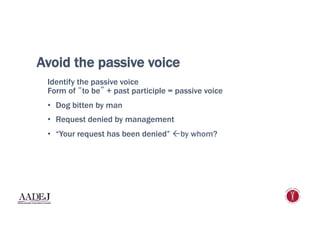
Avoid the passive voice
Identify the passive voice
Form of “to be” + past participle = passive voice
•  Dog bitten by man
•  Request denied by management
•  “Your request has been denied” ßby whom?
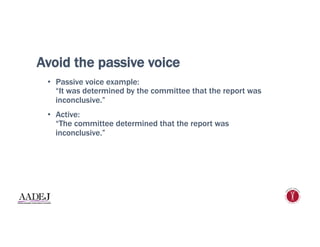
Avoid the passive voice
•  Passive voice example:
“It was determined by the committee that the report was
inconclusive.”
•  Active:
“The committee determined that the report was
inconclusive.”
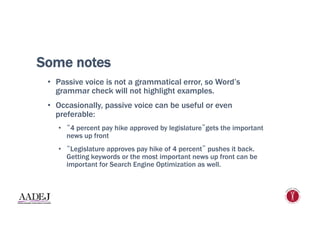
Some notes
•  Passive voice is not a grammatical error, so Word’s
grammar check will not highlight examples.
•  Occasionally, passive voice can be useful or even
preferable:
•  “4 percent pay hike approved by legislature”gets the important
news up front
•  “Legislature approves pay hike of 4 percent” pushes it back.
Getting keywords or the most important news up front can be
important for Search Engine Optimization as well.
Bite, snack, meal
•  Bite: A headline with a message
•  Snack: A concise summary
•  Meal: The full thing
– Leslie O’Flahavan, ewriteonline
http://ewriteonline.com/articles/2011/11/bite-snack-and-meal-how-to-feed-content-hungry-site-visitors/
Focus on the Medium
How people read online
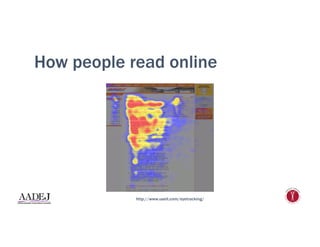
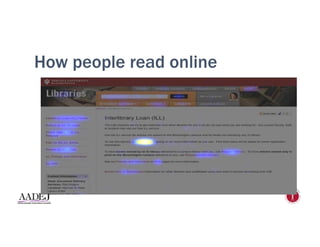
•  They don’t read – when they first encounter a page, they scan it
•  Users are looking for information-carrying words
•  Users decide whether to continue reading a page based on the
first few words
•  First paragraph or two must state the most important
information
•  Users will scroll “below the fold” only if the information above it
makes them believe the rest of the page will be worth their
time
•  Users dislike and skip boilerplate welcome or introduction text,
“marketese” with exaggerated claims
How people read online
http://www.useit.com/eyetracking/
How people read online
People scan, they don’t read
•  They are pressed for time
•  They’ve become “Twitter-ized”
•  Screens are reflective and cause eye fatigue
Make text scannable
• “Chunk” content into sections
• Break up long passages with subheads
• Present information in short bullet points
• Use reader-focused keywords
What does this mean for writers?
•  Write short, descriptive headlines
•  Use inverted pyramid style (most important
information first)
•  Use half the words you’d use in conventional writing
•  Stick to one idea per paragraph
•  Keep sentences clear, descriptive, and simple
•  Keep sentences short – ideally, no more than 15 words
•  Use the active voice as much as possible
Focus on the Words
Use fewer words
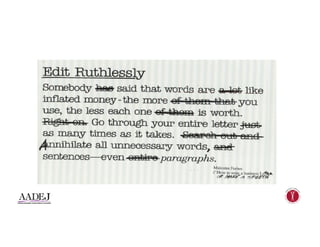
• Shorten verbose text, say more with less
• Write for clarity and impact
• Use standard words
Writing shorter is not easier
I have made this [letter]
longer than usual because I
have not had time to make it
shorter.
-- Blaise Pascal, 1657
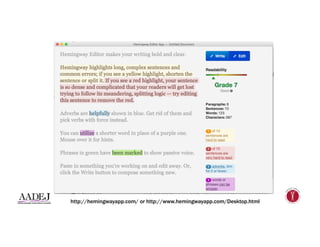
http://hemingwayapp.com/ or http://www.hemingwayapp.com/Desktop.html
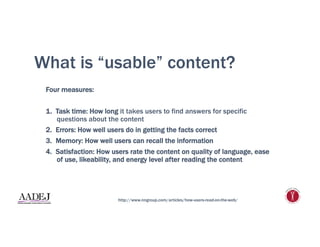
What is “usable” content?
Four measures:
1.  Task time: How long it takes users to find answers for specific
questions about the content
2.  Errors: How well users do in getting the facts correct
3.  Memory: How well users can recall the information
4.  Satisfaction: How users rate the content on quality of language, ease
of use, likeability, and energy level after reading the content
http://www.nngroup.com/articles/how-users-read-on-the-web/
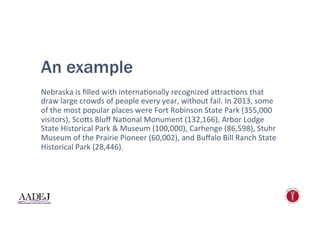
An example
Nebraska	
  is	
  filled	
  with	
  interna1onally	
  recognized	
  a"rac1ons	
  that	
  
draw	
  large	
  crowds	
  of	
  people	
  every	
  year,	
  without	
  fail.	
  In	
  2013,	
  some	
  
of	
  the	
  most	
  popular	
  places	
  were	
  Fort	
  Robinson	
  State	
  Park	
  (355,000	
  
visitors),	
  Sco"s	
  Bluff	
  Na1onal	
  Monument	
  (132,166),	
  Arbor	
  Lodge	
  
State	
  Historical	
  Park	
  &	
  Museum	
  (100,000),	
  Carhenge	
  (86,598),	
  Stuhr	
  
Museum	
  of	
  the	
  Prairie	
  Pioneer	
  (60,002),	
  and	
  Buffalo	
  Bill	
  Ranch	
  State	
  
Historical	
  Park	
  (28,446).	
  
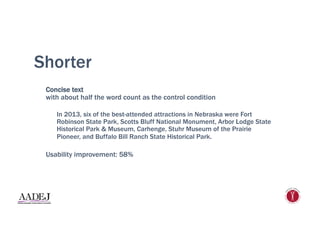
Shorter
Concise text
with about half the word count as the control condition
In 2013, six of the best-attended attractions in Nebraska were Fort
Robinson State Park, Scotts Bluff National Monument, Arbor Lodge State
Historical Park & Museum, Carhenge, Stuhr Museum of the Prairie
Pioneer, and Buffalo Bill Ranch State Historical Park.
Usability improvement: 58%
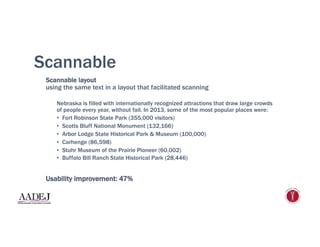
Scannable
Scannable layout
using the same text in a layout that facilitated scanning
Nebraska is filled with internationally recognized attractions that draw large crowds
of people every year, without fail. In 2013, some of the most popular places were:
•  Fort Robinson State Park (355,000 visitors)
•  Scotts Bluff National Monument (132,166)
•  Arbor Lodge State Historical Park & Museum (100,000)
•  Carhenge (86,598)
•  Stuhr Museum of the Prairie Pioneer (60,002)
•  Buffalo Bill Ranch State Historical Park (28,446)
Usability improvement: 47%
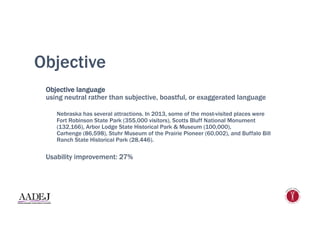
Objective
Objective language
using neutral rather than subjective, boastful, or exaggerated language
Nebraska has several attractions. In 2013, some of the most-visited places were
Fort Robinson State Park (355,000 visitors), Scotts Bluff National Monument
(132,166), Arbor Lodge State Historical Park & Museum (100,000),
Carhenge (86,598), Stuhr Museum of the Prairie Pioneer (60,002), and Buffalo Bill
Ranch State Historical Park (28,446).
Usability improvement: 27%
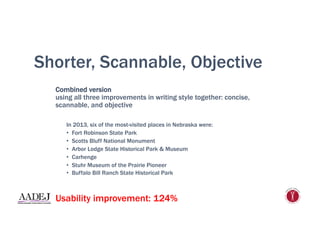
Shorter, Scannable, Objective
Combined version
using all three improvements in writing style together: concise,
scannable, and objective
In 2013, six of the most-visited places in Nebraska were:
•  Fort Robinson State Park
•  Scotts Bluff National Monument
•  Arbor Lodge State Historical Park & Museum
•  Carhenge
•  Stuhr Museum of the Prairie Pioneer
•  Buffalo Bill Ranch State Historical Park
Usability improvement: 124%
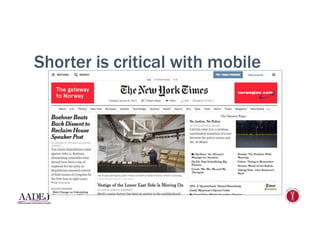
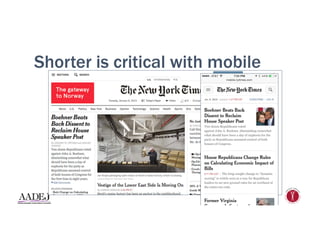
Shorter is critical with mobile
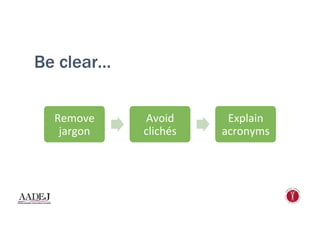
Be clear…
Remove	
  
jargon	
  
Avoid	
  
clichés	
  
Explain	
  
acronyms	
  
Time for a break!
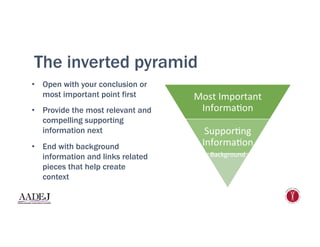
The inverted pyramid
•  Open with your conclusion or
most important point first
•  Provide the most relevant and
compelling supporting
information next
•  End with background
information and links related
pieces that help create
context
Most	
  Important	
  
Informa1on	
  	
  
Suppor1ng	
  
Informa1on	
  
Background	


Why do this?
• Mobile
• Responsive
• More easily read by non-native English speakers
• More accessible -- > now a requirement
Exercise
Try your hand at the inverted pyramid style
Increase Your Content’s Readability
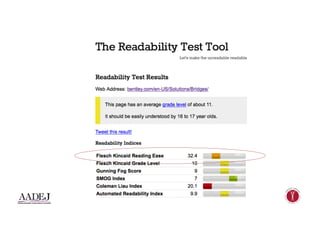
Flesch-Kincaid readability score is based on
•  Average number of words per sentence
•  Average syllables per word
•  Number of passive sentences
Readability tools are a useful “early warning system” to let
writers know when their writing might be too complex
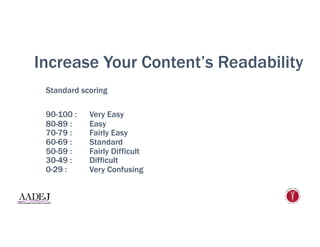
Increase Your Content’s Readability
Standard scoring
90-100 : Very Easy
80-89 : Easy
70-79 : Fairly Easy
60-69 : Standard
50-59 : Fairly Difficult
30-49 : Difficult
0-29 : Very Confusing
Increase Your Content’s Readability
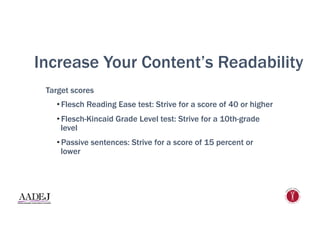
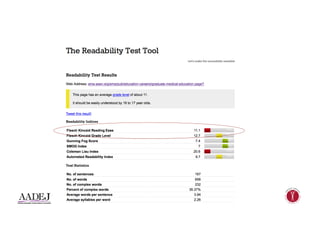
Target scores
• Flesch Reading Ease test: Strive for a score of 40 or higher
• Flesch-Kincaid Grade Level test: Strive for a 10th-grade
level
• Passive sentences: Strive for a score of 15 percent or
lower
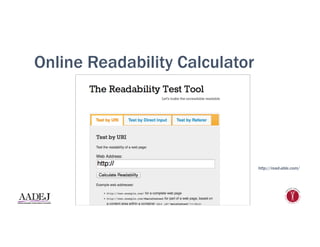
Online Readability Calculator
http://read-able.com/
Exercise
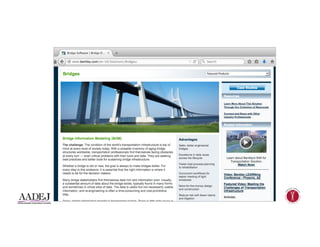
Make this content more readable
Headlines and Links
The entry points for every page
8 types of headlines
1.  Direct
2.  News
3.  How-to
4.  Question
5.  Command
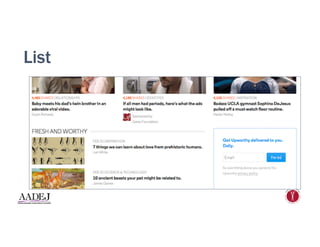
6.  List
7.  Testimonial
8.  Teaser
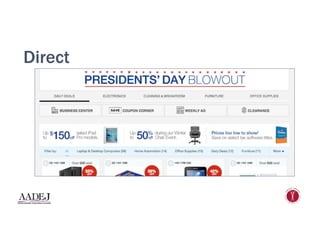
Direct
• Often, more of a label than a headline
• No verb (maybe not needed, because of context)
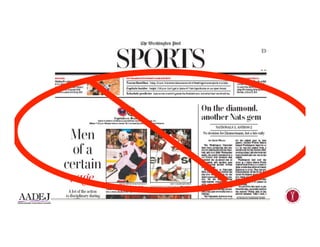
Direct
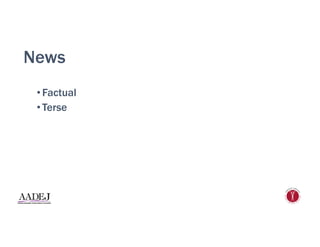
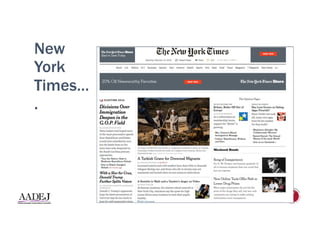
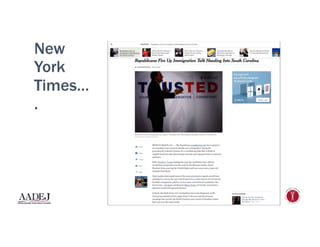
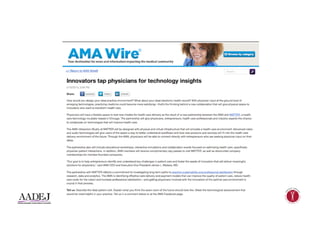
News
• Factual
• Terse
New
York
Times…
.
New
York
Times…
.
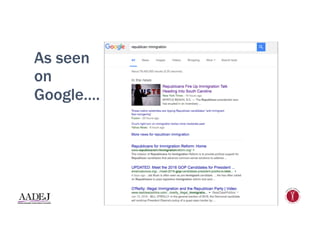
As seen
on
Google….
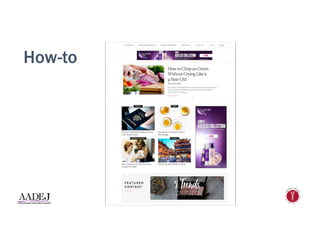
How-to
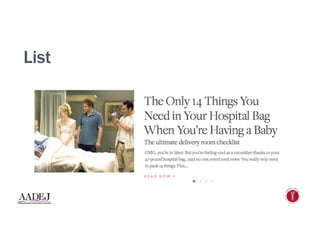
List
List
Teaser
•  “You won’t believe what happened next”
•  Popular on many high-profile sites
•  Use with caution
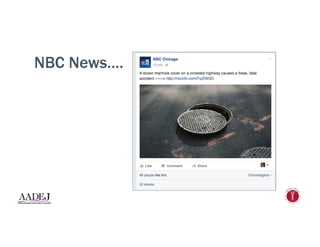
NBC News….
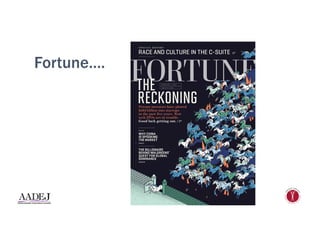
Fortune….
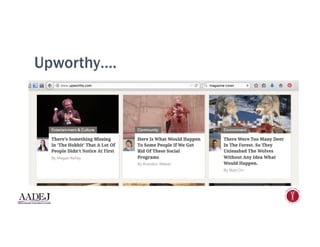
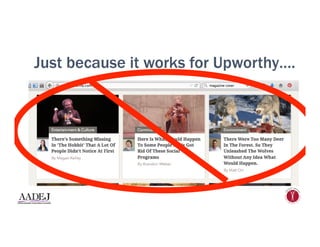
Upworthy….
Just because it works for Upworthy….
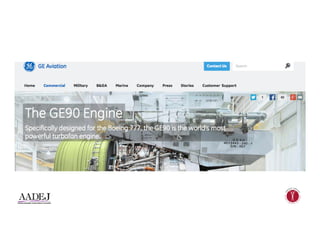
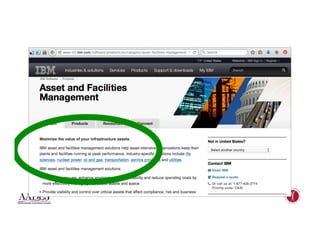
Good headlines
•  Answer readers’ questions
•  Contain action words
•  Avoid puns
•  Tout the features that are important to your audience
Another exercise
Rewrite the headline
Writing SEO-friendly content
•  Keep page goals and keywords in mind
•  Use key words and phrases early
•  Stay smart and user-friendly!
Writing mobile-friendly content
•  Write fewer words
•  Don’t rely on visual cues in the content – for example, “see
related links at right,” – since the visual placement of
components is likely to be rendered differently on a mobile
device
Writing reusable content
•  Clear vs clever, especially for headlines.
A magazine cover line is not a good model for a headline
•  Don’t assume context.
A headline will appear not only on a destination page but
also on a landing page, in related links, on social media, etc.
Resources
Resources
www.prdaily.com/Main/Articles/8_simple_yet_powerful_types_of_headlines__11276.aspx
www.customerfocuscalculator.com
www.hemingwayapp.com
read-able.com

Reader-Centric Publications workshop

  • 1.
    Reader-Centric Publications Workshop How tocreate content that helps you succeed by working for those who look for it, read it, and use it
  • 2.
    Agenda • Introduction • Principles of effectivecontent • Your top-priority audiences • General best practices • Headlines and links
  • 3.
    Hilary Marsh, contentstrategist Content strategy since 1999 Help content-rich organizations conceive, create, publish, promote, manage, and govern their content to maximize its findability, relevance, and usage.
  • 4.
    Purpose of thisworkshop • Understand the basic principles of reader-centric writing • Make your content •  more engaging •  easier to read •  easier to discover, engage with, and act on
  • 5.
  • 6.
    Effective writing •  Soundslike the organization •  Has a goal •  Uses the active voice •  Is specific •  Is focused on the reader, NOT on your organization
  • 7.
  • 8.
    What does itmean to be audience centric? • Delivered when, where, and how they want it • Using their words • Show the benefit, not just state the facts • Lead them to more
  • 9.
  • 10.
  • 12.
  • 13.
    What audiences want 1. Give me benefits, not just information (What’s in it for me?) 2.  Approach me as a person, understanding my life stage and struggles 3.  Give me the freedom to use the site as I want 4.  Make it peer-centric 5.  Simplify! Shorten! Avoid jargon 6.  Don’t waste my time trying to find what I need Source: American Medical Association content analysis document
  • 14.
    “Users don’t careabout your org chart” --Lou Rosenfeld Author, Information Architecture for the World Wide Web
  • 15.
    What does itmean to be business sensitive? • Is created to meet an explicit business goal • Written in the organization’s voice • Crafted in partnership with subject matter experts
  • 16.
  • 17.
  • 27.
  • 28.
    Committees Staff Departments MultipleAudiences Collaborate Contextual Content Co-designing for context & reuse Article/Paper, Video, Webinar Committee Staff department Content Audience Committee Staff department Content Audience
  • 30.
  • 31.
    How to dothis • Context • Common voice • Trust • Collaboration • Editorial calendar
  • 33.
  • 34.
    What does itmean to deliver a message? Watch these versions of the same information (2 clips from http://www.nbc.com/chicago-med/episode-guide/season-1/ bound/106 – to parents, patient)
  • 35.
    Who are youtalking to? Write for the people who read and use your content
  • 36.
    The student •  Ages22 – 26 •  Worked really hard to get into dental school •  High performer
  • 37.
    The early careerprofessional •  Age 25 – 35 •  Money issues: juggling a lot of school debt •  Joined an existing practice, thinking about taking over the reins
  • 38.
    The achiever •  Age35 – 50 •  Runs a busy practice, may specialize •  Went to school to learn dentistry, but is a small business owner as much as a medical professional
  • 39.
    The experienced pro • Age 50+ •  Has seen lots of changes in every aspect of dentistry and business •  Planning for / thinking about retiring
  • 40.
    What do youknow about them? •  What are they already experts in? •  What don’t they know now? •  What keeps them up at night? •  How tech-savvy are they? •  What do they read? •  What do they do outside of work?
  • 41.
    What are theircontent needs?* Exercise 1 * Not topics, but style, pace, channels, timing
  • 42.
  • 43.
    Smart online content… • Islike a conversation • Answers people’s questions • Lets readers “grab and go” – Ginny Redish, Letting Go of the Words
  • 44.
    Three principles Focus on thereader Focus on the words Focus the med
  • 45.
    Reader-centered content… • Has agoal • Helps the reader do a task • Is specific • Is focused on the reader, NOT on the organization
  • 47.
    What is thegoal of this page? Buy the product? Get budget to buy the product? Learn how to use the product? The page must explicitly address the goal The goal will translate to measures of success Without those measures, it’s impossible to know whether it’s working
  • 48.
    Identify goals foryour content •  Each piece of content should have a clear, well-defined focus •  Don’t try to squeeze too much into one article •  Think about what you want the user to take away from the article
  • 50.
  • 51.
    Introducing: the “wewe” score To convert a larger share of the visitors, you must focus more on the visitors than on the business. http://www.customerfocuscalculator.com/
  • 53.
  • 54.
    •  Org-focused •  Narrowinterest •  Not actionable
  • 55.
    Planning for successfulconversations •  What do I want to achieve from this content? •  Who am I talking to? •  What brings those people to my site or app? What are their top tasks? Top questions? Conversations they want to start? •  Make sure your goals are specific, measurable, and focused on what you want your site visitors to do. - Ginny Redish, Content as Conversation
  • 56.
    Write for thespace •  Avoid long paragraphs or other heavy blocks of text •  Write half as much as conventional writing – people read 25 percent more slowly online •  Use bullet points, subheadings, and other visual cues to make information more manageable •  Keep sentences short – ideally, no more than 15 words
  • 58.
    Clear, friendly, understandable • Use the second person (“you”) •  Use contractions and a conversational tone •  Avoid jargon and abbreviations. If unavoidable, explain them briefly. •  If there are steps or lists, make them explicit. •  Avoid qualifiers such as “generally” and “typically.” •  Avoid long sentences. Cut repetitive material.
  • 59.
    Avoid the passivevoice Identify the passive voice Form of “to be” + past participle = passive voice •  Dog bitten by man •  Request denied by management •  “Your request has been denied” ßby whom?
  • 60.
    Avoid the passivevoice •  Passive voice example: “It was determined by the committee that the report was inconclusive.” •  Active: “The committee determined that the report was inconclusive.”
  • 61.
    Some notes •  Passivevoice is not a grammatical error, so Word’s grammar check will not highlight examples. •  Occasionally, passive voice can be useful or even preferable: •  “4 percent pay hike approved by legislature”gets the important news up front •  “Legislature approves pay hike of 4 percent” pushes it back. Getting keywords or the most important news up front can be important for Search Engine Optimization as well.
  • 62.
    Bite, snack, meal • Bite: A headline with a message •  Snack: A concise summary •  Meal: The full thing – Leslie O’Flahavan, ewriteonline http://ewriteonline.com/articles/2011/11/bite-snack-and-meal-how-to-feed-content-hungry-site-visitors/
  • 66.
  • 67.
    How people readonline •  They don’t read – when they first encounter a page, they scan it •  Users are looking for information-carrying words •  Users decide whether to continue reading a page based on the first few words •  First paragraph or two must state the most important information •  Users will scroll “below the fold” only if the information above it makes them believe the rest of the page will be worth their time •  Users dislike and skip boilerplate welcome or introduction text, “marketese” with exaggerated claims
  • 68.
    How people readonline http://www.useit.com/eyetracking/
  • 69.
  • 70.
    People scan, theydon’t read •  They are pressed for time •  They’ve become “Twitter-ized” •  Screens are reflective and cause eye fatigue
  • 71.
    Make text scannable • “Chunk”content into sections • Break up long passages with subheads • Present information in short bullet points • Use reader-focused keywords
  • 72.
    What does thismean for writers? •  Write short, descriptive headlines •  Use inverted pyramid style (most important information first) •  Use half the words you’d use in conventional writing •  Stick to one idea per paragraph •  Keep sentences clear, descriptive, and simple •  Keep sentences short – ideally, no more than 15 words •  Use the active voice as much as possible
  • 73.
    Focus on theWords Use fewer words • Shorten verbose text, say more with less • Write for clarity and impact • Use standard words
  • 74.
    Writing shorter isnot easier I have made this [letter] longer than usual because I have not had time to make it shorter. -- Blaise Pascal, 1657
  • 75.
  • 76.
    What is “usable”content? Four measures: 1.  Task time: How long it takes users to find answers for specific questions about the content 2.  Errors: How well users do in getting the facts correct 3.  Memory: How well users can recall the information 4.  Satisfaction: How users rate the content on quality of language, ease of use, likeability, and energy level after reading the content http://www.nngroup.com/articles/how-users-read-on-the-web/
  • 77.
    An example Nebraska  is  filled  with  interna1onally  recognized  a"rac1ons  that   draw  large  crowds  of  people  every  year,  without  fail.  In  2013,  some   of  the  most  popular  places  were  Fort  Robinson  State  Park  (355,000   visitors),  Sco"s  Bluff  Na1onal  Monument  (132,166),  Arbor  Lodge   State  Historical  Park  &  Museum  (100,000),  Carhenge  (86,598),  Stuhr   Museum  of  the  Prairie  Pioneer  (60,002),  and  Buffalo  Bill  Ranch  State   Historical  Park  (28,446).  
  • 78.
    Shorter Concise text with abouthalf the word count as the control condition In 2013, six of the best-attended attractions in Nebraska were Fort Robinson State Park, Scotts Bluff National Monument, Arbor Lodge State Historical Park & Museum, Carhenge, Stuhr Museum of the Prairie Pioneer, and Buffalo Bill Ranch State Historical Park. Usability improvement: 58%
  • 79.
    Scannable Scannable layout using thesame text in a layout that facilitated scanning Nebraska is filled with internationally recognized attractions that draw large crowds of people every year, without fail. In 2013, some of the most popular places were: •  Fort Robinson State Park (355,000 visitors) •  Scotts Bluff National Monument (132,166) •  Arbor Lodge State Historical Park & Museum (100,000) •  Carhenge (86,598) •  Stuhr Museum of the Prairie Pioneer (60,002) •  Buffalo Bill Ranch State Historical Park (28,446) Usability improvement: 47%
  • 80.
    Objective Objective language using neutralrather than subjective, boastful, or exaggerated language Nebraska has several attractions. In 2013, some of the most-visited places were Fort Robinson State Park (355,000 visitors), Scotts Bluff National Monument (132,166), Arbor Lodge State Historical Park & Museum (100,000), Carhenge (86,598), Stuhr Museum of the Prairie Pioneer (60,002), and Buffalo Bill Ranch State Historical Park (28,446). Usability improvement: 27%
  • 81.
    Shorter, Scannable, Objective Combinedversion using all three improvements in writing style together: concise, scannable, and objective In 2013, six of the most-visited places in Nebraska were: •  Fort Robinson State Park •  Scotts Bluff National Monument •  Arbor Lodge State Historical Park & Museum •  Carhenge •  Stuhr Museum of the Prairie Pioneer •  Buffalo Bill Ranch State Historical Park Usability improvement: 124%
  • 82.
  • 83.
  • 84.
    Be clear… Remove   jargon   Avoid   clichés   Explain   acronyms  
  • 85.
    Time for abreak!
  • 86.
    The inverted pyramid • Open with your conclusion or most important point first •  Provide the most relevant and compelling supporting information next •  End with background information and links related pieces that help create context Most  Important   Informa1on     Suppor1ng   Informa1on   Background        
  • 87.
    Why do this? • Mobile • Responsive • Moreeasily read by non-native English speakers • More accessible -- > now a requirement
  • 88.
    Exercise Try your handat the inverted pyramid style
  • 89.
    Increase Your Content’sReadability Flesch-Kincaid readability score is based on •  Average number of words per sentence •  Average syllables per word •  Number of passive sentences Readability tools are a useful “early warning system” to let writers know when their writing might be too complex
  • 90.
    Increase Your Content’sReadability Standard scoring 90-100 : Very Easy 80-89 : Easy 70-79 : Fairly Easy 60-69 : Standard 50-59 : Fairly Difficult 30-49 : Difficult 0-29 : Very Confusing
  • 91.
    Increase Your Content’sReadability Target scores • Flesch Reading Ease test: Strive for a score of 40 or higher • Flesch-Kincaid Grade Level test: Strive for a 10th-grade level • Passive sentences: Strive for a score of 15 percent or lower
  • 92.
  • 97.
  • 98.
    Headlines and Links Theentry points for every page
  • 99.
    8 types ofheadlines 1.  Direct 2.  News 3.  How-to 4.  Question 5.  Command 6.  List 7.  Testimonial 8.  Teaser
  • 100.
    Direct • Often, more ofa label than a headline • No verb (maybe not needed, because of context)
  • 101.
  • 103.
  • 104.
  • 105.
  • 106.
  • 109.
  • 110.
  • 111.
  • 112.
    Teaser •  “You won’tbelieve what happened next” •  Popular on many high-profile sites •  Use with caution
  • 113.
  • 114.
  • 115.
  • 116.
    Just because itworks for Upworthy….
  • 117.
    Good headlines •  Answerreaders’ questions •  Contain action words •  Avoid puns •  Tout the features that are important to your audience
  • 120.
  • 121.
    Writing SEO-friendly content • Keep page goals and keywords in mind •  Use key words and phrases early •  Stay smart and user-friendly!
  • 122.
    Writing mobile-friendly content • Write fewer words •  Don’t rely on visual cues in the content – for example, “see related links at right,” – since the visual placement of components is likely to be rendered differently on a mobile device
  • 123.
    Writing reusable content • Clear vs clever, especially for headlines. A magazine cover line is not a good model for a headline •  Don’t assume context. A headline will appear not only on a destination page but also on a landing page, in related links, on social media, etc.
  • 127.
  • 128.