“ Good writing…must capture the reader immediately and force him to keep reading.” - William Zinsser, On Writing Well.
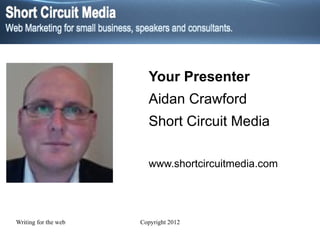
Your Presenter Aidan Crawford Short Circuit Media www.shortcircuitmedia.com
A Bit of History 2001 - 2004 Canada Life 2004 - 2005 BMO Mutual Fund 2005 - 2007 Critical Mass 2007 - 2010 The Clemmer Group 2010 - present Short Circuit Media
Synopsis Keep it short Keep it simple Keep it keyword rich
Nature of the Web Interactive -Web users expect something more active than reading -Content, design and navigation interact
Function of Content Content serves four primary functions online Communicate Educate  Navigate Initiate Action/sale Relationship
Content Managers Know the purpose of the website Understand why the audience visits Create content to appeal to the audience
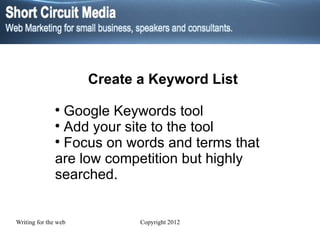
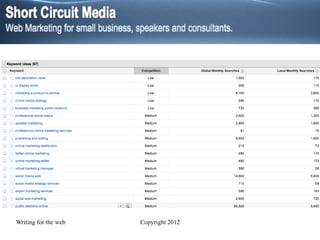
Create a Keyword List Google Keywords tool Add your site to the tool Focus on words and terms that are low competition but highly searched.
 
Write for your reader (and Google) Use a casual style – speak to the user as though one-on-one. Be concise and clear.  Minimize scrolling on navigation pages.  Update information on a regular basis. Use an RSS feed display on your home page to show the latest blogs.
Less is more Web users have a very short attention span  Keep your text to a bare minimum If you can find a shorter word that has the same meaning, go short. Minimize use of cliches, superlatives.
Be Concise Rule of thumb - 1/2 as many words as print but sometimes even less Don’t be too short - brevity can affect clarity Avoid vague references - be specific
“ Don’t write about the thing you’re selling. Write about the people to whom you’re selling it.”  - Nick Usborne
Writing to Brand A brand is a promise Establishes expectations Is an expression of what a company is Writing for a brochure or writing for the web should reinforce what the brand is.
“ Helping people achieve more.”  Canada Life branding message. You’d find it sprinkled through all sorts of communications online and off. Didn't speak to product, but promise. What is your promise?
Links Too many hyperlinks interrupt text flow Hyperlink to more detailed information from keywords to minimize scrolling - deep links Don’t add links that will lead the user to another terrain of thought Place links to other websites or resources at the end of the page/article Open external links in separate window
Don’t Click Here!! Write about your subject, not the medium Avoid references to Web actions Bad “ For a list of resources about how to create an acceptable PowerPoint presentation,  click here .” Good “ Use our  PowerPoint resources  to create stronger presentations.”
Addressing the Audience Address the audience in the first person and they will: identify with a company increased confidence in its   products and services. Examples: We pride ourselves in providing excellent customer service. Our customers are our priority.
Tone Talk to web users the same way you would talk to a friend – in a simple conversational manner.  Avoid lecturing or listing information.
To convey a customer service message, ensure the tone is: positive, enthusiastic, believable, appropriate, human, customer-centric.
Lists Lists are an effective way to: unite unrelated information, draw attention to key information, move the reader through the material efficiently, improve the appearance of dense text.
When creating lists: keep them short; use ordered lists when sequential order is important (e.g. to indicate steps in a plan); use unordered lists to present items of equal status or value. Bullet points make the contents of an unordered list easily scannable.
The Active Voice Eliminates unnecessary words in a sentence Strengthens the impact of what you are communicating. An active voice: emphasizes the subject; shortens the message; clarifies meaning; conveys a sense of action.
Minimize use of lingo and jargon If you can find any other way to describe an technical  term, do it.  If you must include an acronym, please reference what it stands for.
Layout and Spacing Keep text line length to about 40—60 characters per line. Do not use indentations. Use one full line space between paragraphs or between heading and body text. Use one space after periods.
Paragraphs A paragraph contains a single idea.This idea must be clear in the opening sentence – the rest of the paragraph supports or illustrates this idea. Paragraphs should be kept reasonably short; break long paragraphs if possible.
When creating text: keep bolding to a minimum  and  do not italicize AVOID USING ALL UPPERCASE HEADLINES.
Creating titles and Descriptions Be concise –  Titles: 80 characters max. Abstracts: 256 character max. (which includes French, so we only get 70% of that). Key words are important (ie. online writing, estate planning, investments, etc…).
Spelling and Abbreviations Use American spellings and abbreviations if your clients are American.
“ Online, your brand is only as good as your customer’s last experience.”  - Tony Russell

Writing for the Web

  • 1.
    “ Good writing…mustcapture the reader immediately and force him to keep reading.” - William Zinsser, On Writing Well.
  • 2.
    Your Presenter AidanCrawford Short Circuit Media www.shortcircuitmedia.com
  • 3.
    A Bit ofHistory 2001 - 2004 Canada Life 2004 - 2005 BMO Mutual Fund 2005 - 2007 Critical Mass 2007 - 2010 The Clemmer Group 2010 - present Short Circuit Media
  • 4.
    Synopsis Keep itshort Keep it simple Keep it keyword rich
  • 5.
    Nature of theWeb Interactive -Web users expect something more active than reading -Content, design and navigation interact
  • 6.
    Function of ContentContent serves four primary functions online Communicate Educate Navigate Initiate Action/sale Relationship
  • 7.
    Content Managers Knowthe purpose of the website Understand why the audience visits Create content to appeal to the audience
  • 8.
    Create a KeywordList Google Keywords tool Add your site to the tool Focus on words and terms that are low competition but highly searched.
  • 9.
  • 10.
    Write for yourreader (and Google) Use a casual style – speak to the user as though one-on-one. Be concise and clear. Minimize scrolling on navigation pages. Update information on a regular basis. Use an RSS feed display on your home page to show the latest blogs.
  • 11.
    Less is moreWeb users have a very short attention span Keep your text to a bare minimum If you can find a shorter word that has the same meaning, go short. Minimize use of cliches, superlatives.
  • 12.
    Be Concise Ruleof thumb - 1/2 as many words as print but sometimes even less Don’t be too short - brevity can affect clarity Avoid vague references - be specific
  • 13.
    “ Don’t writeabout the thing you’re selling. Write about the people to whom you’re selling it.” - Nick Usborne
  • 14.
    Writing to BrandA brand is a promise Establishes expectations Is an expression of what a company is Writing for a brochure or writing for the web should reinforce what the brand is.
  • 15.
    “ Helping peopleachieve more.” Canada Life branding message. You’d find it sprinkled through all sorts of communications online and off. Didn't speak to product, but promise. What is your promise?
  • 16.
    Links Too manyhyperlinks interrupt text flow Hyperlink to more detailed information from keywords to minimize scrolling - deep links Don’t add links that will lead the user to another terrain of thought Place links to other websites or resources at the end of the page/article Open external links in separate window
  • 17.
    Don’t Click Here!!Write about your subject, not the medium Avoid references to Web actions Bad “ For a list of resources about how to create an acceptable PowerPoint presentation, click here .” Good “ Use our PowerPoint resources to create stronger presentations.”
  • 18.
    Addressing the AudienceAddress the audience in the first person and they will: identify with a company increased confidence in its products and services. Examples: We pride ourselves in providing excellent customer service. Our customers are our priority.
  • 19.
    Tone Talk toweb users the same way you would talk to a friend – in a simple conversational manner. Avoid lecturing or listing information.
  • 20.
    To convey acustomer service message, ensure the tone is: positive, enthusiastic, believable, appropriate, human, customer-centric.
  • 21.
    Lists Lists arean effective way to: unite unrelated information, draw attention to key information, move the reader through the material efficiently, improve the appearance of dense text.
  • 22.
    When creating lists:keep them short; use ordered lists when sequential order is important (e.g. to indicate steps in a plan); use unordered lists to present items of equal status or value. Bullet points make the contents of an unordered list easily scannable.
  • 23.
    The Active VoiceEliminates unnecessary words in a sentence Strengthens the impact of what you are communicating. An active voice: emphasizes the subject; shortens the message; clarifies meaning; conveys a sense of action.
  • 24.
    Minimize use oflingo and jargon If you can find any other way to describe an technical term, do it. If you must include an acronym, please reference what it stands for.
  • 25.
    Layout and SpacingKeep text line length to about 40—60 characters per line. Do not use indentations. Use one full line space between paragraphs or between heading and body text. Use one space after periods.
  • 26.
    Paragraphs A paragraphcontains a single idea.This idea must be clear in the opening sentence – the rest of the paragraph supports or illustrates this idea. Paragraphs should be kept reasonably short; break long paragraphs if possible.
  • 27.
    When creating text:keep bolding to a minimum and do not italicize AVOID USING ALL UPPERCASE HEADLINES.
  • 28.
    Creating titles andDescriptions Be concise – Titles: 80 characters max. Abstracts: 256 character max. (which includes French, so we only get 70% of that). Key words are important (ie. online writing, estate planning, investments, etc…).
  • 29.
    Spelling and AbbreviationsUse American spellings and abbreviations if your clients are American.
  • 30.
    “ Online, yourbrand is only as good as your customer’s last experience.” - Tony Russell