Robert Blake Student Learning Development Centre, CELT EFFECTIVE LEARNING PROGRAMME WRITING  DISSERTATIONS
  DISSERTATION WRITING: OUTLINE Introduction What is a dissertation? Planning your study: generating a research question; background reading & method Planning a research schedule  Structuring your dissertation Working with your supervisor
WHAT IS A DISSERTATION : Depends on department Extended lab/field report & conclusions Extended study Analysis of case study Project work from company placement Library driven examination of problem Model testing [e.g. Acc & Fin]  Metaphor of a journey
  RESEARCH PROPOSALS  i.e. plan for the dissertation Required by many depts. Example from Linguistics:  Area of research Questions you aim to answer Rationale i.e. reasons for researching this area- contribution to understanding & practical use Your background in this area: previous knowledge & gaps Data you will collect How you will collect data and how you will analyse it  Initial bibliography i.e. review of key studies * [progress report/ grant proposal-science]
GENERATING A RESEARCH QUESTION Start with expected outcome or hunches  Develop research question[s] or hypothesis  Research question= well specified critical question rather than description of what aspect you want to find an answer to. 2 stages: What am I interested in? What questions can I make about this topic that could lead to an investigation? Examples of RQs in psychology from Oxford   http://www.psych.ox.ac.uk/babylab/research.html
GENERATING A RESEARCH QUESTION Hypothesis = A tentative proposition which is subject to verification through subsequent verification…. Guide to the researcher depicting & describing the method to be followed in studying the problem. In many cases hypotheses are the hunches that the researcher has about the existence between the variables   [Verma and Bear 1981 in Bell 1993] Forms framework of study: i.e. which literature to investigate, how to select/devise methods; how you discuss results and write conclusions NB need to modify question as study develops
What data will you collect?  How will you collect this data?  -interviews, questionnaires, case study  -lab or field work  -writing code and trialling software  designing a model or hardware   -simulating/testing  -analysis of primary sources e.g. documents [original historical, legal sources etc];  -secondary sources-  library & web sources- peer reviewed? DECIDING ON RESEARCH METHODS
ANALYSING DATA How will you analyse this data? theory or framework,  quantitative or qualitative  quantitative e.g larger scale, number/statistically based.  qualitative e.g.  small scale, detailed description  using software for analysis  e.g. SPSS, Excel etc How much  data can you deal with in time allotted?
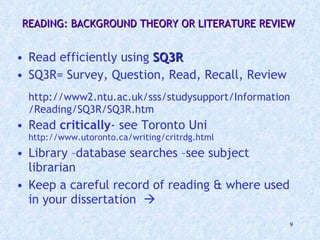
READING: BACKGROUND THEORY OR LITERATURE REVIEW  Read efficiently using  SQ3R SQ3R= Survey, Question, Read, Recall, Review http://www2.ntu.ac.uk/sss/studysupport/Information/Reading/SQ3R/SQ3R.htm Read  critically - see Toronto Uni  http://www.utoronto.ca/writing/critrdg.html Library –database searches –see subject librarian Keep a careful record of reading & where used in your dissertation  
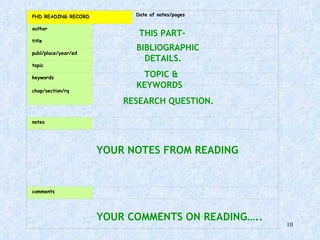
YOUR COMMENTS ON READING….. YOUR NOTES FROM READING BIBLIOGRAPHIC THIS PART- DETAILS. TOPIC & KEYWORDS RESEARCH QUESTION. PHD READING RECORD   Date of notes/pages author     title   publ/place/year/ed   topic   keywords    chap/section/rq     notes                                 comments              
  SCHEDULING YOUR DISSERTATION WORK   Make a timetable or wall chart e.g. Gantt Chart Identify best work times and keep to a daily writing slot Split your dissertation into bite size-chunks Be realistic about daily targets Include time for input [supervisor & critical friends] & for drafts & redrafts Familiarise yourself with deadlines* & plan accordingly
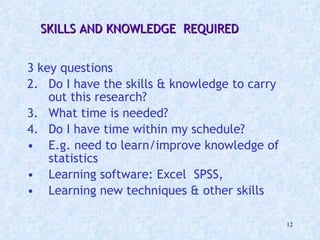
3 key questions Do I have the skills & knowledge to carry out this research? What time is needed?  Do I have time within my schedule? E.g. need to learn/improve knowledge of statistics Learning software: Excel  SPSS,  Learning new techniques & other skills SKILLS AND KNOWLEDGE  REQUIRED
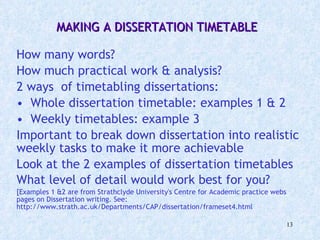
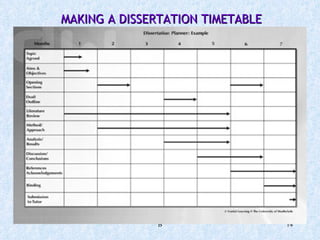
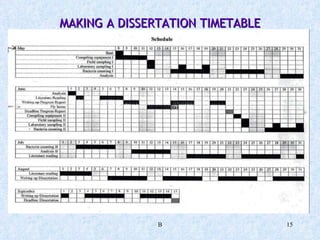
MAKING A DISSERTATION TIMETABLE   How many words?  How much practical work & analysis? 2 ways  of timetabling dissertations: Whole dissertation timetable: examples 1 & 2 Weekly timetables: example 3 Important to break down dissertation into realistic weekly tasks to make it more achievable Look at the 2 examples of dissertation timetables What level of detail would work best for you?   [Examples 1 &2 are from Strathclyde University's Centre for Academic practice webs pages on Dissertation writing. See: http://www.strath.ac.uk/Departments/CAP/dissertation/frameset4.html
MAKING A DISSERTATION TIMETABLE B
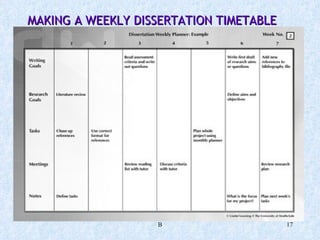
MAKING A DISSERTATION TIMETABLE   The next slide shows how the plan for the whole dissertation can be broken into weekly tasks. Allows you see progress at manageable level-  focus on individual tasks  tick off these tasks not be overwhelmed by totality know exactly where you are or should be
MAKING A WEEKLY DISSERTATION TIMETABLE B
WHAT DOES A DISSERTATION LOOK LIKE? Dissertation structure can vary significantly from dept to dept & whether it’s based on an empirical study or analysis of literature. The former are based on a scientific report structure: Introduction  Methods  Results Discussion Conclusions
  AN OVERVIEW OF THE CHAPTERS: INTRODUCTION  This sets the scene, by introducing:  the research area  previous studies  gap in research to be filled  your research questions/hypotheses brief signposting of dissertation structure NB In some dissertations, the background information is in a separate chapter called Literature Review
METHODS Explains what methods you used to collect data Explains how you collected the data Not just a description as it should explain reasons for various choices made  Goal of  your explanation is to allow future student to repeat your study Grammar! Past tense & passive used e.g. Twenty five interviews were conducted…..
  RESULTS  Presents  the results collected from the method[s] you used  But does  not   analyse these results May use a series of tables and figures to present the results more effectively Talks the reader through the series of results i.e. refers to figures  Figure 4.2 shows that the incidence of x rises when…   Highlights key patterns NB Some writers combine the Results & Discussion headings and organise by topic
  DISCUSSION Interprets the results i.e. explains what they mean Broadens from discussion of your results to how they can be compared with the results of others who’ve done similar research Refers to the previous studies you introduced earlier Discusses any problems with results Doesn’t include tables & figures, except when comparing your results with others
  CONCLUSIONS A short, succinctly written summary  Must addresses the research question/hypotheses presented in the introduction  May include limitations of your study and suggestions for further work
OTHER BITS   FRONT Title page Acknowledgements Contents List of figures*  Glossary* BACK References Appendices* *if your study requires this
WORKING WITH YOUR SUPERVISOR What can my supervisor?  What won’t my supervisor do? Will they approve the research proposal/research questions?  Will they read with drafts of work & if so, to what extent? Will they advise on methodology & help with difficulties ~~~ NB Make agendas for supervision meetings/ Tape as a record
SOME DISSERTATION WRITING TIPS [i] Keep a research journal with you to record ideas Write a dissertation timetable: whole process & weekly Start writing early Set a daily writing  slot Allow time for problems:personal & with your data collection Set plenty of editing and rewriting time Get a critical friend to read through drafts and feed them!
MORE DISSERTATION WRITING TIPS [ii] Read at a couple of past dissertations Compare their structure by tracing  through the research questions from the introduction to conclusion. Start writing in the middle- methodology or background  Write the introduction and abstract last, when you know what you’ve found Introduce and conclude chapters. Guide the reader through with signposting & cross referencing

Writing Dissertations

  • 1.
    Robert Blake StudentLearning Development Centre, CELT EFFECTIVE LEARNING PROGRAMME WRITING DISSERTATIONS
  • 2.
    DISSERTATIONWRITING: OUTLINE Introduction What is a dissertation? Planning your study: generating a research question; background reading & method Planning a research schedule Structuring your dissertation Working with your supervisor
  • 3.
    WHAT IS ADISSERTATION : Depends on department Extended lab/field report & conclusions Extended study Analysis of case study Project work from company placement Library driven examination of problem Model testing [e.g. Acc & Fin] Metaphor of a journey
  • 4.
    RESEARCHPROPOSALS i.e. plan for the dissertation Required by many depts. Example from Linguistics: Area of research Questions you aim to answer Rationale i.e. reasons for researching this area- contribution to understanding & practical use Your background in this area: previous knowledge & gaps Data you will collect How you will collect data and how you will analyse it Initial bibliography i.e. review of key studies * [progress report/ grant proposal-science]
  • 5.
    GENERATING A RESEARCHQUESTION Start with expected outcome or hunches Develop research question[s] or hypothesis Research question= well specified critical question rather than description of what aspect you want to find an answer to. 2 stages: What am I interested in? What questions can I make about this topic that could lead to an investigation? Examples of RQs in psychology from Oxford http://www.psych.ox.ac.uk/babylab/research.html
  • 6.
    GENERATING A RESEARCHQUESTION Hypothesis = A tentative proposition which is subject to verification through subsequent verification…. Guide to the researcher depicting & describing the method to be followed in studying the problem. In many cases hypotheses are the hunches that the researcher has about the existence between the variables [Verma and Bear 1981 in Bell 1993] Forms framework of study: i.e. which literature to investigate, how to select/devise methods; how you discuss results and write conclusions NB need to modify question as study develops
  • 7.
    What data willyou collect? How will you collect this data? -interviews, questionnaires, case study -lab or field work -writing code and trialling software designing a model or hardware -simulating/testing -analysis of primary sources e.g. documents [original historical, legal sources etc]; -secondary sources- library & web sources- peer reviewed? DECIDING ON RESEARCH METHODS
  • 8.
    ANALYSING DATA Howwill you analyse this data? theory or framework, quantitative or qualitative quantitative e.g larger scale, number/statistically based. qualitative e.g. small scale, detailed description using software for analysis e.g. SPSS, Excel etc How much data can you deal with in time allotted?
  • 9.
    READING: BACKGROUND THEORYOR LITERATURE REVIEW Read efficiently using SQ3R SQ3R= Survey, Question, Read, Recall, Review http://www2.ntu.ac.uk/sss/studysupport/Information/Reading/SQ3R/SQ3R.htm Read critically - see Toronto Uni http://www.utoronto.ca/writing/critrdg.html Library –database searches –see subject librarian Keep a careful record of reading & where used in your dissertation 
  • 10.
    YOUR COMMENTS ONREADING….. YOUR NOTES FROM READING BIBLIOGRAPHIC THIS PART- DETAILS. TOPIC & KEYWORDS RESEARCH QUESTION. PHD READING RECORD   Date of notes/pages author     title   publ/place/year/ed   topic   keywords   chap/section/rq     notes                                 comments              
  • 11.
    SCHEDULINGYOUR DISSERTATION WORK Make a timetable or wall chart e.g. Gantt Chart Identify best work times and keep to a daily writing slot Split your dissertation into bite size-chunks Be realistic about daily targets Include time for input [supervisor & critical friends] & for drafts & redrafts Familiarise yourself with deadlines* & plan accordingly
  • 12.
    3 key questionsDo I have the skills & knowledge to carry out this research? What time is needed? Do I have time within my schedule? E.g. need to learn/improve knowledge of statistics Learning software: Excel SPSS, Learning new techniques & other skills SKILLS AND KNOWLEDGE REQUIRED
  • 13.
    MAKING A DISSERTATIONTIMETABLE How many words? How much practical work & analysis? 2 ways of timetabling dissertations: Whole dissertation timetable: examples 1 & 2 Weekly timetables: example 3 Important to break down dissertation into realistic weekly tasks to make it more achievable Look at the 2 examples of dissertation timetables What level of detail would work best for you? [Examples 1 &2 are from Strathclyde University's Centre for Academic practice webs pages on Dissertation writing. See: http://www.strath.ac.uk/Departments/CAP/dissertation/frameset4.html
  • 14.
  • 15.
  • 16.
    MAKING A DISSERTATIONTIMETABLE The next slide shows how the plan for the whole dissertation can be broken into weekly tasks. Allows you see progress at manageable level- focus on individual tasks tick off these tasks not be overwhelmed by totality know exactly where you are or should be
  • 17.
    MAKING A WEEKLYDISSERTATION TIMETABLE B
  • 18.
    WHAT DOES ADISSERTATION LOOK LIKE? Dissertation structure can vary significantly from dept to dept & whether it’s based on an empirical study or analysis of literature. The former are based on a scientific report structure: Introduction Methods Results Discussion Conclusions
  • 19.
    ANOVERVIEW OF THE CHAPTERS: INTRODUCTION This sets the scene, by introducing: the research area previous studies gap in research to be filled your research questions/hypotheses brief signposting of dissertation structure NB In some dissertations, the background information is in a separate chapter called Literature Review
  • 20.
    METHODS Explains whatmethods you used to collect data Explains how you collected the data Not just a description as it should explain reasons for various choices made Goal of your explanation is to allow future student to repeat your study Grammar! Past tense & passive used e.g. Twenty five interviews were conducted…..
  • 21.
    RESULTS Presents the results collected from the method[s] you used But does not analyse these results May use a series of tables and figures to present the results more effectively Talks the reader through the series of results i.e. refers to figures Figure 4.2 shows that the incidence of x rises when… Highlights key patterns NB Some writers combine the Results & Discussion headings and organise by topic
  • 22.
    DISCUSSIONInterprets the results i.e. explains what they mean Broadens from discussion of your results to how they can be compared with the results of others who’ve done similar research Refers to the previous studies you introduced earlier Discusses any problems with results Doesn’t include tables & figures, except when comparing your results with others
  • 23.
    CONCLUSIONSA short, succinctly written summary Must addresses the research question/hypotheses presented in the introduction May include limitations of your study and suggestions for further work
  • 24.
    OTHER BITS FRONT Title page Acknowledgements Contents List of figures* Glossary* BACK References Appendices* *if your study requires this
  • 25.
    WORKING WITH YOURSUPERVISOR What can my supervisor? What won’t my supervisor do? Will they approve the research proposal/research questions? Will they read with drafts of work & if so, to what extent? Will they advise on methodology & help with difficulties ~~~ NB Make agendas for supervision meetings/ Tape as a record
  • 26.
    SOME DISSERTATION WRITINGTIPS [i] Keep a research journal with you to record ideas Write a dissertation timetable: whole process & weekly Start writing early Set a daily writing slot Allow time for problems:personal & with your data collection Set plenty of editing and rewriting time Get a critical friend to read through drafts and feed them!
  • 27.
    MORE DISSERTATION WRITINGTIPS [ii] Read at a couple of past dissertations Compare their structure by tracing through the research questions from the introduction to conclusion. Start writing in the middle- methodology or background Write the introduction and abstract last, when you know what you’ve found Introduce and conclude chapters. Guide the reader through with signposting & cross referencing

Editor's Notes

  • #9 learning about data collection methods, analysis (learning software), writing up -Results & Discussion] Qual +words rather than numbers
  • #10 card index system
  • #20 [theory & review of previous studies] General-specific pattern
  • #26 Record your dissertation timetable, when your supervisor is away.