CONTEXTUAL STUDIES:
DISSERTATION
In introduction
WEIGHTED
Presentation 30%
(5 to 10 minutes presentation)
Dissertation 70%
6000 word dissertation
(word count )
PRESENTATION
Early in the first term.
To outline and define your research strategy
To indicate what support may be needed
To indicate the appropriate dissertation supervisor
This is a formative assessment point.
Failure?
THEORY
Asking why !
STARTING
Good foundation
Difficulties without solid foundation
Proposal
Aim
Objectives
Methodology
Lit review
PROPOSAL
The purpose of the proposal is to formulate your ideas for a
dissertation and to enable you to visualise a more detailed
description of your outcomes.
Proposed structure
1 - TITLE
This could be a title or a research question
Research question prompts your area of research
Research question prompts a theoretical argument
A clear indication of the content of the dissertation.
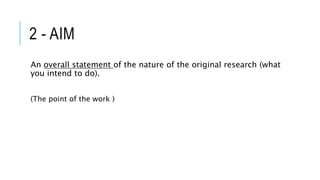
2 - AIM
An overall statement of the nature of the original research (what
you intend to do).
(The point of the work )
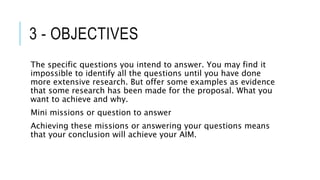
3 - OBJECTIVES
The specific questions you intend to answer. You may find it
impossible to identify all the questions until you have done
more extensive research. But offer some examples as evidence
that some research has been made for the proposal. What you
want to achieve and why.
Mini missions or question to answer
Achieving these missions or answering your questions means
that your conclusion will achieve your AIM.
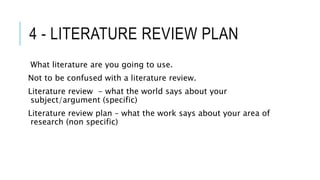
4 - LITERATURE REVIEW PLAN
What literature are you going to use.
Not to be confused with a literature review.
Literature review - what the world says about your
subject/argument (specific)
Literature review plan – what the work says about your area of
research (non specific)
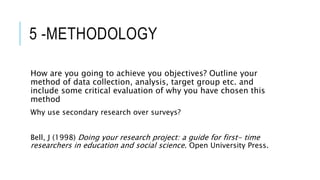
5 -METHODOLOGY
How are you going to achieve you objectives? Outline your
method of data collection, analysis, target group etc. and
include some critical evaluation of why you have chosen this
method
Why use secondary research over surveys?
Bell, J (1998) Doing your research project: a guide for first- time
researchers in education and social science. Open University Press.
6 - BIBLIOGRAPHY
This is a bibliography and references that you have used in the
making of the proposal.
NOT what literature you will use in the final dissertation.
DISSERTATION HANDBOOK
Useful tips.
ATTENDANCE
Limited number of contact time
Take full advantage of:-
Lectures
Seminars
Group tutorials
Individual one to one with your dissertation supervisor.
DISSERTATION SUPERVISOR
Contact time
Come prepared
Talk things through
Draft – very important
Not here to do the research for you
PLAGIARISM
Reference people who help you
Reference proof reader or translator
Do not self –plagiarise
SCHEME OF WORK
1. title
2. lectures
3. presentation
4. group tutorials
5. draft
6. one to one
EXTRA SUPPORT
Academic support – available over the summer
Disability support
Language support
EXTRAS
Proof reading
Research expenses
Binding (if you want a copy)
QUESTIONS
TASK
Work in groups
Look at your title
Major project?

Contextual studies prep

  • 1.
  • 2.
    WEIGHTED Presentation 30% (5 to10 minutes presentation) Dissertation 70% 6000 word dissertation (word count )
  • 3.
    PRESENTATION Early in thefirst term. To outline and define your research strategy To indicate what support may be needed To indicate the appropriate dissertation supervisor This is a formative assessment point. Failure?
  • 4.
  • 5.
    STARTING Good foundation Difficulties withoutsolid foundation Proposal Aim Objectives Methodology Lit review
  • 6.
    PROPOSAL The purpose ofthe proposal is to formulate your ideas for a dissertation and to enable you to visualise a more detailed description of your outcomes. Proposed structure
  • 7.
    1 - TITLE Thiscould be a title or a research question Research question prompts your area of research Research question prompts a theoretical argument A clear indication of the content of the dissertation.
  • 8.
    2 - AIM Anoverall statement of the nature of the original research (what you intend to do). (The point of the work )
  • 9.
    3 - OBJECTIVES Thespecific questions you intend to answer. You may find it impossible to identify all the questions until you have done more extensive research. But offer some examples as evidence that some research has been made for the proposal. What you want to achieve and why. Mini missions or question to answer Achieving these missions or answering your questions means that your conclusion will achieve your AIM.
  • 10.
    4 - LITERATUREREVIEW PLAN What literature are you going to use. Not to be confused with a literature review. Literature review - what the world says about your subject/argument (specific) Literature review plan – what the work says about your area of research (non specific)
  • 11.
    5 -METHODOLOGY How areyou going to achieve you objectives? Outline your method of data collection, analysis, target group etc. and include some critical evaluation of why you have chosen this method Why use secondary research over surveys? Bell, J (1998) Doing your research project: a guide for first- time researchers in education and social science. Open University Press.
  • 12.
    6 - BIBLIOGRAPHY Thisis a bibliography and references that you have used in the making of the proposal. NOT what literature you will use in the final dissertation.
  • 13.
  • 14.
    ATTENDANCE Limited number ofcontact time Take full advantage of:- Lectures Seminars Group tutorials Individual one to one with your dissertation supervisor.
  • 15.
    DISSERTATION SUPERVISOR Contact time Comeprepared Talk things through Draft – very important Not here to do the research for you
  • 16.
    PLAGIARISM Reference people whohelp you Reference proof reader or translator Do not self –plagiarise
  • 17.
    SCHEME OF WORK 1.title 2. lectures 3. presentation 4. group tutorials 5. draft 6. one to one
  • 18.
    EXTRA SUPPORT Academic support– available over the summer Disability support Language support
  • 19.
  • 20.
  • 21.
    TASK Work in groups Lookat your title Major project?