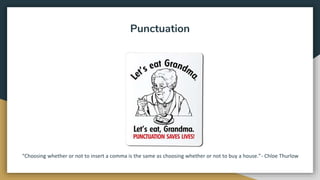
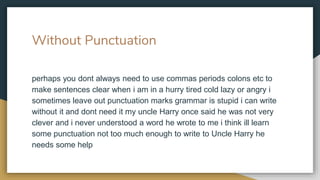

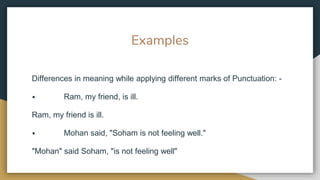
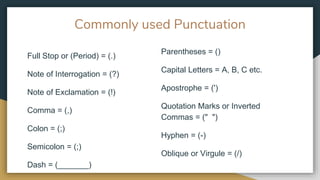


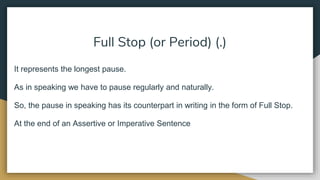

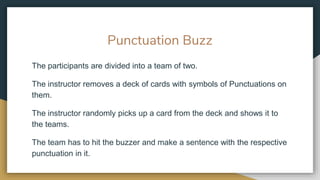


Punctuation is derived from the Latin word 'punctum' meaning 'point' and refers to the art of inserting points, stops, or marks in writing. Proper punctuation is important for clarity and understanding as it reflects the rhythm of spoken language in written form. The document provides examples of sentences with and without punctuation to demonstrate the differences. Commonly used punctuation marks are defined such as periods, commas, colons, semicolons, dashes, parentheses, quotation marks, hyphens, and obliques. Exercises are suggested to help students learn punctuation through practice forming sentences and a punctuation buzz game.


