Written Communication
Mario Fonseka
FCMA (UK), Dip. M (UK), FCMA (SL), MBA (Merit), MSc. (Bus. Psy) Coventry, UK, Pg. Dip Edu Mgt (OTHM)
MGT3200 Management Communications
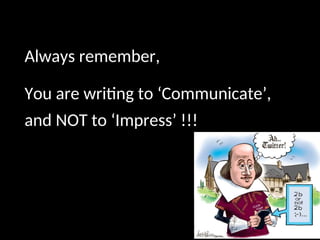
Always remember,
You are writing to ‘Communicate’,
and NOT to ‘Impress’ !!!
The Five ‘C’s of Good Writing
 Concise: Writing the message as briefly as possible
 Complete: Ensuring that all information needed by the
reader to respond or act appropriately is included
 Courteous: Being considerate about the reader
 Clear: Writing clearly with no ambiguity or vagueness
 Correct: Checking the writing for accuracy of all facts
and statements made
Types of Business Writing
• Letters
• Reports
• Memos
• e-mail
Letters
Letter Writing
• Be specific about the subject matter to be dealt with; be clear
and to the point
• Offer adequate but brief reasons/explanations for whatever
claims you make
• Make appropriate reference to previous correspondence
wherever relevant; don’t expect the other party to remember the
‘situation’ up to now
• Proof read the letter before sending
• Double check spellings of recipient name; his/her designation
and gender !!!
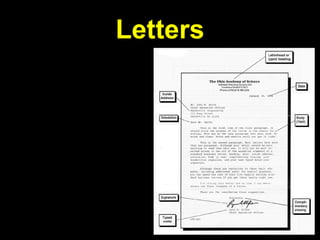
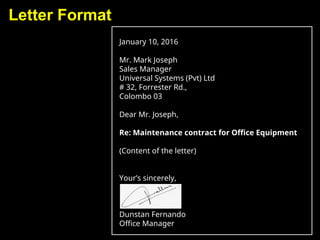
Letter Format
January 10, 2016
Mr. Mark Joseph
Sales Manager
Universal Systems (Pvt) Ltd
# 32, Forrester Rd.,
Colombo 03
Dear Mr. Joseph,
Re: Maintenance contract for Office Equipment
(Content of the letter)
Your’s sincerely,
Dunstan Fernando
Office Manager
Reports
Reports - Basics
• Be sure of the purpose of the report. Ensure you keep
this in mind throughout the report
• Have an Executive Summary of one A4 sheet preferably
(max two !)
• Always have a contents page to make navigation within
the report easy
• Avoid jargon unless you are sure that the recipient
finds it ‘second nature’
Reports - Basics
• Use numbering of contents and sub contents as follows
1.
1.1
1.2
1.2.1
1.2.2
(a)
(b)
(i)
(ii)
Reports - Basics
• Ensure you use appropriate headings and sub
headings to deal with all necessary areas
• Use appendices appropriately
• Use charts, diagrams etc., (graphical representation)
wherever possible to represent data instead of tables
and text (a picture tells the story of a thousand words)
• Conclude with your recommendations and conclusion
Report Writing Rules
 Brevity: Be as brief as possible. Thin reports are attractive,
easy to handle, cheap to produce, and more widely read. Most
will not complain of a report being too short
 Simplicity: This is not a place to prove your technical
knowledge on a subject or your eloquence in English.
 Purpose: Put yourself in the ‘reader’s shoes’. Review your
report as a ‘reader’ not as a ‘writer’
 Beginning: Have a meaningful start which explains the reason
for the report and which introduces the reader to the subject
 Ending: Summarise and show how the report has achieved its
objectives. You should not have to write ‘The End’; it should be
obvious
Reports Writing Rules
 Content: Structure the content into sub headings so that the
reader can choose to read only certain parts if required
 Title: Give the report a meaningful title
 Author: Clearly indicate the writer or writers
 Date: Always date the report
Report Format
• Cover Page
• Executive Summary
• Contents Page
• Introduction
• Body of the Report (main headings & sub-headings as
required)
• Recommendations
• Conclusion
• Appendices
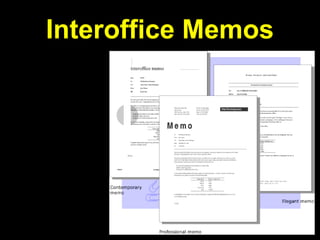
Interoffice Memos
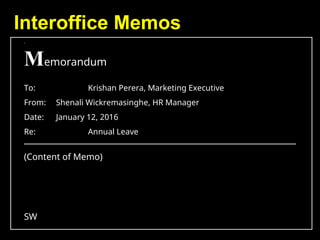
Interoffice Memos
• A Memo must be as brief as possible
• Should avoid personal language (no first person
references)
• When a memo is addressed to more than one party
replace individual names with ‘Distribution List’ (list these
names below the last line of the message)
• Its better to use the recipient’s name followed by job title
Interoffice Memos
• Use a descriptive subject line
• Have paragraphs if there are multiple ideas to
communicate
• Memos do not require a closing like a report or a letter
• Replace the signature line by the handwritten initials of
the originator
Interoffice Memos
.
Memorandum
To: Krishan Perera, Marketing Executive
From: Shenali Wickremasinghe, HR Manager
Date: January 12, 2016
Re: Annual Leave
(Content of Memo)
SW
What do all executives do, in their
first half hour at work, every day
?
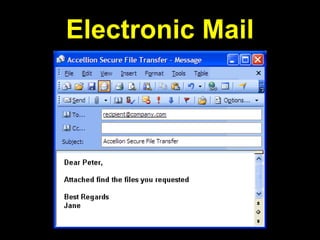
Electronic Mail
e-mail Etiquette
• Use only necessary facts; avoid unnecessary details
• Change the Subject line when you are using an already
received mail to reply, unless when the subject has NOT
changed !
• Restrict the circulation list. Don’t copy the mail unnecessarily
• Don’t be too hasty when writing e-mails. Remember that there
is a permanent record of your communication elsewhere
• Double check the contents of the mail, and ensure that the
communication is grammatically correct, and the intended
message is clear
• Never select the ‘reply all’ option unless when its actually
required !
e-mail Etiquette (Cont.)
• Keep the e-mail brief. Don’t use long winding sentences or
many paragraphs which hide the most important facts.
• If some explanation is necessary highlight the key points by
either underlining or bolding such key information (eg. Date
and time of a meeting or name and contact details of a
person)
• When sending a mini report, a briefing note etc., type out
those details in a word processed doc and attach it to the
mail as opposed to typing such content in the body of the
mail
• Sign off as ‘Regards’ or ‘Best Regards’ and use ‘Thanks and
regards’ when its appropriate to ‘thank’ the other person
e-mail Etiquette (Cont.)
• Use ‘automated signatures’ (saved contact info) to save time
in writing out your contact details at the end of each e-mail
• Use the ‘cc’ and ‘bcc’ option as appropriate. Be very careful
about the use of ‘bcc’ !
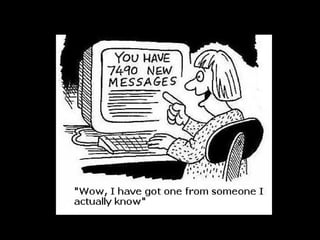
• Don’t overuse e-mail; By sending too many mails, important
ones may get unnoticed
• Don’t be hasty when replying e-mail. Plan your message
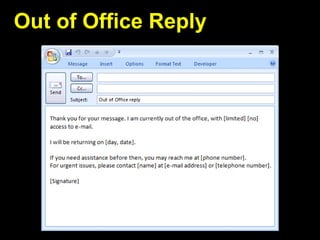
• Always use the ‘Out of Office Reply’ feature and leave a
message. Let them know how they can still be served,
during your absence
Out of Office Reply
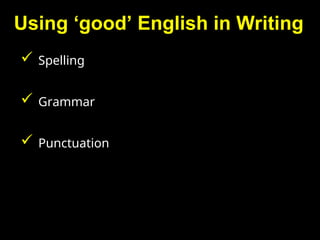
Using ‘good’ English in Writing
 Spelling
 Grammar
 Punctuation
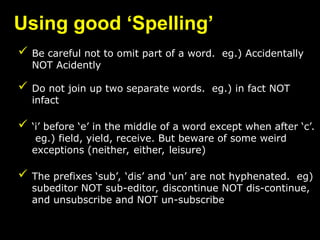
Using good ‘Spelling’
 Be careful not to omit part of a word. eg.) Accidentally
NOT Acidently
 Do not join up two separate words. eg.) in fact NOT
infact
 ‘i’ before ‘e’ in the middle of a word except when after ‘c’.
eg.) field, yield, receive. But beware of some weird
exceptions (neither, either, leisure)
 The prefixes ‘sub’, ‘dis’ and ‘un’ are not hyphenated. eg)
subeditor NOT sub-editor, discontinue NOT dis-continue,
and unsubscribe and NOT un-subscribe
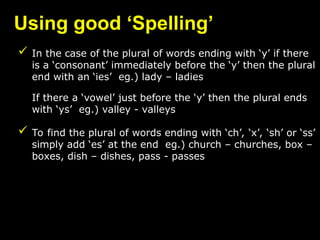
Using good ‘Spelling’
 In the case of the plural of words ending with ‘y’ if there
is a ‘consonant’ immediately before the ‘y’ then the plural
end with an ‘ies’ eg.) lady – ladies
If there a ‘vowel’ just before the ‘y’ then the plural ends
with ‘ys’ eg.) valley - valleys
 To find the plural of words ending with ‘ch’, ‘x’, ‘sh’ or ‘ss’
simply add ‘es’ at the end eg.) church – churches, box –
boxes, dish – dishes, pass - passes
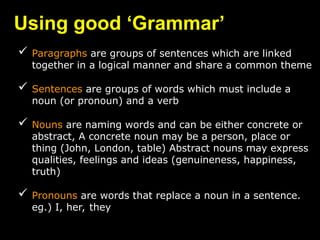
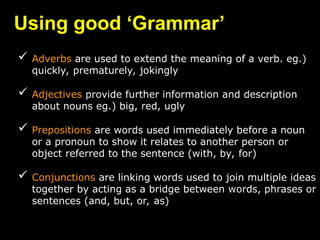
Using good ‘Grammar’
 Paragraphs are groups of sentences which are linked
together in a logical manner and share a common theme
 Sentences are groups of words which must include a
noun (or pronoun) and a verb
 Nouns are naming words and can be either concrete or
abstract, A concrete noun may be a person, place or
thing (John, London, table) Abstract nouns may express
qualities, feelings and ideas (genuineness, happiness,
truth)
 Pronouns are words that replace a noun in a sentence.
eg.) I, her, they
Using good ‘Grammar’
 Adverbs are used to extend the meaning of a verb. eg.)
quickly, prematurely, jokingly
 Adjectives provide further information and description
about nouns eg.) big, red, ugly
 Prepositions are words used immediately before a noun
or a pronoun to show it relates to another person or
object referred to the sentence (with, by, for)
 Conjunctions are linking words used to join multiple ideas
together by acting as a bridge between words, phrases or
sentences (and, but, or, as)
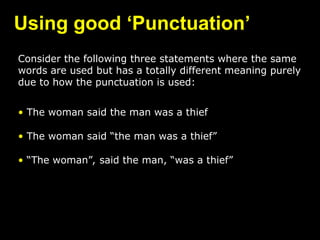
Using good ‘Punctuation’
Consider the following three statements where the same
words are used but has a totally different meaning purely
due to how the punctuation is used:
• The woman said the man was a thief
• The woman said “the man was a thief”
• “The woman”, said the man, “was a thief”
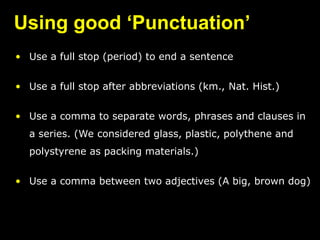
Using good ‘Punctuation’
• Use a full stop (period) to end a sentence
• Use a full stop after abbreviations (km., Nat. Hist.)
• Use a comma to separate words, phrases and clauses in
a series. (We considered glass, plastic, polythene and
polystyrene as packing materials.)
• Use a comma between two adjectives (A big, brown dog)
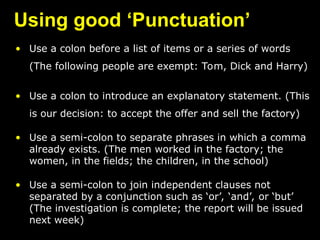
Using good ‘Punctuation’
• Use a colon before a list of items or a series of words
(The following people are exempt: Tom, Dick and Harry)
• Use a colon to introduce an explanatory statement. (This
is our decision: to accept the offer and sell the factory)
• Use a semi-colon to separate phrases in which a comma
already exists. (The men worked in the factory; the
women, in the fields; the children, in the school)
• Use a semi-colon to join independent clauses not
separated by a conjunction such as ‘or’, ‘and’, or ‘but’
(The investigation is complete; the report will be issued
next week)
Using good ‘Punctuation’
• Use quotation marks (double inverted commas) to
enclose a direct quote. As the main said “live and let live”
• Use single quotation marks to enclose titles, words or
phrases borrowed from others or which are used in a
special way (A ‘magical’ atmosphere was created.)
• An apostrophe shows possession. Use before the
additional ‘s’ if singular, use after the final ‘s’ if plural
(Mark’s report; the boys’ hideout)
• Use an apostrophe to shorten a word. Place it above the
space created by the removal of the letter (isn’t; don’t)
Using good ‘Punctuation’
• Use parenthesis (brackets) to enclose explanatory words
eg.) Report writers must be aware of the law of libel
(defamation published in a permanent form)
• Use a question mark to end a sentence containing a
query (That is quite straightforward, isn’t it ?)
• Use an exclamation mark to suggest sudden change of
emotion and stressing of a point (Use them sparingly !)

2 - Written Communication about business communication

  • 1.
    Written Communication Mario Fonseka FCMA(UK), Dip. M (UK), FCMA (SL), MBA (Merit), MSc. (Bus. Psy) Coventry, UK, Pg. Dip Edu Mgt (OTHM) MGT3200 Management Communications
  • 2.
    Always remember, You arewriting to ‘Communicate’, and NOT to ‘Impress’ !!!
  • 3.
    The Five ‘C’sof Good Writing  Concise: Writing the message as briefly as possible  Complete: Ensuring that all information needed by the reader to respond or act appropriately is included  Courteous: Being considerate about the reader  Clear: Writing clearly with no ambiguity or vagueness  Correct: Checking the writing for accuracy of all facts and statements made
  • 4.
    Types of BusinessWriting • Letters • Reports • Memos • e-mail
  • 5.
  • 6.
    Letter Writing • Bespecific about the subject matter to be dealt with; be clear and to the point • Offer adequate but brief reasons/explanations for whatever claims you make • Make appropriate reference to previous correspondence wherever relevant; don’t expect the other party to remember the ‘situation’ up to now • Proof read the letter before sending • Double check spellings of recipient name; his/her designation and gender !!!
  • 7.
    Letter Format January 10,2016 Mr. Mark Joseph Sales Manager Universal Systems (Pvt) Ltd # 32, Forrester Rd., Colombo 03 Dear Mr. Joseph, Re: Maintenance contract for Office Equipment (Content of the letter) Your’s sincerely, Dunstan Fernando Office Manager
  • 8.
  • 9.
    Reports - Basics •Be sure of the purpose of the report. Ensure you keep this in mind throughout the report • Have an Executive Summary of one A4 sheet preferably (max two !) • Always have a contents page to make navigation within the report easy • Avoid jargon unless you are sure that the recipient finds it ‘second nature’
  • 10.
    Reports - Basics •Use numbering of contents and sub contents as follows 1. 1.1 1.2 1.2.1 1.2.2 (a) (b) (i) (ii)
  • 11.
    Reports - Basics •Ensure you use appropriate headings and sub headings to deal with all necessary areas • Use appendices appropriately • Use charts, diagrams etc., (graphical representation) wherever possible to represent data instead of tables and text (a picture tells the story of a thousand words) • Conclude with your recommendations and conclusion
  • 12.
    Report Writing Rules Brevity: Be as brief as possible. Thin reports are attractive, easy to handle, cheap to produce, and more widely read. Most will not complain of a report being too short  Simplicity: This is not a place to prove your technical knowledge on a subject or your eloquence in English.  Purpose: Put yourself in the ‘reader’s shoes’. Review your report as a ‘reader’ not as a ‘writer’  Beginning: Have a meaningful start which explains the reason for the report and which introduces the reader to the subject  Ending: Summarise and show how the report has achieved its objectives. You should not have to write ‘The End’; it should be obvious
  • 13.
    Reports Writing Rules Content: Structure the content into sub headings so that the reader can choose to read only certain parts if required  Title: Give the report a meaningful title  Author: Clearly indicate the writer or writers  Date: Always date the report
  • 14.
    Report Format • CoverPage • Executive Summary • Contents Page • Introduction • Body of the Report (main headings & sub-headings as required) • Recommendations • Conclusion • Appendices
  • 15.
  • 16.
    Interoffice Memos • AMemo must be as brief as possible • Should avoid personal language (no first person references) • When a memo is addressed to more than one party replace individual names with ‘Distribution List’ (list these names below the last line of the message) • Its better to use the recipient’s name followed by job title
  • 17.
    Interoffice Memos • Usea descriptive subject line • Have paragraphs if there are multiple ideas to communicate • Memos do not require a closing like a report or a letter • Replace the signature line by the handwritten initials of the originator
  • 18.
    Interoffice Memos . Memorandum To: KrishanPerera, Marketing Executive From: Shenali Wickremasinghe, HR Manager Date: January 12, 2016 Re: Annual Leave (Content of Memo) SW
  • 19.
    What do allexecutives do, in their first half hour at work, every day ?
  • 21.
  • 22.
    e-mail Etiquette • Useonly necessary facts; avoid unnecessary details • Change the Subject line when you are using an already received mail to reply, unless when the subject has NOT changed ! • Restrict the circulation list. Don’t copy the mail unnecessarily • Don’t be too hasty when writing e-mails. Remember that there is a permanent record of your communication elsewhere • Double check the contents of the mail, and ensure that the communication is grammatically correct, and the intended message is clear • Never select the ‘reply all’ option unless when its actually required !
  • 23.
    e-mail Etiquette (Cont.) •Keep the e-mail brief. Don’t use long winding sentences or many paragraphs which hide the most important facts. • If some explanation is necessary highlight the key points by either underlining or bolding such key information (eg. Date and time of a meeting or name and contact details of a person) • When sending a mini report, a briefing note etc., type out those details in a word processed doc and attach it to the mail as opposed to typing such content in the body of the mail • Sign off as ‘Regards’ or ‘Best Regards’ and use ‘Thanks and regards’ when its appropriate to ‘thank’ the other person
  • 24.
    e-mail Etiquette (Cont.) •Use ‘automated signatures’ (saved contact info) to save time in writing out your contact details at the end of each e-mail • Use the ‘cc’ and ‘bcc’ option as appropriate. Be very careful about the use of ‘bcc’ ! • Don’t overuse e-mail; By sending too many mails, important ones may get unnoticed • Don’t be hasty when replying e-mail. Plan your message • Always use the ‘Out of Office Reply’ feature and leave a message. Let them know how they can still be served, during your absence
  • 25.
  • 26.
    Using ‘good’ Englishin Writing  Spelling  Grammar  Punctuation
  • 27.
    Using good ‘Spelling’ Be careful not to omit part of a word. eg.) Accidentally NOT Acidently  Do not join up two separate words. eg.) in fact NOT infact  ‘i’ before ‘e’ in the middle of a word except when after ‘c’. eg.) field, yield, receive. But beware of some weird exceptions (neither, either, leisure)  The prefixes ‘sub’, ‘dis’ and ‘un’ are not hyphenated. eg) subeditor NOT sub-editor, discontinue NOT dis-continue, and unsubscribe and NOT un-subscribe
  • 28.
    Using good ‘Spelling’ In the case of the plural of words ending with ‘y’ if there is a ‘consonant’ immediately before the ‘y’ then the plural end with an ‘ies’ eg.) lady – ladies If there a ‘vowel’ just before the ‘y’ then the plural ends with ‘ys’ eg.) valley - valleys  To find the plural of words ending with ‘ch’, ‘x’, ‘sh’ or ‘ss’ simply add ‘es’ at the end eg.) church – churches, box – boxes, dish – dishes, pass - passes
  • 29.
    Using good ‘Grammar’ Paragraphs are groups of sentences which are linked together in a logical manner and share a common theme  Sentences are groups of words which must include a noun (or pronoun) and a verb  Nouns are naming words and can be either concrete or abstract, A concrete noun may be a person, place or thing (John, London, table) Abstract nouns may express qualities, feelings and ideas (genuineness, happiness, truth)  Pronouns are words that replace a noun in a sentence. eg.) I, her, they
  • 30.
    Using good ‘Grammar’ Adverbs are used to extend the meaning of a verb. eg.) quickly, prematurely, jokingly  Adjectives provide further information and description about nouns eg.) big, red, ugly  Prepositions are words used immediately before a noun or a pronoun to show it relates to another person or object referred to the sentence (with, by, for)  Conjunctions are linking words used to join multiple ideas together by acting as a bridge between words, phrases or sentences (and, but, or, as)
  • 31.
    Using good ‘Punctuation’ Considerthe following three statements where the same words are used but has a totally different meaning purely due to how the punctuation is used: • The woman said the man was a thief • The woman said “the man was a thief” • “The woman”, said the man, “was a thief”
  • 32.
    Using good ‘Punctuation’ •Use a full stop (period) to end a sentence • Use a full stop after abbreviations (km., Nat. Hist.) • Use a comma to separate words, phrases and clauses in a series. (We considered glass, plastic, polythene and polystyrene as packing materials.) • Use a comma between two adjectives (A big, brown dog)
  • 33.
    Using good ‘Punctuation’ •Use a colon before a list of items or a series of words (The following people are exempt: Tom, Dick and Harry) • Use a colon to introduce an explanatory statement. (This is our decision: to accept the offer and sell the factory) • Use a semi-colon to separate phrases in which a comma already exists. (The men worked in the factory; the women, in the fields; the children, in the school) • Use a semi-colon to join independent clauses not separated by a conjunction such as ‘or’, ‘and’, or ‘but’ (The investigation is complete; the report will be issued next week)
  • 34.
    Using good ‘Punctuation’ •Use quotation marks (double inverted commas) to enclose a direct quote. As the main said “live and let live” • Use single quotation marks to enclose titles, words or phrases borrowed from others or which are used in a special way (A ‘magical’ atmosphere was created.) • An apostrophe shows possession. Use before the additional ‘s’ if singular, use after the final ‘s’ if plural (Mark’s report; the boys’ hideout) • Use an apostrophe to shorten a word. Place it above the space created by the removal of the letter (isn’t; don’t)
  • 35.
    Using good ‘Punctuation’ •Use parenthesis (brackets) to enclose explanatory words eg.) Report writers must be aware of the law of libel (defamation published in a permanent form) • Use a question mark to end a sentence containing a query (That is quite straightforward, isn’t it ?) • Use an exclamation mark to suggest sudden change of emotion and stressing of a point (Use them sparingly !)