

ACRL’s Framework for 
Information Literacy 
Workshop for 
Reference & 
Instruction 
Librarians 
Gina Calia-Lotz, Instructional Services 
Librarian, Harford Community College
ACRL’s expanded definition of 
information literacy 
“Information literacy combines a repertoire 
of abilities, practices, and dispositions 
focused on expanding one’s understanding 
of the information ecosystem, with the 
proficiencies of finding, using and 
analyzing information, scholarship, and data 
to answer questions, develop new ones, 
and create new knowledge, through ethical 
participation in communities of learning 
and scholarship.”
Comparison of Old and New 
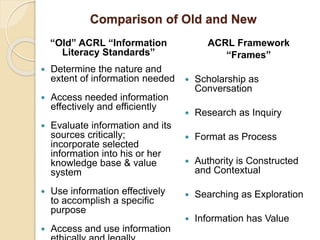
“Old” ACRL “Information 
Literacy Standards” 
 Determine the nature and 
extent of information needed 
 Access needed information 
effectively and efficiently 
 Evaluate information and its 
sources critically; 
incorporate selected 
information into his or her 
knowledge base & value 
system 
 Use information effectively 
to accomplish a specific 
purpose 
 Access and use information 
ethically and legally 
ACRL Framework 
“Frames” 
 Scholarship as 
Conversation 
 Research as Inquiry 
 Format as Process 
 Authority is Constructed 
and Contextual 
 Searching as Exploration 
 Information has Value
SNAPSHOTS OF THE 
INFO LIT FRAMEWORK
The Framework consists 
of six “frames,” or 
“lenses through which to 
view information literacy.” 
Each frame contains a 
threshold concept, 
knowledge practices, and 
a set of dispositions of 
learners who are 
developing 
understanding of the 
related concepts. “Frames”
Threshold Concepts: 
“Those challenging 
‘gateway’ or portal 
concepts through 
which students must 
pass in order to 
develop genuine 
expertise within a 
discipline, profession, 
or knowledge domain.”
Sustained discourse 
within a community of 
scholars or thinkers. 
Scholarly research 
resists simple answers. 
Scholarship is a 
discursive practice, 
over extended periods 
of time. 
The experienced 
researcher seeks out 
many perspectives in a 
scholarly conversation, 
not merely the one with 
which the researcher 
already agrees. 
Frame 1: 
Scholarship is a Conversation
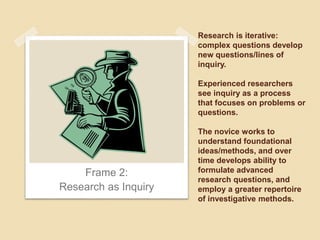
Research is iterative: 
complex questions develop 
new questions/lines of 
inquiry. 
Experienced researchers 
see inquiry as a process 
that focuses on problems or 
questions. 
The novice works to 
understand foundational 
ideas/methods, and over 
time develops ability to 
formulate advanced 
research questions, and 
employ a greater repertoire 
of investigative methods. 
Frame 2: 
Research as Inquiry
Depends on origin, need, 
context. 
How authoritative is 
necessary? 
Understand standards 
within a discipline. 
Be skeptical, but keep an 
open mind. 
Even authoritative should 
be regarded with 
“informed skepticism.” 
Frame 3: 
Authority is Constructed & Contextual
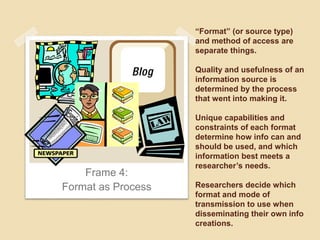
“Format” (or source type) 
and method of access are 
separate things. 
Quality and usefulness of an 
information source is 
determined by the process 
that went into making it. 
Unique capabilities and 
constraints of each format 
determine how info can and 
should be used, and which 
information best meets a 
researcher’s needs. 
Researchers decide which 
format and mode of 
transmission to use when 
disseminating their own info 
creations. 
Frame 4: 
Format as Process
The search for 
information is ignited 
by inquiry. 
Process of discovery. 
No single system works 
well for all research 
needs. 
Effective use of 
selected resources is 
predicated on 
understanding them. 
Different resources 
require different 
methods of access. 
Frame 5: 
Searching as Exploration
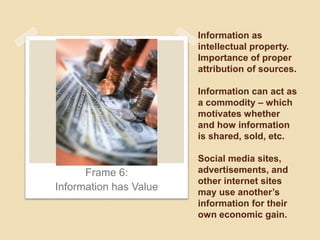
Information as 
intellectual property. 
Importance of proper 
attribution of sources. 
Information can act as 
a commodity – which 
motivates whether 
and how information 
is shared, sold, etc. 
Social media sites, 
advertisements, and 
other internet sites 
may use another’s 
information for their 
own economic gain. 
Frame 6: 
Information has Value
Threshold Concepts = 
“Core Understandings” 
 Should position info lit on a higher 
plane, as an integral part of the 
learning process within and across 
disciplines. 
 Should address the “bottlenecks of 
understanding” or challenges that 
students face in learning to maneuver 
within the information landscape.
HCC Librarians’ “Overarching 
Understandings” (May 2011) 
Corresponding ACRL Frame/ 
Core Understanding 
1.Your topic/research need 
determines the kinds of sources 
you will need 
2. Different kinds of sources 
require different search 
tools/resources to find them. 
3. The librarians/the library are a 
resource here to help them! 
4. Information differs in quality 
depending on various criteria 
5. Your search terms/search 
strategy will influence your 
success in finding sources 
1. Format as Process 
2. Format as 
Process/Searching is 
Strategic 
3. Searching as Exploration! 
4. Format as Process/ 
Authority is Constructed and 
Contextual 
5. Searching as Exploration 
Do you remember *our* 
“Overarching Understandings?”
Our Eng. 101 Lesson Objectives Corresponding ACRL Frame 
1. Develop sub-topics for a given 
topic using an essay from a 
reference database. 
2. Determine which databases to 
use to find articles on specific 
topics. 
3. Develop keyword search 
statements/use advanced search 
strategies in databases to 
improve search results. 
4. Compare characteristics of 
scholarly journals & popular 
magazines. 
5. Evaluate the credibility and 
objectivity of sources from the 
Web. 
6. Determine information needed 
to cite sources in MLA format. 
1. Research as Inquiry 
2. Searching as Exploration 
3. Searching as Exploration 
4. Format as Process 
5. Format as Process/ 
Authority is Constructed and 
Contextual 
6. Information has Value 
How about our student learning objectives?
“Research is a Process” 
 Overall concept on which our Eng. 
101 sessions are based. 
 = “Research as Inquiry” (Frame II)
GROUP EXERCISE TIME!
“WARM FUZZIES” 
https://www.youtube.com/watch?v=KcRTYTaVCuc&feature=k 
p
EVALUATION

ACRL Framework: Workshop for Reference & Instruction Librarians

  • 1.
    ACRL’s Framework for Information Literacy Workshop for Reference & Instruction Librarians Gina Calia-Lotz, Instructional Services Librarian, Harford Community College
  • 2.
    ACRL’s expanded definitionof information literacy “Information literacy combines a repertoire of abilities, practices, and dispositions focused on expanding one’s understanding of the information ecosystem, with the proficiencies of finding, using and analyzing information, scholarship, and data to answer questions, develop new ones, and create new knowledge, through ethical participation in communities of learning and scholarship.”
  • 3.
    Comparison of Oldand New “Old” ACRL “Information Literacy Standards”  Determine the nature and extent of information needed  Access needed information effectively and efficiently  Evaluate information and its sources critically; incorporate selected information into his or her knowledge base & value system  Use information effectively to accomplish a specific purpose  Access and use information ethically and legally ACRL Framework “Frames”  Scholarship as Conversation  Research as Inquiry  Format as Process  Authority is Constructed and Contextual  Searching as Exploration  Information has Value
  • 4.
    SNAPSHOTS OF THE INFO LIT FRAMEWORK
  • 5.
    The Framework consists of six “frames,” or “lenses through which to view information literacy.” Each frame contains a threshold concept, knowledge practices, and a set of dispositions of learners who are developing understanding of the related concepts. “Frames”
  • 6.
    Threshold Concepts: “Thosechallenging ‘gateway’ or portal concepts through which students must pass in order to develop genuine expertise within a discipline, profession, or knowledge domain.”
  • 7.
    Sustained discourse withina community of scholars or thinkers. Scholarly research resists simple answers. Scholarship is a discursive practice, over extended periods of time. The experienced researcher seeks out many perspectives in a scholarly conversation, not merely the one with which the researcher already agrees. Frame 1: Scholarship is a Conversation
  • 8.
    Research is iterative: complex questions develop new questions/lines of inquiry. Experienced researchers see inquiry as a process that focuses on problems or questions. The novice works to understand foundational ideas/methods, and over time develops ability to formulate advanced research questions, and employ a greater repertoire of investigative methods. Frame 2: Research as Inquiry
  • 9.
    Depends on origin,need, context. How authoritative is necessary? Understand standards within a discipline. Be skeptical, but keep an open mind. Even authoritative should be regarded with “informed skepticism.” Frame 3: Authority is Constructed & Contextual
  • 10.
    “Format” (or sourcetype) and method of access are separate things. Quality and usefulness of an information source is determined by the process that went into making it. Unique capabilities and constraints of each format determine how info can and should be used, and which information best meets a researcher’s needs. Researchers decide which format and mode of transmission to use when disseminating their own info creations. Frame 4: Format as Process
  • 11.
    The search for information is ignited by inquiry. Process of discovery. No single system works well for all research needs. Effective use of selected resources is predicated on understanding them. Different resources require different methods of access. Frame 5: Searching as Exploration
  • 12.
    Information as intellectualproperty. Importance of proper attribution of sources. Information can act as a commodity – which motivates whether and how information is shared, sold, etc. Social media sites, advertisements, and other internet sites may use another’s information for their own economic gain. Frame 6: Information has Value
  • 13.
    Threshold Concepts = “Core Understandings”  Should position info lit on a higher plane, as an integral part of the learning process within and across disciplines.  Should address the “bottlenecks of understanding” or challenges that students face in learning to maneuver within the information landscape.
  • 14.
    HCC Librarians’ “Overarching Understandings” (May 2011) Corresponding ACRL Frame/ Core Understanding 1.Your topic/research need determines the kinds of sources you will need 2. Different kinds of sources require different search tools/resources to find them. 3. The librarians/the library are a resource here to help them! 4. Information differs in quality depending on various criteria 5. Your search terms/search strategy will influence your success in finding sources 1. Format as Process 2. Format as Process/Searching is Strategic 3. Searching as Exploration! 4. Format as Process/ Authority is Constructed and Contextual 5. Searching as Exploration Do you remember *our* “Overarching Understandings?”
  • 15.
    Our Eng. 101Lesson Objectives Corresponding ACRL Frame 1. Develop sub-topics for a given topic using an essay from a reference database. 2. Determine which databases to use to find articles on specific topics. 3. Develop keyword search statements/use advanced search strategies in databases to improve search results. 4. Compare characteristics of scholarly journals & popular magazines. 5. Evaluate the credibility and objectivity of sources from the Web. 6. Determine information needed to cite sources in MLA format. 1. Research as Inquiry 2. Searching as Exploration 3. Searching as Exploration 4. Format as Process 5. Format as Process/ Authority is Constructed and Contextual 6. Information has Value How about our student learning objectives?
  • 16.
    “Research is aProcess”  Overall concept on which our Eng. 101 sessions are based.  = “Research as Inquiry” (Frame II)
  • 17.
  • 18.
  • 19.