I m a g e b y J ü r g e n f r o m S a n d e s n e b e n , G e r m a n y ( F l i c k r ) [ C C - B Y - 2 . 0 ] , v i a W i k i m e d i a C o m m o n s
FACULTY POWER:
A RENEWABLE ENERGY SOURCE FOR TEACHING
INFORMATION LITERACY
ELISA SLATER ACOSTA
SUSAN [GARDNER] ARCHAMBAULT
LOYOLA MARYMOUNT UNIVERSITY
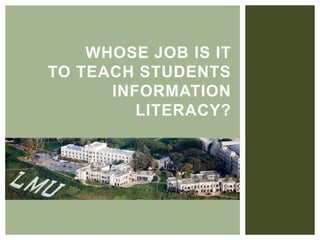
WHOSE JOB IS IT
TO TEACH STUDENTS
INFORMATION
LITERACY?
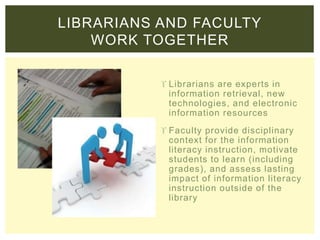
 Librarians are experts in
information retrieval, new
technologies, and electronic
information resources
 Faculty provide disciplinary
context for the information
literacy instruction, motivate
students to learn (including
grades), and assess lasting
impact of information literacy
instruction outside of the
library
LIBRARIANS AND FACULTY
WORK TOGETHER
WHAT IS TRAIN THE TRAINER?
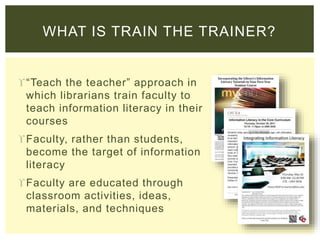
“Teach the teacher” approach in
which librarians train faculty to
teach information literacy in their
courses
Faculty, rather than students,
become the target of information
literacy
Faculty are educated through
classroom activities, ideas,
materials, and techniques
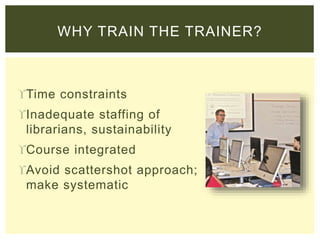
Time constraints
Inadequate staffing of
librarians, sustainability
Course integrated
Avoid scattershot approach;
make systematic
WHY TRAIN THE TRAINER?
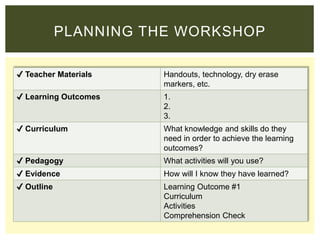
✔ Teacher Materials Handouts, technology, dry erase
markers, etc.
✔ Learning Outcomes 1.
2.
3.
✔ Curriculum What knowledge and skills do they
need in order to achieve the learning
outcomes?
✔ Pedagogy What activities will you use?
✔ Evidence How will I know they have learned?
✔ Outline Learning Outcome #1
Curriculum
Activities
Comprehension Check
PLANNING THE WORKSHOP
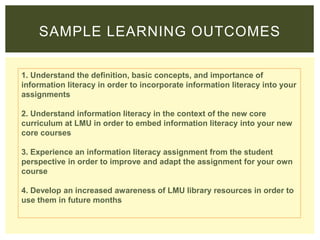
1. Understand the definition, basic concepts, and importance of
information literacy in order to incorporate information literacy into your
assignments
2. Understand information literacy in the context of the new core
curriculum at LMU in order to embed information literacy into your new
core courses
3. Experience an information literacy assignment from the student
perspective in order to improve and adapt the assignment for your own
course
4. Develop an increased awareness of LMU library resources in order to
use them in future months
SAMPLE LEARNING OUTCOMES
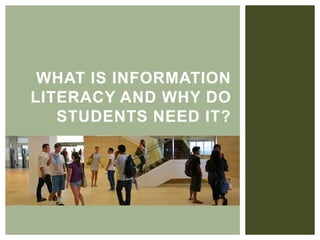
WHAT IS INFORMATION
LITERACY AND WHY DO
STUDENTS NEED IT?
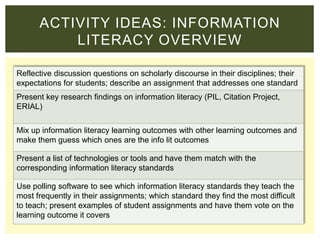
ACTIVITY IDEAS: INFORMATION
LITERACY OVERVIEW
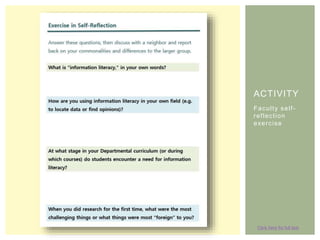
Reflective discussion questions on scholarly discourse in their disciplines; their
expectations for students; describe an assignment that addresses one standard
Present key research findings on information literacy (PIL, Citation Project,
ERIAL)
Mix up information literacy learning outcomes with other learning outcomes and
make them guess which ones are the info lit outcomes
Present a list of technologies or tools and have them match with the
corresponding information literacy standards
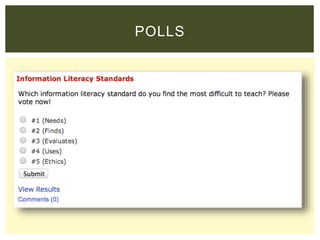
Use polling software to see which information literacy standards they teach the
most frequently in their assignments; which standard they find the most difficult
to teach; present examples of student assignments and have them vote on the
learning outcome it covers
Click here for full text
ACTIVITY
Faculty self-
reflection
exercise
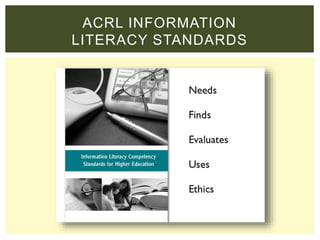
ACRL INFORMATION
LITERACY STANDARDS
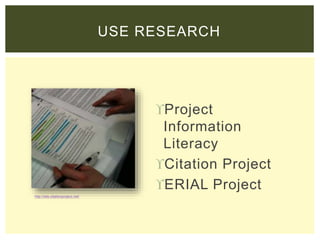
Project
Information
Literacy
Citation Project
ERIAL Project
USE RESEARCH
http://site.citationproject.net/
http://projectinfolit.org/
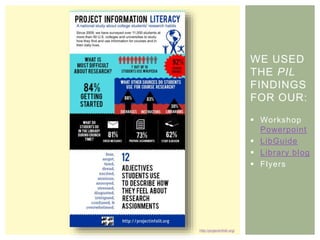
 Workshop
Powerpoint
 LibGuide
 Library blog
 Flyers
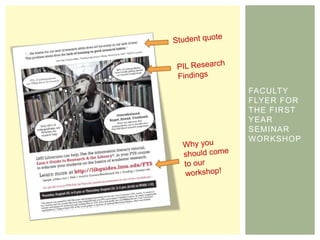
WE USED
THE PIL
FINDINGS
FOR OUR:
FACULTY
FLYER FOR
THE FIRST
YEAR
SEMINAR
WORKSHOP
Click here for full text
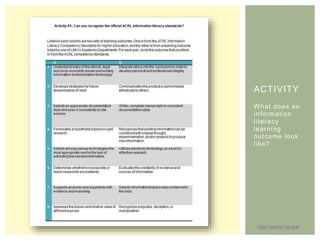
ACTIVITY
What does an
information
literacy
learning
outcome look
like?
POLLS
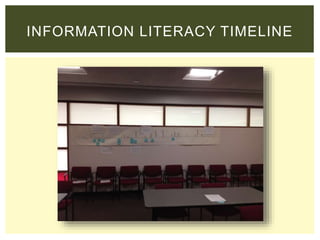
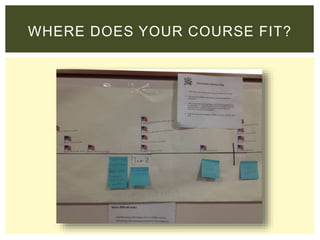
INFORMATION LITERACY TIMELINE
WHERE DOES YOUR COURSE FIT?
HOW DO YOU DESIGN A
GOOD INFORMATION
LITERACY ASSIGNMENT?
Carry out assignment “from student perspective” and then modify
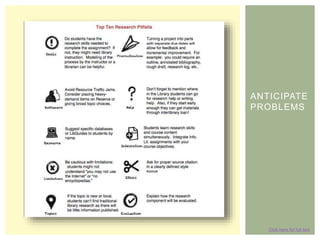
“Assignment Pitfalls”
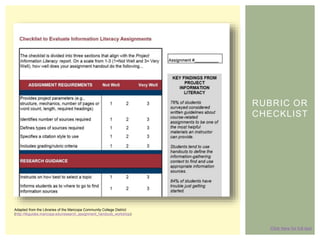
“Best practice” rubrics or checklists for evaluating assignments
Assignment Database
Explore a library database and think about how your students could use it in an
assignment
Use a tutorial evaluation checklist to explore and evaluate an information
literacy tutorial. Think about if/how you might want to modify it and adapt for
your course
ACTIVITY IDEAS: INFORMATION
LITERACY ASSIGNMENT DESIGN
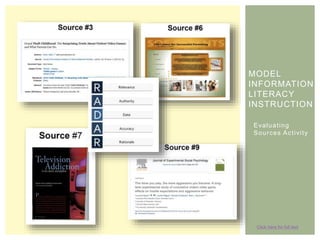
MODEL
INFORMATION
LITERACY
INSTRUCTION
Click here for full text
Evaluating
Sources Activity
Click here for full text
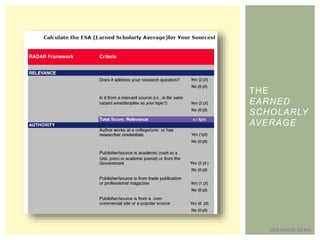
THE
EARNED
SCHOLARLY
AVERAGE
Click here for full text
ANTICIPATE
PROBLEMS
RUBRIC OR
CHECKLIST
Click here for full text
Adapted from the Libraries of the Maricopa Community College District
(http://libguides.maricopa.edu/research_assignment_handouts_workshop)
HOW DO I INCORPORATE
A SPECIFIC INFORMATION
LITERACY LEARNING
OUTCOME?
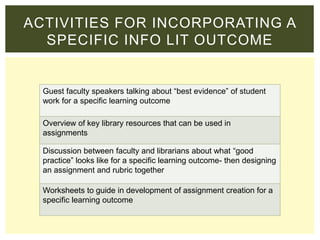
Guest faculty speakers talking about “best evidence” of student
work for a specific learning outcome
Overview of key library resources that can be used in
assignments
Discussion between faculty and librarians about what “good
practice” looks like for a specific learning outcome- then designing
an assignment and rubric together
Worksheets to guide in development of assignment creation for a
specific learning outcome
ACTIVITIES FOR INCORPORATING A
SPECIFIC INFO LIT OUTCOME
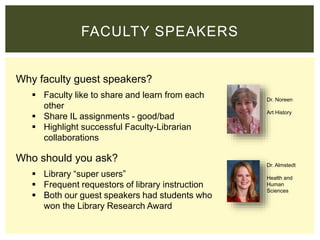
FACULTY SPEAKERS
Dr. Almstedt
Health and
Human
Sciences
Dr. Noreen
Art History
Why faculty guest speakers?
 Faculty like to share and learn from each
other
 Share IL assignments - good/bad
 Highlight successful Faculty-Librarian
collaborations
Who should you ask?
 Library “super users”
 Frequent requestors of library instruction
 Both our guest speakers had students who
won the Library Research Award
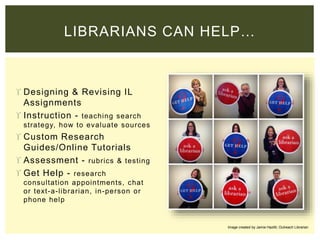
 Designing & Revising IL
Assignments
 Instruction - teaching search
strategy, how to evaluate sources
 Custom Research
Guides/Online Tutorials
 Assessment - rubrics & testing
 Get Help - research
consultation appointments, chat
or text-a-librarian, in-person or
phone help
LIBRARIANS CAN HELP…
Image created by Jamie Hazlitt, Outreach Librarian
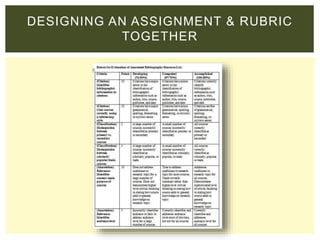
DESIGNING AN ASSIGNMENT & RUBRIC
TOGETHER
Click here for full text
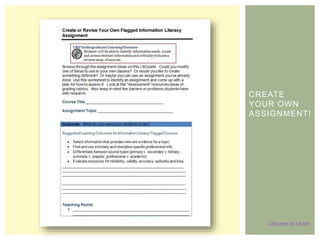
CREATE
YOUR OWN
ASSIGNMENT!
FACULTY FEEDBACK
QUESTIONS?
 Information Literacy Workshop for Faculty
http://libguides.lmu.edu/infolitworkshop
 First Year Seminar LibGuide for Faculty
http://libguides.lmu.edu/FYS
 Information Literacy Flagged LibGuide
http://libguides.lmu.edu/flag
 Librarian Retreat on Information Literacy
http://libguides.lmu.edu/librariansretreat
ADDITIONAL RESOURCES
Contact Information:
Elisa Slater Acosta
elis@lmu.edu
Susan [Gardner] Archambault
susan.gardner@lmu.edu
PPT Slides:
http://works.bepress.com/elisa_acosta/8
CONTACT US
ACKNOWLEDGEMENTS
Thank You
William H. Hannon Library
Research Incentive Travel
Grant
Image by Jürgen f rom Sandesneben, Germany (Flick r)
[CC-BY-2.0], via W ikimedia Commons

Faculty Power: A Renewable Energy Source for Teaching Information Literacy

  • 1.
    I m ag e b y J ü r g e n f r o m S a n d e s n e b e n , G e r m a n y ( F l i c k r ) [ C C - B Y - 2 . 0 ] , v i a W i k i m e d i a C o m m o n s FACULTY POWER: A RENEWABLE ENERGY SOURCE FOR TEACHING INFORMATION LITERACY ELISA SLATER ACOSTA SUSAN [GARDNER] ARCHAMBAULT LOYOLA MARYMOUNT UNIVERSITY
  • 2.
    WHOSE JOB ISIT TO TEACH STUDENTS INFORMATION LITERACY?
  • 3.
     Librarians areexperts in information retrieval, new technologies, and electronic information resources  Faculty provide disciplinary context for the information literacy instruction, motivate students to learn (including grades), and assess lasting impact of information literacy instruction outside of the library LIBRARIANS AND FACULTY WORK TOGETHER
  • 4.
    WHAT IS TRAINTHE TRAINER? “Teach the teacher” approach in which librarians train faculty to teach information literacy in their courses Faculty, rather than students, become the target of information literacy Faculty are educated through classroom activities, ideas, materials, and techniques
  • 5.
    Time constraints Inadequate staffingof librarians, sustainability Course integrated Avoid scattershot approach; make systematic WHY TRAIN THE TRAINER?
  • 6.
    ✔ Teacher MaterialsHandouts, technology, dry erase markers, etc. ✔ Learning Outcomes 1. 2. 3. ✔ Curriculum What knowledge and skills do they need in order to achieve the learning outcomes? ✔ Pedagogy What activities will you use? ✔ Evidence How will I know they have learned? ✔ Outline Learning Outcome #1 Curriculum Activities Comprehension Check PLANNING THE WORKSHOP
  • 7.
    1. Understand thedefinition, basic concepts, and importance of information literacy in order to incorporate information literacy into your assignments 2. Understand information literacy in the context of the new core curriculum at LMU in order to embed information literacy into your new core courses 3. Experience an information literacy assignment from the student perspective in order to improve and adapt the assignment for your own course 4. Develop an increased awareness of LMU library resources in order to use them in future months SAMPLE LEARNING OUTCOMES
  • 8.
    WHAT IS INFORMATION LITERACYAND WHY DO STUDENTS NEED IT?
  • 9.
    ACTIVITY IDEAS: INFORMATION LITERACYOVERVIEW Reflective discussion questions on scholarly discourse in their disciplines; their expectations for students; describe an assignment that addresses one standard Present key research findings on information literacy (PIL, Citation Project, ERIAL) Mix up information literacy learning outcomes with other learning outcomes and make them guess which ones are the info lit outcomes Present a list of technologies or tools and have them match with the corresponding information literacy standards Use polling software to see which information literacy standards they teach the most frequently in their assignments; which standard they find the most difficult to teach; present examples of student assignments and have them vote on the learning outcome it covers
  • 10.
    Click here forfull text ACTIVITY Faculty self- reflection exercise
  • 11.
  • 12.
  • 13.
    http://projectinfolit.org/  Workshop Powerpoint  LibGuide Library blog  Flyers WE USED THE PIL FINDINGS FOR OUR:
  • 14.
  • 15.
    Click here forfull text ACTIVITY What does an information literacy learning outcome look like?
  • 16.
  • 17.
  • 18.
    WHERE DOES YOURCOURSE FIT?
  • 19.
    HOW DO YOUDESIGN A GOOD INFORMATION LITERACY ASSIGNMENT?
  • 20.
    Carry out assignment“from student perspective” and then modify “Assignment Pitfalls” “Best practice” rubrics or checklists for evaluating assignments Assignment Database Explore a library database and think about how your students could use it in an assignment Use a tutorial evaluation checklist to explore and evaluate an information literacy tutorial. Think about if/how you might want to modify it and adapt for your course ACTIVITY IDEAS: INFORMATION LITERACY ASSIGNMENT DESIGN
  • 21.
    MODEL INFORMATION LITERACY INSTRUCTION Click here forfull text Evaluating Sources Activity
  • 22.
    Click here forfull text THE EARNED SCHOLARLY AVERAGE
  • 23.
    Click here forfull text ANTICIPATE PROBLEMS
  • 24.
    RUBRIC OR CHECKLIST Click herefor full text Adapted from the Libraries of the Maricopa Community College District (http://libguides.maricopa.edu/research_assignment_handouts_workshop)
  • 25.
    HOW DO IINCORPORATE A SPECIFIC INFORMATION LITERACY LEARNING OUTCOME?
  • 26.
    Guest faculty speakerstalking about “best evidence” of student work for a specific learning outcome Overview of key library resources that can be used in assignments Discussion between faculty and librarians about what “good practice” looks like for a specific learning outcome- then designing an assignment and rubric together Worksheets to guide in development of assignment creation for a specific learning outcome ACTIVITIES FOR INCORPORATING A SPECIFIC INFO LIT OUTCOME
  • 27.
    FACULTY SPEAKERS Dr. Almstedt Healthand Human Sciences Dr. Noreen Art History Why faculty guest speakers?  Faculty like to share and learn from each other  Share IL assignments - good/bad  Highlight successful Faculty-Librarian collaborations Who should you ask?  Library “super users”  Frequent requestors of library instruction  Both our guest speakers had students who won the Library Research Award
  • 28.
     Designing &Revising IL Assignments  Instruction - teaching search strategy, how to evaluate sources  Custom Research Guides/Online Tutorials  Assessment - rubrics & testing  Get Help - research consultation appointments, chat or text-a-librarian, in-person or phone help LIBRARIANS CAN HELP… Image created by Jamie Hazlitt, Outreach Librarian
  • 29.
    DESIGNING AN ASSIGNMENT& RUBRIC TOGETHER
  • 30.
    Click here forfull text CREATE YOUR OWN ASSIGNMENT!
  • 31.
  • 32.
  • 33.
     Information LiteracyWorkshop for Faculty http://libguides.lmu.edu/infolitworkshop  First Year Seminar LibGuide for Faculty http://libguides.lmu.edu/FYS  Information Literacy Flagged LibGuide http://libguides.lmu.edu/flag  Librarian Retreat on Information Literacy http://libguides.lmu.edu/librariansretreat ADDITIONAL RESOURCES
  • 34.
    Contact Information: Elisa SlaterAcosta elis@lmu.edu Susan [Gardner] Archambault susan.gardner@lmu.edu PPT Slides: http://works.bepress.com/elisa_acosta/8 CONTACT US
  • 35.
    ACKNOWLEDGEMENTS Thank You William H.Hannon Library Research Incentive Travel Grant Image by Jürgen f rom Sandesneben, Germany (Flick r) [CC-BY-2.0], via W ikimedia Commons

Editor's Notes

  • #4 Ways to Collaborate: Brown bag lunch discussions Faculty focus groups Librarian-faculty grants Faculty governance Faculty workshops Program review/accreditation Train the Trainer
  • #11 Reflective discussion questions on scholarly discourse in their disciplines; their expectations for students; describe an assignment that addresses one standard
  • #12 Understand the definition, basic concepts, and importance of information literacy in order to incorporate information literacy into your assignments
  • #13 Present key research findings on information literacy (PIL, Citation Project, ERIAL)
  • #16 We got this idea from Patricia Iannuzzi (2013 ACRL Academic/ Research Librarian of the Year). Icebreaker “Learning outcomes: What’s in a name?” She used ACRL standards and AAC&U VALUE rubrics, MAAP test, ec. http://libguides.lmu.edu/content.php?pid=334119&sid=4913625
  • #17 Use polling software to see which information literacy standards they teach the most frequently in their assignments; which standard they find the most difficult to teach; present examples of student assignments and have them vote on the learning outcome it covers
  • #19 Sequential library instruction
  • #22 In the Student’s Shoes: Evaluate Sources Activity Experience an information literacy assignment from the student perspective in order to improve and adapt the assignment for your own course
  • #24 “Assignment Pitfalls”
  • #25 “Best practice” rubrics or checklists for evaluating assignments Show PIL video “Handout Study”
  • #28 Guest faculty speakers talking about “best evidence” of student work for a specific learning outcome
  • #29 Overview of key library resources that can be used in assignments Develop an increased awareness of LMU library resources in order to use them in future months
  • #30 Discussion between faculty and librarians about what “good practice” looks like for a specific learning outcome- then designing an assignment and rubric together
  • #31 Worksheets to guide in development of assignment creation for a specific learning outcome