By: Abhinav Goel
    Tarun Sharma
         Avinash
Wireless Transmission of Electricity (Witricity)
concept originated during turn between 19th
and 20th century. Then scientists who
contributed to this technology are –
  Nickola Tesla
  William C Brown
  Bill Brown
  Hidetsugu Yagi
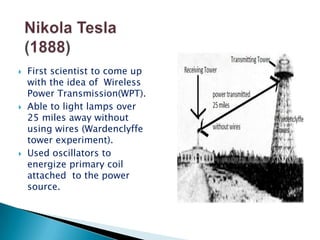
   First scientist to come up
    with the idea of Wireless
    Power Transmission(WPT).
   Able to light lamps over
    25 miles away without
    using wires (Wardenclyffe
    tower experiment).
   Used oscillators to
    energize primary coil
    attached to the power
    source.
       Induction
    ◦    Electrodynamics
    ◦    Electrostatic
       Electromagnetic Radiation
    ◦    Laser
    ◦    Microwaves
       Evanescent Wave Coupling
   Principle: Mutual Induction between isolated
    coils or conductors.
    -Electrodynamics (Electromagnetic coupling)
    -Electrostatic (Capacitive Coupling)
   Transformer is a basic example.
   The main drawback to induction is the short
    range.
   Magnetic field spreads in all directions
    wasting a large amount of energy.
   Electricity transmitted by converting it into
    electromagnetic waves.
   Antennas of electronic devices will receive
    waves converting them back to electrical
    energy.
   Mainly, two types of e.m. waves are used-
     -Lasers
     -Microwaves
   A big disadvantage is that e.m. waves can
    harm the environment & even living beings
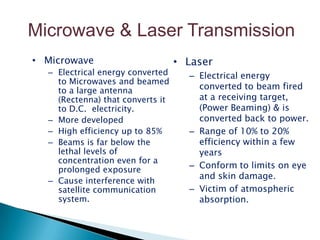
Microwave & Laser Transmission
• Microwave                       • Laser
  – Electrical energy converted     – Electrical energy
    to Microwaves and beamed
    to a large antenna                converted to beam fired
    (Rectenna) that converts it       at a receiving target,
    to D.C. electricity.              (Power Beaming) & is
  – More developed                    converted back to power.
  – High efficiency up to 85%       – Range of 10% to 20%
  – Beams is far below the            efficiency within a few
    lethal levels of                  years
    concentration even for a
    prolonged exposure              – Conform to limits on eye
                                      and skin damage.
  – Cause interference with
    satellite communication         – Victim of atmospheric
    system.                           absorption.
   In 2006 MIT researchers discovered an efficient
    method to transfer power.
   Transfer power using non-radiative.
    Electromagnetic energy Resonant Tunnelling.
   Does not disturbs communication system.
   Wastage of energy is small.
   No need of line of sight between transmitter and
    receiver as in lasers.
   Most efficient way to transmit Power wirelessly
    introduced up till now.
   Negative health effects.
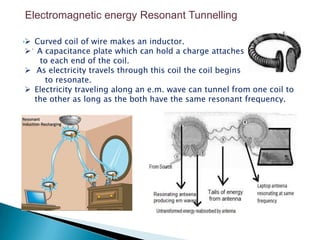
Electromagnetic energy Resonant Tunnelling

 Curved coil of wire makes an inductor.

 .
 A capacitance plate which can hold a charge attaches
    to each end of the coil.
 As electricity travels through this coil the coil begins
      to resonate.
 Electricity traveling along an e.m. wave can tunnel from one coil to
   the other as long as the both have the same resonant frequency.
   For small portable electronic devices electrical
    energy can be converted to radio signals and can
    be transferred to the device which receives radio
    frequency radiation and converts it to DC
    electricity that could be stored in a battery for
    use.

   Electrical energy can propagate around the world.
    Power demands differ at different time, high
    demands during day and low during night . So,
    the extra power available during the night could
    be transmitted to the side of the planet where it
    is day time.
Merits:                          Demerits
  Eliminates use of existing
   high-tension power           • The Capital Cost for
                                  practical implementation
   transmission line cables,      of WPT seems to be very
   towers and sub stations.       high.
  Facilitates transmission     • Microwaves interferes with
   of energy on a global          the present
                                  communication systems.
   scale.
                                • Develops reactive power
  Low Energy costs.              at a small frequency that
  The power failure due to       is very biologically
   short circuit would never      compatible and harmful to
                                  environment & living
   exist.                         beings on over exposure.
  Power theft would be not
   possible at all.
   Wireless transmission is now a reality & is in
    development.
   Will make Transmission system more
    economical, cheap & reduce pollution.
   Merits of this technology overshadow its
    demerits.
Thank You

Wireless Power Transmisson

  • 1.
    By: Abhinav Goel Tarun Sharma Avinash
  • 2.
    Wireless Transmission ofElectricity (Witricity) concept originated during turn between 19th and 20th century. Then scientists who contributed to this technology are –  Nickola Tesla  William C Brown  Bill Brown  Hidetsugu Yagi
  • 3.
    First scientist to come up with the idea of Wireless Power Transmission(WPT).  Able to light lamps over 25 miles away without using wires (Wardenclyffe tower experiment).  Used oscillators to energize primary coil attached to the power source.
  • 4.
    Induction ◦ Electrodynamics ◦ Electrostatic  Electromagnetic Radiation ◦ Laser ◦ Microwaves  Evanescent Wave Coupling
  • 5.
    Principle: Mutual Induction between isolated coils or conductors. -Electrodynamics (Electromagnetic coupling) -Electrostatic (Capacitive Coupling)  Transformer is a basic example.  The main drawback to induction is the short range.  Magnetic field spreads in all directions wasting a large amount of energy.
  • 6.
    Electricity transmitted by converting it into electromagnetic waves.  Antennas of electronic devices will receive waves converting them back to electrical energy.  Mainly, two types of e.m. waves are used- -Lasers -Microwaves  A big disadvantage is that e.m. waves can harm the environment & even living beings
  • 7.
    Microwave & LaserTransmission • Microwave • Laser – Electrical energy converted – Electrical energy to Microwaves and beamed to a large antenna converted to beam fired (Rectenna) that converts it at a receiving target, to D.C. electricity. (Power Beaming) & is – More developed converted back to power. – High efficiency up to 85% – Range of 10% to 20% – Beams is far below the efficiency within a few lethal levels of years concentration even for a prolonged exposure – Conform to limits on eye and skin damage. – Cause interference with satellite communication – Victim of atmospheric system. absorption.
  • 8.
    In 2006 MIT researchers discovered an efficient method to transfer power.  Transfer power using non-radiative. Electromagnetic energy Resonant Tunnelling.  Does not disturbs communication system.  Wastage of energy is small.  No need of line of sight between transmitter and receiver as in lasers.  Most efficient way to transmit Power wirelessly introduced up till now.  Negative health effects.
  • 9.
    Electromagnetic energy ResonantTunnelling  Curved coil of wire makes an inductor.  .  A capacitance plate which can hold a charge attaches to each end of the coil.  As electricity travels through this coil the coil begins to resonate.  Electricity traveling along an e.m. wave can tunnel from one coil to the other as long as the both have the same resonant frequency.
  • 10.
    For small portable electronic devices electrical energy can be converted to radio signals and can be transferred to the device which receives radio frequency radiation and converts it to DC electricity that could be stored in a battery for use.  Electrical energy can propagate around the world. Power demands differ at different time, high demands during day and low during night . So, the extra power available during the night could be transmitted to the side of the planet where it is day time.
  • 11.
    Merits: Demerits  Eliminates use of existing high-tension power • The Capital Cost for practical implementation transmission line cables, of WPT seems to be very towers and sub stations. high.  Facilitates transmission • Microwaves interferes with of energy on a global the present communication systems. scale. • Develops reactive power  Low Energy costs. at a small frequency that  The power failure due to is very biologically short circuit would never compatible and harmful to environment & living exist. beings on over exposure.  Power theft would be not possible at all.
  • 12.
    Wireless transmission is now a reality & is in development.  Will make Transmission system more economical, cheap & reduce pollution.  Merits of this technology overshadow its demerits.
  • 13.