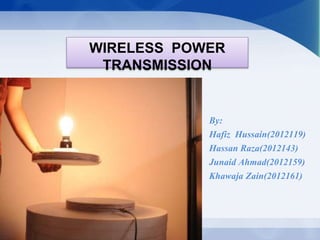
WIRELESS POWER 
TRANSMISSION 
By: 
Hafiz Hussain(2012119) 
Hassan Raza(2012143) 
Junaid Ahmad(2012159) 
Khawaja Zain(2012161)
Introduction 
Transmission and distribution losses 
Loss of energy generated in wires 
Nicola Tesla
History of Wireless Power 
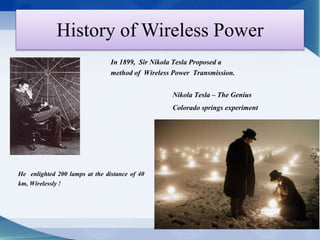
In 1899, Sir Nikola Tesla Proposed a 
method of Wireless Power Transmission. 
He enlighted 200 lamps at the distance of 40 
km, Wirelessly ! 
Nikola Tesla – The Genius 
Colorado springs experiment
Earth current transmission 
Wireless Tower 
Charged by high frequency and high voltage apparatus 
High frequency AC Current discharged 
Conduction, Earth surface shell 
Tesla Coil 
Electrical resonant transformer circuit 
High frequency output illuminates fluorescent tubes
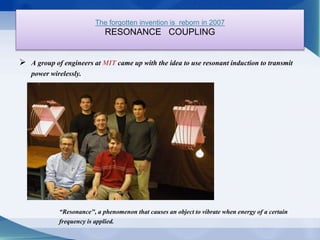
The forgotten invention is reborn in 2007 
RESONANCE COUPLING 
 A group of engineers at MIT came up with the idea to use resonant induction to transmit 
power wirelessly. 
“Resonance", a phenomenon that causes an object to vibrate when energy of a certain 
frequency is applied.
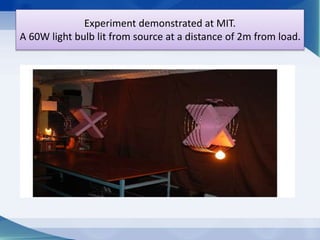
Experiment demonstrated at MIT. 
A 60W light bulb lit from source at a distance of 2m from load.
What is WPT ? 
definition is : 
 “Transmission of energy through the air”. 
 A system of two electromagnetic resonators 
coupled mostly through their magnetic fields.
Types of WPT 
Near-field techniques 
Inductive Coupling 
Resonant Inductive Coupling 
Air Ionization 
Far-field techniques 
Microwave Power Transmission (MPT) 
LASER power transmission 
8
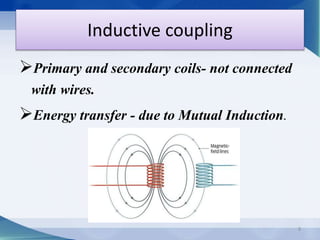
Inductive coupling 
Primary and secondary coils- not connected 
with wires. 
Energy transfer - due to Mutual Induction. 
9
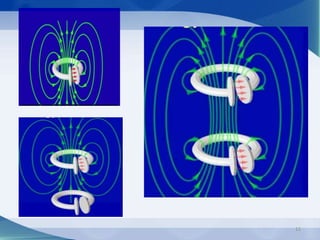
Resonance Inductive Coupling(RIC) 
Same concept as Inductive coupling just that the coils 
operate at resonant frequency leading to efficient 
transfer of energy over a larger distance. 
 Interacts weakly with extraneous off resonant objects. 
Radiation loss will be negligible
11
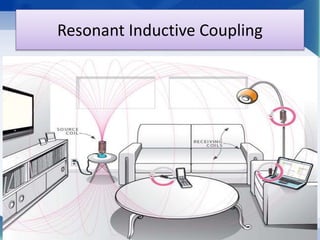
Resonant Inductive Coupling
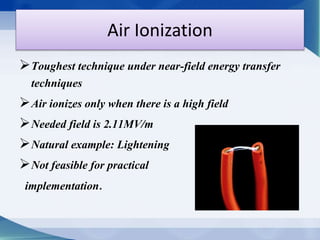
Air Ionization 
Toughest technique under near-field energy transfer 
techniques 
Air ionizes only when there is a high field 
Needed field is 2.11MV/m 
Natural example: Lightening 
Not feasible for practical 
implementation.
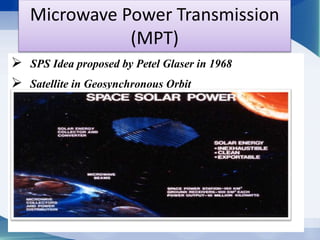
Microwave Power Transmission 
(MPT) 
 SPS Idea proposed by Petel Glaser in 1968 
 Satellite in Geosynchronous Orbit
Microwave Power Transmission 
(MPT) 
Microwaves produced at 2.45 GHz by using Magnetron 
Rectenna is used for collecting these Microwaves (One and 
half mile long) 
 Rectenna converted these Microwaves in DC power with 
antenna and rectifier 
Through this type of Power Station, we can get 5 to 10 G-Watts 
power. 
Power efficiency up to 85%.
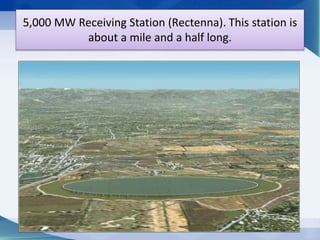
5,000 MW Receiving Station (Rectenna). This station is 
about a mile and a half long.
Laser Power Transmission 
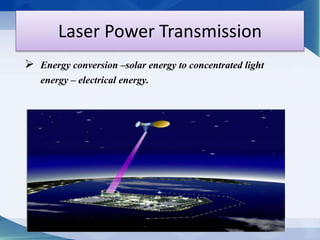
 Energy conversion –solar energy to concentrated light 
energy – electrical energy.
Laser Power Transmission 
Long distance transmission possible. 
Solar energy- Not a concentrated source of energy. 
Losses due to scattering of light. 
Presently only 3% of solar energy is being utilized. 
High efficiency about 50% to 75%. 
With this technology it is expected 1GW of power can be 
generated.
19 
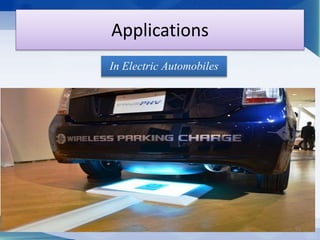
Applications 
In Electric Automobiles
Applications 
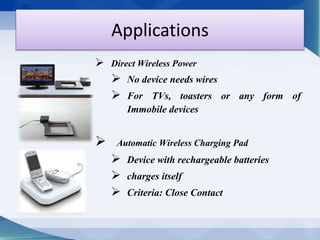
 Direct Wireless Power 
 No device needs wires 
 For TVs, toasters or any form of 
Immobile devices 
 
Automatic Wireless Charging Pad 
 Device with rechargeable batteries 
 charges itself 
 Criteria: Close Contact
WPT CONCERNS 
Will it harm me? 
Will it harm the environment? 
NO
 No wires 
 No Energy-waste as compared to dumped used batteries 
 Need for battery is eliminated 
Maintenance cost is less 
22 
Advantages of WPT
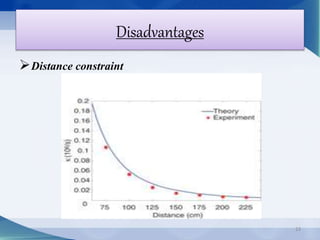
Distance constraint 
23 
Disadvantages
Initial cost is high 
In RIC, tuning is difficult(L & C Values for Resonance) 
Air ionization technique is not feasible( small distance, 
High voltage, ) 
24 
Disadvantages
CONCLUSION 
Transmission without wires- a reality 
Efficient (MIT experiment more than 60%) 
Energy crisis can be decreased 
In near future, world will be completely wireless
Wireless Power Transmission

Wireless Power Transmission

  • 1.
    WIRELESS POWER TRANSMISSION By: Hafiz Hussain(2012119) Hassan Raza(2012143) Junaid Ahmad(2012159) Khawaja Zain(2012161)
  • 2.
    Introduction Transmission anddistribution losses Loss of energy generated in wires Nicola Tesla
  • 3.
    History of WirelessPower In 1899, Sir Nikola Tesla Proposed a method of Wireless Power Transmission. He enlighted 200 lamps at the distance of 40 km, Wirelessly ! Nikola Tesla – The Genius Colorado springs experiment
  • 4.
    Earth current transmission Wireless Tower Charged by high frequency and high voltage apparatus High frequency AC Current discharged Conduction, Earth surface shell Tesla Coil Electrical resonant transformer circuit High frequency output illuminates fluorescent tubes
  • 5.
    The forgotten inventionis reborn in 2007 RESONANCE COUPLING  A group of engineers at MIT came up with the idea to use resonant induction to transmit power wirelessly. “Resonance", a phenomenon that causes an object to vibrate when energy of a certain frequency is applied.
  • 6.
    Experiment demonstrated atMIT. A 60W light bulb lit from source at a distance of 2m from load.
  • 7.
    What is WPT? definition is :  “Transmission of energy through the air”.  A system of two electromagnetic resonators coupled mostly through their magnetic fields.
  • 8.
    Types of WPT Near-field techniques Inductive Coupling Resonant Inductive Coupling Air Ionization Far-field techniques Microwave Power Transmission (MPT) LASER power transmission 8
  • 9.
    Inductive coupling Primaryand secondary coils- not connected with wires. Energy transfer - due to Mutual Induction. 9
  • 10.
    Resonance Inductive Coupling(RIC) Same concept as Inductive coupling just that the coils operate at resonant frequency leading to efficient transfer of energy over a larger distance.  Interacts weakly with extraneous off resonant objects. Radiation loss will be negligible
  • 11.
  • 12.
  • 13.
    Air Ionization Toughesttechnique under near-field energy transfer techniques Air ionizes only when there is a high field Needed field is 2.11MV/m Natural example: Lightening Not feasible for practical implementation.
  • 14.
    Microwave Power Transmission (MPT)  SPS Idea proposed by Petel Glaser in 1968  Satellite in Geosynchronous Orbit
  • 15.
    Microwave Power Transmission (MPT) Microwaves produced at 2.45 GHz by using Magnetron Rectenna is used for collecting these Microwaves (One and half mile long)  Rectenna converted these Microwaves in DC power with antenna and rectifier Through this type of Power Station, we can get 5 to 10 G-Watts power. Power efficiency up to 85%.
  • 16.
    5,000 MW ReceivingStation (Rectenna). This station is about a mile and a half long.
  • 17.
    Laser Power Transmission  Energy conversion –solar energy to concentrated light energy – electrical energy.
  • 18.
    Laser Power Transmission Long distance transmission possible. Solar energy- Not a concentrated source of energy. Losses due to scattering of light. Presently only 3% of solar energy is being utilized. High efficiency about 50% to 75%. With this technology it is expected 1GW of power can be generated.
  • 19.
    19 Applications InElectric Automobiles
  • 20.
    Applications  DirectWireless Power  No device needs wires  For TVs, toasters or any form of Immobile devices  Automatic Wireless Charging Pad  Device with rechargeable batteries  charges itself  Criteria: Close Contact
  • 21.
    WPT CONCERNS Willit harm me? Will it harm the environment? NO
  • 22.
     No wires  No Energy-waste as compared to dumped used batteries  Need for battery is eliminated Maintenance cost is less 22 Advantages of WPT
  • 23.
  • 24.
    Initial cost ishigh In RIC, tuning is difficult(L & C Values for Resonance) Air ionization technique is not feasible( small distance, High voltage, ) 24 Disadvantages
  • 25.
    CONCLUSION Transmission withoutwires- a reality Efficient (MIT experiment more than 60%) Energy crisis can be decreased In near future, world will be completely wireless