Prof. U. Murali.
Wound Healing
Learning Objectives
•Introduction
•Phases of wound healing
•Types of wound healing
•Factors of wound healing
•Complications
• Wound healing is a complex and
dynamic biological process.
• It is related to tissue reconstitution
which is the process by which the body
replenishes cells that are being lost.
• All wounds heal following a specific
sequence of phases which may
overlap.
• The process of wound healing depends
on the type of tissue which has been
damaged and the nature of tissue
disruption.
Introduction
4
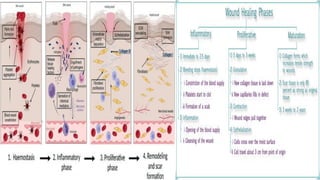
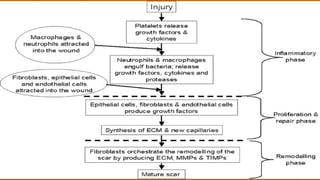
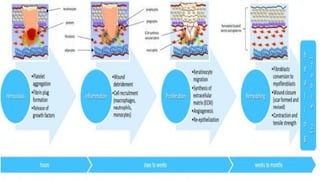
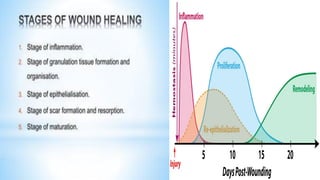
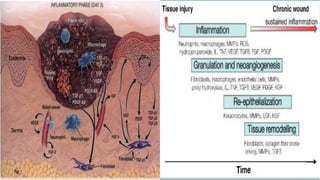
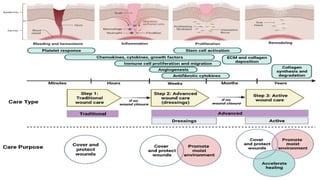
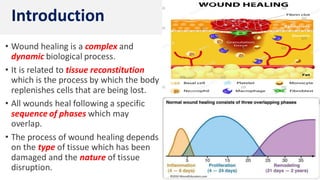
• Classically, wound healing has been
arbitrarily described in 3 overlapping
but distinct stages / phases and include:
• Inflammatory phase
[ Lag / Substrate / Exudative phase ]
• Proliferative phase
[ Collagen / Fibroblastic phase ]
• Remodeling phase
[ Maturation phase ]
Phases of Wound Healing
5
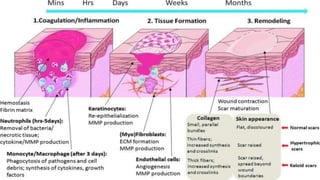
• It begins immediately after wounding & and
lasts 2–3 days.
• Hemostasis, is often described as the
immediate phase occurring before
inflammation.
• Hemostasis is achieved by vasoconstriction
with formation of platelet plug [PT adhere,
activate and aggregate] & activation of
clotting pathway, resulting in formation of
fibrin matrix.
• The fibrin clot helps to stabilize the platelet
plug and form a scaffold for migration of
inflammatory cells [PMLs] into the wound.
I. Phase – H & I
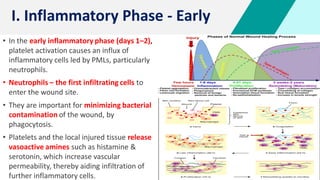
• In the early inflammatory phase (days 1–2),
platelet activation causes an influx of
inflammatory cells led by PMLs, particularly
neutrophils.
• Neutrophils – the first infiltrating cells to
enter the wound site.
• They are important for minimizing bacterial
contamination of the wound, by
phagocytosis.
• Platelets and the local injured tissue release
vasoactive amines such as histamine &
serotonin, which increase vascular
permeability, thereby aiding infiltration of
further inflammatory cells.
I. Inflammatory Phase - Early
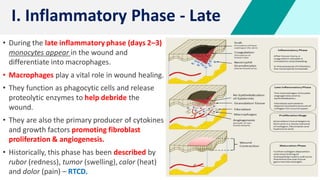
• During the late inflammatory phase (days 2–3)
monocytes appear in the wound and
differentiate into macrophages.
• Macrophages play a vital role in wound healing.
• They function as phagocytic cells and release
proteolytic enzymes to help debride the
wound.
• They are also the primary producer of cytokines
and growth factors promoting fibroblast
proliferation & angiogenesis.
• Historically, this phase has been described by
rubor (redness), tumor (swelling), calor (heat)
and dolor (pain) – RTCD.
I. Inflammatory Phase - Late
8
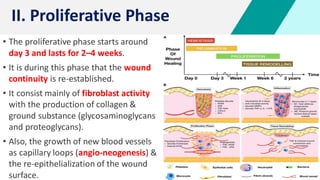
• The proliferative phase starts around
day 3 and lasts for 2–4 weeks.
• It is during this phase that the wound
continuity is re-established.
• It consist mainly of fibroblast activity
with the production of collagen &
ground substance (glycosaminoglycans
and proteoglycans).
• Also, the growth of new blood vessels
as capillary loops (angio-neogenesis) &
the re-epithelialization of the wound
surface.
II. Proliferative Phase
9
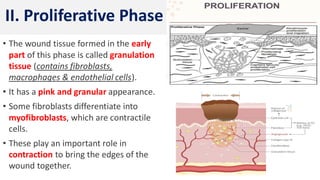
• The wound tissue formed in the early
part of this phase is called granulation
tissue (contains fibroblasts,
macrophages & endothelial cells).
• It has a pink and granular appearance.
• Some fibroblasts differentiate into
myofibroblasts, which are contractile
cells.
• These play an important role in
contraction to bring the edges of the
wound together.
II. Proliferative Phase
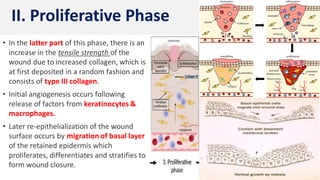
• In the latter part of this phase, there is an
increase in the tensile strength of the
wound due to increased collagen, which is
at first deposited in a random fashion and
consists of type III collagen.
• Initial angiogenesis occurs following
release of factors from keratinocytes &
macrophages.
• Later re-epithelialization of the wound
surface occurs by migration of basal layer
of the retained epidermis which
proliferates, differentiates and stratifies to
form wound closure.
II. Proliferative Phase
11
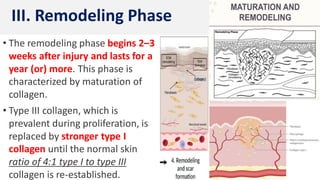
• The remodeling phase begins 2–3
weeks after injury and lasts for a
year (or) more. This phase is
characterized by maturation of
collagen.
• Type III collagen, which is
prevalent during proliferation, is
replaced by stronger type I
collagen until the normal skin
ratio of 4:1 type I to type III
collagen is re-established.
III. Remodeling Phase
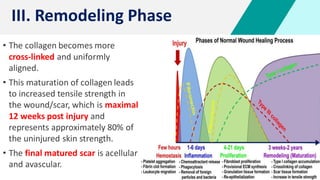
• The collagen becomes more
cross-linked and uniformly
aligned.
• This maturation of collagen leads
to increased tensile strength in
the wound/scar, which is maximal
12 weeks post injury and
represents approximately 80% of
the uninjured skin strength.
• The final matured scar is acellular
and avascular.
III. Remodeling Phase
16
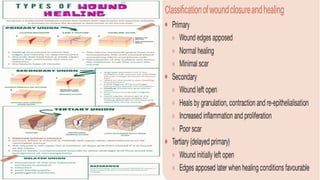
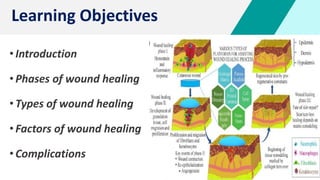
• Wound healing is accomplished in one of
the following 3 ways –
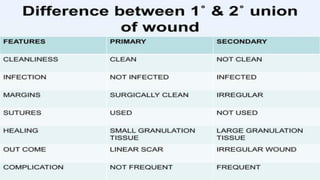
• Healing by primary intention
[wounds with opposed edges]
• Healing by secondary intention
[wounds with separated edges]
• Healing by tertiary intention
[tertiary wound healing]
Types of Wound Healing
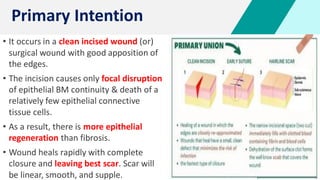
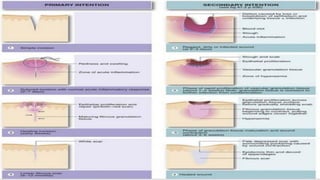
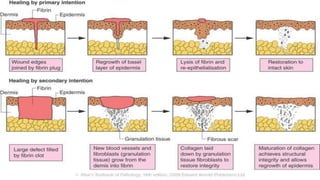
• It occurs in a clean incised wound (or)
surgical wound with good apposition of
the edges.
• The incision causes only focal disruption
of epithelial BM continuity & death of a
relatively few epithelial connective
tissue cells.
• As a result, there is more epithelial
regeneration than fibrosis.
• Wound heals rapidly with complete
closure and leaving best scar. Scar will
be linear, smooth, and supple.
Primary Intention
18
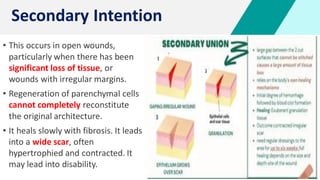
• This occurs in open wounds,
particularly when there has been
significant loss of tissue, or
wounds with irregular margins.
• Regeneration of parenchymal cells
cannot completely reconstitute
the original architecture.
• It heals slowly with fibrosis. It leads
into a wide scar, often
hypertrophied and contracted. It
may lead into disability.
Secondary Intention
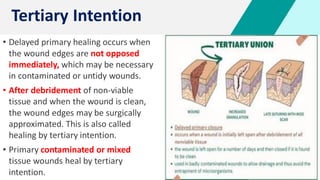
• Delayed primary healing occurs when
the wound edges are not opposed
immediately, which may be necessary
in contaminated or untidy wounds.
• After debridement of non-viable
tissue and when the wound is clean,
the wound edges may be surgically
approximated. This is also called
healing by tertiary intention.
• Primary contaminated or mixed
tissue wounds heal by tertiary
intention.
Tertiary Intention
22
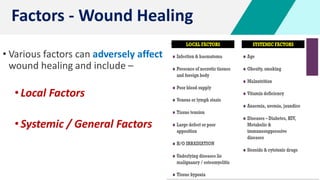
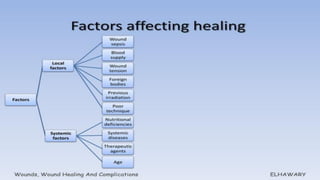
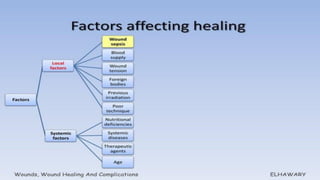
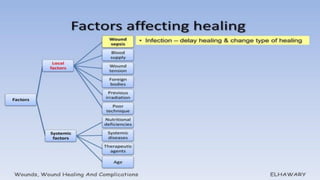
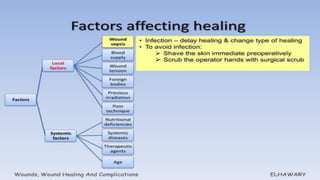
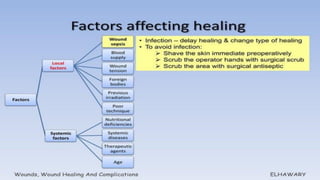
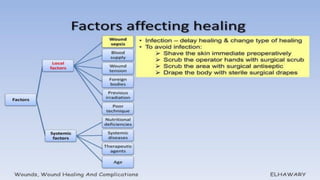
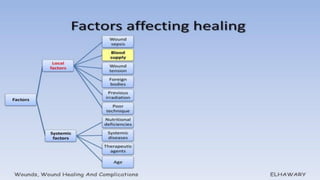
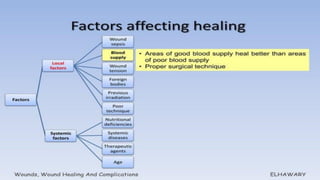
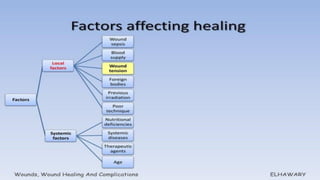
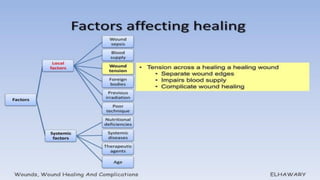
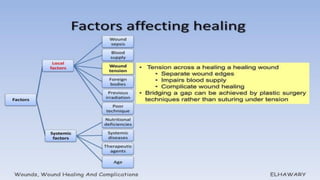
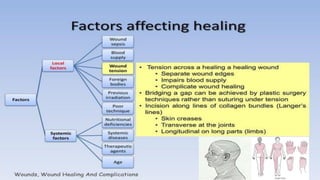
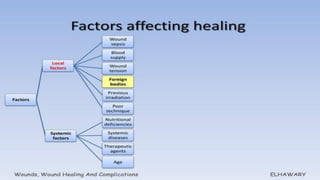
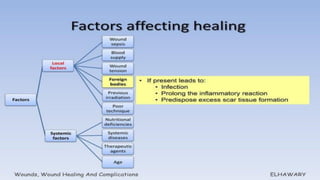
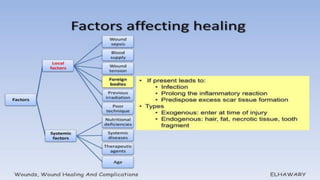
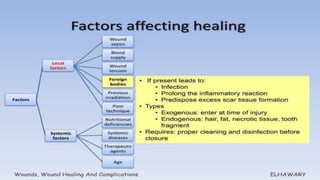
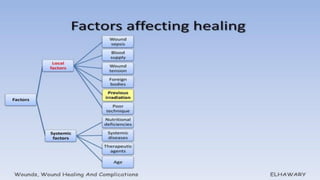
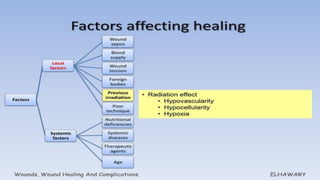
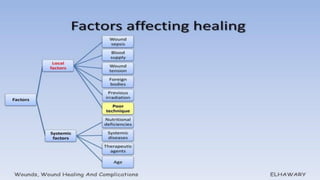
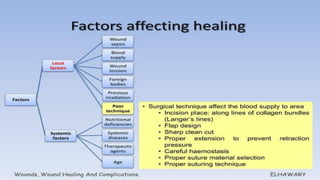
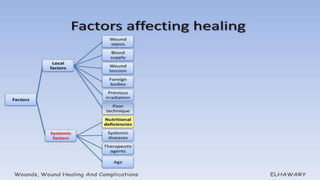
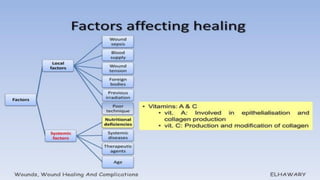
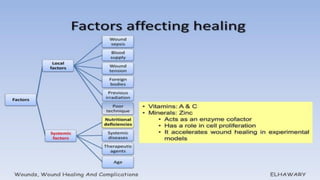
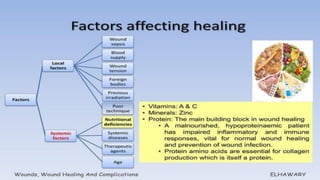
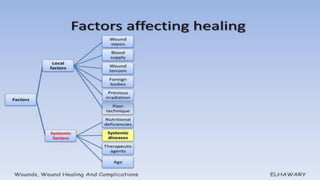
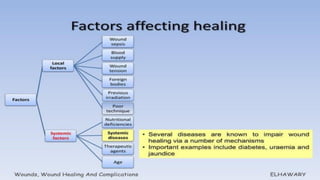
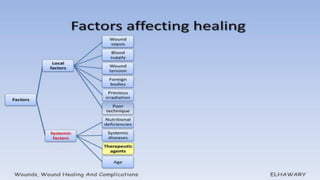
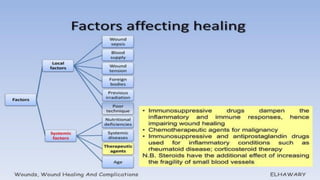
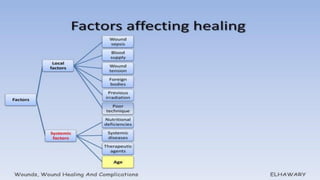
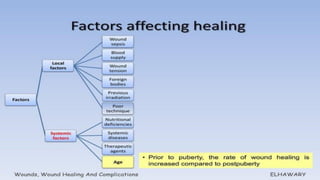
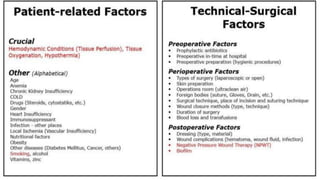
• Various factors can adversely affect
wound healing and include –
•Local Factors
•Systemic / General Factors
Factors - Wound Healing
Complications – W H
• Excessive Scar Formation: Hypertrophic scar,
Keloid.
• Deficient Scar Formation: Result in wound
dehiscence [or] rupture of the wound due to
inadequate formation of granulation tissue.
• Exuberant Granulation (Proud Flesh):
Excessive GT that protrudes above the skin
level.
• Deficient contraction – Skin grafts
Excessive contraction – In Burns
• Others: Pigmentary changes, Incisional
hernia, Dystrophic calcification, Neoplastic
changes.
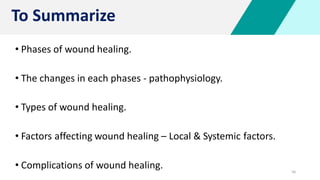
56
• Phases of wound healing.
• The changes in each phases - pathophysiology.
• Types of wound healing.
• Factors affecting wound healing – Local & Systemic factors.
• Complications of wound healing.
To Summarize
References
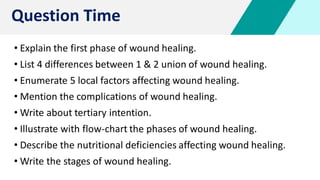
• Explain the first phase of wound healing.
• List 4 differences between 1 & 2 union of wound healing.
• Enumerate 5 local factors affecting wound healing.
• Mention the complications of wound healing.
• Write about tertiary intention.
• Illustrate with flow-chart the phases of wound healing.
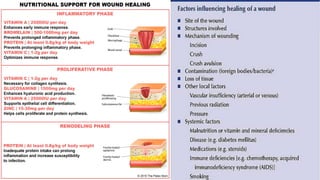
• Describe the nutritional deficiencies affecting wound healing.
• Write the stages of wound healing.
Question Time
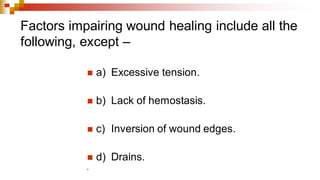
Factors impairing wound healing include all the
following, except –
◼ a) Excessive tension.
◼ b) Lack of hemostasis.
◼ c) Inversion of wound edges.
◼ d) Drains.
◼
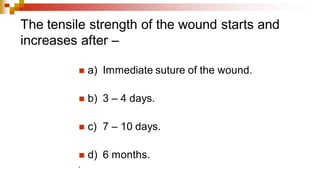
The tensile strength of the wound starts and
increases after –
◼ a) Immediate suture of the wound.
◼ b) 3 – 4 days.
◼ c) 7 – 10 days.
◼ d) 6 months.
◼
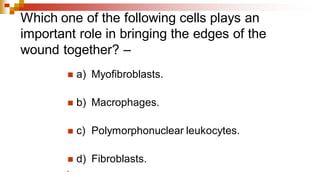
Which one of the following cells plays an
important role in bringing the edges of the
wound together? –
◼ a) Myofibroblasts.
◼ b) Macrophages.
◼ c) Polymorphonuclear leukocytes.
◼ d) Fibroblasts.
◼
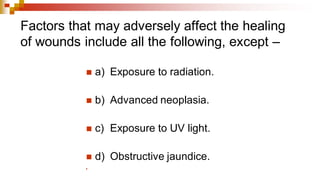
Factors that may adversely affect the healing
of wounds include all the following, except –
◼ a) Exposure to radiation.
◼ b) Advanced neoplasia.
◼ c) Exposure to UV light.
◼ d) Obstructive jaundice.
◼
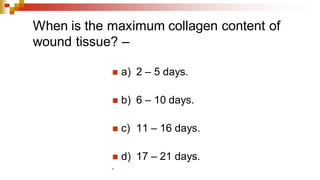
When is the maximum collagen content of
wound tissue? –
◼ a) 2 – 5 days.
◼ b) 6 – 10 days.
◼ c) 11 – 16 days.
◼ d) 17 – 21 days.
◼
64
Wound Healing
Wound Healing
Wound Healing
Wound Healing
Wound Healing
Wound Healing

Wound Healing

  • 1.
  • 2.
    Learning Objectives •Introduction •Phases ofwound healing •Types of wound healing •Factors of wound healing •Complications
  • 3.
    • Wound healingis a complex and dynamic biological process. • It is related to tissue reconstitution which is the process by which the body replenishes cells that are being lost. • All wounds heal following a specific sequence of phases which may overlap. • The process of wound healing depends on the type of tissue which has been damaged and the nature of tissue disruption. Introduction
  • 4.
    4 • Classically, woundhealing has been arbitrarily described in 3 overlapping but distinct stages / phases and include: • Inflammatory phase [ Lag / Substrate / Exudative phase ] • Proliferative phase [ Collagen / Fibroblastic phase ] • Remodeling phase [ Maturation phase ] Phases of Wound Healing
  • 5.
    5 • It beginsimmediately after wounding & and lasts 2–3 days. • Hemostasis, is often described as the immediate phase occurring before inflammation. • Hemostasis is achieved by vasoconstriction with formation of platelet plug [PT adhere, activate and aggregate] & activation of clotting pathway, resulting in formation of fibrin matrix. • The fibrin clot helps to stabilize the platelet plug and form a scaffold for migration of inflammatory cells [PMLs] into the wound. I. Phase – H & I
  • 6.
    • In theearly inflammatory phase (days 1–2), platelet activation causes an influx of inflammatory cells led by PMLs, particularly neutrophils. • Neutrophils – the first infiltrating cells to enter the wound site. • They are important for minimizing bacterial contamination of the wound, by phagocytosis. • Platelets and the local injured tissue release vasoactive amines such as histamine & serotonin, which increase vascular permeability, thereby aiding infiltration of further inflammatory cells. I. Inflammatory Phase - Early
  • 7.
    • During thelate inflammatory phase (days 2–3) monocytes appear in the wound and differentiate into macrophages. • Macrophages play a vital role in wound healing. • They function as phagocytic cells and release proteolytic enzymes to help debride the wound. • They are also the primary producer of cytokines and growth factors promoting fibroblast proliferation & angiogenesis. • Historically, this phase has been described by rubor (redness), tumor (swelling), calor (heat) and dolor (pain) – RTCD. I. Inflammatory Phase - Late
  • 8.
    8 • The proliferativephase starts around day 3 and lasts for 2–4 weeks. • It is during this phase that the wound continuity is re-established. • It consist mainly of fibroblast activity with the production of collagen & ground substance (glycosaminoglycans and proteoglycans). • Also, the growth of new blood vessels as capillary loops (angio-neogenesis) & the re-epithelialization of the wound surface. II. Proliferative Phase
  • 9.
    9 • The woundtissue formed in the early part of this phase is called granulation tissue (contains fibroblasts, macrophages & endothelial cells). • It has a pink and granular appearance. • Some fibroblasts differentiate into myofibroblasts, which are contractile cells. • These play an important role in contraction to bring the edges of the wound together. II. Proliferative Phase
  • 10.
    • In thelatter part of this phase, there is an increase in the tensile strength of the wound due to increased collagen, which is at first deposited in a random fashion and consists of type III collagen. • Initial angiogenesis occurs following release of factors from keratinocytes & macrophages. • Later re-epithelialization of the wound surface occurs by migration of basal layer of the retained epidermis which proliferates, differentiates and stratifies to form wound closure. II. Proliferative Phase
  • 11.
    11 • The remodelingphase begins 2–3 weeks after injury and lasts for a year (or) more. This phase is characterized by maturation of collagen. • Type III collagen, which is prevalent during proliferation, is replaced by stronger type I collagen until the normal skin ratio of 4:1 type I to type III collagen is re-established. III. Remodeling Phase
  • 12.
    • The collagenbecomes more cross-linked and uniformly aligned. • This maturation of collagen leads to increased tensile strength in the wound/scar, which is maximal 12 weeks post injury and represents approximately 80% of the uninjured skin strength. • The final matured scar is acellular and avascular. III. Remodeling Phase
  • 16.
    16 • Wound healingis accomplished in one of the following 3 ways – • Healing by primary intention [wounds with opposed edges] • Healing by secondary intention [wounds with separated edges] • Healing by tertiary intention [tertiary wound healing] Types of Wound Healing
  • 17.
    • It occursin a clean incised wound (or) surgical wound with good apposition of the edges. • The incision causes only focal disruption of epithelial BM continuity & death of a relatively few epithelial connective tissue cells. • As a result, there is more epithelial regeneration than fibrosis. • Wound heals rapidly with complete closure and leaving best scar. Scar will be linear, smooth, and supple. Primary Intention
  • 18.
    18 • This occursin open wounds, particularly when there has been significant loss of tissue, or wounds with irregular margins. • Regeneration of parenchymal cells cannot completely reconstitute the original architecture. • It heals slowly with fibrosis. It leads into a wide scar, often hypertrophied and contracted. It may lead into disability. Secondary Intention
  • 19.
    • Delayed primaryhealing occurs when the wound edges are not opposed immediately, which may be necessary in contaminated or untidy wounds. • After debridement of non-viable tissue and when the wound is clean, the wound edges may be surgically approximated. This is also called healing by tertiary intention. • Primary contaminated or mixed tissue wounds heal by tertiary intention. Tertiary Intention
  • 22.
  • 24.
    • Various factorscan adversely affect wound healing and include – •Local Factors •Systemic / General Factors Factors - Wound Healing
  • 55.
    Complications – WH • Excessive Scar Formation: Hypertrophic scar, Keloid. • Deficient Scar Formation: Result in wound dehiscence [or] rupture of the wound due to inadequate formation of granulation tissue. • Exuberant Granulation (Proud Flesh): Excessive GT that protrudes above the skin level. • Deficient contraction – Skin grafts Excessive contraction – In Burns • Others: Pigmentary changes, Incisional hernia, Dystrophic calcification, Neoplastic changes.
  • 56.
    56 • Phases ofwound healing. • The changes in each phases - pathophysiology. • Types of wound healing. • Factors affecting wound healing – Local & Systemic factors. • Complications of wound healing. To Summarize
  • 57.
  • 58.
    • Explain thefirst phase of wound healing. • List 4 differences between 1 & 2 union of wound healing. • Enumerate 5 local factors affecting wound healing. • Mention the complications of wound healing. • Write about tertiary intention. • Illustrate with flow-chart the phases of wound healing. • Describe the nutritional deficiencies affecting wound healing. • Write the stages of wound healing. Question Time
  • 59.
    Factors impairing woundhealing include all the following, except – ◼ a) Excessive tension. ◼ b) Lack of hemostasis. ◼ c) Inversion of wound edges. ◼ d) Drains. ◼
  • 60.
    The tensile strengthof the wound starts and increases after – ◼ a) Immediate suture of the wound. ◼ b) 3 – 4 days. ◼ c) 7 – 10 days. ◼ d) 6 months. ◼
  • 61.
    Which one ofthe following cells plays an important role in bringing the edges of the wound together? – ◼ a) Myofibroblasts. ◼ b) Macrophages. ◼ c) Polymorphonuclear leukocytes. ◼ d) Fibroblasts. ◼
  • 62.
    Factors that mayadversely affect the healing of wounds include all the following, except – ◼ a) Exposure to radiation. ◼ b) Advanced neoplasia. ◼ c) Exposure to UV light. ◼ d) Obstructive jaundice. ◼
  • 63.
    When is themaximum collagen content of wound tissue? – ◼ a) 2 – 5 days. ◼ b) 6 – 10 days. ◼ c) 11 – 16 days. ◼ d) 17 – 21 days. ◼
  • 64.