
WOUND HEALING
Wound
 A wound is an injury, especially one in
which the skin or another external
surface is torn, pierced, cut, or
otherwise broken.
Wound types
1- open
Incisions or incised wounds, caused by a clean,
sharp-edged object such as a knife, a razor or a
glass splinter.
 Lacerations, irregular tear-like wounds caused by
some blunt trauma.
Abrasions (grazes), superficial wounds in which the
topmost layer of the skin (the epidermis) is scraped off.
Puncture wounds, caused by an object puncturing the
skin, such as a nail or needle.
Penetration wounds, caused by an object such as a knife
entering and coming out from the skin .
Gunshot wounds, caused by a bullet or similar projectile
driving into or through the body
2-Closed
 Contusions, more commonly known as bruises,
caused by a blunt force trauma that damages
tissue under the skin.
 Hematomas, also called a blood tumor, caused
by damage to a blood vessel that in turn causes
blood to collect under the skin.
 Crush injury, caused by a great or extreme
amount of force applied over a long period of
time.
Types of wound closure
 Primary closure
 Delayed primary closure
 Secondary closure
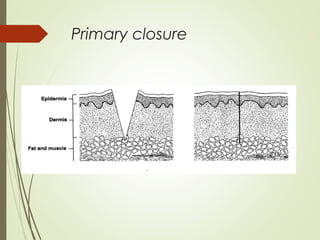
Primary closure
 First intention closure
 Immediately sealed wounds with simple suturing,
skin graft placement, or flap closure
 Eg. emergency laceration repair,
closure of the surgical wound
Primary closure
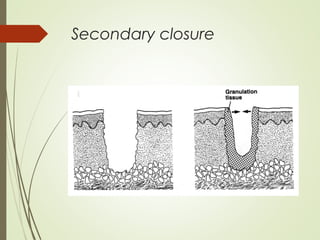
Secondary closure
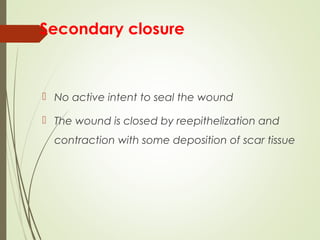
 No active intent to seal the wound
 The wound is closed by reepithelization and
contraction with some deposition of scar tissue
Secondary closure
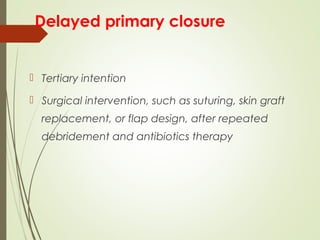
Delayed primary closure
 Tertiary intention
 Surgical intervention, such as suturing, skin graft
replacement, or flap design, after repeated
debridement and antibiotics therapy
Delayed primary closure
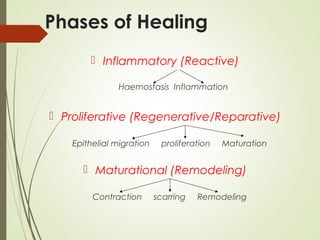
Phases of Healing
 Inflammatory (Reactive)
Haemostasis Inflammation
 Proliferative (Regenerative/Reparative)
Epithelial migration proliferation Maturation
 Maturational (Remodeling)
Contraction scarring Remodeling
Phases of Wound Healing
A. Inflammatory or reactive phase
Events
1. Increase vascular permeability
2.Chemotaxis
3.Secretion of cytokines
4.Growth factor
Phases of Wound Healing
B. Proliferative phase
Goal: granulation tissue formation
Events:
1. Angiogenesis
2.Fibroplasia
3.Epithelization
Phases of Wound Healing
C. Maturation phase
Goal: scar contraction with collagen cross-
linking, shrinking and loss of edema
Events:
1. Scarring
2.Contraction
3.Remodeling of scar
Factors affecting Wound Healing
 Infection
 Nutrition ( proteins, vit.C, vit.A, Zn, Fe)
 Steroids / Adriamycin
 Mechanical factors
(a) Increased pressure/torsion)
(b) Ischemia
 Malnutrition
 Advanced age
 Ionising Radiation
 Diabetes Mellitus
Wound healing

Wound healing

  • 1.
  • 2.
    Wound  A woundis an injury, especially one in which the skin or another external surface is torn, pierced, cut, or otherwise broken.
  • 3.
    Wound types 1- open Incisionsor incised wounds, caused by a clean, sharp-edged object such as a knife, a razor or a glass splinter.  Lacerations, irregular tear-like wounds caused by some blunt trauma.
  • 4.
    Abrasions (grazes), superficialwounds in which the topmost layer of the skin (the epidermis) is scraped off. Puncture wounds, caused by an object puncturing the skin, such as a nail or needle. Penetration wounds, caused by an object such as a knife entering and coming out from the skin . Gunshot wounds, caused by a bullet or similar projectile driving into or through the body
  • 5.
    2-Closed  Contusions, morecommonly known as bruises, caused by a blunt force trauma that damages tissue under the skin.  Hematomas, also called a blood tumor, caused by damage to a blood vessel that in turn causes blood to collect under the skin.  Crush injury, caused by a great or extreme amount of force applied over a long period of time.
  • 6.
    Types of woundclosure  Primary closure  Delayed primary closure  Secondary closure
  • 7.
    Primary closure  Firstintention closure  Immediately sealed wounds with simple suturing, skin graft placement, or flap closure  Eg. emergency laceration repair, closure of the surgical wound
  • 8.
  • 9.
    Secondary closure  Noactive intent to seal the wound  The wound is closed by reepithelization and contraction with some deposition of scar tissue
  • 10.
  • 11.
    Delayed primary closure Tertiary intention  Surgical intervention, such as suturing, skin graft replacement, or flap design, after repeated debridement and antibiotics therapy
  • 12.
  • 13.
    Phases of Healing Inflammatory (Reactive) Haemostasis Inflammation  Proliferative (Regenerative/Reparative) Epithelial migration proliferation Maturation  Maturational (Remodeling) Contraction scarring Remodeling
  • 14.
    Phases of WoundHealing A. Inflammatory or reactive phase Events 1. Increase vascular permeability 2.Chemotaxis 3.Secretion of cytokines 4.Growth factor
  • 15.
    Phases of WoundHealing B. Proliferative phase Goal: granulation tissue formation Events: 1. Angiogenesis 2.Fibroplasia 3.Epithelization
  • 16.
    Phases of WoundHealing C. Maturation phase Goal: scar contraction with collagen cross- linking, shrinking and loss of edema Events: 1. Scarring 2.Contraction 3.Remodeling of scar
  • 17.
    Factors affecting WoundHealing  Infection  Nutrition ( proteins, vit.C, vit.A, Zn, Fe)  Steroids / Adriamycin  Mechanical factors (a) Increased pressure/torsion) (b) Ischemia  Malnutrition  Advanced age  Ionising Radiation  Diabetes Mellitus