Wound Healing
Prepared by: Dr. Dounia Maamar Kebbab
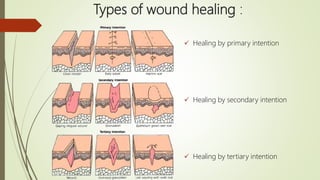
Types of wound healing :
 Healing by primary intention
 Healing by secondary intention
 Healing by tertiary intention
DEBRIDMENT.
Components of wound healing :
1. Wound contraction: the centripetal or concentric reduction in size of
an open wound, is essential to second-intention healing. Caused by
movement of fibroblasts in granulation tissue collagen and pulling forces
of granulation tissue myofibroblasts on the skin edges.
2. Granulation tissue formation: new connective tissue and
microscopic blood vessels that form on the surfaces of a wound during
the healing process. Granulation tissue typically grows from the base of a
wound and is able to fill wounds of almost any size.
3. Epithelialization: the process by which the skin and mucous
membranes replace superficial epithelial cells damaged or lost in a
wound.
Stages of wound healing :
1. Inflammatory phase
0 – 4 days
2. Proliferation phase
4 – 21 days
3. Remodeling phase
21 – 360 days
Wound strength :
Inflammatory + proliferative phase  little strength.
During remodeling:
6 weeks  50 % of the final strength.
6 - 12 months  maximum strength ( 75% of the preinjury).
Factors affecting wound healing :
General factors:
1.Age:  protein
2.Nutrition:
vit A deficiency ---->  epithelialization
Vit c deficiency ---->  protocollagen maturity
Protein deficiency ---->  collagen synthesis
3.Cortisone
4.Irradiation
5.Chronic disease
Local factors:
1.Poor vascularity
2.Tension
3.Foreign body + necrotic tissue
4.Infection
5.Immobilization
6.Adhesion to bone surface
Factors affecting wound healing :
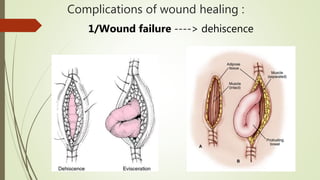
Complications of wound healing :
1/Wound failure ----> dehiscence
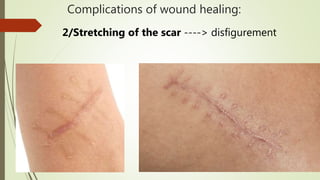
2/Stretching of the scar ----> disfigurement
Complications of wound healing:
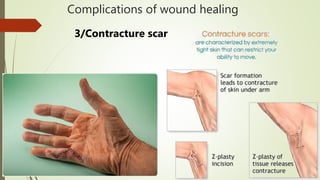
3/Contracture scar
Complications of wound healing
4/Post-operative wound infection
Complications of wound healing
5/Hypertrophic scar 6/Keloid scar
Red thickened
raised scar
Confined to wound edge Extends beyond the original
wound into normal tissue
Related to Wound tension
Prolonged inflammatory phase
Dark skin ++
Familial tendency
Occurs Sooner after injury Months after injury
Regression Spontaneous regression over years No regression
Common in Pre-sternal areas
Over shoulder
Ear lobules
Pre-sternal areas
Over shoulder
TTT Difficult, high rate of recurrence
1/ intra lesion steroid inj
2/ post-excision irradiation to 
recurrence
Complications of wound healing
General:
1. Shock.
2. Crush sd: traumatic rhabdomyolysis or Bywaters' syndrome major
shock and kidney failure after a crushing injury to skeletal muscle.
Local:
1. Infection ( pyogenetic + specific e.g: tetanus, gas
gangrene).
2. Injury of important structures, Vx, nerves, viscus.
3. Gangrene (infection + vascular).
4. Cpc of wound healing.
COMPLICATIONS OF WOUND:
Wound healing

Wound healing

  • 1.
    Wound Healing Prepared by:Dr. Dounia Maamar Kebbab
  • 2.
    Types of woundhealing :  Healing by primary intention  Healing by secondary intention  Healing by tertiary intention
  • 5.
  • 6.
    Components of woundhealing : 1. Wound contraction: the centripetal or concentric reduction in size of an open wound, is essential to second-intention healing. Caused by movement of fibroblasts in granulation tissue collagen and pulling forces of granulation tissue myofibroblasts on the skin edges. 2. Granulation tissue formation: new connective tissue and microscopic blood vessels that form on the surfaces of a wound during the healing process. Granulation tissue typically grows from the base of a wound and is able to fill wounds of almost any size. 3. Epithelialization: the process by which the skin and mucous membranes replace superficial epithelial cells damaged or lost in a wound.
  • 7.
    Stages of woundhealing : 1. Inflammatory phase 0 – 4 days 2. Proliferation phase 4 – 21 days 3. Remodeling phase 21 – 360 days
  • 9.
    Wound strength : Inflammatory+ proliferative phase  little strength. During remodeling: 6 weeks  50 % of the final strength. 6 - 12 months  maximum strength ( 75% of the preinjury).
  • 10.
    Factors affecting woundhealing : General factors: 1.Age:  protein 2.Nutrition: vit A deficiency ---->  epithelialization Vit c deficiency ---->  protocollagen maturity Protein deficiency ---->  collagen synthesis 3.Cortisone 4.Irradiation 5.Chronic disease
  • 11.
    Local factors: 1.Poor vascularity 2.Tension 3.Foreignbody + necrotic tissue 4.Infection 5.Immobilization 6.Adhesion to bone surface Factors affecting wound healing :
  • 12.
    Complications of woundhealing : 1/Wound failure ----> dehiscence
  • 13.
    2/Stretching of thescar ----> disfigurement Complications of wound healing:
  • 14.
  • 15.
  • 16.
    5/Hypertrophic scar 6/Keloidscar Red thickened raised scar Confined to wound edge Extends beyond the original wound into normal tissue Related to Wound tension Prolonged inflammatory phase Dark skin ++ Familial tendency Occurs Sooner after injury Months after injury Regression Spontaneous regression over years No regression Common in Pre-sternal areas Over shoulder Ear lobules Pre-sternal areas Over shoulder TTT Difficult, high rate of recurrence 1/ intra lesion steroid inj 2/ post-excision irradiation to  recurrence
  • 20.
  • 21.
    General: 1. Shock. 2. Crushsd: traumatic rhabdomyolysis or Bywaters' syndrome major shock and kidney failure after a crushing injury to skeletal muscle. Local: 1. Infection ( pyogenetic + specific e.g: tetanus, gas gangrene). 2. Injury of important structures, Vx, nerves, viscus. 3. Gangrene (infection + vascular). 4. Cpc of wound healing. COMPLICATIONS OF WOUND: