Shubhangi shukla
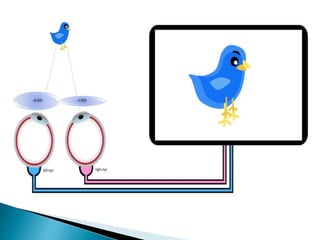
 It is condition of eye in which the 2 eye
refractive power is unequal. A difference of
1D in two eye then cause 2% difference in the
size of 2 retinal image of 2 eye is well
tolerated and 2.5 - 4D can be tolerated
depending upon the individual sensitivity but
it is more than 4D is not tolerated
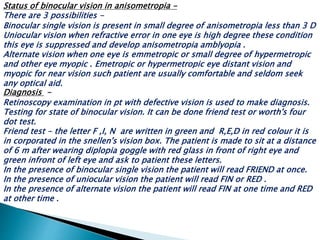
Status of binocular vision in anisometropia -
There are 3 possibilities -
Binocular single vision is present in small degree of anisometropia less than 3 D
Uniocular vision when refractive error in one eye is high degree these condition
this eye is suppressed and develop anisometropia amblyopia .
Alternate vision when one eye is emmetropic or small degree of hypermetropic
and other eye myopic . Emetropic or hypermetropic eye distant vision and
myopic for near vision such patient are usually comfortable and seldom seek
any optical aid.
Diagnosis -
Retinoscopy examination in pt with defective vision is used to make diagnosis.
Testing for state of binocular vision. It can be done friend test or worth's four
dot test.
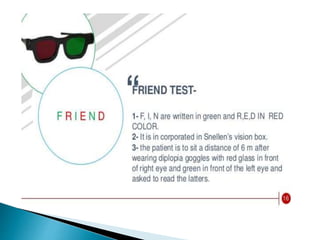
Friend test - the letter F ,I, N are written in green and R,E,D in red colour it is
in corporated in the snellen's vision box. The patient is made to sit at a distance
of 6 m after wearing diplopia goggle with red glass in front of right eye and
green infront of left eye and ask to patient these letters.
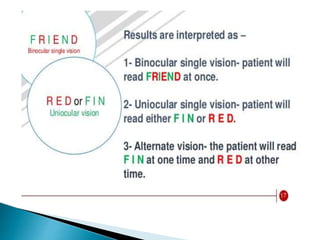
In the presence of binocular single vision the patient will read FRIEND at once.
In the presence of uniocular vision the patient will read FIN or RED .
In the presence of alternate vision the patient will read FIN at one time and RED
at other time .
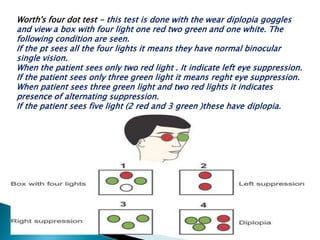
Worth's four dot test - this test is done with the wear diplopia goggles
and view a box with four light one red two green and one white. The
following condition are seen.
If the pt sees all the four lights it means they have normal binocular
single vision.
When the patient sees only two red light . It indicate left eye suppression.
If the patient sees only three green light it means reght eye suppression.
When patient sees three green light and two red lights it indicates
presence of alternating suppression.
If the patient sees five light (2 red and 3 green )these have diplopia.
Anisometropia

Anisometropia

  • 1.
  • 2.
     It iscondition of eye in which the 2 eye refractive power is unequal. A difference of 1D in two eye then cause 2% difference in the size of 2 retinal image of 2 eye is well tolerated and 2.5 - 4D can be tolerated depending upon the individual sensitivity but it is more than 4D is not tolerated
  • 12.
    Status of binocularvision in anisometropia - There are 3 possibilities - Binocular single vision is present in small degree of anisometropia less than 3 D Uniocular vision when refractive error in one eye is high degree these condition this eye is suppressed and develop anisometropia amblyopia . Alternate vision when one eye is emmetropic or small degree of hypermetropic and other eye myopic . Emetropic or hypermetropic eye distant vision and myopic for near vision such patient are usually comfortable and seldom seek any optical aid. Diagnosis - Retinoscopy examination in pt with defective vision is used to make diagnosis. Testing for state of binocular vision. It can be done friend test or worth's four dot test. Friend test - the letter F ,I, N are written in green and R,E,D in red colour it is in corporated in the snellen's vision box. The patient is made to sit at a distance of 6 m after wearing diplopia goggle with red glass in front of right eye and green infront of left eye and ask to patient these letters. In the presence of binocular single vision the patient will read FRIEND at once. In the presence of uniocular vision the patient will read FIN or RED . In the presence of alternate vision the patient will read FIN at one time and RED at other time .
  • 15.
    Worth's four dottest - this test is done with the wear diplopia goggles and view a box with four light one red two green and one white. The following condition are seen. If the pt sees all the four lights it means they have normal binocular single vision. When the patient sees only two red light . It indicate left eye suppression. If the patient sees only three green light it means reght eye suppression. When patient sees three green light and two red lights it indicates presence of alternating suppression. If the patient sees five light (2 red and 3 green )these have diplopia.