Second World War (1939-1945)
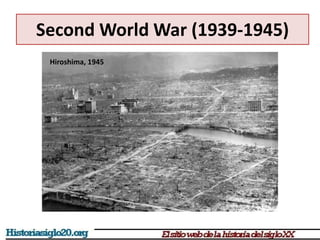
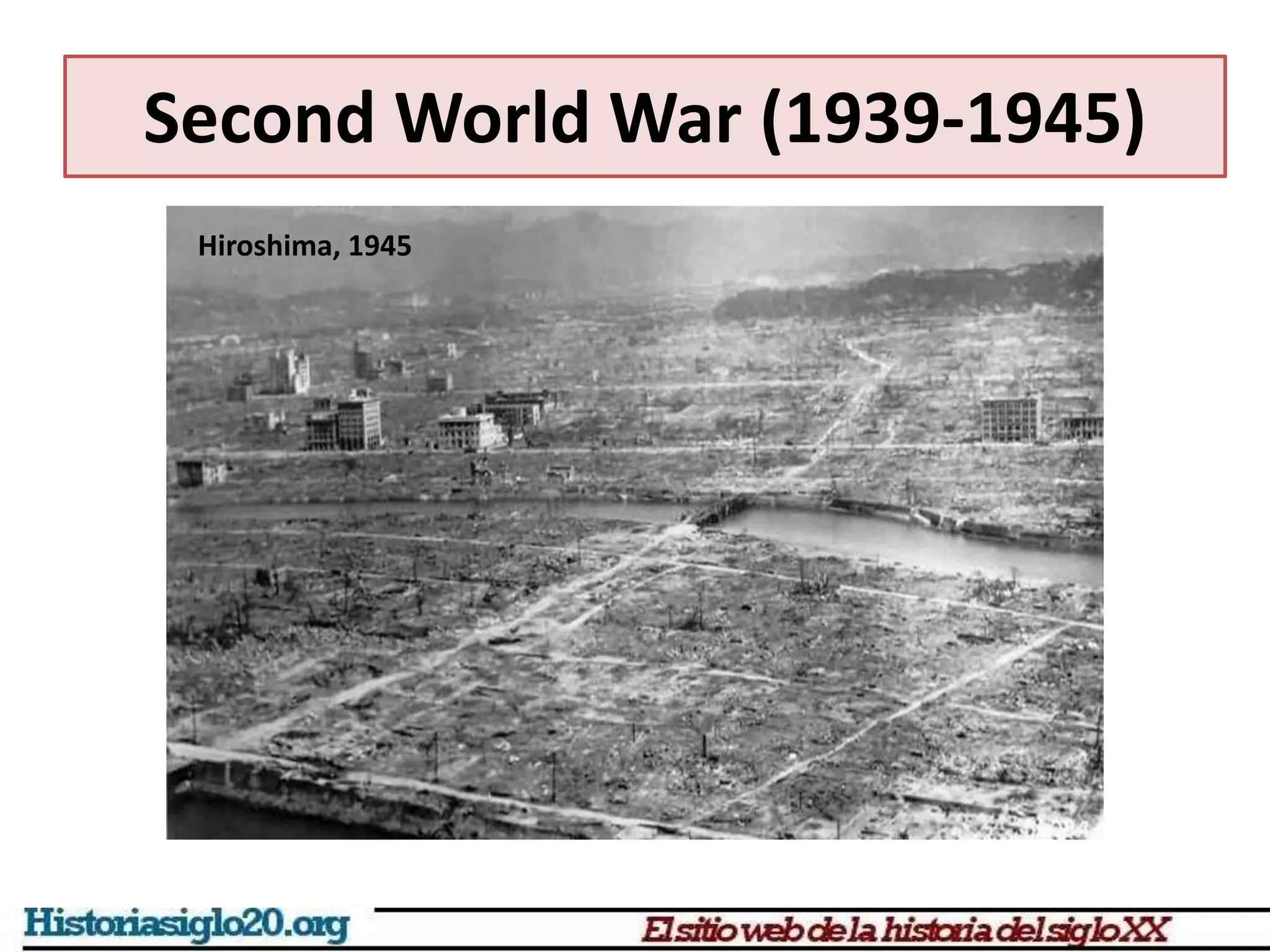
Hiroshima, 1945
Second World War (1939-1945)
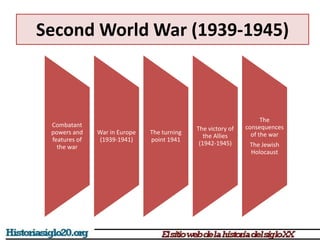
Combatant
powers and
features of
the war
War in Europe
(1939-1941)
The turning
point 1941
The victory of
the Allies
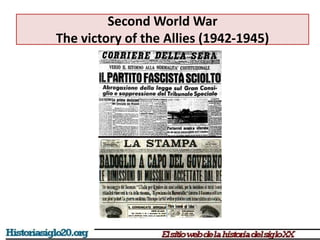
(1942-1945)
The
consequences
of the war
The Jewish
Holocaust
Second World War (1939-1945)
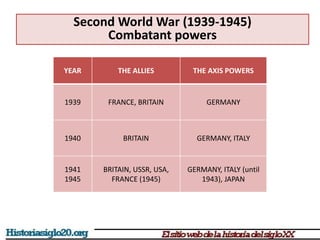
Combatant powers
YEAR THE ALLIES THE AXIS POWERS
1939 FRANCE, BRITAIN GERMANY
1940 BRITAIN GERMANY, ITALY
1941
1945
BRITAIN, USSR, USA,
FRANCE (1945)
GERMANY, ITALY (until
1943), JAPAN
Second World War (1939-1945)
Features of the war
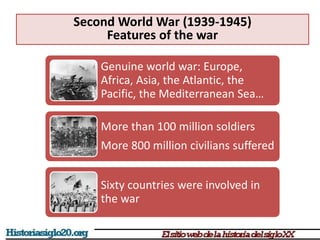
Genuine world war: Europe,
Africa, Asia, the Atlantic, the
Pacific, the Mediterranean Sea…
More than 100 million soldiers
More 800 million civilians suffered
Sixty countries were involved in
the war
Second World War (1939-1945)
Features of the war
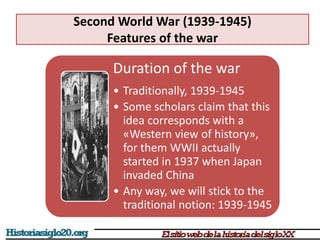
Duration of the war
• Traditionally, 1939-1945
• Some scholars claim that this
idea corresponds with a
«Western view of history»,
for them WWII actually
started in 1937 when Japan
invaded China
• Any way, we will stick to the
traditional notion: 1939-1945
Second World War (1939-1945)
Features of the war
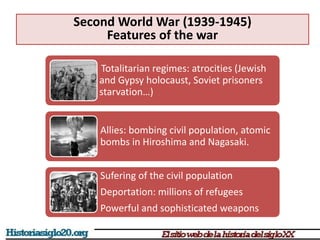
Totalitarian regimes: atrocities (Jewish
and Gypsy holocaust, Soviet prisoners
starvation…)
Allies: bombing civil population, atomic
bombs in Hiroshima and Nagasaki.
Sufering of the civil population
Deportation: millions of refugees
Powerful and sophisticated weapons
Second World War
War in Europe (1939-1941)
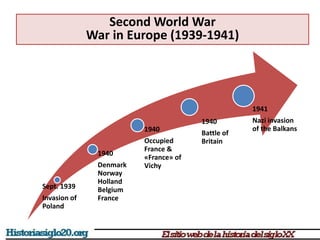
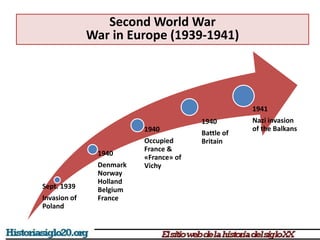
Sept. 1939
Invasion of
Poland
1940
Denmark
Norway
Holland
Belgium
France
1940
Occupied
France &
«France» of
Vichy
1941
Nazi invasion
of the Balkans
1940
Battle of
Britain
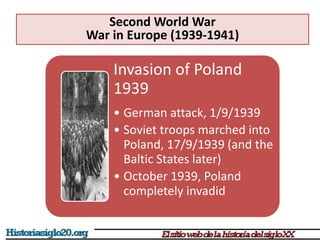
Invasion of Poland
1939
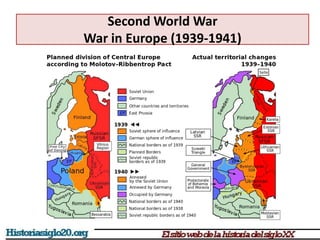
• German attack, 1/9/1939
• Soviet troops marched into
Poland, 17/9/1939 (and the
Baltic States later)
• October 1939, Poland
completely invadid
Second World War
War in Europe (1939-1941)
Second World War
War in Europe (1939-1941)
Second World War
War in Europe (1939-1941)
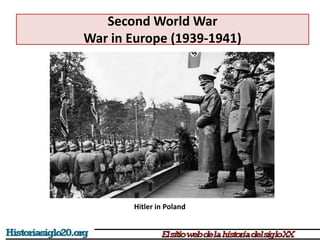
Hitler in Poland
Second World War
War in Europe (1939-1941)
)
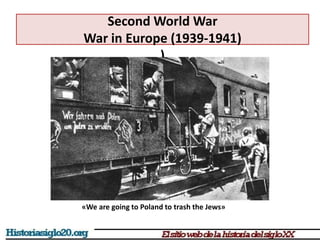
«We are going to Poland to trash the Jews»
Second World War
War in Europe (1939-1941)
Sept. 1939
Invasion of
Poland
1940
Denmark
Norway
Holland
Belgium
France
1940
Occupied
France &
«France» of
Vichy
1941
Nazi invasion
of the Balkans
1940
Battle of
Britain
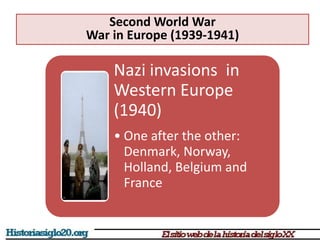
Nazi invasions in
Western Europe
(1940)
• One after the other:
Denmark, Norway,
Holland, Belgium and
France
Second World War
War in Europe (1939-1941)
Second World War
War in Europe (1939-1941)
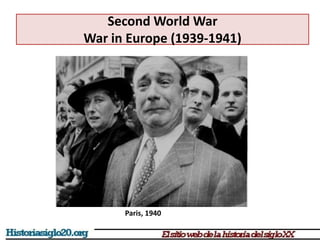
Paris, 1940
Second World War
War in Europe (1939-1941)
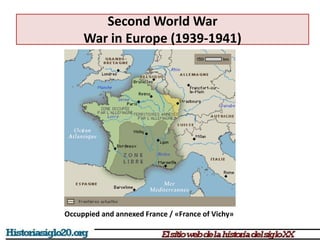
Occuppied and annexed France / «France of Vichy»
Second World War
War in Europe (1939-1941)
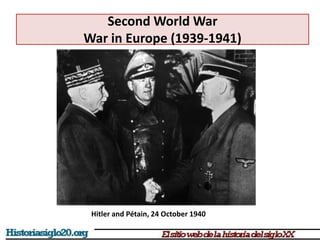
Hitler and Pétain, 24 October 1940
Second World War
War in Europe (1939-1941)
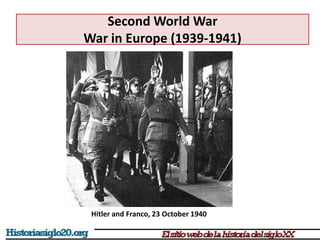
Hitler and Franco, 23 October 1940
Second World War
War in Europe (1939-1941)
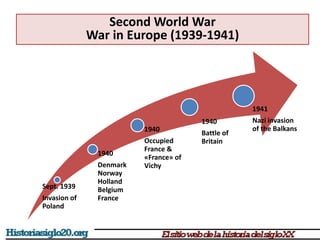
Sept. 1939
Invasion of
Poland
1940
Denmark
Norway
Holland
Belgium
France
1940
Occupied
France &
«France» of
Vichy
1941
Nazi invasion
of the Balkans
1940
Battle of
Britain
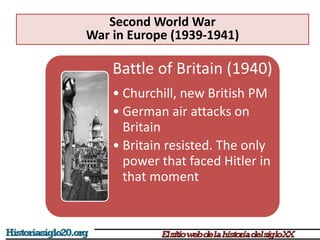
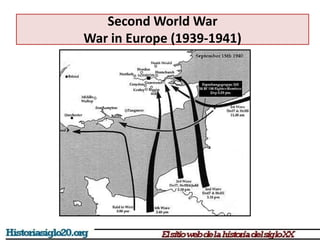
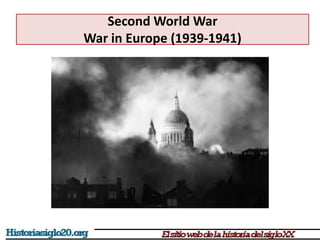
Battle of Britain (1940)
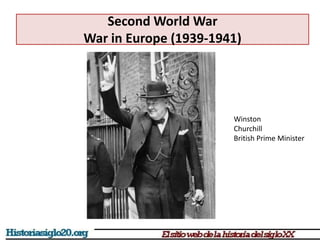
• Churchill, new British PM
• German air attacks on
Britain
• Britain resisted. The only
power that faced Hitler in
that moment
Second World War
War in Europe (1939-1941)
Second World War
War in Europe (1939-1941)
Winston
Churchill
British Prime Minister
Second World War
War in Europe (1939-1941)
Second World War
War in Europe (1939-1941)
Second World War
The turning point (1941)
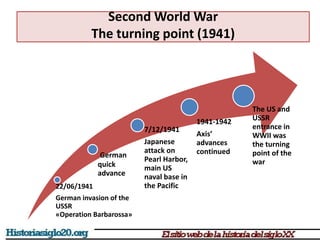
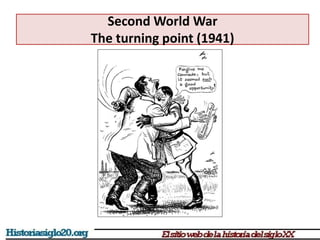
22/06/1941
German invasion of the
USSR
«Operation Barbarossa»
German
quick
advance
7/12/1941
Japanese
attack on
Pearl Harbor,
main US
naval base in
the Pacific
The US and
USSR
entrance in
WWII was
the turning
point of the
war
1941-1942
Axis’
advances
continued
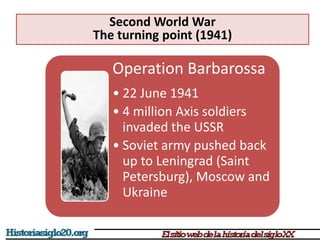
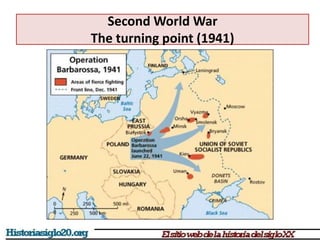
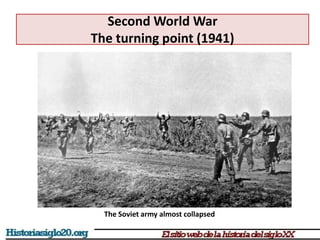
Operation Barbarossa
• 22 June 1941
• 4 million Axis soldiers
invaded the USSR
• Soviet army pushed back
up to Leningrad (Saint
Petersburg), Moscow and
Ukraine
Second World War
The turning point (1941)
Second World War
The turning point (1941)
Second World War
The turning point (1941)
Second World War
The turning point (1941)
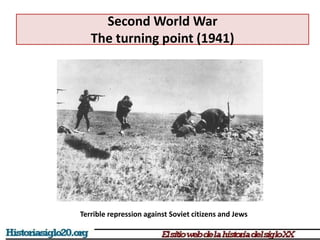
Terrible repression against Soviet citizens and Jews
Second World War
The turning point (1941)
The Soviet army almost collapsed
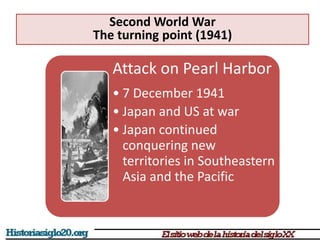
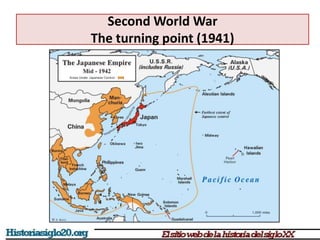
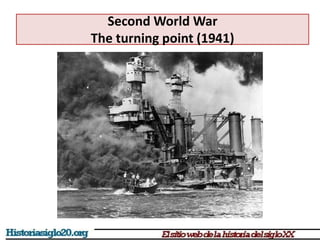
Attack on Pearl Harbor
• 7 December 1941
• Japan and US at war
• Japan continued
conquering new
territories in Southeastern
Asia and the Pacific
Second World War
The turning point (1941)
Second World War
The turning point (1941)
Second World War
The turning point (1941)
Second World War
The turning point (1941)
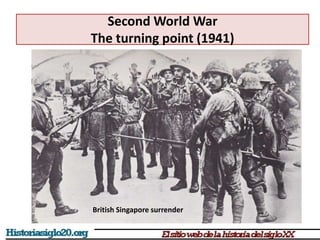
British Singapore surrender
Second World War
The turning point (1941)
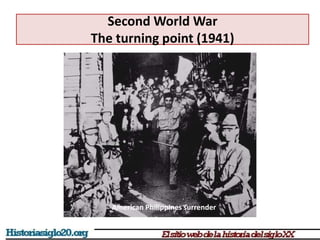
American Philippines surrender
Second World War
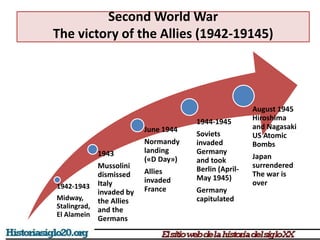
The victory of the Allies (1942-19145)
1942-1943
Midway,
Stalingrad,
El Alamein
1943
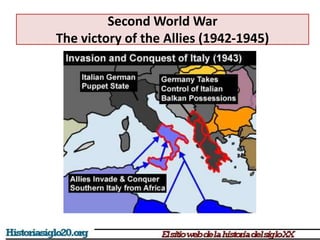
Mussolini
dismissed
Italy
invaded by
the Allies
and the
Germans
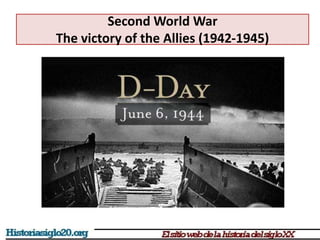
June 1944
Normandy
landing
(«D Day»)
Allies
invaded
France
August 1945
Hiroshima
and Nagasaki
US Atomic
Bombs
Japan
surrendered
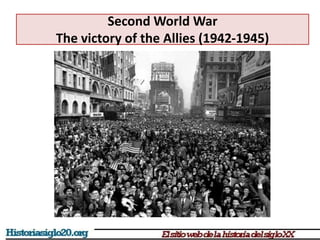
The war is
over
1944-1945
Soviets
invaded
Germany
and took
Berlin (April-
May 1945)
Germany
capitulated
Second World War
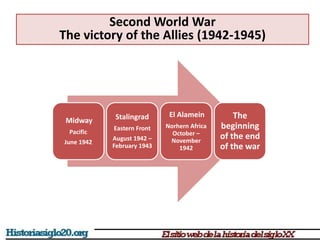
The victory of the Allies (1942-1945)
Midway
Pacific
June 1942
Stalingrad
Eastern Front
August 1942 –
February 1943
El Alamein
Norhern Africa
October –
November
1942
The
beginning
of the end
of the war
Second World War
The victory of the Allies(1942-1945)
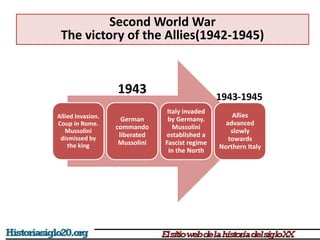
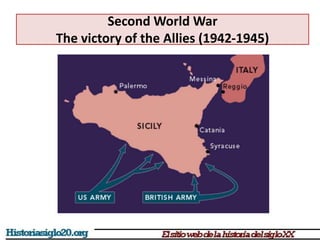
Allied invasion.
Coup in Rome.
Mussolini
dismissed by
the king
German
commando
liberated
Mussolini
Italy invaded
by Germany.
Mussolini
established a
Fascist regime
in the North
Allies
advanced
slowly
towards
Northern Italy
1943 1943-1945
Second World War
The victory of the Allies (1942-1945)
Second World War
The victory of the Allies (1942-1945)
Second World War
The victory of the Allies (1942-1945)
Second World War
The victory of the Allies (1942-1945)
Second World War
The victory of the Allies (1942-1945)
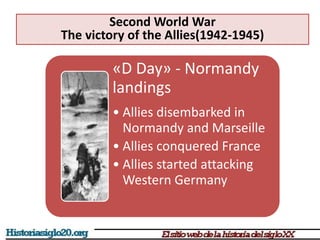
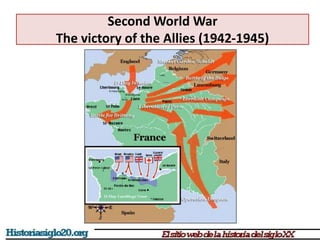
«D Day» - Normandy
landings
• Allies disembarked in
Normandy and Marseille
• Allies conquered France
• Allies started attacking
Western Germany
Second World War
The victory of the Allies(1942-1945)
Second World War
The victory of the Allies (1942-1945)
Second World War
The victory of the Allies (1942-1945)
Second World War
The victory of the Allies (1942-1945)
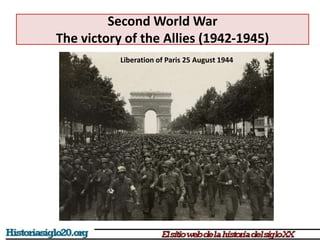
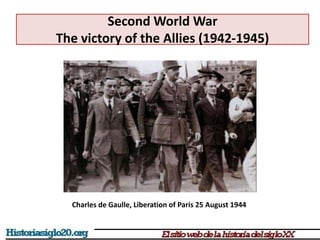
Liberation of Paris 25 August 1944
Second World War
The victory of the Allies (1942-1945)
Charles de Gaulle, Liberation of Paris 25 August 1944
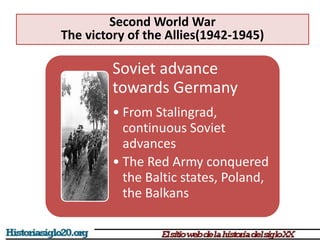
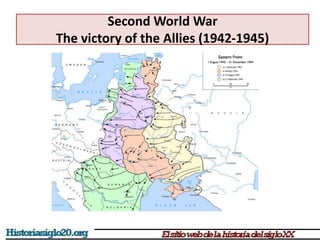
Soviet advance
towards Germany
• From Stalingrad,
continuous Soviet
advances
• The Red Army conquered
the Baltic states, Poland,
the Balkans
Second World War
The victory of the Allies(1942-1945)
Second World War
The victory of the Allies (1942-1945)
Second World War
The victory of the Allies (1942-1945)
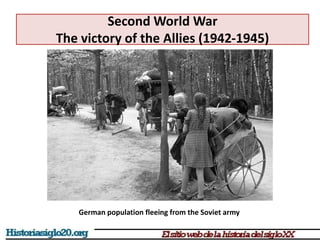
German population fleeing from the Soviet army
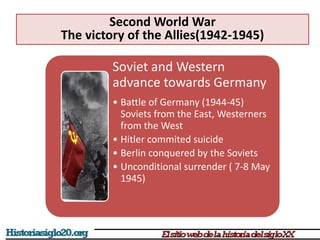
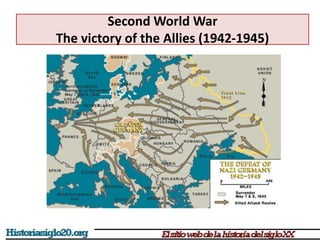
Soviet and Western
advance towards Germany
• Battle of Germany (1944-45)
Soviets from the East, Westerners
from the West
• Hitler commited suicide
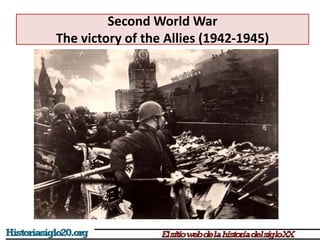
• Berlin conquered by the Soviets
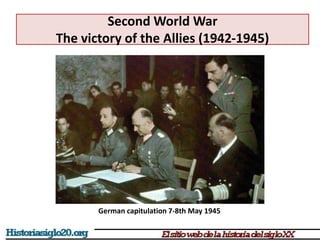
• Unconditional surrender ( 7-8 May
1945)
Second World War
The victory of the Allies(1942-1945)
Second World War
The victory of the Allies (1942-1945)
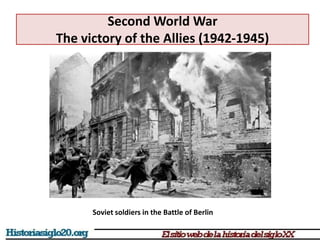
Soviet soldiers in the Battle of Berlin
Second World War
The victory of the Allies (1942-1945)
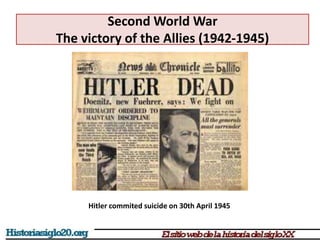
Hitler commited suicide on 30th April 1945
Second World War
The victory of the Allies (1942-1945)
Second World War
The victory of the Allies (1942-1945)
German capitulation 7-8th May 1945
Second World War
The victory of the Allies (1942-1945)
German capitulation 7-8th May 1945
Second World War
The victory of the Allies (1942-1945)
German capitulation 7-8th May 1945
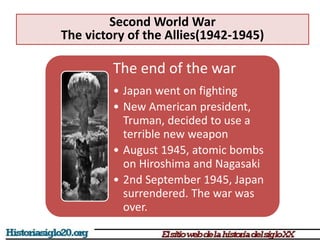
The end of the war
• Japan went on fighting
• New American president,
Truman, decided to use a
terrible new weapon
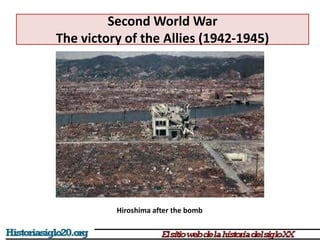
• August 1945, atomic bombs
on Hiroshima and Nagasaki
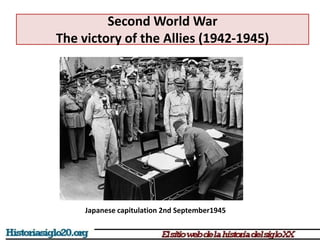
• 2nd September 1945, Japan
surrendered. The war was
over.
Second World War
The victory of the Allies(1942-1945)
Second World War
The victory of the Allies (1942-1945)
Hiroshima after the bomb
Second World War
The victory of the Allies (1942-1945)
Japanese capitulation 2nd September1945
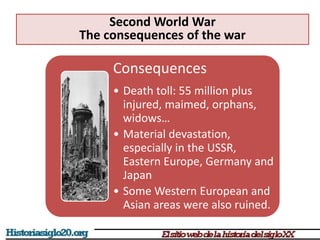
Consequences
• Death toll: 55 million plus
injured, maimed, orphans,
widows…
• Material devastation,
especially in the USSR,
Eastern Europe, Germany and
Japan
• Some Western European and
Asian areas were also ruined.
Second World War
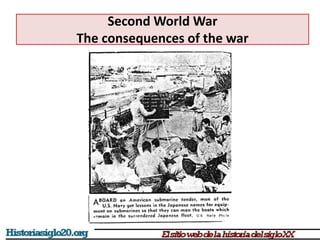
The consequences of the war
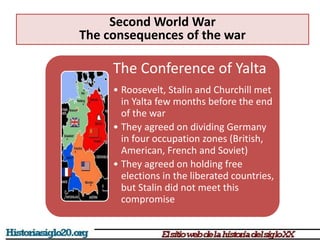
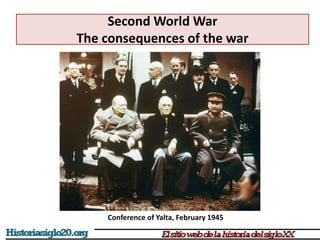
The Conference of Yalta
• Roosevelt, Stalin and Churchill met
in Yalta few months before the end
of the war
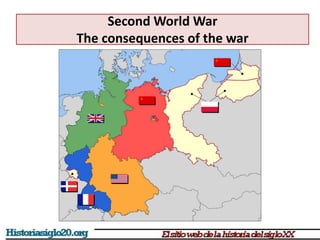
• They agreed on dividing Germany
in four occupation zones (British,
American, French and Soviet)
• They agreed on holding free
elections in the liberated countries,
but Stalin did not meet this
compromise
Second World War
The consequences of the war
Second World War
The consequences of the war
Conference of Yalta, February 1945
Second World War
The consequences of the war
Japanese capitulation 2nd September1945
Second World War
The consequences of the war
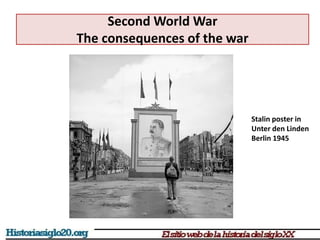
Stalin poster in
Unter den Linden
Berlin 1945
Second World War
The consequences of the war
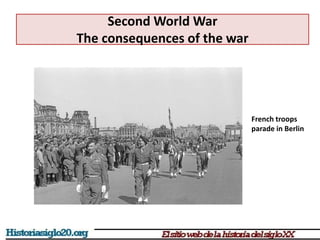
French troops
parade in Berlin
Second World War
The consequences of the war
Second World War
The consequences of the war
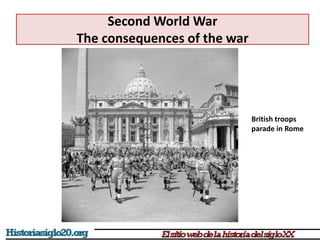
British troops
parade in Rome
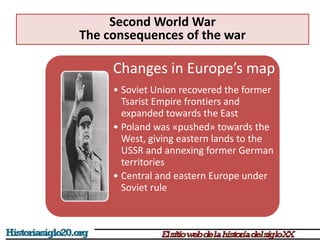
Changes in Europe’s map
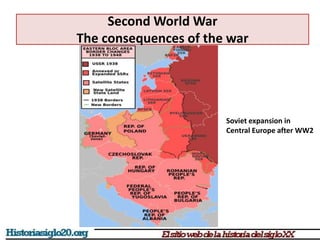
• Soviet Union recovered the former
Tsarist Empire frontiers and
expanded towards the East
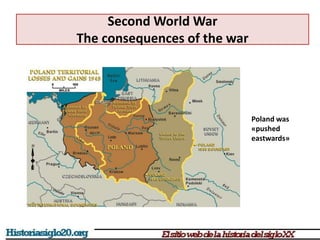
• Poland was «pushed» towards the
West, giving eastern lands to the
USSR and annexing former German
territories
• Central and eastern Europe under
Soviet rule
Second World War
The consequences of the war
Second World War
The consequences of the war
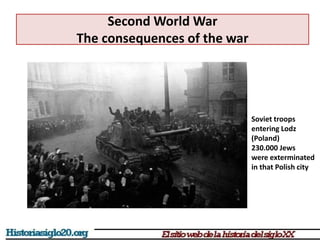
Soviet troops
entering Lodz
(Poland)
230.000 Jews
were exterminated
in that Polish city
Second World War
The consequences of the war
Poland was
«pushed
eastwards»
Second World War
The consequences of the war
Soviet expansion in
Central Europe after WW2
Aftermath of WWII
• Europe, as a continent, was the
great loser
• USA and USSR became the two
«superpowers»
• Cruelty, genocide, atomic bomb…
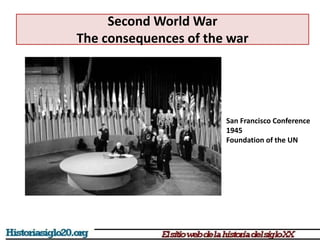
• United Nations were founded in
1945  maintain international
peace and protect human rights
Second World War
The consequences of the war
Second World War
The consequences of the war
San Francisco Conference
1945
Foundation of the UN
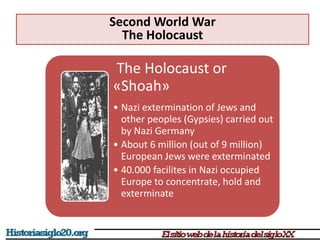
The Holocaust or
«Shoah»
• Nazi extermination of Jews and
other peoples (Gypsies) carried out
by Nazi Germany
• About 6 million (out of 9 million)
European Jews were exterminated
• 40.000 facilites in Nazi occupied
Europe to concentrate, hold and
exterminate
Second World War
The Holocaust
The Holocaust
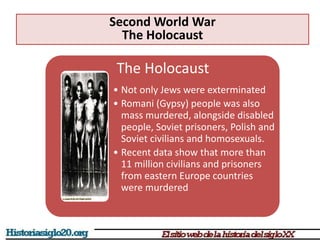
• Not only Jews were exterminated
• Romani (Gypsy) people was also
mass murdered, alongside disabled
people, Soviet prisoners, Polish and
Soviet civilians and homosexuals.
• Recent data show that more than
11 million civilians and prisoners
from eastern Europe countries
were murdered
Second World War
The Holocaust
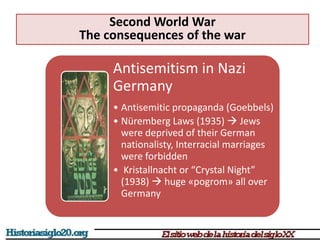
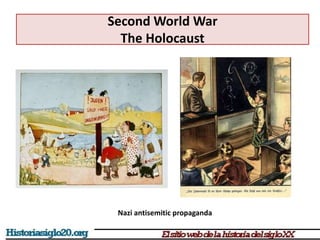
Antisemitism in Nazi
Germany
• Antisemitic propaganda (Goebbels)
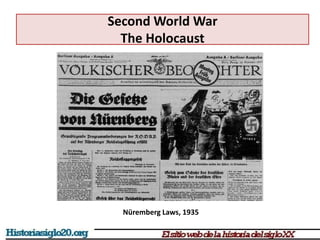
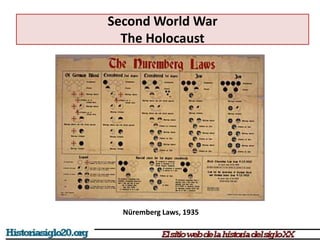
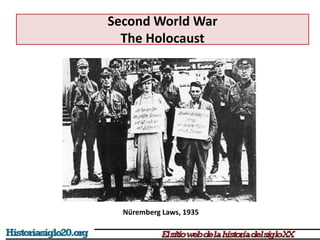
• Nüremberg Laws (1935)  Jews
were deprived of their German
nationalisty, Interracial marriages
were forbidden
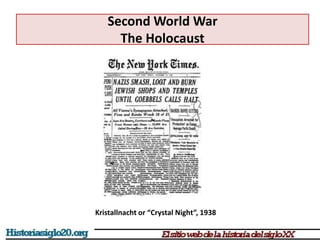
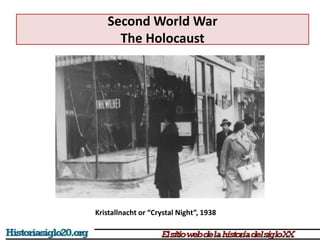
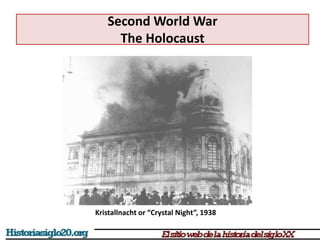
• Kristallnacht or “Crystal Night”
(1938)  huge «pogrom» all over
Germany
Second World War
The consequences of the war
Second World War
The Holocaust
Nüremberg Laws, 1935
Second World War
The Holocaust
Nüremberg Laws, 1935
Second World War
The Holocaust
Nüremberg Laws, 1935
Second World War
The Holocaust
Kristallnacht or “Crystal Night”, 1938
Second World War
The Holocaust
Kristallnacht or “Crystal Night”, 1938
Second World War
The Holocaust
Kristallnacht or “Crystal Night”, 1938
Second World War
The Holocaust
Nazi antisemitic propaganda
The Holocaust in WWII
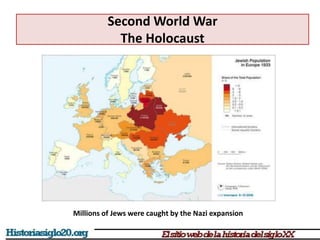
• From 1941 on, Nazis came to
control most of central and eastern
Europe
• Poland, Belarus, Ukraine, the Baltic
states, Russia had important Jewish
minorities that in certain areas
made up the majority of the
population
• Wannsee Conference 1942  Final
solution to the «Jewish Problem»
Second World War
The consequences of the war
Second World War
The Holocaust
Millions of Jews were caught by the Nazi expansion
The Holocaust in WWII
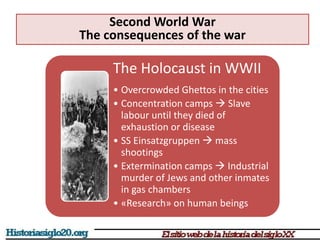
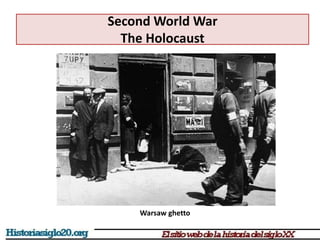
• Overcrowded Ghettos in the cities
• Concentration camps  Slave
labour until they died of
exhaustion or disease
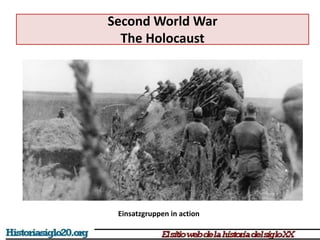
• SS Einsatzgruppen  mass
shootings
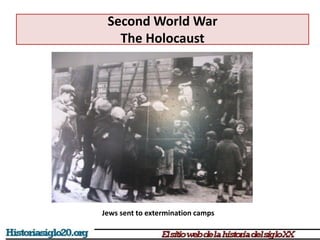
• Extermination camps  Industrial
murder of Jews and other inmates
in gas chambers
• «Research» on human beings
Second World War
The consequences of the war
Second World War
The Holocaust
Warsaw ghetto
Second World War
The Holocaust
Einsatzgruppen in action
Second World War
The Holocaust
Jews sent to extermination camps
Second World War
The Holocaust
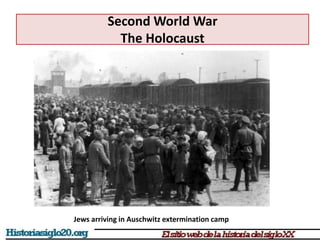
Jews arriving in Auschwitz extermination camp
Second World War
The Holocaust
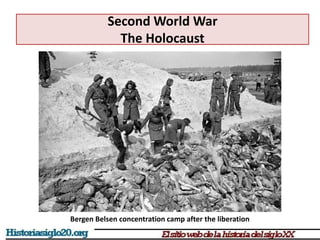
Bergen Belsen concentration camp after the liberation
Second World War
The Holocaust
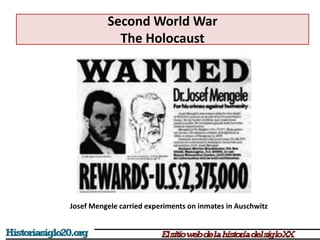
Josef Mengele carried experiments on inmates in Auschwitz

Second World War

  • 1.
    Second World War(1939-1945) Hiroshima, 1945
  • 2.
    Second World War(1939-1945) Combatant powers and features of the war War in Europe (1939-1941) The turning point 1941 The victory of the Allies (1942-1945) The consequences of the war The Jewish Holocaust
  • 3.
    Second World War(1939-1945) Combatant powers YEAR THE ALLIES THE AXIS POWERS 1939 FRANCE, BRITAIN GERMANY 1940 BRITAIN GERMANY, ITALY 1941 1945 BRITAIN, USSR, USA, FRANCE (1945) GERMANY, ITALY (until 1943), JAPAN
  • 4.
    Second World War(1939-1945) Features of the war Genuine world war: Europe, Africa, Asia, the Atlantic, the Pacific, the Mediterranean Sea… More than 100 million soldiers More 800 million civilians suffered Sixty countries were involved in the war
  • 5.
    Second World War(1939-1945) Features of the war Duration of the war • Traditionally, 1939-1945 • Some scholars claim that this idea corresponds with a «Western view of history», for them WWII actually started in 1937 when Japan invaded China • Any way, we will stick to the traditional notion: 1939-1945
  • 6.
    Second World War(1939-1945) Features of the war Totalitarian regimes: atrocities (Jewish and Gypsy holocaust, Soviet prisoners starvation…) Allies: bombing civil population, atomic bombs in Hiroshima and Nagasaki. Sufering of the civil population Deportation: millions of refugees Powerful and sophisticated weapons
  • 7.
    Second World War Warin Europe (1939-1941) Sept. 1939 Invasion of Poland 1940 Denmark Norway Holland Belgium France 1940 Occupied France & «France» of Vichy 1941 Nazi invasion of the Balkans 1940 Battle of Britain
  • 8.
    Invasion of Poland 1939 •German attack, 1/9/1939 • Soviet troops marched into Poland, 17/9/1939 (and the Baltic States later) • October 1939, Poland completely invadid Second World War War in Europe (1939-1941)
  • 9.
    Second World War Warin Europe (1939-1941)
  • 10.
    Second World War Warin Europe (1939-1941) Hitler in Poland
  • 11.
    Second World War Warin Europe (1939-1941) ) «We are going to Poland to trash the Jews»
  • 12.
    Second World War Warin Europe (1939-1941) Sept. 1939 Invasion of Poland 1940 Denmark Norway Holland Belgium France 1940 Occupied France & «France» of Vichy 1941 Nazi invasion of the Balkans 1940 Battle of Britain
  • 13.
    Nazi invasions in WesternEurope (1940) • One after the other: Denmark, Norway, Holland, Belgium and France Second World War War in Europe (1939-1941)
  • 14.
    Second World War Warin Europe (1939-1941) Paris, 1940
  • 15.
    Second World War Warin Europe (1939-1941) Occuppied and annexed France / «France of Vichy»
  • 16.
    Second World War Warin Europe (1939-1941) Hitler and Pétain, 24 October 1940
  • 17.
    Second World War Warin Europe (1939-1941) Hitler and Franco, 23 October 1940
  • 18.
    Second World War Warin Europe (1939-1941) Sept. 1939 Invasion of Poland 1940 Denmark Norway Holland Belgium France 1940 Occupied France & «France» of Vichy 1941 Nazi invasion of the Balkans 1940 Battle of Britain
  • 19.
    Battle of Britain(1940) • Churchill, new British PM • German air attacks on Britain • Britain resisted. The only power that faced Hitler in that moment Second World War War in Europe (1939-1941)
  • 20.
    Second World War Warin Europe (1939-1941) Winston Churchill British Prime Minister
  • 21.
    Second World War Warin Europe (1939-1941)
  • 22.
    Second World War Warin Europe (1939-1941)
  • 23.
    Second World War Theturning point (1941) 22/06/1941 German invasion of the USSR «Operation Barbarossa» German quick advance 7/12/1941 Japanese attack on Pearl Harbor, main US naval base in the Pacific The US and USSR entrance in WWII was the turning point of the war 1941-1942 Axis’ advances continued
  • 24.
    Operation Barbarossa • 22June 1941 • 4 million Axis soldiers invaded the USSR • Soviet army pushed back up to Leningrad (Saint Petersburg), Moscow and Ukraine Second World War The turning point (1941)
  • 25.
    Second World War Theturning point (1941)
  • 26.
    Second World War Theturning point (1941)
  • 27.
    Second World War Theturning point (1941) Terrible repression against Soviet citizens and Jews
  • 28.
    Second World War Theturning point (1941) The Soviet army almost collapsed
  • 29.
    Attack on PearlHarbor • 7 December 1941 • Japan and US at war • Japan continued conquering new territories in Southeastern Asia and the Pacific Second World War The turning point (1941)
  • 30.
    Second World War Theturning point (1941)
  • 31.
    Second World War Theturning point (1941)
  • 32.
    Second World War Theturning point (1941) British Singapore surrender
  • 33.
    Second World War Theturning point (1941) American Philippines surrender
  • 34.
    Second World War Thevictory of the Allies (1942-19145) 1942-1943 Midway, Stalingrad, El Alamein 1943 Mussolini dismissed Italy invaded by the Allies and the Germans June 1944 Normandy landing («D Day») Allies invaded France August 1945 Hiroshima and Nagasaki US Atomic Bombs Japan surrendered The war is over 1944-1945 Soviets invaded Germany and took Berlin (April- May 1945) Germany capitulated
  • 35.
    Second World War Thevictory of the Allies (1942-1945) Midway Pacific June 1942 Stalingrad Eastern Front August 1942 – February 1943 El Alamein Norhern Africa October – November 1942 The beginning of the end of the war
  • 36.
    Second World War Thevictory of the Allies(1942-1945) Allied invasion. Coup in Rome. Mussolini dismissed by the king German commando liberated Mussolini Italy invaded by Germany. Mussolini established a Fascist regime in the North Allies advanced slowly towards Northern Italy 1943 1943-1945
  • 37.
    Second World War Thevictory of the Allies (1942-1945)
  • 38.
    Second World War Thevictory of the Allies (1942-1945)
  • 39.
    Second World War Thevictory of the Allies (1942-1945)
  • 40.
    Second World War Thevictory of the Allies (1942-1945)
  • 41.
    Second World War Thevictory of the Allies (1942-1945)
  • 42.
    «D Day» -Normandy landings • Allies disembarked in Normandy and Marseille • Allies conquered France • Allies started attacking Western Germany Second World War The victory of the Allies(1942-1945)
  • 43.
    Second World War Thevictory of the Allies (1942-1945)
  • 44.
    Second World War Thevictory of the Allies (1942-1945)
  • 45.
    Second World War Thevictory of the Allies (1942-1945) Liberation of Paris 25 August 1944
  • 46.
    Second World War Thevictory of the Allies (1942-1945) Charles de Gaulle, Liberation of Paris 25 August 1944
  • 47.
    Soviet advance towards Germany •From Stalingrad, continuous Soviet advances • The Red Army conquered the Baltic states, Poland, the Balkans Second World War The victory of the Allies(1942-1945)
  • 48.
    Second World War Thevictory of the Allies (1942-1945)
  • 49.
    Second World War Thevictory of the Allies (1942-1945) German population fleeing from the Soviet army
  • 50.
    Soviet and Western advancetowards Germany • Battle of Germany (1944-45) Soviets from the East, Westerners from the West • Hitler commited suicide • Berlin conquered by the Soviets • Unconditional surrender ( 7-8 May 1945) Second World War The victory of the Allies(1942-1945)
  • 51.
    Second World War Thevictory of the Allies (1942-1945) Soviet soldiers in the Battle of Berlin
  • 52.
    Second World War Thevictory of the Allies (1942-1945) Hitler commited suicide on 30th April 1945
  • 53.
    Second World War Thevictory of the Allies (1942-1945)
  • 54.
    Second World War Thevictory of the Allies (1942-1945) German capitulation 7-8th May 1945
  • 55.
    Second World War Thevictory of the Allies (1942-1945) German capitulation 7-8th May 1945
  • 56.
    Second World War Thevictory of the Allies (1942-1945) German capitulation 7-8th May 1945
  • 57.
    The end ofthe war • Japan went on fighting • New American president, Truman, decided to use a terrible new weapon • August 1945, atomic bombs on Hiroshima and Nagasaki • 2nd September 1945, Japan surrendered. The war was over. Second World War The victory of the Allies(1942-1945)
  • 58.
    Second World War Thevictory of the Allies (1942-1945) Hiroshima after the bomb
  • 59.
    Second World War Thevictory of the Allies (1942-1945) Japanese capitulation 2nd September1945
  • 60.
    Consequences • Death toll:55 million plus injured, maimed, orphans, widows… • Material devastation, especially in the USSR, Eastern Europe, Germany and Japan • Some Western European and Asian areas were also ruined. Second World War The consequences of the war
  • 61.
    The Conference ofYalta • Roosevelt, Stalin and Churchill met in Yalta few months before the end of the war • They agreed on dividing Germany in four occupation zones (British, American, French and Soviet) • They agreed on holding free elections in the liberated countries, but Stalin did not meet this compromise Second World War The consequences of the war
  • 62.
    Second World War Theconsequences of the war Conference of Yalta, February 1945
  • 63.
    Second World War Theconsequences of the war Japanese capitulation 2nd September1945
  • 64.
    Second World War Theconsequences of the war Stalin poster in Unter den Linden Berlin 1945
  • 65.
    Second World War Theconsequences of the war French troops parade in Berlin
  • 66.
    Second World War Theconsequences of the war
  • 67.
    Second World War Theconsequences of the war British troops parade in Rome
  • 68.
    Changes in Europe’smap • Soviet Union recovered the former Tsarist Empire frontiers and expanded towards the East • Poland was «pushed» towards the West, giving eastern lands to the USSR and annexing former German territories • Central and eastern Europe under Soviet rule Second World War The consequences of the war
  • 69.
    Second World War Theconsequences of the war Soviet troops entering Lodz (Poland) 230.000 Jews were exterminated in that Polish city
  • 70.
    Second World War Theconsequences of the war Poland was «pushed eastwards»
  • 71.
    Second World War Theconsequences of the war Soviet expansion in Central Europe after WW2
  • 72.
    Aftermath of WWII •Europe, as a continent, was the great loser • USA and USSR became the two «superpowers» • Cruelty, genocide, atomic bomb… • United Nations were founded in 1945  maintain international peace and protect human rights Second World War The consequences of the war
  • 73.
    Second World War Theconsequences of the war San Francisco Conference 1945 Foundation of the UN
  • 74.
    The Holocaust or «Shoah» •Nazi extermination of Jews and other peoples (Gypsies) carried out by Nazi Germany • About 6 million (out of 9 million) European Jews were exterminated • 40.000 facilites in Nazi occupied Europe to concentrate, hold and exterminate Second World War The Holocaust
  • 75.
    The Holocaust • Notonly Jews were exterminated • Romani (Gypsy) people was also mass murdered, alongside disabled people, Soviet prisoners, Polish and Soviet civilians and homosexuals. • Recent data show that more than 11 million civilians and prisoners from eastern Europe countries were murdered Second World War The Holocaust
  • 76.
    Antisemitism in Nazi Germany •Antisemitic propaganda (Goebbels) • Nüremberg Laws (1935)  Jews were deprived of their German nationalisty, Interracial marriages were forbidden • Kristallnacht or “Crystal Night” (1938)  huge «pogrom» all over Germany Second World War The consequences of the war
  • 77.
    Second World War TheHolocaust Nüremberg Laws, 1935
  • 78.
    Second World War TheHolocaust Nüremberg Laws, 1935
  • 79.
    Second World War TheHolocaust Nüremberg Laws, 1935
  • 80.
    Second World War TheHolocaust Kristallnacht or “Crystal Night”, 1938
  • 81.
    Second World War TheHolocaust Kristallnacht or “Crystal Night”, 1938
  • 82.
    Second World War TheHolocaust Kristallnacht or “Crystal Night”, 1938
  • 83.
    Second World War TheHolocaust Nazi antisemitic propaganda
  • 84.
    The Holocaust inWWII • From 1941 on, Nazis came to control most of central and eastern Europe • Poland, Belarus, Ukraine, the Baltic states, Russia had important Jewish minorities that in certain areas made up the majority of the population • Wannsee Conference 1942  Final solution to the «Jewish Problem» Second World War The consequences of the war
  • 85.
    Second World War TheHolocaust Millions of Jews were caught by the Nazi expansion
  • 86.
    The Holocaust inWWII • Overcrowded Ghettos in the cities • Concentration camps  Slave labour until they died of exhaustion or disease • SS Einsatzgruppen  mass shootings • Extermination camps  Industrial murder of Jews and other inmates in gas chambers • «Research» on human beings Second World War The consequences of the war
  • 87.
    Second World War TheHolocaust Warsaw ghetto
  • 88.
    Second World War TheHolocaust Einsatzgruppen in action
  • 89.
    Second World War TheHolocaust Jews sent to extermination camps
  • 90.
    Second World War TheHolocaust Jews arriving in Auschwitz extermination camp
  • 91.
    Second World War TheHolocaust Bergen Belsen concentration camp after the liberation
  • 92.
    Second World War TheHolocaust Josef Mengele carried experiments on inmates in Auschwitz