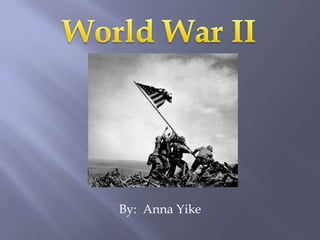
World War IIBy:  Anna Yike
Questions to PonderHow do world leaders influence international politics?What factors influenced the US decision to become involved in WWII?What are some similarities and dissimilarities between the war in Europe and the war in the Pacific?How did private civilian leadership influence the development of the atom bomb? How did the Treaty of Versailles define the peace settlements post WW II and how are modern nations still influenced by these terms of peace?
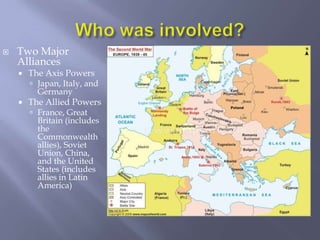
Who was involved?Two Major AlliancesThe Axis PowersJapan, Italy, and GermanyThe Allied PowersFrance, Great Britain (includes the Commonwealth allies), Soviet Union, China, and the United States (includes allies in Latin America)
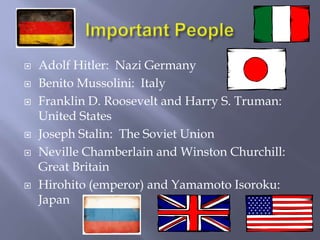
Important PeopleAdolf Hitler:  Nazi GermanyBenito Mussolini:  ItalyFranklin D. Roosevelt and Harry S. Truman:  United StatesJoseph Stalin:  The Soviet UnionNeville Chamberlain and Winston Churchill:  Great BritainHirohito (emperor) and Yamamoto Isoroku:  Japan
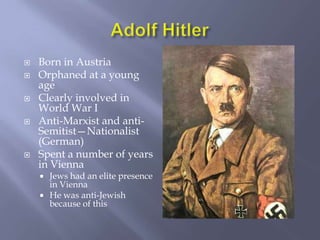
Adolf HitlerBorn in AustriaOrphaned at a young ageClearly involved in World War IAnti-Marxist and anti-Semitist—Nationalist (German)Spent a number of years in ViennaJews had an elite presence in ViennaHe was anti-Jewish because of this
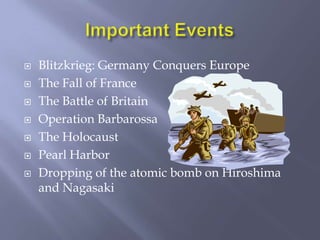
Important EventsBlitzkrieg: Germany Conquers EuropeThe Fall of FranceThe Battle of BritainOperation BarbarossaThe HolocaustPearl HarborDropping of the atomic bomb on Hiroshima and Nagasaki
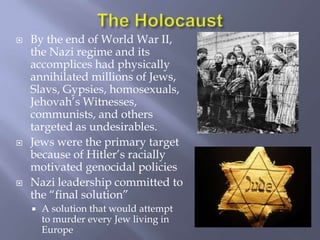
The HolocaustBy the end of World War II, the Nazi regime and its accomplices had physically annihilated millions of Jews, Slavs, Gypsies, homosexuals, Jehovah’s Witnesses, communists, and others targeted as undesirables.Jews were the primary target because of Hitler’s racially motivated genocidal policiesNazi leadership committed to the “final solution”A solution that would attempt to murder every Jew living in Europe
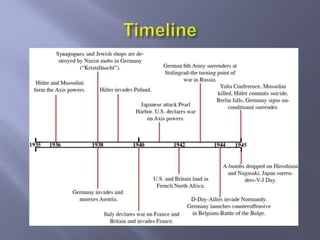
Allied Victory in EuropeBy 1943, German forces in Russia lost momentum and faced bleak prospects as the Soviets retook territory.Moscow never fell.The battle for Stalingrad ended in February 1943. This marked the first large-scale victory for Soviet forces.British and U.S. forces attacked the Germans from north Africa and then through Italy.In August 1944 the Allies forced Italy to withdraw from the Axis and to join them. On D-Day (June 6, 1944), British and U.S. troops landed on the French coast of Normandy, overwhelming the Germans.On May 8, 1945, Germany was forced to unconditional surrender.
Timeline

World War II Power Point #1

  • 1.
    World War IIBy: Anna Yike
  • 2.
    Questions to PonderHowdo world leaders influence international politics?What factors influenced the US decision to become involved in WWII?What are some similarities and dissimilarities between the war in Europe and the war in the Pacific?How did private civilian leadership influence the development of the atom bomb? How did the Treaty of Versailles define the peace settlements post WW II and how are modern nations still influenced by these terms of peace?
  • 3.
    Who was involved?TwoMajor AlliancesThe Axis PowersJapan, Italy, and GermanyThe Allied PowersFrance, Great Britain (includes the Commonwealth allies), Soviet Union, China, and the United States (includes allies in Latin America)
  • 4.
    Important PeopleAdolf Hitler: Nazi GermanyBenito Mussolini: ItalyFranklin D. Roosevelt and Harry S. Truman: United StatesJoseph Stalin: The Soviet UnionNeville Chamberlain and Winston Churchill: Great BritainHirohito (emperor) and Yamamoto Isoroku: Japan
  • 5.
    Adolf HitlerBorn inAustriaOrphaned at a young ageClearly involved in World War IAnti-Marxist and anti-Semitist—Nationalist (German)Spent a number of years in ViennaJews had an elite presence in ViennaHe was anti-Jewish because of this
  • 6.
    Important EventsBlitzkrieg: GermanyConquers EuropeThe Fall of FranceThe Battle of BritainOperation BarbarossaThe HolocaustPearl HarborDropping of the atomic bomb on Hiroshima and Nagasaki
  • 7.
    The HolocaustBy theend of World War II, the Nazi regime and its accomplices had physically annihilated millions of Jews, Slavs, Gypsies, homosexuals, Jehovah’s Witnesses, communists, and others targeted as undesirables.Jews were the primary target because of Hitler’s racially motivated genocidal policiesNazi leadership committed to the “final solution”A solution that would attempt to murder every Jew living in Europe
  • 8.
    Allied Victory inEuropeBy 1943, German forces in Russia lost momentum and faced bleak prospects as the Soviets retook territory.Moscow never fell.The battle for Stalingrad ended in February 1943. This marked the first large-scale victory for Soviet forces.British and U.S. forces attacked the Germans from north Africa and then through Italy.In August 1944 the Allies forced Italy to withdraw from the Axis and to join them. On D-Day (June 6, 1944), British and U.S. troops landed on the French coast of Normandy, overwhelming the Germans.On May 8, 1945, Germany was forced to unconditional surrender.
  • 9.