
World Class Manufacturing
By
Deepti Anand     (066)
Rahul Hedau      (073)
Amit Sharma      (080)
Shilpa Sharma     (087)
Komal Sachan      (094)
Kanad Kale        (101)
Manisha Mishra    (108)
Ritika Mittal     (115)
Tushar Mehta      (122)
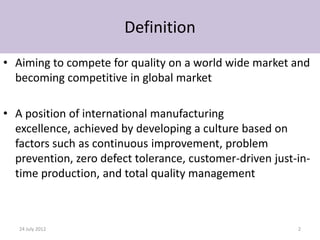
Definition
• Aiming to compete for quality on a world wide market and
  becoming competitive in global market

• A position of international manufacturing
  excellence, achieved by developing a culture based on
  factors such as continuous improvement, problem
  prevention, zero defect tolerance, customer-driven just-in-
  time production, and total quality management


   24 July 2012                                           2
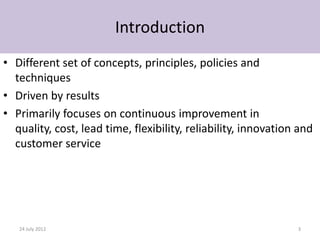
Introduction
• Different set of concepts, principles, policies and
  techniques
• Driven by results
• Primarily focuses on continuous improvement in
  quality, cost, lead time, flexibility, reliability, innovation and
  customer service


   24 July 2012                                                 3
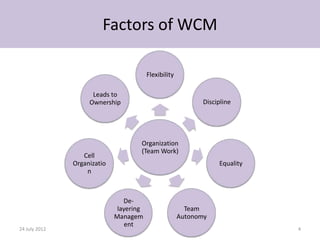
Factors of WCM

                                         Flexibility

                     Leads to
                    Ownership                                 Discipline


                                     Organization
                                     (Team Work)
                  Cell
               Organizatio                                         Equality
                   n


                                De-
                              layering                   Team
                             Managem                   Autonomy
                                 ent
24 July 2012                                                                  4
Check Points for WCM (Contd…)
• Timely delivery
• Knowledge of key customers and competitors
• Authority and empowerment to staff
• Elimination of central storage of direct materials and supply
  of purchased material to the point of use without routine
  inspection
• Training and development of existing employees


    24 July 2012                                           5
Check Points for WCM (Contd…)
• Reduction of set - up time and economical batch sizes
• Active policy to help keep work areas clean, tidy and
  uncluttered
• Culture of continuous improvement in customer service
• Mechanism to quickly and effectively receive and evaluate
  suggestions from all employees


  24 July 2012                                          6
Objectives of Global Production
•   Reduce costs ( labor, taxes, tariffs etc.)
•   Reduce risks ( foreign exchange)
•   Improve supply chain
•   Provide better goods and services
•   Attract new markets
•   Learn to improve operations
•   Attract and retain global talent


    24 July 2012                                 7
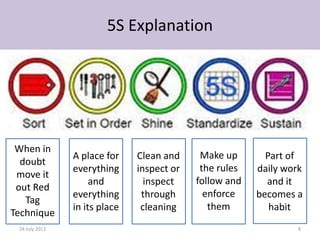
5S Explanation


 When in
                A place for    Clean and     Make up       Part of
  doubt
                everything     inspect or    the rules   daily work
 move it
                     and         inspect    follow and     and it
 out Red
                everything      through       enforce    becomes a
   Tag
                in its place    cleaning       them         habit
Technique
 24 July 2012                                                    8
Kaizen
• Continuous improvement involving everyone
• Business strategy involves working together to make
  improvements without large capital investments
• Setting doable, replicable standards and then continually
  improving those standards
• It is not all about incentives and rewards—it is about the
  support given to front-liners to help them improve the way
  work is done


  24 July 2012                                           9
Lean Manufacturing (Contd...)
• Lean Manufacturing is a Team Based continuous
  improvement process designed for long term maximization
  of company resources
• Lean Manufacturing is an approach to achieve
  manufacturing excellence based upon the continuous
  elimination of waste
• Waste is defined as activities that do not add value to the
  product


  24 July 2012                                           10
Lean Manufacturing (Contd...)
• Lean Manufacturing utilizes techniques and principles that
  improve efficiencies of value added activities
• Value Added Activities : Transform raw materials and
  information into parts or products
• Non - Value Added Activities : Consume resources that do
  not contribute to the physical changes of the product


  24 July 2012                                          11
7 Wastes
•   Over production
•   Waiting
•   Transportation
•   Unnecessary inventory
•   Inappropriate processing
•   Excess motion
•   Defects


    24 July 2012                    12
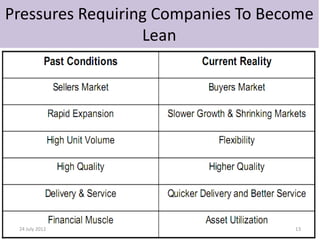
Pressures Requiring Companies To Become
                  Lean


 24 July 2012                       13
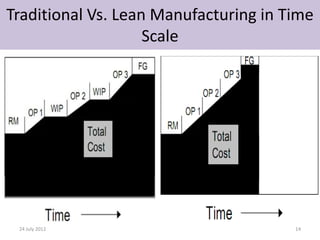
Traditional Vs. Lean Manufacturing in Time
                    Scale


 24 July 2012                          14
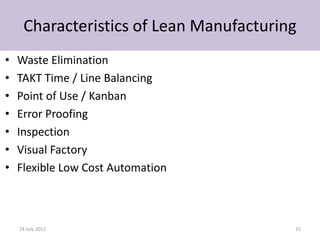
Characteristics of Lean Manufacturing
•   Waste Elimination
•   TAKT Time / Line Balancing
•   Point of Use / Kanban
•   Error Proofing
•   Inspection
•   Visual Factory
•   Flexible Low Cost Automation


    24 July 2012                         15
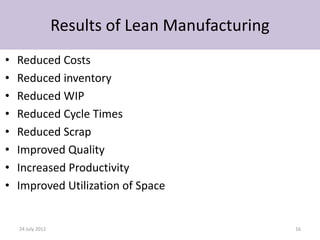
Results of Lean Manufacturing
•   Reduced Costs
•   Reduced inventory
•   Reduced WIP
•   Reduced Cycle Times
•   Reduced Scrap
•   Improved Quality
•   Increased Productivity
•   Improved Utilization of Space


    24 July 2012                                   16
Flexible Manufacturing
• Manufacturing system which allows flexibility into the
  system to respond to changes.
• Two types
  - Machine Flexibility
  - Routing Flexibility


  24 July 2012                                             17
Advantages and Disadvantages of FM
 Advantages
• Reduced manufacturing time
• Lower cost per unit produced
• Greater labor productivity
• Greater machine efficiency
• Improved quality
• Increased system reliability
Disadvantages
• Cost to implement
• Substantial pre-planning required
   24 July 2012                          18
Just In Time Manufacturing
• Just in Time manufacturing is a systems approach to
  developing and operating a manufacturing system
• JIT means making what the market wants, when it wants it.
• JIT has been found to be so effective that it increases
  productivity, work performance and product quality, while
  saving costs


  24 July 2012                                         19
Just In Time Characteristics
•   Accurate demand forecast
•   Low inventories
•   Small lot sizes
•   Quick / low cost setups
•   Multifunctional workers
•   Reliable vendors
•   Problem Solving
•   Continuous improvement


    24 July 2012                                  20
How does implementing WCM improve
            productivity


24 July 2012                    21
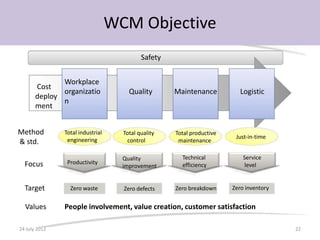
WCM Objective
                                           Safety


              Workplace
       Cost
              organizatio             Quality         Maintenance           Logistic
       deploy
              n
       ment


Method         Total industrial              Method
                                    Total quality     Total productive
                                                                          Just‐in‐time
& std.          engineering          control & std.    maintenance

                                    Quality             Technical            Service
  Focus         Productivity                            efficiency           level
                                    improvement


  Target         Zero waste         Zero defects      Zero breakdown     Zero inventory


  Values       People involvement, value creation, customer satisfaction

24 July 2012                                                                              22
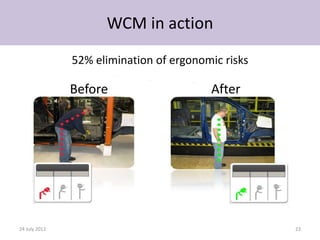
WCM in action
               52% elimination of ergonomic risks

               Before                    After


24 July 2012                                        23
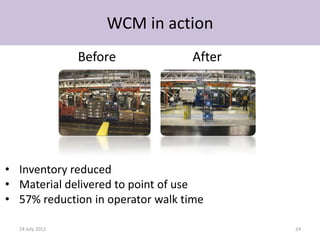
WCM in action
                 Before           After


• Inventory reduced
• Material delivered to point of use
• 57% reduction in operator walk time

  24 July 2012                            24
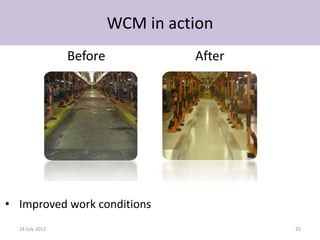
WCM in action
                 Before             After


• Improved work conditions
  24 July 2012                              25
Kanban
• Meaning – Signboard is a concept related to lean and just-
  in-time (JIT) production
• Kanban is one means through which JIT is achieved
• Kanban cards are a key component of Kanban that uses
  cards to signal the need to move materials within a
  manufacturing or production facility or move materials
  from an outside supplier to the production facility


  24 July 2012                                         26
Indian Scenario
• TVS Motors
  – A leading two-wheeler manufacturer
  – Winner of the top quality award -Deming award

• Tata Motors
  – Acquiring Daewoo Motors-truck manufacturing in South Korea


  24 July 2012                                              27
Indian Scenario
• Reliance Group
  – Acquired Flag Telecom of USA
  – One of the largest refining capacities in the world
  – Second biggest producer of polyester fiber in the world-expecting
    to buy out Australia’s largest polyethylene maker Quenos to
    become the largest global player


  24 July 2012                                                  28
Indian Scenario

• Aditya Birla group
  – Acquisition of copper mines in Australia
   – Acquisition of Liaoning Black plant in China
   – Acquisition of cement business from L&T makes them 8th
     largest in the world


   24 July 2012                                               29
Bibliography

• http://www.smthacker.co.uk/world_class_manufactu
  ring.htm
• http://world-class-manufacturing.com
• http://www.leanrapid.com/manufacturing/world_cla
  ss.asp
• http://en.wikipedia.org/wiki/Lean_manufacturing
• http://www.chrysler.com/en/


  24 July 2012                                       30
Thank You


24 July 2012               31

World class manufacturing (wcm)

  • 1.
    World Class Manufacturing By DeeptiAnand (066) Rahul Hedau (073) Amit Sharma (080) Shilpa Sharma (087) Komal Sachan (094) Kanad Kale (101) Manisha Mishra (108) Ritika Mittal (115) Tushar Mehta (122)
  • 2.
    Definition • Aiming tocompete for quality on a world wide market and becoming competitive in global market • A position of international manufacturing excellence, achieved by developing a culture based on factors such as continuous improvement, problem prevention, zero defect tolerance, customer-driven just-in- time production, and total quality management 24 July 2012 2
  • 3.
    Introduction • Different setof concepts, principles, policies and techniques • Driven by results • Primarily focuses on continuous improvement in quality, cost, lead time, flexibility, reliability, innovation and customer service 24 July 2012 3
  • 4.
    Factors of WCM Flexibility Leads to Ownership Discipline Organization (Team Work) Cell Organizatio Equality n De- layering Team Managem Autonomy ent 24 July 2012 4
  • 5.
    Check Points forWCM (Contd…) • Timely delivery • Knowledge of key customers and competitors • Authority and empowerment to staff • Elimination of central storage of direct materials and supply of purchased material to the point of use without routine inspection • Training and development of existing employees 24 July 2012 5
  • 6.
    Check Points forWCM (Contd…) • Reduction of set - up time and economical batch sizes • Active policy to help keep work areas clean, tidy and uncluttered • Culture of continuous improvement in customer service • Mechanism to quickly and effectively receive and evaluate suggestions from all employees 24 July 2012 6
  • 7.
    Objectives of GlobalProduction • Reduce costs ( labor, taxes, tariffs etc.) • Reduce risks ( foreign exchange) • Improve supply chain • Provide better goods and services • Attract new markets • Learn to improve operations • Attract and retain global talent 24 July 2012 7
  • 8.
    5S Explanation Whenin A place for Clean and Make up Part of doubt everything inspect or the rules daily work move it and inspect follow and and it out Red everything through enforce becomes a Tag in its place cleaning them habit Technique 24 July 2012 8
  • 9.
    Kaizen • Continuous improvementinvolving everyone • Business strategy involves working together to make improvements without large capital investments • Setting doable, replicable standards and then continually improving those standards • It is not all about incentives and rewards—it is about the support given to front-liners to help them improve the way work is done 24 July 2012 9
  • 10.
    Lean Manufacturing (Contd...) •Lean Manufacturing is a Team Based continuous improvement process designed for long term maximization of company resources • Lean Manufacturing is an approach to achieve manufacturing excellence based upon the continuous elimination of waste • Waste is defined as activities that do not add value to the product 24 July 2012 10
  • 11.
    Lean Manufacturing (Contd...) •Lean Manufacturing utilizes techniques and principles that improve efficiencies of value added activities • Value Added Activities : Transform raw materials and information into parts or products • Non - Value Added Activities : Consume resources that do not contribute to the physical changes of the product 24 July 2012 11
  • 12.
    7 Wastes • Over production • Waiting • Transportation • Unnecessary inventory • Inappropriate processing • Excess motion • Defects 24 July 2012 12
  • 13.
    Pressures Requiring CompaniesTo Become Lean 24 July 2012 13
  • 14.
    Traditional Vs. LeanManufacturing in Time Scale 24 July 2012 14
  • 15.
    Characteristics of LeanManufacturing • Waste Elimination • TAKT Time / Line Balancing • Point of Use / Kanban • Error Proofing • Inspection • Visual Factory • Flexible Low Cost Automation 24 July 2012 15
  • 16.
    Results of LeanManufacturing • Reduced Costs • Reduced inventory • Reduced WIP • Reduced Cycle Times • Reduced Scrap • Improved Quality • Increased Productivity • Improved Utilization of Space 24 July 2012 16
  • 17.
    Flexible Manufacturing • Manufacturingsystem which allows flexibility into the system to respond to changes. • Two types - Machine Flexibility - Routing Flexibility 24 July 2012 17
  • 18.
    Advantages and Disadvantagesof FM Advantages • Reduced manufacturing time • Lower cost per unit produced • Greater labor productivity • Greater machine efficiency • Improved quality • Increased system reliability Disadvantages • Cost to implement • Substantial pre-planning required 24 July 2012 18
  • 19.
    Just In TimeManufacturing • Just in Time manufacturing is a systems approach to developing and operating a manufacturing system • JIT means making what the market wants, when it wants it. • JIT has been found to be so effective that it increases productivity, work performance and product quality, while saving costs 24 July 2012 19
  • 20.
    Just In TimeCharacteristics • Accurate demand forecast • Low inventories • Small lot sizes • Quick / low cost setups • Multifunctional workers • Reliable vendors • Problem Solving • Continuous improvement 24 July 2012 20
  • 21.
    How does implementingWCM improve productivity 24 July 2012 21
  • 22.
    WCM Objective Safety Workplace Cost organizatio Quality Maintenance Logistic deploy n ment Method Total industrial Method Total quality Total productive Just‐in‐time & std. engineering control & std. maintenance Quality Technical Service Focus Productivity efficiency level improvement Target Zero waste Zero defects Zero breakdown Zero inventory Values People involvement, value creation, customer satisfaction 24 July 2012 22
  • 23.
    WCM in action 52% elimination of ergonomic risks Before After 24 July 2012 23
  • 24.
    WCM in action Before After • Inventory reduced • Material delivered to point of use • 57% reduction in operator walk time 24 July 2012 24
  • 25.
    WCM in action Before After • Improved work conditions 24 July 2012 25
  • 26.
    Kanban • Meaning –Signboard is a concept related to lean and just- in-time (JIT) production • Kanban is one means through which JIT is achieved • Kanban cards are a key component of Kanban that uses cards to signal the need to move materials within a manufacturing or production facility or move materials from an outside supplier to the production facility 24 July 2012 26
  • 27.
    Indian Scenario • TVSMotors – A leading two-wheeler manufacturer – Winner of the top quality award -Deming award • Tata Motors – Acquiring Daewoo Motors-truck manufacturing in South Korea 24 July 2012 27
  • 28.
    Indian Scenario • RelianceGroup – Acquired Flag Telecom of USA – One of the largest refining capacities in the world – Second biggest producer of polyester fiber in the world-expecting to buy out Australia’s largest polyethylene maker Quenos to become the largest global player 24 July 2012 28
  • 29.
    Indian Scenario • AdityaBirla group – Acquisition of copper mines in Australia – Acquisition of Liaoning Black plant in China – Acquisition of cement business from L&T makes them 8th largest in the world 24 July 2012 29
  • 30.
    Bibliography • http://www.smthacker.co.uk/world_class_manufactu ring.htm • http://world-class-manufacturing.com • http://www.leanrapid.com/manufacturing/world_cla ss.asp • http://en.wikipedia.org/wiki/Lean_manufacturing • http://www.chrysler.com/en/ 24 July 2012 30
  • 31.