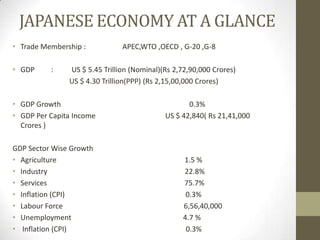

JAPANESE ECONOMY AT A GLANCE
• Trade Membership :           APEC,WTO ,OECD , G-20 ,G-8

• GDP     :    US $ 5.45 Trillion (Nominal)(Rs 2,72,90,000 Crores)
               US $ 4.30 Trillion(PPP) (Rs 2,15,00,000 Crores)

• GDP Growth                                       0.3%
• GDP Per Capita Income                     US $ 42,840( Rs 21,41,000
  Crores )

GDP Sector Wise Growth
• Agriculture                                    1.5 %
• Industry                                       22.8%
• Services                                       75.7%
• Inflation (CPI)                                 0.3%
• Labour Force                                   6,56,40,000
• Unemployment                                   4.7 %
• Inflation (CPI)                                 0.3%
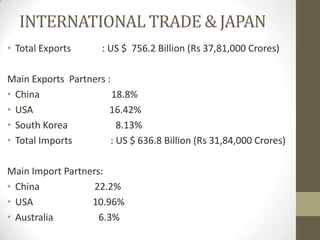
INTERNATIONAL TRADE & JAPAN
• Total Exports       : US $ 756.2 Billion (Rs 37,81,000 Crores)

Main Exports Partners :
• China                 18.8%
• USA                  16.42%
• South Korea            8.13%
• Total Imports        : US $ 636.8 Billion (Rs 31,84,000 Crores)

Main Import Partners:
• China            22.2%
• USA             10.96%
• Australia         6.3%
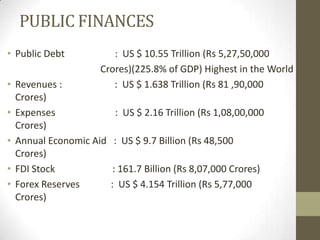
PUBLIC FINANCES
• Public Debt         : US $ 10.55 Trillion (Rs 5,27,50,000
                   Crores)(225.8% of GDP) Highest in the World
• Revenues :          : US $ 1.638 Trillion (Rs 81 ,90,000
  Crores)
• Expenses               : US $ 2.16 Trillion (Rs 1,08,00,000
  Crores)
• Annual Economic Aid   : US $ 9.7 Billion (Rs 48,500
  Crores)
• FDI Stock              : 161.7 Billion (Rs 8,07,000 Crores)
• Forex Reserves        : US $ 4.154 Trillion (Rs 5,77,000
  Crores)
OLIGOPOLISTIC NATURE OF JAPANESE
  ECONOMY
• In Japan major industries of domestic demand are : Automobile
  ,Banking ,Electronic Goods, Industrial goods
• Japanese economy is dominated in each sector by few players.
• Many of these players are diversified conglomerates having a
  formidable presence everywhere .
• In Japanese language these are known as 'Kempentsku'
• Therefore the possibility of quality of services & offerings being
  dominated by few players is very high.
• Therefore Japanese govt takes utmost care to ensure that
  injustice is done to consumers & market through constant
  regulation.
IMPLICATIONS OF OLIGOPOLISTIC
   NATURE
• Some of the possible effects of Oligopolistic nature of economy are
   1) Cartel arrangements
   2)Price Leadership
   3)Sales Maximization Model

• Some of the dominant players in Japanese economy sector-wise are:
• Automobile Sector: Toyota ,Mitsubishi,Suzuki,Yamaha,Nissan Motors,
  Kawasaki
• Consumer Electronics: Sony ,Toshiba, Sansui, Canon, Casio, Panasonic
• Banking      :Nomura Securities, Bank of Tokyo-Mitsubishi UFJ
• Heavy Industrial Production :Bridgestone, Alpine Electronics, JX Holdings Inc,
  Nippon Mining
GOVERNMENT ROLE IN ECONOMY
Government-business relations are conducted in many ways and
through numerous channels.
Role of various Ministries:-
  Ministry of Finance
  Ministry of International Trade and Industry
  Ministry of Transportation
  Ministry of Construction
  Ministry of Health and Welfare
  Ministry of Posts and Telecommunications
Taxation
• Japan ranks 15th of 183 countries in the Ease of Doing Business
  Index 2010.
• Japan has one of the smallest tax rates in the developed world.
• After deductions, the majority of workers are free from personal
  income taxes. Value-added tax rate is only 5%, while corporate
  tax rates are high.
• Relatively complicated tax system
• Variety of tax rates for corporations.
• Taxes and stamp revenues form the bulk of government
  revenues.
BUSINESS OPPORTUNITIES - JAPAN
• The Pharmaceutical Industry
• The Information Technology (IT) Industry
• The Energy Industry
• The Social Infrastructure Industries, Railway, Water Purification,
  Civil Engineering and Construction
• The Manufacturing Industry
• The Retail Industry
TECHNOLOGY
• A leading nation in scientific research, particularly technology, machinery
  and biomedical research.
• Nearly 700,000 researchers share a US$130 billion research and
  development budget, the third largest in the world.
• Japan's more prominent technological contributions are in the fields of
  electronics, automobiles, machinery, earthquake engineering, industrial
  robotics, optics, chemicals, semiconductors and metals.
• Japan leads the world in robotics production and use, possessing more than
  half of the world's industrial robots.
• The Japanese automotive industry is one of the most prominent industries in
  the world.
• Automobile player – Toyota, Honda, Mazda, Suzuki, Nissan , Subaru and
  many others.
• Majority of car makers and Technology goods in India are imported from
  Japan.
GLOBAL REACH
• Tokyo is the hub for all the industries.

• Some of the industries setup in Tokyo are as follows.
1. 2247 Heavy-machinery and machine-parts makers.
2. 10550 Electrical equipment makers.
3. 1457 Steel companies.
4. 3016 paper mills.
MAJOR COMPANIES HEADQUARTERED IN
TOKYO

1 Toshiba Corporation
2 Kawasaki Heavy Industries Ltd
3 Honda Motor co. Ltd
4. Nissan Motor co. Ltd
5. Toyota Motors
6. Sony Corporation
EXPORTED PRODUCTS
1 Electrical Products
2. Transport Equipment
3. General machinery
4. Chemical Products
5. Metal Products
6. Electronic Products
7. Automobiles
8. Agricultural Products
EXPORTS DETAILS

Main Exports Partners:
 China – 18.8%
 USA – 16.42%
 South Korea – 8.13%
 India – 6.4%
 To USA – Agricultural Products
 To India – Automobile Products
 To China – Electronic Products
  Total Exports – US $ 756.2 Billion
DIVERSIFICATION
Japan's Rapid Evolution to an Industrialized Country :
• During the post-war era, Japan has experienced a
  drastic change in its economic status and in the role of
  agriculture in the society.
• Its economy has grown to the second largest in the
  world. This change has been accompanied by social
  changes in the area of agriculture and food systems in
  Japan.
CONTI..

• Technological Diversification of Japanese Industry
• Petroleum and diversification
• Electricity generation
• Nuclear sector's diversification
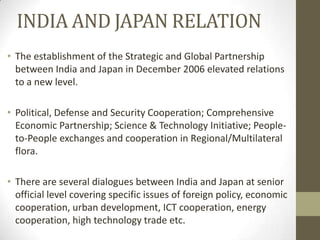
INDIA AND JAPAN RELATION
• The establishment of the Strategic and Global Partnership
  between India and Japan in December 2006 elevated relations
  to a new level.

• Political, Defense and Security Cooperation; Comprehensive
  Economic Partnership; Science & Technology Initiative; People-
  to-People exchanges and cooperation in Regional/Multilateral
  flora.

• There are several dialogues between India and Japan at senior
  official level covering specific issues of foreign policy, economic
  cooperation, urban development, ICT cooperation, energy
  cooperation, high technology trade etc.
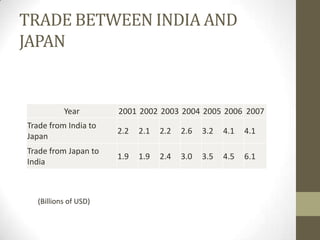
TRADE BETWEEN INDIA AND
JAPAN


          Year        2001 2002 2003 2004 2005 2006 2007
Trade from India to
                      2.2   2.1   2.2   2.6   3.2   4.1   4.1
Japan
Trade from Japan to
                      1.9   1.9   2.4   3.0   3.5   4.5   6.1
India


  (Billions of USD)
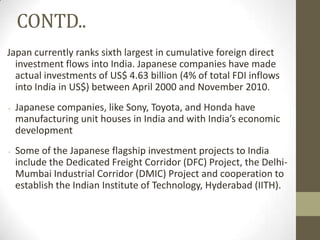
CONTD..
Japan currently ranks sixth largest in cumulative foreign direct
  investment flows into India. Japanese companies have made
  actual investments of US$ 4.63 billion (4% of total FDI inflows
  into India in US$) between April 2000 and November 2010.
   Japanese companies, like Sony, Toyota, and Honda have
    manufacturing unit houses in India and with India’s economic
    development
   Some of the Japanese flagship investment projects to India
    include the Dedicated Freight Corridor (DFC) Project, the Delhi-
    Mumbai Industrial Corridor (DMIC) Project and cooperation to
    establish the Indian Institute of Technology, Hyderabad (IITH).
DOUMO ARIGATOU
GOZAIMASU………. (THANK YOU VERY MUCH)

Economics japan

  • 2.
    JAPANESE ECONOMY ATA GLANCE • Trade Membership : APEC,WTO ,OECD , G-20 ,G-8 • GDP : US $ 5.45 Trillion (Nominal)(Rs 2,72,90,000 Crores) US $ 4.30 Trillion(PPP) (Rs 2,15,00,000 Crores) • GDP Growth 0.3% • GDP Per Capita Income US $ 42,840( Rs 21,41,000 Crores ) GDP Sector Wise Growth • Agriculture 1.5 % • Industry 22.8% • Services 75.7% • Inflation (CPI) 0.3% • Labour Force 6,56,40,000 • Unemployment 4.7 % • Inflation (CPI) 0.3%
  • 3.
    INTERNATIONAL TRADE &JAPAN • Total Exports : US $ 756.2 Billion (Rs 37,81,000 Crores) Main Exports Partners : • China 18.8% • USA 16.42% • South Korea 8.13% • Total Imports : US $ 636.8 Billion (Rs 31,84,000 Crores) Main Import Partners: • China 22.2% • USA 10.96% • Australia 6.3%
  • 4.
    PUBLIC FINANCES • PublicDebt : US $ 10.55 Trillion (Rs 5,27,50,000 Crores)(225.8% of GDP) Highest in the World • Revenues : : US $ 1.638 Trillion (Rs 81 ,90,000 Crores) • Expenses : US $ 2.16 Trillion (Rs 1,08,00,000 Crores) • Annual Economic Aid : US $ 9.7 Billion (Rs 48,500 Crores) • FDI Stock : 161.7 Billion (Rs 8,07,000 Crores) • Forex Reserves : US $ 4.154 Trillion (Rs 5,77,000 Crores)
  • 5.
    OLIGOPOLISTIC NATURE OFJAPANESE ECONOMY • In Japan major industries of domestic demand are : Automobile ,Banking ,Electronic Goods, Industrial goods • Japanese economy is dominated in each sector by few players. • Many of these players are diversified conglomerates having a formidable presence everywhere . • In Japanese language these are known as 'Kempentsku' • Therefore the possibility of quality of services & offerings being dominated by few players is very high. • Therefore Japanese govt takes utmost care to ensure that injustice is done to consumers & market through constant regulation.
  • 6.
    IMPLICATIONS OF OLIGOPOLISTIC NATURE • Some of the possible effects of Oligopolistic nature of economy are 1) Cartel arrangements 2)Price Leadership 3)Sales Maximization Model • Some of the dominant players in Japanese economy sector-wise are: • Automobile Sector: Toyota ,Mitsubishi,Suzuki,Yamaha,Nissan Motors, Kawasaki • Consumer Electronics: Sony ,Toshiba, Sansui, Canon, Casio, Panasonic • Banking :Nomura Securities, Bank of Tokyo-Mitsubishi UFJ • Heavy Industrial Production :Bridgestone, Alpine Electronics, JX Holdings Inc, Nippon Mining
  • 7.
    GOVERNMENT ROLE INECONOMY Government-business relations are conducted in many ways and through numerous channels. Role of various Ministries:- Ministry of Finance Ministry of International Trade and Industry Ministry of Transportation Ministry of Construction Ministry of Health and Welfare Ministry of Posts and Telecommunications
  • 8.
    Taxation • Japan ranks15th of 183 countries in the Ease of Doing Business Index 2010. • Japan has one of the smallest tax rates in the developed world. • After deductions, the majority of workers are free from personal income taxes. Value-added tax rate is only 5%, while corporate tax rates are high. • Relatively complicated tax system • Variety of tax rates for corporations. • Taxes and stamp revenues form the bulk of government revenues.
  • 9.
    BUSINESS OPPORTUNITIES -JAPAN • The Pharmaceutical Industry • The Information Technology (IT) Industry • The Energy Industry • The Social Infrastructure Industries, Railway, Water Purification, Civil Engineering and Construction • The Manufacturing Industry • The Retail Industry
  • 10.
    TECHNOLOGY • A leadingnation in scientific research, particularly technology, machinery and biomedical research. • Nearly 700,000 researchers share a US$130 billion research and development budget, the third largest in the world. • Japan's more prominent technological contributions are in the fields of electronics, automobiles, machinery, earthquake engineering, industrial robotics, optics, chemicals, semiconductors and metals. • Japan leads the world in robotics production and use, possessing more than half of the world's industrial robots. • The Japanese automotive industry is one of the most prominent industries in the world. • Automobile player – Toyota, Honda, Mazda, Suzuki, Nissan , Subaru and many others. • Majority of car makers and Technology goods in India are imported from Japan.
  • 11.
    GLOBAL REACH • Tokyois the hub for all the industries. • Some of the industries setup in Tokyo are as follows. 1. 2247 Heavy-machinery and machine-parts makers. 2. 10550 Electrical equipment makers. 3. 1457 Steel companies. 4. 3016 paper mills.
  • 12.
    MAJOR COMPANIES HEADQUARTEREDIN TOKYO 1 Toshiba Corporation 2 Kawasaki Heavy Industries Ltd 3 Honda Motor co. Ltd 4. Nissan Motor co. Ltd 5. Toyota Motors 6. Sony Corporation
  • 13.
    EXPORTED PRODUCTS 1 ElectricalProducts 2. Transport Equipment 3. General machinery 4. Chemical Products 5. Metal Products 6. Electronic Products 7. Automobiles 8. Agricultural Products
  • 14.
    EXPORTS DETAILS Main ExportsPartners: China – 18.8% USA – 16.42% South Korea – 8.13% India – 6.4% To USA – Agricultural Products To India – Automobile Products To China – Electronic Products Total Exports – US $ 756.2 Billion
  • 15.
    DIVERSIFICATION Japan's Rapid Evolutionto an Industrialized Country : • During the post-war era, Japan has experienced a drastic change in its economic status and in the role of agriculture in the society. • Its economy has grown to the second largest in the world. This change has been accompanied by social changes in the area of agriculture and food systems in Japan.
  • 16.
    CONTI.. • Technological Diversificationof Japanese Industry • Petroleum and diversification • Electricity generation • Nuclear sector's diversification
  • 17.
    INDIA AND JAPANRELATION • The establishment of the Strategic and Global Partnership between India and Japan in December 2006 elevated relations to a new level. • Political, Defense and Security Cooperation; Comprehensive Economic Partnership; Science & Technology Initiative; People- to-People exchanges and cooperation in Regional/Multilateral flora. • There are several dialogues between India and Japan at senior official level covering specific issues of foreign policy, economic cooperation, urban development, ICT cooperation, energy cooperation, high technology trade etc.
  • 18.
    TRADE BETWEEN INDIAAND JAPAN Year 2001 2002 2003 2004 2005 2006 2007 Trade from India to 2.2 2.1 2.2 2.6 3.2 4.1 4.1 Japan Trade from Japan to 1.9 1.9 2.4 3.0 3.5 4.5 6.1 India (Billions of USD)
  • 19.
    CONTD.. Japan currently rankssixth largest in cumulative foreign direct investment flows into India. Japanese companies have made actual investments of US$ 4.63 billion (4% of total FDI inflows into India in US$) between April 2000 and November 2010.  Japanese companies, like Sony, Toyota, and Honda have manufacturing unit houses in India and with India’s economic development  Some of the Japanese flagship investment projects to India include the Dedicated Freight Corridor (DFC) Project, the Delhi- Mumbai Industrial Corridor (DMIC) Project and cooperation to establish the Indian Institute of Technology, Hyderabad (IITH).
  • 20.