Workshop Social Media for ROON


Samuel Driessen - Information Architect Océ
- Regional meeting of Works Councils - April 19, 2010
Goal Workshop

   Describe Web 2.0 and Enterprise 2.0
   Reflect on Web 2.0/Enterprise 2.0 <> ROON


                                                2
Shift Happens

   Video: Shift Happens, Did you know 4.0
   Video: Social Media Revolution

   What did you see?
   What does this say?
   Which media do you use? And why?


                                             3
The name of the revolution in media


        Web 2.0           Or: Social Media, Social Web, Social Computing


                                                                           4
Web 2.0 defined

   internet as platform
   harness network effects (collective intelligence)


                                                        5
Shift Happens in Business too

   YouTube - The Break Up
   Online Communities Change the World

   What did you see?
   What does this say?
   How is are you responding?


                                          6
The name of the revolution in business


              Enterprise 2.0


                                         7
Enterprise 2.0 defined

   Simply stated: Apply Web 2.0 concepts to enterprises

   Enterprise 2.0 is the use of emergent social software platforms
    within companies, or between companies and their partners or
    customers.
   Social software enables people to rendezvous, connect or
    collaborate through computer-mediated communication and to
    form online communities.
   Platforms are digital environments in which contributions and
    interactions are globally visible and persistent over time.
   Emergent means that the software is freeform, and that it
    contains mechanisms to let the patterns and structure inherent
    in people’s interactions become visible over time.
   Freeform means that the software is most or all of the following:
     Optional
     Free of up-front workflow
     Egalitarian, or indifferent to formal organizational identities
     Accepting of many types of data

                                                                        8
9
10
11
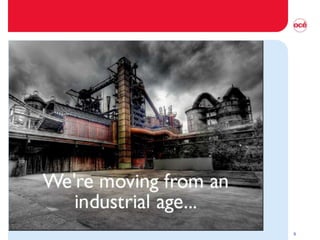
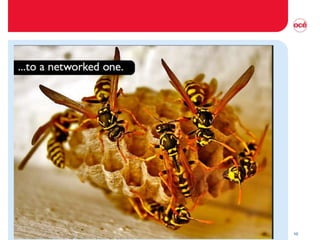
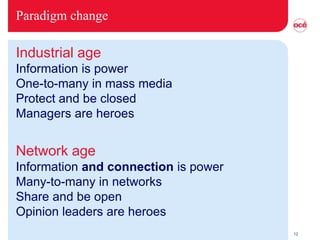
Paradigm change

Industrial age
Information is power
One-to-many in mass media
Protect and be closed
Managers are heroes


Network age
Information and connection is power
Many-to-many in networks
Share and be open
Opinion leaders are heroes
                                      12
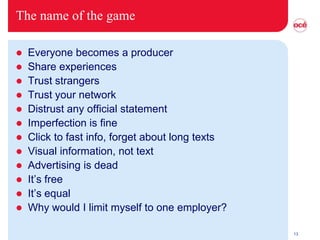
The name of the game

 Everyone becomes a producer
 Share experiences
 Trust strangers
 Trust your network
 Distrust any official statement
 Imperfection is fine
 Click to fast info, forget about long texts
 Visual information, not text
 Advertising is dead
 It’s free
 It’s equal
 Why would I limit myself to one employer?

                                                13
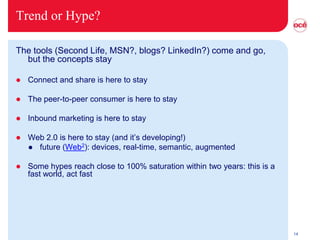
Trend or Hype?

The tools (Second Life, MSN?, blogs? LinkedIn?) come and go,
  but the concepts stay

   Connect and share is here to stay

   The peer-to-peer consumer is here to stay

   Inbound marketing is here to stay

   Web 2.0 is here to stay (and it’s developing!)
     future (Web2): devices, real-time, semantic, augmented


   Some hypes reach close to 100% saturation within two years: this is a
    fast world, act fast


                                                                            14
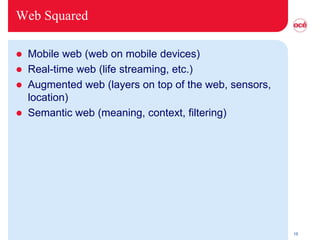
Web Squared

 Mobile web (web on mobile devices)
 Real-time web (life streaming, etc.)
 Augmented web (layers on top of the web, sensors,
  location)
 Semantic web (meaning, context, filtering)


                                                      15
Examples of Web 2.0/E2.0 tools

 Blogs
 Microblogs
 Wiki’s
 Social networks
 Bookmarking
 RSS


                                 16
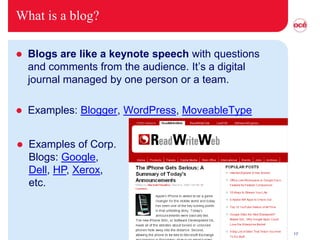
What is a blog?

   Blogs are like a keynote speech with questions
    and comments from the audience. It’s a digital
    journal managed by one person or a team.

   Examples: Blogger, WordPress, MoveableType


   Examples of Corp.
    Blogs: Google,
    Dell, HP, Xerox,
    etc.


                                                     17
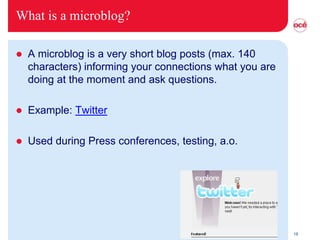
What is a microblog?

   A microblog is a very short blog posts (max. 140
    characters) informing your connections what you are
    doing at the moment and ask questions.

   Example: Twitter

   Used during Press conferences, testing, a.o.


                                                          18
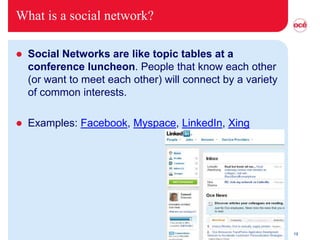
What is a social network?

   Social Networks are like topic tables at a
    conference luncheon. People that know each other
    (or want to meet each other) will connect by a variety
    of common interests.

   Examples: Facebook, Myspace, LinkedIn, Xing


                                                             19
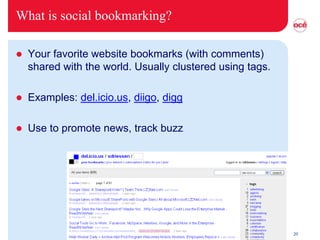
What is social bookmarking?

   Your favorite website bookmarks (with comments)
    shared with the world. Usually clustered using tags.

   Examples: del.icio.us, diigo, digg

   Use to promote news, track buzz


                                                           20
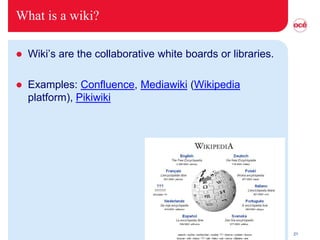
What is a wiki?

   Wiki’s are the collaborative white boards or libraries.

   Examples: Confluence, Mediawiki (Wikipedia
    platform), Pikiwiki


                                                              21
What is RSS?

   RSS = Really Simple Syndication. RSS enabled sites
    allow you to aggregate all changes to that site in a
    feed reader. (Core web technology)

   Example: an RSS enabled webpage can be
    recognized by this button:


   Example of feed readers: Newsgator, Attensa,
    Google Reader, Bloglines, Fa.vor.it


                                                           22
Was our explanation unclear…?

   Go to the Common Craft website for insightful short
    video on all ‘social media’ tools!
       RSS in Plain English
       Social Bookmarking in plain English
       Social Networking in Plain English
       Blogs in Plain English
       Wikis in Plain English
       Twitter in Plain English


                                                          23
24

Workshop Web 2.0 for ROON

  • 1.
    Workshop Social Mediafor ROON Samuel Driessen - Information Architect Océ - Regional meeting of Works Councils - April 19, 2010
  • 2.
    Goal Workshop  Describe Web 2.0 and Enterprise 2.0  Reflect on Web 2.0/Enterprise 2.0 <> ROON 2
  • 3.
    Shift Happens  Video: Shift Happens, Did you know 4.0  Video: Social Media Revolution  What did you see?  What does this say?  Which media do you use? And why? 3
  • 4.
    The name ofthe revolution in media Web 2.0 Or: Social Media, Social Web, Social Computing 4
  • 5.
    Web 2.0 defined  internet as platform  harness network effects (collective intelligence) 5
  • 6.
    Shift Happens inBusiness too  YouTube - The Break Up  Online Communities Change the World  What did you see?  What does this say?  How is are you responding? 6
  • 7.
    The name ofthe revolution in business Enterprise 2.0 7
  • 8.
    Enterprise 2.0 defined  Simply stated: Apply Web 2.0 concepts to enterprises  Enterprise 2.0 is the use of emergent social software platforms within companies, or between companies and their partners or customers.  Social software enables people to rendezvous, connect or collaborate through computer-mediated communication and to form online communities.  Platforms are digital environments in which contributions and interactions are globally visible and persistent over time.  Emergent means that the software is freeform, and that it contains mechanisms to let the patterns and structure inherent in people’s interactions become visible over time.  Freeform means that the software is most or all of the following:  Optional  Free of up-front workflow  Egalitarian, or indifferent to formal organizational identities  Accepting of many types of data 8
  • 9.
  • 10.
  • 11.
  • 12.
    Paradigm change Industrial age Informationis power One-to-many in mass media Protect and be closed Managers are heroes Network age Information and connection is power Many-to-many in networks Share and be open Opinion leaders are heroes 12
  • 13.
    The name ofthe game  Everyone becomes a producer  Share experiences  Trust strangers  Trust your network  Distrust any official statement  Imperfection is fine  Click to fast info, forget about long texts  Visual information, not text  Advertising is dead  It’s free  It’s equal  Why would I limit myself to one employer? 13
  • 14.
    Trend or Hype? Thetools (Second Life, MSN?, blogs? LinkedIn?) come and go, but the concepts stay  Connect and share is here to stay  The peer-to-peer consumer is here to stay  Inbound marketing is here to stay  Web 2.0 is here to stay (and it’s developing!)  future (Web2): devices, real-time, semantic, augmented  Some hypes reach close to 100% saturation within two years: this is a fast world, act fast 14
  • 15.
    Web Squared  Mobileweb (web on mobile devices)  Real-time web (life streaming, etc.)  Augmented web (layers on top of the web, sensors, location)  Semantic web (meaning, context, filtering) 15
  • 16.
    Examples of Web2.0/E2.0 tools  Blogs  Microblogs  Wiki’s  Social networks  Bookmarking  RSS 16
  • 17.
    What is ablog?  Blogs are like a keynote speech with questions and comments from the audience. It’s a digital journal managed by one person or a team.  Examples: Blogger, WordPress, MoveableType  Examples of Corp. Blogs: Google, Dell, HP, Xerox, etc. 17
  • 18.
    What is amicroblog?  A microblog is a very short blog posts (max. 140 characters) informing your connections what you are doing at the moment and ask questions.  Example: Twitter  Used during Press conferences, testing, a.o. 18
  • 19.
    What is asocial network?  Social Networks are like topic tables at a conference luncheon. People that know each other (or want to meet each other) will connect by a variety of common interests.  Examples: Facebook, Myspace, LinkedIn, Xing 19
  • 20.
    What is socialbookmarking?  Your favorite website bookmarks (with comments) shared with the world. Usually clustered using tags.  Examples: del.icio.us, diigo, digg  Use to promote news, track buzz 20
  • 21.
    What is awiki?  Wiki’s are the collaborative white boards or libraries.  Examples: Confluence, Mediawiki (Wikipedia platform), Pikiwiki 21
  • 22.
    What is RSS?  RSS = Really Simple Syndication. RSS enabled sites allow you to aggregate all changes to that site in a feed reader. (Core web technology)  Example: an RSS enabled webpage can be recognized by this button:  Example of feed readers: Newsgator, Attensa, Google Reader, Bloglines, Fa.vor.it 22
  • 23.
    Was our explanationunclear…?  Go to the Common Craft website for insightful short video on all ‘social media’ tools!  RSS in Plain English  Social Bookmarking in plain English  Social Networking in Plain English  Blogs in Plain English  Wikis in Plain English  Twitter in Plain English 23
  • 24.