Online:the rise and risePaul Wilkinson
Agendabefore webWeb 1.0Web 2.0What is Web 2.0 – a lightning tourWeb 2.0 – putting it all togetherWhy does Web 2.0 matter?Final words
‘Before web’Mainly printed collateral and face-to-face:print advertisingbrochures, company magazines, newslettersmedia relations and other PRdirect marketingmarket researchevents – exhibitions, conferences, etcStill important, but from 1993 …
Web 1.0Mid 1990s …first generation websitesstatic pages instead of dynamic user-generated contentHTML ‘brochure-ware’, later PDFslimited interaction with site visitorssome integration with email
Web 1.5Since late 1990s …shared drivesintranets – closed internal websitesextranets – private websites shared, for example, among project team membersBut still mainly information-centric
Web 2.0 – aka: social mediaDefinitions:primarily internet- and mobile-based tools for sharing and discussing information among human beingsthe use of web technologies and web design to enhance creativity, information sharing and collaboration among users.“People having conversations online”In business, also Enterprise 2.0(Sources: Wikipedia; Kaizo)
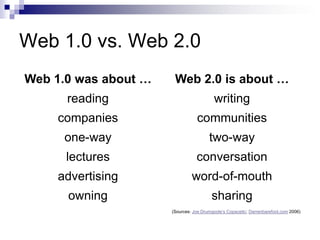
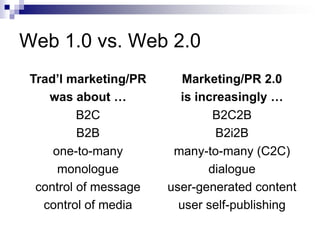
Web 1.0 vs. Web 2.0(Sources: Joe Drumgoole’s Copacetic; Darrenbarefoot.com 2006)
Web 1.0 vs. Web 2.0
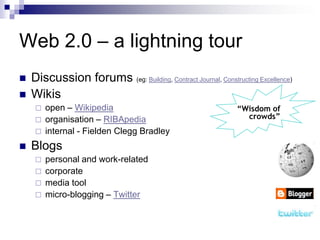
Web 2.0 – a lightning tourDiscussion forums (eg: Building, Contract Journal, Constructing Excellence)Wikisopen – Wikipediaorganisation – RIBApediainternal - Fielden Clegg BradleyBlogspersonal and work-related corporate media tool micro-blogging – Twitter“Wisdom of crowds”
Web 2.0 – a lightning tourRSSRSS publishing (from bloggers, media, corporate, search)Feed-readers (local or web-based: Newsgator, Google Reader, etc)Social networkingfrom personal (eg: MySpace, Bebo, Facebook) …to professional (Facebook, LinkedIn) … to networks/communities (eg: Be2camp - built on Ning platform)Social search (eg: Wikia)Tagging/sharing (eg: Delicious, Digg, etc)
Web 2.0 – a lightning tourSharing:Documents, presentations, etc (eg: Google Apps)Voice over IP – SkypeCalendar - Google Calendar; fixing meetings (Doodle)Photos – FlickrVideo – YouTubeStuff – FreecycleMashups: Maps (Google Maps, OSM), timelines (Dipity)Virtual worlds – eg: Second Life
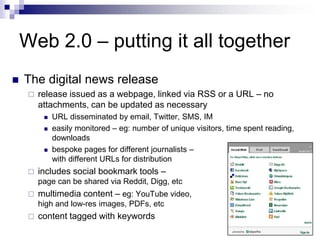
The digital news releaserelease issued as a webpage, linked via RSS or a URL – no attachments, can be updated as necessaryURL disseminated by email, Twitter, SMS, IMeasily monitored – eg: number of unique visitors, time spent reading, downloadsbespoke pages for different journalists –with different URLs for distributionincludes social bookmark tools –page can be shared via Reddit, Digg, etcmultimedia content – eg: YouTube video,high and low-res images, PDFs, etccontent tagged with keywordsWeb 2.0 – putting it all together
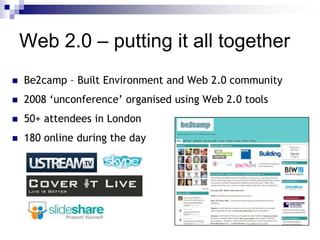
Be2camp – Built Environment and Web 2.0 community2008 ‘unconference’ organised using Web 2.0 tools50+ attendees in London180 online during the dayWeb 2.0 – putting it all together
Crowd-sourcing tools for marketing:Logo design = 99designsrun an online competition to design a logo to meet your briefBrand names = namethis“48-hour contest to find a brand name for your venture. The namethis community suggests names, and then votes on the best ones” ($99)Product design and manufacturing = Ponokotake a picture of a sketch, upload it, and then wait for designers to tell you how much it would cost to have made for realProduct redesign = redesignme“platform where communities and companies collaborate on new / revamped products and services.”Software & usability testing = uTestImages = FlickrWeb 2.0 – putting it all together
Why does Web 2.0 matter?Context:70% UK homes have PC or laptop65% have home internet access (58% via broadband)71% UK adults access internet41% of UK adults accessed blogs during August 200830% of British adults have a social networking profileHalf UK's online population have a Facebook profile and spend an average of nearly six hours a month on the site  not just Gen Y: 35% of Facebook users in 35-54 age range2m+ UK LinkedIn users; 2.6m UK Twitter users27.4m people watched online videos during May 2008(Sources: Ofcom, ComScore, BBC, LinkedIn – 2008, 2009)
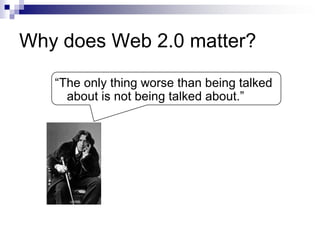
Why does Web 2.0 matter?“The only thing worse than being talked about is not being talked about.”
Online:the rise and riseTo find out more…paul.wilkinson@pwcom.co.ukhttp://www.pwcom.co.ukTwitter: @EEPaulTel: 020 8858 1104, mob 07788 445920

Online: the rise and rise. How Web 2.0 is changing construction PR and marketing

  • 1.
    Online:the rise andrisePaul Wilkinson
  • 2.
    Agendabefore webWeb 1.0Web2.0What is Web 2.0 – a lightning tourWeb 2.0 – putting it all togetherWhy does Web 2.0 matter?Final words
  • 3.
    ‘Before web’Mainly printedcollateral and face-to-face:print advertisingbrochures, company magazines, newslettersmedia relations and other PRdirect marketingmarket researchevents – exhibitions, conferences, etcStill important, but from 1993 …
  • 4.
    Web 1.0Mid 1990s…first generation websitesstatic pages instead of dynamic user-generated contentHTML ‘brochure-ware’, later PDFslimited interaction with site visitorssome integration with email
  • 5.
    Web 1.5Since late1990s …shared drivesintranets – closed internal websitesextranets – private websites shared, for example, among project team membersBut still mainly information-centric
  • 6.
    Web 2.0 –aka: social mediaDefinitions:primarily internet- and mobile-based tools for sharing and discussing information among human beingsthe use of web technologies and web design to enhance creativity, information sharing and collaboration among users.“People having conversations online”In business, also Enterprise 2.0(Sources: Wikipedia; Kaizo)
  • 7.
    Web 1.0 vs.Web 2.0(Sources: Joe Drumgoole’s Copacetic; Darrenbarefoot.com 2006)
  • 8.
  • 9.
    Web 2.0 –a lightning tourDiscussion forums (eg: Building, Contract Journal, Constructing Excellence)Wikisopen – Wikipediaorganisation – RIBApediainternal - Fielden Clegg BradleyBlogspersonal and work-related corporate media tool micro-blogging – Twitter“Wisdom of crowds”
  • 10.
    Web 2.0 –a lightning tourRSSRSS publishing (from bloggers, media, corporate, search)Feed-readers (local or web-based: Newsgator, Google Reader, etc)Social networkingfrom personal (eg: MySpace, Bebo, Facebook) …to professional (Facebook, LinkedIn) … to networks/communities (eg: Be2camp - built on Ning platform)Social search (eg: Wikia)Tagging/sharing (eg: Delicious, Digg, etc)
  • 11.
    Web 2.0 –a lightning tourSharing:Documents, presentations, etc (eg: Google Apps)Voice over IP – SkypeCalendar - Google Calendar; fixing meetings (Doodle)Photos – FlickrVideo – YouTubeStuff – FreecycleMashups: Maps (Google Maps, OSM), timelines (Dipity)Virtual worlds – eg: Second Life
  • 12.
    The digital newsreleaserelease issued as a webpage, linked via RSS or a URL – no attachments, can be updated as necessaryURL disseminated by email, Twitter, SMS, IMeasily monitored – eg: number of unique visitors, time spent reading, downloadsbespoke pages for different journalists –with different URLs for distributionincludes social bookmark tools –page can be shared via Reddit, Digg, etcmultimedia content – eg: YouTube video,high and low-res images, PDFs, etccontent tagged with keywordsWeb 2.0 – putting it all together
  • 13.
    Be2camp – BuiltEnvironment and Web 2.0 community2008 ‘unconference’ organised using Web 2.0 tools50+ attendees in London180 online during the dayWeb 2.0 – putting it all together
  • 14.
    Crowd-sourcing tools formarketing:Logo design = 99designsrun an online competition to design a logo to meet your briefBrand names = namethis“48-hour contest to find a brand name for your venture. The namethis community suggests names, and then votes on the best ones” ($99)Product design and manufacturing = Ponokotake a picture of a sketch, upload it, and then wait for designers to tell you how much it would cost to have made for realProduct redesign = redesignme“platform where communities and companies collaborate on new / revamped products and services.”Software & usability testing = uTestImages = FlickrWeb 2.0 – putting it all together
  • 15.
    Why does Web2.0 matter?Context:70% UK homes have PC or laptop65% have home internet access (58% via broadband)71% UK adults access internet41% of UK adults accessed blogs during August 200830% of British adults have a social networking profileHalf UK's online population have a Facebook profile and spend an average of nearly six hours a month on the site not just Gen Y: 35% of Facebook users in 35-54 age range2m+ UK LinkedIn users; 2.6m UK Twitter users27.4m people watched online videos during May 2008(Sources: Ofcom, ComScore, BBC, LinkedIn – 2008, 2009)
  • 16.
    Why does Web2.0 matter?“The only thing worse than being talked about is not being talked about.”
  • 17.
    Online:the rise andriseTo find out more…paul.wilkinson@pwcom.co.ukhttp://www.pwcom.co.ukTwitter: @EEPaulTel: 020 8858 1104, mob 07788 445920