Workshop Implications Web 2.0 for IT Samuel Driessen
Goal Workshop Reflect on Web 2.0 Define Implications of Web 2.0 for IT
Agenda Knowledge Worker 2.0 Assignment Enterprise 2.0 Assignment
Shift Happens Video:  Shift Happens, Did you know 4.0 Video:  Social Media Revolution What did you see? What does this say? Which media do you use? And why?
The name of the revolution in media Web 2.0 Or:  Social Media, Social Web, Social Computing
Web 2.0 defined internet as platform harness network effects (collective intelligence)
Consequences for our employees Were you ever taught to be a knowledge worker?
Were you ever officially educated to Use e-mail effectively? Find information through a feed reader? Post information in relevant peer groups? Share and store your information so others can retrieve it? Use social bookmarking? Use a wiki? Write a blogpost? Use Slideshare?
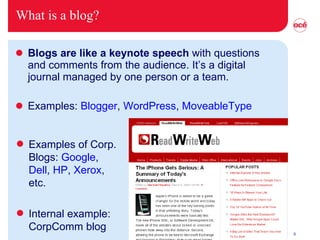
What is a blog? Blogs are like a keynote speech  with questions and comments from the audience. It’s a digital journal managed by one person or a team. Examples:  Blogger ,  WordPress ,  MoveableType Examples of Corp. Blogs:  Google ,  Dell ,  HP ,  Xerox , etc. Internal example: CorpComm blog
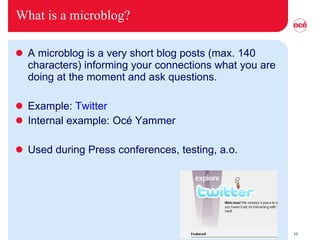
What is a microblog? A microblog is a very short blog posts (max. 140 characters) informing your connections what you are doing at the moment and ask questions. Example:  Twitter Internal example: Océ Yammer Used during Press conferences, testing, a.o.
What is a social network? Social Networks are like topic tables at a conference luncheon . People that know each other (or want to meet each other) will connect by a variety of common interests.  Examples:  Facebook ,  Myspace ,  LinkedIn ,  Xing Internal example: [none]
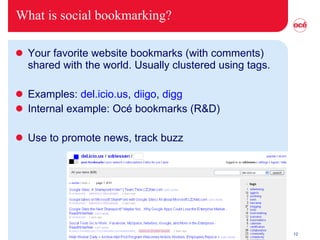
What is social bookmarking? Your favorite website bookmarks (with comments) shared with the world. Usually clustered using tags. Examples:  del.icio.us ,  diigo ,  digg Internal example: Océ bookmarks (R&D) Use to promote news, track buzz
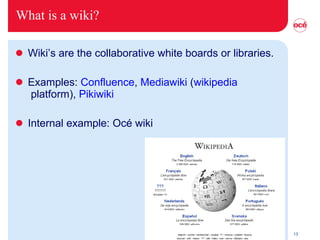
What is a wiki? Wiki’s are the collaborative white boards or libraries. Examples:  Confluence ,  Mediawiki  ( wikipedia  platform),  Pikiwiki Internal example: Océ wiki
What is RSS? RSS = Really Simple Syndication. RSS enabled sites allow you to aggregate all changes to that site in a feed reader. (Core web technology) Example: an RSS enabled webpage can be recognized by this button: Example of feed readers:  Newsgator ,  Attensa ,  Google Reader ,  Bloglines ,  Fa.vor.it Internal example: NewInfo,  RSSPopper ,  Greatnews
Was our explanation unclear…? Go to the  Common Craft  website for insightful short video on all ‘social media’ tools! RSS in Plain English Social Bookmarking in plain English Social Networking in Plain English Blogs in Plain English Wikis in Plain English Twitter in Plain English SlideShare
Assignment part 1 Apply the above-mentioned concepts and tools to your daily work. Which part of your work fits with the concepts and tools? Which type of information fits? Which can/will you use? Define a daily routine!
Part 2: Enterprise 2.0
Shift Happens in Business too YouTube  - The Break Up Online  Communities   Change  the World What did you see? What does this say? How is Océ responding?
The name of the revolution in business Enterprise 2.0
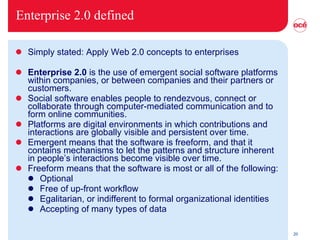
Enterprise 2.0 defined Simply stated: Apply Web 2.0 concepts to enterprises Enterprise 2.0  is the use of emergent social software platforms within companies, or between companies and their partners or customers. Social software enables people to rendezvous, connect or collaborate through computer-mediated communication and to form online communities. Platforms are digital environments in which contributions and interactions are globally visible and persistent over time. Emergent means that the software is freeform, and that it contains mechanisms to let the patterns and structure inherent in people’s interactions become visible over time. Freeform means that the software is most or all of the following: Optional  Free of up-front workflow  Egalitarian, or indifferent to formal organizational identities  Accepting of many types of data
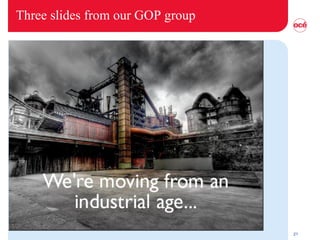
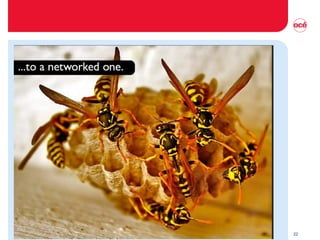
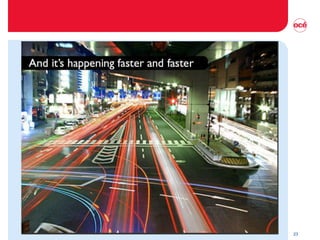
Three slides from our GOP group
 
 
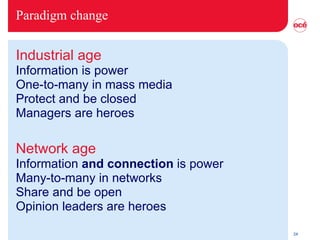
Paradigm change Industrial age Information is power One-to-many in mass media Protect and be closed Managers are heroes Network age Information  and connection  is power Many-to-many in networks  Share and be open  Opinion leaders are heroes
The name of the game Everyone becomes a producer Share experiences Trust strangers Trust your network Distrust any official statement Imperfection is fine Click to fast info, forget about long texts Visual information, not text Advertising is dead It’s free It’s equal Why would I limit myself to one employer?
Trend or Hype? The tools (Second Life, MSN?, blogs? LinkedIn?) come and go, but the concepts stay Connect and share is here to stay The peer-to-peer consumer is here to stay Inbound marketing is here to stay Web 2.0 is here to stay (and it’s developing!) future ( Web 2 ): devices, real-time, semantic, augmented Some hypes reach close to 100% saturation within two years: this is a fast world, act fast
Web Squared Mobile web (web on mobile devices) Real-time web (life streaming, etc.) Augmented web (layers on top of the web, sensors, location) Semantic web (meaning, context, filtering)
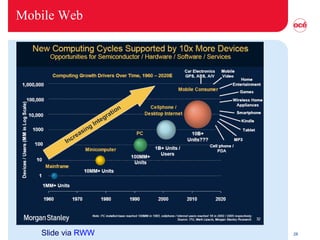
Mobile Web Slide via  RWW
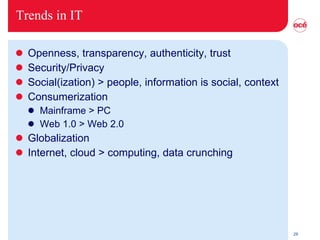
Trends in IT Openness, transparency, authenticity, trust Security/Privacy Social(ization) > people, information is social, context Consumerization Mainframe > PC Web 1.0 > Web 2.0  Globalization Internet, cloud > computing, data crunching
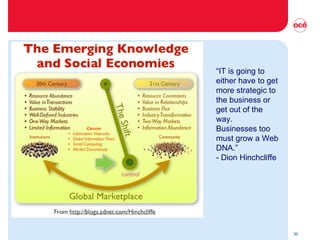
“ IT is going to either have to get more strategic to the business or get out of the way. Businesses too must grow a Web DNA.” - Dion Hinchcliffe
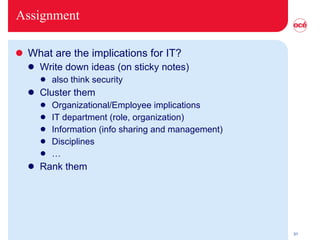
Assignment What are the implications for IT? Write down ideas (on sticky notes) also think security Cluster them Organizational/Employee implications IT department (role, organization) Information (info sharing and management) Disciplines … Rank them
 

Workshop implications web 2.0 for IT

  • 1.
    Workshop Implications Web2.0 for IT Samuel Driessen
  • 2.
    Goal Workshop Reflecton Web 2.0 Define Implications of Web 2.0 for IT
  • 3.
    Agenda Knowledge Worker2.0 Assignment Enterprise 2.0 Assignment
  • 4.
    Shift Happens Video: Shift Happens, Did you know 4.0 Video: Social Media Revolution What did you see? What does this say? Which media do you use? And why?
  • 5.
    The name ofthe revolution in media Web 2.0 Or: Social Media, Social Web, Social Computing
  • 6.
    Web 2.0 definedinternet as platform harness network effects (collective intelligence)
  • 7.
    Consequences for ouremployees Were you ever taught to be a knowledge worker?
  • 8.
    Were you everofficially educated to Use e-mail effectively? Find information through a feed reader? Post information in relevant peer groups? Share and store your information so others can retrieve it? Use social bookmarking? Use a wiki? Write a blogpost? Use Slideshare?
  • 9.
    What is ablog? Blogs are like a keynote speech with questions and comments from the audience. It’s a digital journal managed by one person or a team. Examples: Blogger , WordPress , MoveableType Examples of Corp. Blogs: Google , Dell , HP , Xerox , etc. Internal example: CorpComm blog
  • 10.
    What is amicroblog? A microblog is a very short blog posts (max. 140 characters) informing your connections what you are doing at the moment and ask questions. Example: Twitter Internal example: Océ Yammer Used during Press conferences, testing, a.o.
  • 11.
    What is asocial network? Social Networks are like topic tables at a conference luncheon . People that know each other (or want to meet each other) will connect by a variety of common interests. Examples: Facebook , Myspace , LinkedIn , Xing Internal example: [none]
  • 12.
    What is socialbookmarking? Your favorite website bookmarks (with comments) shared with the world. Usually clustered using tags. Examples: del.icio.us , diigo , digg Internal example: Océ bookmarks (R&D) Use to promote news, track buzz
  • 13.
    What is awiki? Wiki’s are the collaborative white boards or libraries. Examples: Confluence , Mediawiki ( wikipedia platform), Pikiwiki Internal example: Océ wiki
  • 14.
    What is RSS?RSS = Really Simple Syndication. RSS enabled sites allow you to aggregate all changes to that site in a feed reader. (Core web technology) Example: an RSS enabled webpage can be recognized by this button: Example of feed readers: Newsgator , Attensa , Google Reader , Bloglines , Fa.vor.it Internal example: NewInfo, RSSPopper , Greatnews
  • 15.
    Was our explanationunclear…? Go to the Common Craft website for insightful short video on all ‘social media’ tools! RSS in Plain English Social Bookmarking in plain English Social Networking in Plain English Blogs in Plain English Wikis in Plain English Twitter in Plain English SlideShare
  • 16.
    Assignment part 1Apply the above-mentioned concepts and tools to your daily work. Which part of your work fits with the concepts and tools? Which type of information fits? Which can/will you use? Define a daily routine!
  • 17.
  • 18.
    Shift Happens inBusiness too YouTube - The Break Up Online Communities Change the World What did you see? What does this say? How is Océ responding?
  • 19.
    The name ofthe revolution in business Enterprise 2.0
  • 20.
    Enterprise 2.0 definedSimply stated: Apply Web 2.0 concepts to enterprises Enterprise 2.0 is the use of emergent social software platforms within companies, or between companies and their partners or customers. Social software enables people to rendezvous, connect or collaborate through computer-mediated communication and to form online communities. Platforms are digital environments in which contributions and interactions are globally visible and persistent over time. Emergent means that the software is freeform, and that it contains mechanisms to let the patterns and structure inherent in people’s interactions become visible over time. Freeform means that the software is most or all of the following: Optional Free of up-front workflow Egalitarian, or indifferent to formal organizational identities Accepting of many types of data
  • 21.
    Three slides fromour GOP group
  • 22.
  • 23.
  • 24.
    Paradigm change Industrialage Information is power One-to-many in mass media Protect and be closed Managers are heroes Network age Information and connection is power Many-to-many in networks Share and be open Opinion leaders are heroes
  • 25.
    The name ofthe game Everyone becomes a producer Share experiences Trust strangers Trust your network Distrust any official statement Imperfection is fine Click to fast info, forget about long texts Visual information, not text Advertising is dead It’s free It’s equal Why would I limit myself to one employer?
  • 26.
    Trend or Hype?The tools (Second Life, MSN?, blogs? LinkedIn?) come and go, but the concepts stay Connect and share is here to stay The peer-to-peer consumer is here to stay Inbound marketing is here to stay Web 2.0 is here to stay (and it’s developing!) future ( Web 2 ): devices, real-time, semantic, augmented Some hypes reach close to 100% saturation within two years: this is a fast world, act fast
  • 27.
    Web Squared Mobileweb (web on mobile devices) Real-time web (life streaming, etc.) Augmented web (layers on top of the web, sensors, location) Semantic web (meaning, context, filtering)
  • 28.
  • 29.
    Trends in ITOpenness, transparency, authenticity, trust Security/Privacy Social(ization) > people, information is social, context Consumerization Mainframe > PC Web 1.0 > Web 2.0 Globalization Internet, cloud > computing, data crunching
  • 30.
    “ IT isgoing to either have to get more strategic to the business or get out of the way. Businesses too must grow a Web DNA.” - Dion Hinchcliffe
  • 31.
    Assignment What arethe implications for IT? Write down ideas (on sticky notes) also think security Cluster them Organizational/Employee implications IT department (role, organization) Information (info sharing and management) Disciplines … Rank them
  • 32.

Editor's Notes

  • #9 Wie kent welke tools al, wie gebruikt ze?
  • #17 ieder persoonlijk, 20 min., een paar kort laten vertellen
  • #31 Control moves from institutions to the community