LISTENING
Presented by : Cember Castle Caracas
INTRODUCTI
ON
Listening is the ability to accurately receive
and interpret messages in the communication
process. Listening is key to all effective
communication, without the ability to listen
effectively messages are easily misunderstood
– communication breaks down and the sender
of the message can easily become frustrated
or irritated.
REMEMBER:
LISTENING IS NOT
THE SAME AS
HEARING!
Hearing refers to the sounds that you hear,
whereas listening requires more than that: it
requires focus. Listening means paying attention
not only to the story, but how it is told, the use of
language and voice, and how the other person
uses his or her body. In other words, it means
being aware of both verbal and non-verbal
messages. Your ability to listen effectively depends
on the degree to which you perceive and
understand these messages.
METHODS OF
TEACHING LISTENING
SKILLS
1. Interpersonal Activities 3. Audio Segments/songs
4. Video Segments
2. Group Activities
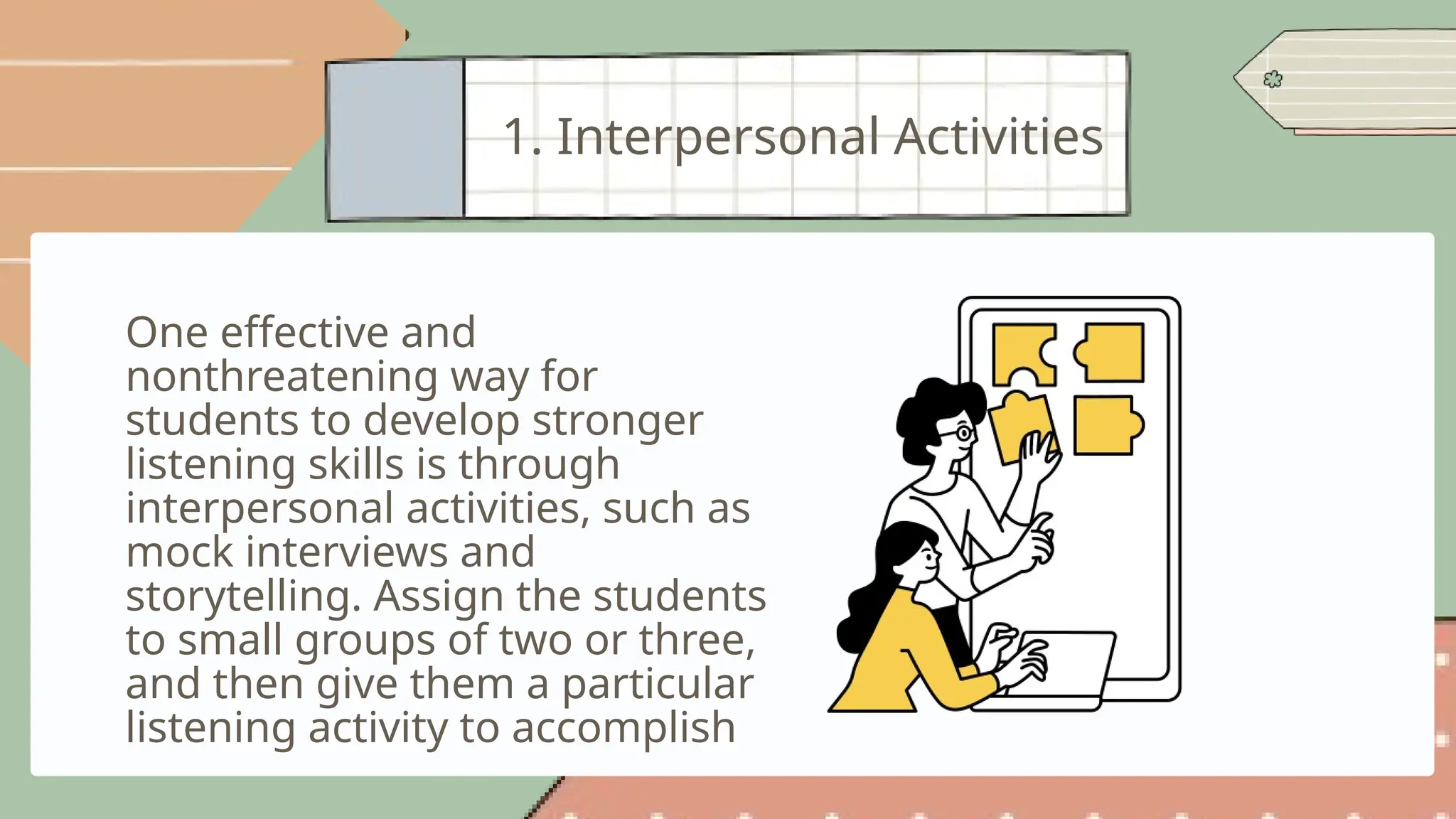
One effective and
nonthreatening way for
students to develop stronger
listening skills is through
interpersonal activities, such as
mock interviews and
storytelling. Assign the students
to small groups of two or three,
and then give them a particular
listening activity to accomplish
1. Interpersonal Activities
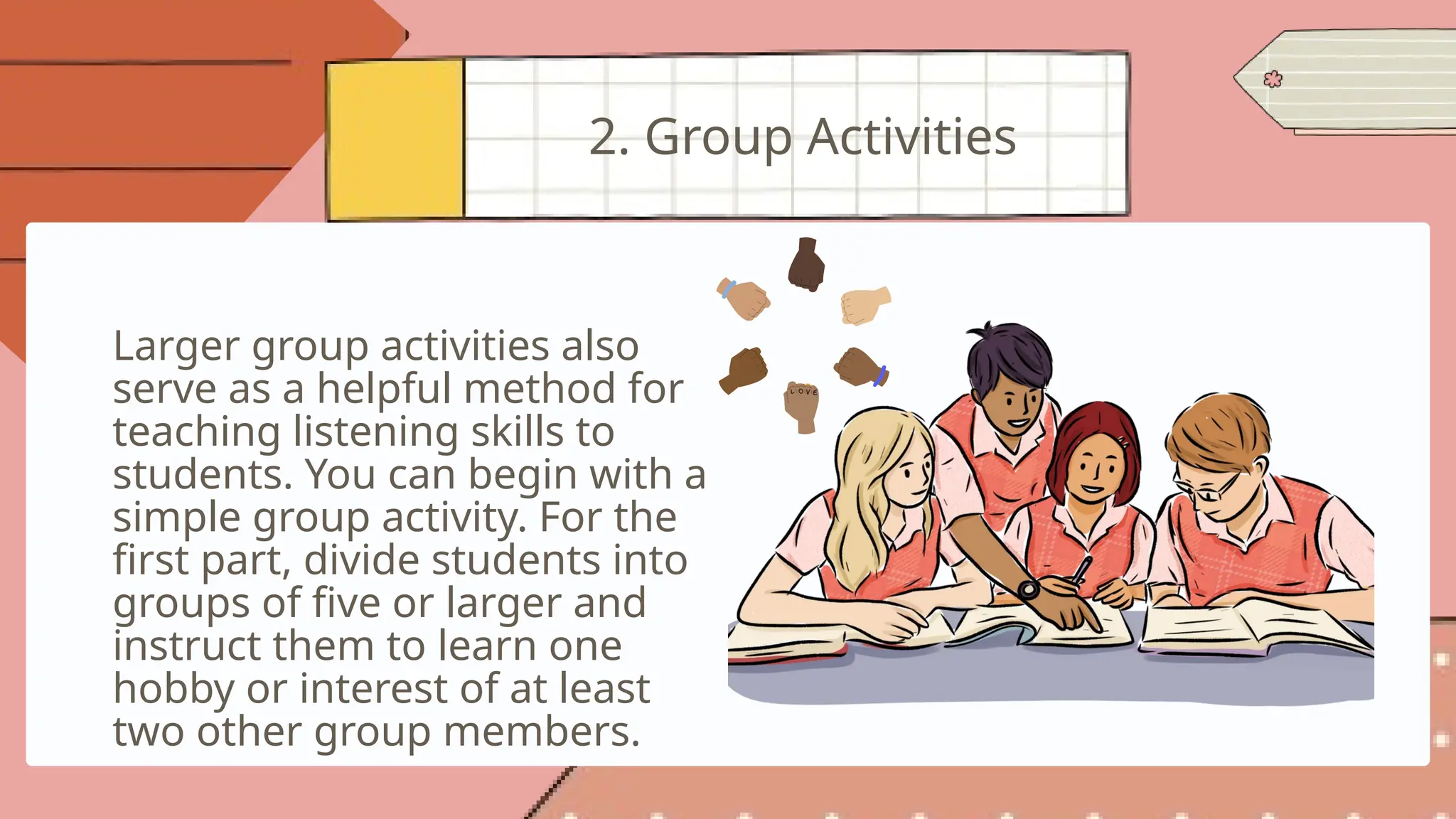
Larger group activities also
serve as a helpful method for
teaching listening skills to
students. You can begin with a
simple group activity. For the
first part, divide students into
groups of five or larger and
instruct them to learn one
hobby or interest of at least
two other group members.
2. Group Activities
You can also teach listening skills
through audio segments of radio
programs, online podcast,
instructional lectures and other
audio messages. You should model
this interactive listening process in
class with your students, and then
instruct them to repeat the exercise
on their own. First, instruct students
to prepare for listening by
considering anything that they will
want to learn from the content of the
audio segment.
3. Audio Segments/songs
Another helpful resource for
teaching listening skills are
video segments, including
short sketches, news
programs, documentary
films, interview segments,
and dramatic and comedic
material.
4. Video Segments
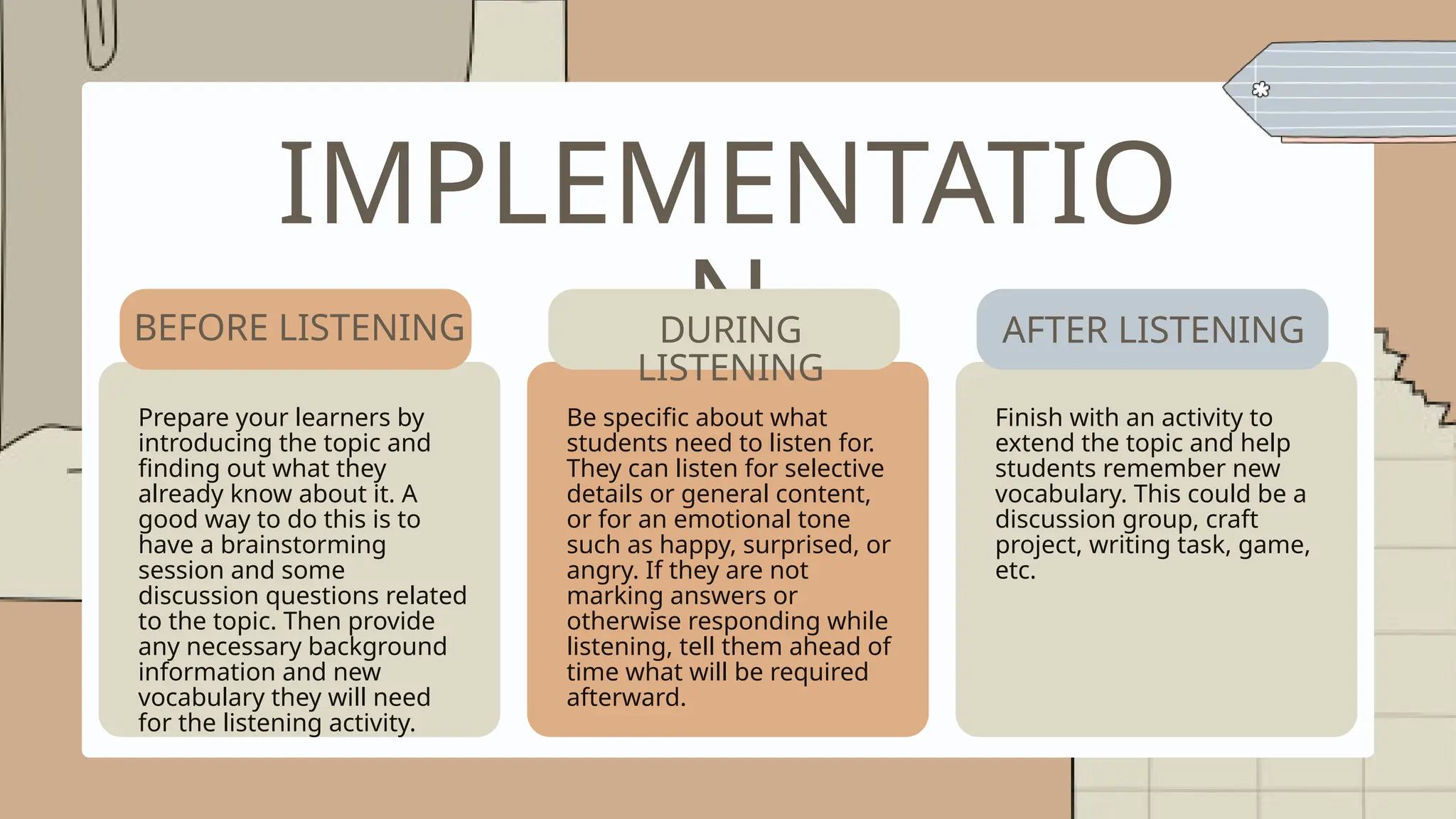
IMPLEMENTATIO
N
Prepare your learners by
introducing the topic and
finding out what they
already know about it. A
good way to do this is to
have a brainstorming
session and some
discussion questions related
to the topic. Then provide
any necessary background
information and new
vocabulary they will need
for the listening activity.
BEFORE LISTENING
Be specific about what
students need to listen for.
They can listen for selective
details or general content,
or for an emotional tone
such as happy, surprised, or
angry. If they are not
marking answers or
otherwise responding while
listening, tell them ahead of
time what will be required
afterward.
DURING
LISTENING
Finish with an activity to
extend the topic and help
students remember new
vocabulary. This could be a
discussion group, craft
project, writing task, game,
etc.
AFTER LISTENING
Thank You

Listening Presentation.pptx ONE OF THE MACRO SKILLS

  • 1.
    LISTENING Presented by :Cember Castle Caracas
  • 2.
    INTRODUCTI ON Listening is theability to accurately receive and interpret messages in the communication process. Listening is key to all effective communication, without the ability to listen effectively messages are easily misunderstood – communication breaks down and the sender of the message can easily become frustrated or irritated.
  • 3.
    REMEMBER: LISTENING IS NOT THESAME AS HEARING! Hearing refers to the sounds that you hear, whereas listening requires more than that: it requires focus. Listening means paying attention not only to the story, but how it is told, the use of language and voice, and how the other person uses his or her body. In other words, it means being aware of both verbal and non-verbal messages. Your ability to listen effectively depends on the degree to which you perceive and understand these messages.
  • 4.
    METHODS OF TEACHING LISTENING SKILLS 1.Interpersonal Activities 3. Audio Segments/songs 4. Video Segments 2. Group Activities
  • 5.
    One effective and nonthreateningway for students to develop stronger listening skills is through interpersonal activities, such as mock interviews and storytelling. Assign the students to small groups of two or three, and then give them a particular listening activity to accomplish 1. Interpersonal Activities
  • 6.
    Larger group activitiesalso serve as a helpful method for teaching listening skills to students. You can begin with a simple group activity. For the first part, divide students into groups of five or larger and instruct them to learn one hobby or interest of at least two other group members. 2. Group Activities
  • 7.
    You can alsoteach listening skills through audio segments of radio programs, online podcast, instructional lectures and other audio messages. You should model this interactive listening process in class with your students, and then instruct them to repeat the exercise on their own. First, instruct students to prepare for listening by considering anything that they will want to learn from the content of the audio segment. 3. Audio Segments/songs
  • 8.
    Another helpful resourcefor teaching listening skills are video segments, including short sketches, news programs, documentary films, interview segments, and dramatic and comedic material. 4. Video Segments
  • 9.
    IMPLEMENTATIO N Prepare your learnersby introducing the topic and finding out what they already know about it. A good way to do this is to have a brainstorming session and some discussion questions related to the topic. Then provide any necessary background information and new vocabulary they will need for the listening activity. BEFORE LISTENING Be specific about what students need to listen for. They can listen for selective details or general content, or for an emotional tone such as happy, surprised, or angry. If they are not marking answers or otherwise responding while listening, tell them ahead of time what will be required afterward. DURING LISTENING Finish with an activity to extend the topic and help students remember new vocabulary. This could be a discussion group, craft project, writing task, game, etc. AFTER LISTENING
  • 10.