The Communicative
Approach
Ivy F. Garcia, M.A.
The communicative approach is the
theory that language is
communication. Therefore the final
aim of CLT (Communicative
Language Teaching) is
communicative competence.
What is the communicative
approach?
Model of communicative competence
Grammatical competence:
knowledge of the language
code- syntax , lexis,
Sociolinguistic
competence:
[Pragmatic]
Strategic competence :
Verbal and non-verbal
communication strategies,
compensate for breakdown
in communication. Ability to
get one’s meaning across
successfully when problems
Sociocultural rules:
rules of using language
appropriately in a given
social situation,
concerned with style,
politeness register, etc
Discourse rules:
knowledge of combining
language structures to
produce unifies texts in
different modes: writing,
speaking
ที่มา: Canale, M & Swain,M 1980. Theoretical based of communicative
approaches to second language teaching and testing. Applied Linguistics.1/1:1-
47.
 Learners learn through using it to communicate
 Authentic and meaningful communication
should be the goal of classroom activities
 Fluency is an important dimension of
communication
 Communication involves the integration of
different language skills
 Learning is a process of creative construction
and involves trial and error
The Principles of the Communicative
Approach:
 Use Language as:
 means of communication
 object of learning
 means of expressing values
 Focus on communication rather than structure
 Language learning within the school curriculum
 Focus on meaningful tasks
 Collaboration
CLT Objectives
Compare and Contrast
 The learner role as a negotiator, between himself, the
learning process, interaction with the group’s
activities and classroom procedures.
 In other words, the learner should contribute as much
as he gains in the classroom, learning in an
interdependent way. (Richards J., C., Rodgers T.
S.(p.77).
Learner Role
The teacher has two main roles:
 To facilitate the communication process in the classroom
 To act as an independent participant within the learning-
teaching group
what is the teacher’s role in this?
It means that we need to concentrate on the
following:
Teacher – Student activities
Activities
Materials
In practical terms, what does that
mean?
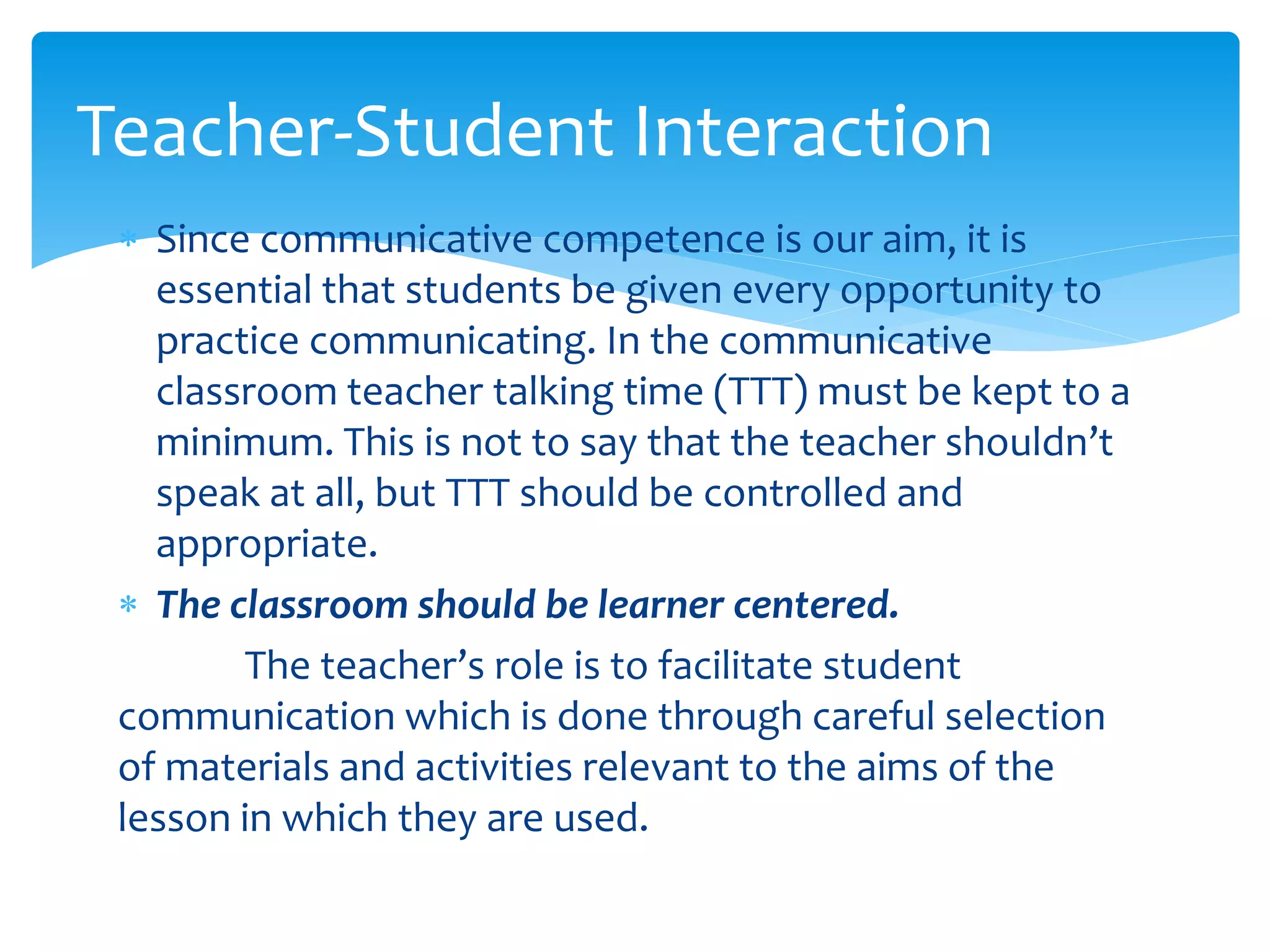
 Since communicative competence is our aim, it is
essential that students be given every opportunity to
practice communicating. In the communicative
classroom teacher talking time (TTT) must be kept to a
minimum. This is not to say that the teacher shouldn’t
speak at all, but TTT should be controlled and
appropriate.
 The classroom should be learner centered.
The teacher’s role is to facilitate student
communication which is done through careful selection
of materials and activities relevant to the aims of the
lesson in which they are used.
Teacher-Student Interaction
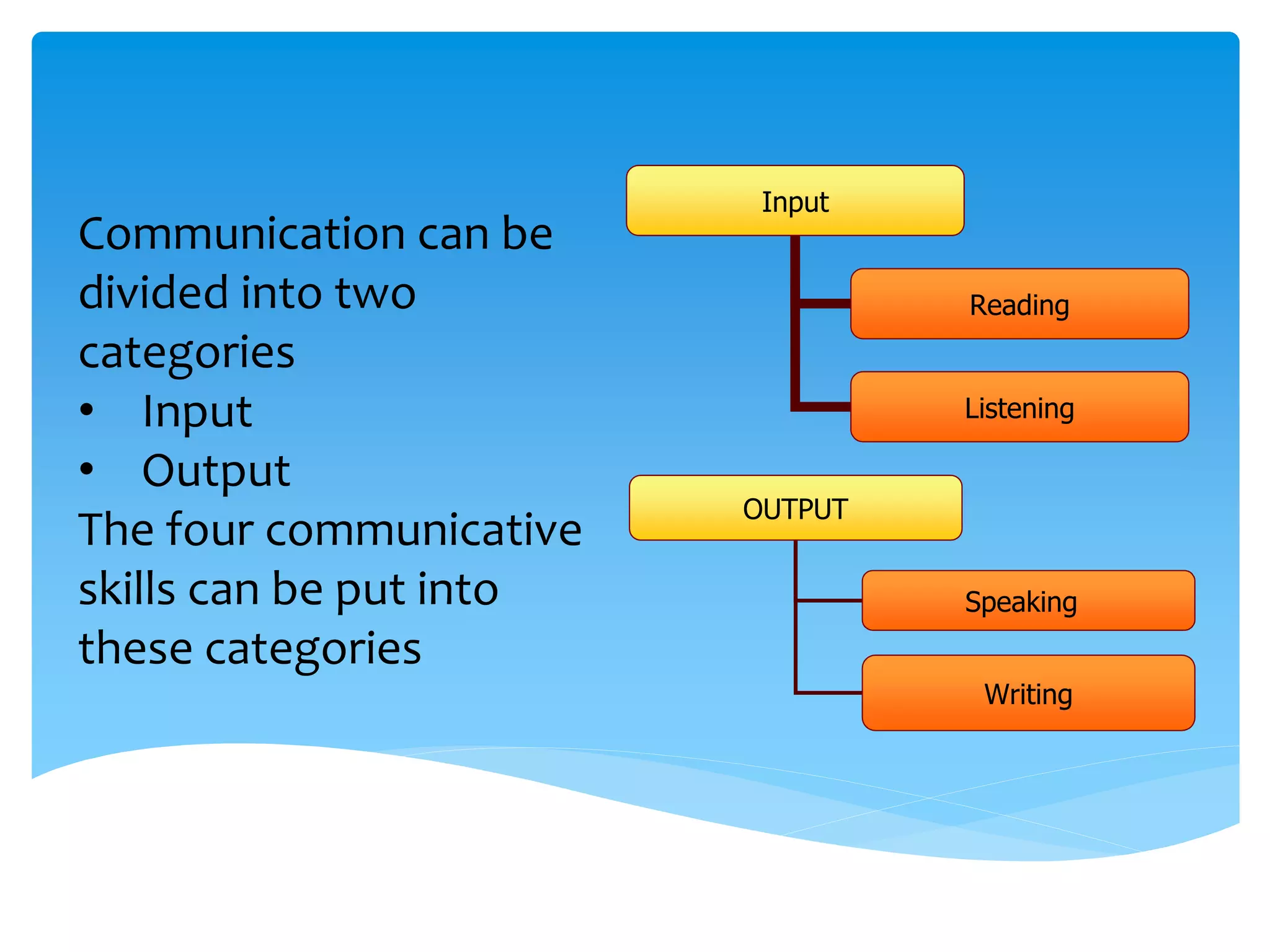
Input
Reading
Listening
OUTPUT
Speaking
Writing
Communication can be
divided into two
categories
• Input
• Output
The four communicative
skills can be put into
these categories
Whichever of these skills is being taught the
main focus must be on the student and not on
the teacher. The interaction should usually be
the student to student and should include the
teacher only where necessary. During most
classroom activities the teacher will monitor
and intervene only where necessary.
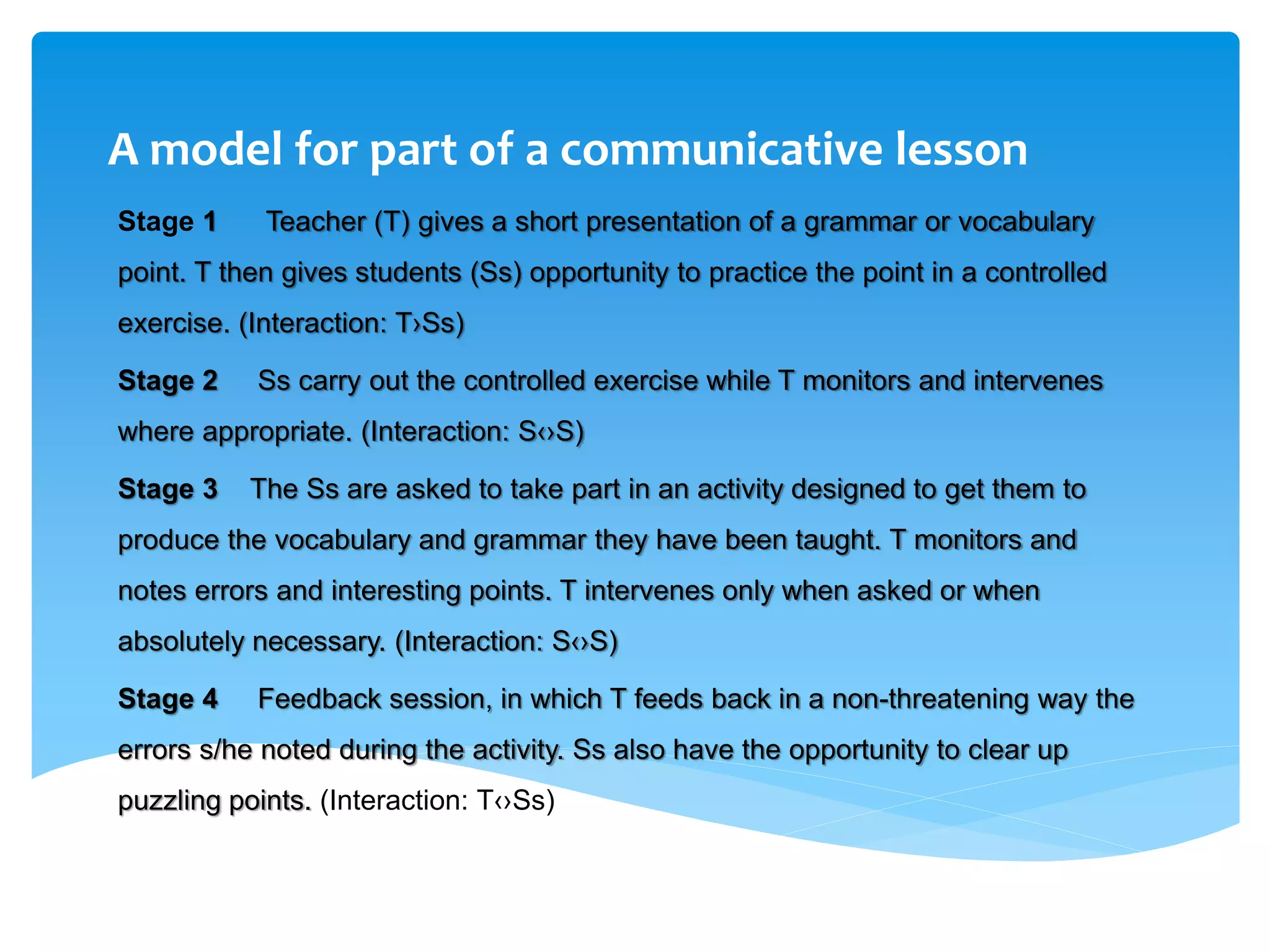
A model for part of a communicative lesson
Stage 1 Teacher (T) gives a short presentation of a grammar or vocabulary
point. T then gives students (Ss) opportunity to practice the point in a controlled
exercise. (Interaction: T›Ss)
Stage 2 Ss carry out the controlled exercise while T monitors and intervenes
where appropriate. (Interaction: S‹›S)
Stage 3 The Ss are asked to take part in an activity designed to get them to
produce the vocabulary and grammar they have been taught. T monitors and
notes errors and interesting points. T intervenes only when asked or when
absolutely necessary. (Interaction: S‹›S)
Stage 4 Feedback session, in which T feeds back in a non-threatening way the
errors s/he noted during the activity. Ss also have the opportunity to clear up
puzzling points. (Interaction: T‹›Ss)
 The lesson extract follows a method called
Presentation-Practice-Production or PPP for
short.
 This was the standard method until a few years
ago. Now there are a number of possibilities open to
the teacher.
 You will be introduced to these at a later stage.
Classroom activities should be carried out in the target
language (English).
Having said this, there may sometimes be occasions where
allowing the students to briefly discuss a point in their native
tongue can promote greater understanding and assimilation of
new information. This is controversial issue and should not
usually be permitted.
Activities
 Materials are seen as a way of influencing the quality
of classroom interaction and language use.
 They have promote communicative language use.
 Some Instructional Materials are:
 Visual cues
 Taped cues
 Pictures
The Role of Instructional Materials
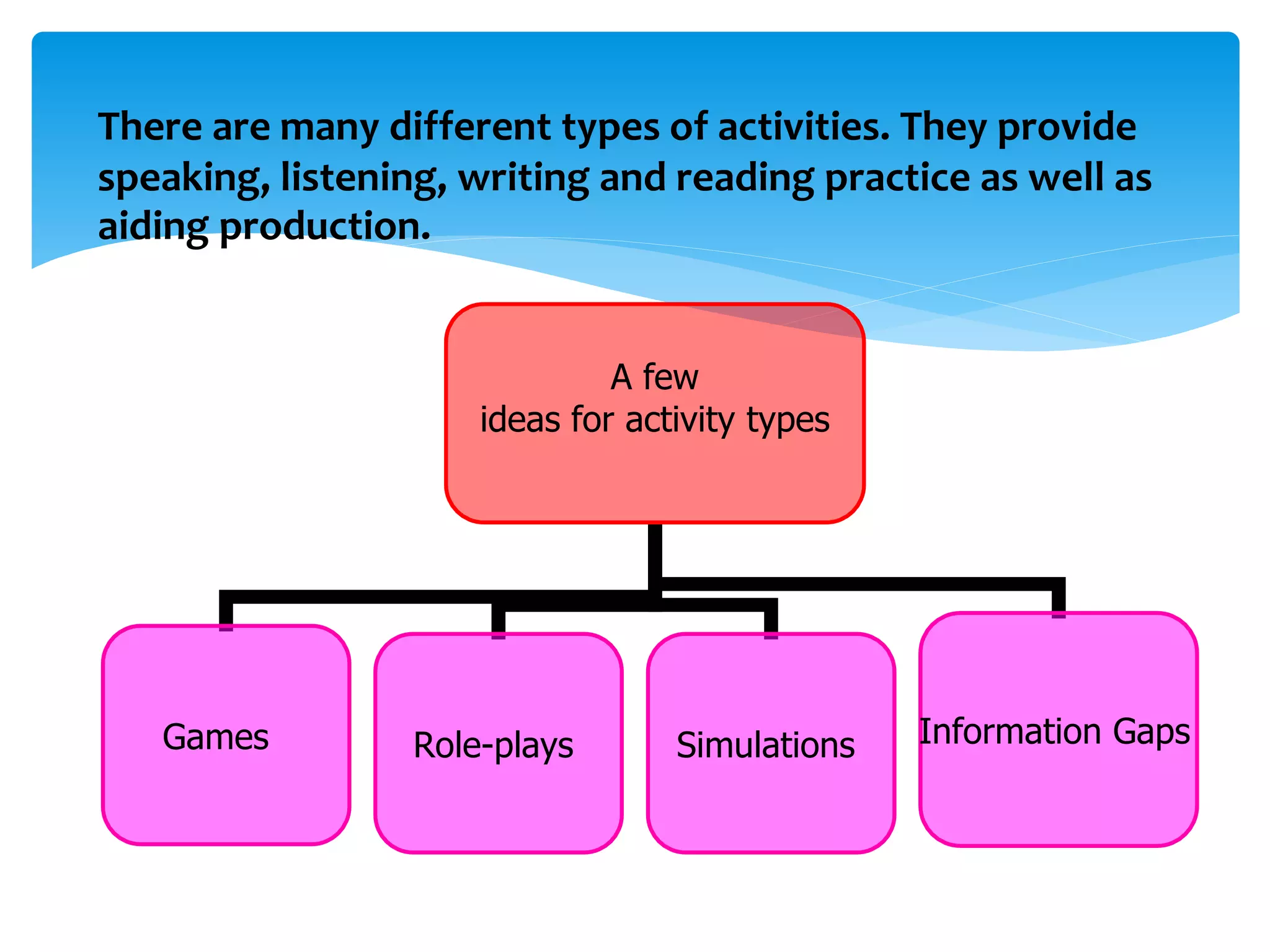
There are many different types of activities. They provide
speaking, listening, writing and reading practice as well as
aiding production.
A few
ideas for activity types
Games Role-plays Simulations Information Gaps
 They can be found in books containing supplementary
material.
 Many teachers enjoy creating their own activities,
which can be tailored specifically to their classes needs.
 Activities used in the classroom must be selected
carefully as if they are above the level of the students they
can destroy self-confidence and if below they can bore the
students.
 Activities usually involve the students working
together either in pairs or in small groups.
Where do I find activities?
Activities are often used to
practice real-life situations
involving social interaction and
so a high level of social and
functional language should be
expected.
 Materials fall into three broad categories:
 text-based,
 task-based
 realia.
They can be used as the basis for classroom
activities. Once again not only must the activity be
appropriate to the level of the students but the materials
used must be appropriate too.
Materials
For example practice exercises,
reading passages, gap fills, recordings,
etc. can be found in almost any course
book as well as in books containing
supplementary materials. They form an
essential part of most lessons.
Text-based materials
These include game boards, role-play cards,
materials for drilling, pair work tasks, etc.
They might be used to support 'real life'
tasks such as role playing booking into a hotel,
or a job interview.
Task-based materials
This includes such things as magazines,
newspapers, fruit and vegetables, axes, maps - things
from the real world outside the classroom.
They can be used in many activities.
For example, fruit and vegetables could be used
in a shopping activity, an act could be used to show the
effect of using the present perfect continuous on a
short action verb.
Realia
 We should now understand that the
teacher's job is to get their students to
communicate using real language by
providing them with instruction,
practice, and above all opportunities to
produce English in activities which
encourage acquisition and fluency.
what does the communicative
approach mean in practical terms?
 CLT should be fun for both teacher and students.
 Enabling students to communicate successfully
is also very rewarding.
In conclusion
 Richards, J. C. Rodgers, T. S. (1992). Approaches and Methods in Language Teaching.
New York: Cambridge University Press.
 Littlewood, W. (1981). Communicative Language Teaching an I ntroduction. London:
Cambridge University Press.
 Nunan, D. (1999). Second Language Teaching & Learning. New York: Heinle &
Heinle Publishers.
 Sun, G. & Cheng, L. (Spring 2002). From Context to Curriculum: A Case Study of
Communicative Language Teaching in China. [Electronic version]. TESL
Canada Journal. VOL. 19, NO.2. Retrieved August 29, 2012, from the Eric database.
 Criado, R. & Sánchez A. (2009). English Language Teaching in Spain: Do Textbooks
Comply with the Official Methodological Regulations? A Sample Analysis.
[Electronic version]. University of Murcia Publications. IJES, vol. 9 (1).
 Orwig, C. J. (1999, March 21). Communicative Language Teaching. Retrieved:
August 28, 2012, from SIL International, 1999. Web site:
 http://www.sil.org/lingualinks/LANGUAGELEARNING/WaysToApproachLanguageLearni
ng/CommunicativeLanguageTeaching.htm
References

Communicative approach

  • 1.
  • 2.
    The communicative approachis the theory that language is communication. Therefore the final aim of CLT (Communicative Language Teaching) is communicative competence. What is the communicative approach?
  • 3.
    Model of communicativecompetence Grammatical competence: knowledge of the language code- syntax , lexis, Sociolinguistic competence: [Pragmatic] Strategic competence : Verbal and non-verbal communication strategies, compensate for breakdown in communication. Ability to get one’s meaning across successfully when problems Sociocultural rules: rules of using language appropriately in a given social situation, concerned with style, politeness register, etc Discourse rules: knowledge of combining language structures to produce unifies texts in different modes: writing, speaking ที่มา: Canale, M & Swain,M 1980. Theoretical based of communicative approaches to second language teaching and testing. Applied Linguistics.1/1:1- 47.
  • 4.
     Learners learnthrough using it to communicate  Authentic and meaningful communication should be the goal of classroom activities  Fluency is an important dimension of communication  Communication involves the integration of different language skills  Learning is a process of creative construction and involves trial and error The Principles of the Communicative Approach:
  • 5.
     Use Languageas:  means of communication  object of learning  means of expressing values  Focus on communication rather than structure  Language learning within the school curriculum  Focus on meaningful tasks  Collaboration CLT Objectives
  • 6.
  • 7.
     The learnerrole as a negotiator, between himself, the learning process, interaction with the group’s activities and classroom procedures.  In other words, the learner should contribute as much as he gains in the classroom, learning in an interdependent way. (Richards J., C., Rodgers T. S.(p.77). Learner Role
  • 8.
    The teacher hastwo main roles:  To facilitate the communication process in the classroom  To act as an independent participant within the learning- teaching group what is the teacher’s role in this?
  • 9.
    It means thatwe need to concentrate on the following: Teacher – Student activities Activities Materials In practical terms, what does that mean?
  • 10.
     Since communicativecompetence is our aim, it is essential that students be given every opportunity to practice communicating. In the communicative classroom teacher talking time (TTT) must be kept to a minimum. This is not to say that the teacher shouldn’t speak at all, but TTT should be controlled and appropriate.  The classroom should be learner centered. The teacher’s role is to facilitate student communication which is done through careful selection of materials and activities relevant to the aims of the lesson in which they are used. Teacher-Student Interaction
  • 11.
    Input Reading Listening OUTPUT Speaking Writing Communication can be dividedinto two categories • Input • Output The four communicative skills can be put into these categories
  • 12.
    Whichever of theseskills is being taught the main focus must be on the student and not on the teacher. The interaction should usually be the student to student and should include the teacher only where necessary. During most classroom activities the teacher will monitor and intervene only where necessary.
  • 13.
    A model forpart of a communicative lesson Stage 1 Teacher (T) gives a short presentation of a grammar or vocabulary point. T then gives students (Ss) opportunity to practice the point in a controlled exercise. (Interaction: T›Ss) Stage 2 Ss carry out the controlled exercise while T monitors and intervenes where appropriate. (Interaction: S‹›S) Stage 3 The Ss are asked to take part in an activity designed to get them to produce the vocabulary and grammar they have been taught. T monitors and notes errors and interesting points. T intervenes only when asked or when absolutely necessary. (Interaction: S‹›S) Stage 4 Feedback session, in which T feeds back in a non-threatening way the errors s/he noted during the activity. Ss also have the opportunity to clear up puzzling points. (Interaction: T‹›Ss)
  • 14.
     The lessonextract follows a method called Presentation-Practice-Production or PPP for short.  This was the standard method until a few years ago. Now there are a number of possibilities open to the teacher.  You will be introduced to these at a later stage.
  • 15.
    Classroom activities shouldbe carried out in the target language (English). Having said this, there may sometimes be occasions where allowing the students to briefly discuss a point in their native tongue can promote greater understanding and assimilation of new information. This is controversial issue and should not usually be permitted. Activities
  • 16.
     Materials areseen as a way of influencing the quality of classroom interaction and language use.  They have promote communicative language use.  Some Instructional Materials are:  Visual cues  Taped cues  Pictures The Role of Instructional Materials
  • 17.
    There are manydifferent types of activities. They provide speaking, listening, writing and reading practice as well as aiding production. A few ideas for activity types Games Role-plays Simulations Information Gaps
  • 18.
     They canbe found in books containing supplementary material.  Many teachers enjoy creating their own activities, which can be tailored specifically to their classes needs.  Activities used in the classroom must be selected carefully as if they are above the level of the students they can destroy self-confidence and if below they can bore the students.  Activities usually involve the students working together either in pairs or in small groups. Where do I find activities?
  • 19.
    Activities are oftenused to practice real-life situations involving social interaction and so a high level of social and functional language should be expected.
  • 20.
     Materials fallinto three broad categories:  text-based,  task-based  realia. They can be used as the basis for classroom activities. Once again not only must the activity be appropriate to the level of the students but the materials used must be appropriate too. Materials
  • 21.
    For example practiceexercises, reading passages, gap fills, recordings, etc. can be found in almost any course book as well as in books containing supplementary materials. They form an essential part of most lessons. Text-based materials
  • 22.
    These include gameboards, role-play cards, materials for drilling, pair work tasks, etc. They might be used to support 'real life' tasks such as role playing booking into a hotel, or a job interview. Task-based materials
  • 23.
    This includes suchthings as magazines, newspapers, fruit and vegetables, axes, maps - things from the real world outside the classroom. They can be used in many activities. For example, fruit and vegetables could be used in a shopping activity, an act could be used to show the effect of using the present perfect continuous on a short action verb. Realia
  • 24.
     We shouldnow understand that the teacher's job is to get their students to communicate using real language by providing them with instruction, practice, and above all opportunities to produce English in activities which encourage acquisition and fluency. what does the communicative approach mean in practical terms?
  • 25.
     CLT shouldbe fun for both teacher and students.  Enabling students to communicate successfully is also very rewarding. In conclusion
  • 26.
     Richards, J.C. Rodgers, T. S. (1992). Approaches and Methods in Language Teaching. New York: Cambridge University Press.  Littlewood, W. (1981). Communicative Language Teaching an I ntroduction. London: Cambridge University Press.  Nunan, D. (1999). Second Language Teaching & Learning. New York: Heinle & Heinle Publishers.  Sun, G. & Cheng, L. (Spring 2002). From Context to Curriculum: A Case Study of Communicative Language Teaching in China. [Electronic version]. TESL Canada Journal. VOL. 19, NO.2. Retrieved August 29, 2012, from the Eric database.  Criado, R. & Sánchez A. (2009). English Language Teaching in Spain: Do Textbooks Comply with the Official Methodological Regulations? A Sample Analysis. [Electronic version]. University of Murcia Publications. IJES, vol. 9 (1).  Orwig, C. J. (1999, March 21). Communicative Language Teaching. Retrieved: August 28, 2012, from SIL International, 1999. Web site:  http://www.sil.org/lingualinks/LANGUAGELEARNING/WaysToApproachLanguageLearni ng/CommunicativeLanguageTeaching.htm References