HOSTILE OR A RESPECTFUL
WORKPLACE?
Presented by LifeServices EAP
Margie Roop, LPCC-S,CEAP; SAP
1-800-822-4847
www.lifeserviceseap.com
Training Objectives
 Increase understanding of difference between
disrespectful (hostile) and respectful behavior.
 Increase understanding of the impact
disrespectful behavior has on you, your work and
others.
 Identify your role and responsibility in creating
and maintaining a respectful workplace.
 Learn tools for creating a more respectful work
environment.
Why Should I Care?
 Increased commitment to job/higher job
satisfaction
 More productive on the job
 Higher satisfaction with personal/professional
development
 Higher trust of supervisor/coworkers
 More comfortable in providing feedback and ideas
 Avoid a lawsuit!
Why should I care?
 Feel more secure about my job.
 Alignment of my career plans with that of
institution
 Less absenteeism
 Improved morale
 Fewer work-family conflicts/stress
Factors to consider:
 Past experiences-how you were influenced?
 Norms/values that you adopted
 Polices/regulations/procedures/laws
 Own needs/motivations/self-confidence
 Cultural/socialization-sex, religion, ethnicity
 Position in organization
Why people are disrespectful
PersonalityTraits Motives
 Insecure
 Depressed
 Lack of empathy
 Clueless/lack of insight
 Paranoia
 Self-loathing
 Power & control
 “Pump self up”
 Self-righteousness
 Be left alone: repel others
 Confidence
 Be seen in the spotlight
How do you feel when someone is:
•Derogatory about your
ethnic background?
•Gender?
•Age?
•Physical characteristics?
•Religion?
•Physical appearance?
•Physical abilities?
•Intellectual abilities?
•Be honest!
Do you…
 Feel uncomfortable? Angry?
 Speak up?
 Walk away?
 Struggle with what IS appropriate and not?
 Find yourself unbothered?
 Avoid those who offend?
 Enjoin those disrespecting others?
When someone else is the
object of offense, do you…
 Laugh along with
everybody else?
 Walk away?
 Confront the offender?
 Report this behavior to
superiors?
 Just think the person is
“thin-skinned?”
Examples of Disrespectful
Behavior
 Body language
 Disrespectful listening
 Gossip/putting others in
bad light
 Invasion of
privacy/personal space
 Avoid/ignore others
 Putdowns/hurtful
statements or humor
More on the Continuum:
 Fault-finding; negativity
 Criticism or mocking in front of others
 “Know-it-all”/superiority attitude
 Obvious (to others) power struggles
 Unwanted imposition of beliefs/values
 Misuse of power/position
 Sexual Harassment; Hostile Work Environment
 Sex, Age, Disability, or Religious Discrimination
Continuum……
 Misdirected anger-”projection”
 Discrimination/harassment
 Outbursts of anger/rage
 Veiled threats
 Direct threats
 Physical violence
Why Disrespectful Behavior
is Not Addressed
 “It’s Justified.” “She deserved it.”
 Role modeling/normative for that workplace
 Own needs/motivations/feel self-confident
 Not taking responsibility for own behavior
 Ignore it and it’ll go away.
 Ignorance
More reasons…
 Lack of tools/training
 Don’t understand nor care about impact on
workplace/individuals.
 Lack of confidence in other’s responses (no
support within work group including
management).
 Fear of hurting other’s feelings; not being taken
seriously; being blamed
 Fear of retaliation.
More on “Projection”
 A classic defense
mechanism
 Persons externalize
negative feelings about
themselves onto
others.
 Personal foundation is
flawed, so insecurity is
great.
Projection: Classic Defense
Mechanism
 Persons have need to feel better about
themselves; only way they know (learned
behavior) is through disrespecting others.
 It’s easier to focus “self-negativity” or self-
loathing onto others than to face it
themselves.
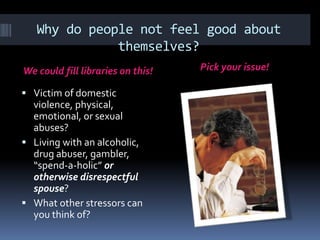
Why do people not feel good about
themselves?
We could fill libraries on this! Pick your issue!
 Victim of domestic
violence, physical,
emotional, or sexual
abuses?
 Living with an alcoholic,
drug abuser, gambler,
“spend-a-holic” or
otherwise disrespectful
spouse?
 What other stressors can
you think of?
The Individual Impact
 Stress/anxiety
 Fatigue/apathy
 Avoidance
 Withdrawal
 Self-esteem
 Retaliation
 Less job commitment
 Anger
 Powerlessness
 Less productive
 Fear
 Lose trust/respect
 Less communication
 Absenteeism
The Workplace Impact
 Productivity
 Job turnover
 Customer service
 Grievances
 Misuse of time
 Absenteeism
 Morale
 Fear/uncertainty
 Conflict
 Less group work
 Communication
 Factions
 Power struggles
 Less caring
 Suspicion/hostility
 Less committed
The Impact on Institution
 Public relations
 Morale
 Legal expenses
 Recruitment
 Higher use of medical
benefits
 Productivity
 Factions
 Loss of trust/respect
 Grievances
 Turnover costs
 Safety issues
How do you respond when…..
 When you see
offending behavior at
WORK what do you
do?
 Ignore?
 Deny it?
 Chime in?
 Laugh?
 DoYOU tell offending
jokes?
 DoYOU bully others?
What to do….
Helpful? Or, harmful?
 Get educated on what IS or IS
NOT appropriate!
 Do not ignore it!
 Say something right away to
the offending party or parties
to STOP IT!
 Speak to offending party (ies)
in more depth in a
confidential setting.
 Report it to management.
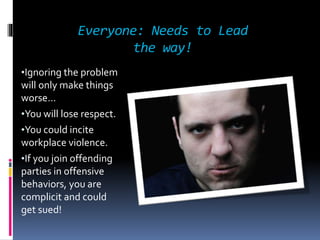
Everyone: Needs to Lead
the way!
•Ignoring the problem
will only make things
worse…
•You will lose respect.
•You could incite
workplace violence.
•If you join offending
parties in offensive
behaviors, you are
complicit and could
get sued!
Management
 Educate your staff on what is/is not
appropriate.
 Show them that you take this behavior
seriously.
 Utilize discipline as appropriate up to and
including the management referral
 Seek advice from your HR Department!
One-on-One
HowYOU communicate What you communicate
 Makes all the difference in
the world.
 Either demonstrates your
knowledge or your
ignorance.
 Sets the tone for your
department.
 Employees either feel safe
or fearful.
 Are you sending a message
that to “be part of the
group” one must be
offensive to others?
 Either produces or reduces
departmental stress.
 Either enhances or
destroys departmental
morale.
Continuum of Respectful
Behavior
Your Everyday Behavior Towards persons who offend
 Personal responsibility
 Integrity
 Positivity
 Honesty
 Accessibility
 Inclusion
 Credibility
 Objectivity
 Active listening
 Assertive communication
 Limit setting
 Seeking assistance with
management
 Management Referral to
EAP?
Active Listener?
 Body language
 Encouraging words
 Inviting, open-ended questions
 Restate what was said.
 Check out for mutual understanding.
 Summarize
Assertive Communicator?
 Objectivity
 Clarify your wants/needs
 Responsibility for OWN behavior
communication
 Speak directly with person involved
 “I” statements
Assertive Communicator?
 Identify type of communication occurring.
 Stay focused on issue.
 Problem-solving
 Establish boundaries/consequences.
 Mutual understanding of conversation
Problem Solver?
 Identify the real problem or its source.
 Identify all possible solutions.
 Discuss possible outcome of each solution.
 Mutually agree upon a solution and
implement it.
 Develop implementation plan.
 Evaluate
Can you reframe a situation?
 Identify situation that produces
uncomfortable or distressing feelings.
 Identify your automatic focus, thoughts, and
feelings about situation.
 Identify a more useful way to view this
situation which offers you choices and the
potential for growth.
Do YOU feel lack of power?
 DoYOU feel bullied by your employees?
 Feel pressure to “chime in” to their
behaviors?
 Feel ostrisized when you don’t laugh at their
inappropriate jokes?
 Feel powerless to do anything about it?
A good rule of thumb: What if it
were:
•Your wife or husband
•Your son or daughter
•Your mother or father
•How would you feel?
•What makes it different
to have someone else be
the butt of disrespect?
•Why do your co-
workers not deserve a
respectful workplace?
You have got to take a
stand!
 If you are struggling with “doing things
differently” now that you’ve heard this
lecture-FANTASTIC!
 If it makes you feel uncomfortable-BETTER
YET!
 If you want some help figuring things out and
wanting direction-WAYTO GO!
Call LifeServices EAP!
 For affirmation of your thoughts & feelings.
 For education on how to best approach
situations both in the workplace and family or
social situations.
 You deserve a safe & respectful workplace!!
Call LifeServices EAP
1-800-822-4847 24 hours a day!
Go out, do great things &
enjoy your life!

Respectfulworkplace forees-130115090711-phpapp01[1]

  • 1.
    HOSTILE OR ARESPECTFUL WORKPLACE? Presented by LifeServices EAP Margie Roop, LPCC-S,CEAP; SAP 1-800-822-4847 www.lifeserviceseap.com
  • 2.
    Training Objectives  Increaseunderstanding of difference between disrespectful (hostile) and respectful behavior.  Increase understanding of the impact disrespectful behavior has on you, your work and others.  Identify your role and responsibility in creating and maintaining a respectful workplace.  Learn tools for creating a more respectful work environment.
  • 3.
    Why Should ICare?  Increased commitment to job/higher job satisfaction  More productive on the job  Higher satisfaction with personal/professional development  Higher trust of supervisor/coworkers  More comfortable in providing feedback and ideas  Avoid a lawsuit!
  • 4.
    Why should Icare?  Feel more secure about my job.  Alignment of my career plans with that of institution  Less absenteeism  Improved morale  Fewer work-family conflicts/stress
  • 5.
    Factors to consider: Past experiences-how you were influenced?  Norms/values that you adopted  Polices/regulations/procedures/laws  Own needs/motivations/self-confidence  Cultural/socialization-sex, religion, ethnicity  Position in organization
  • 6.
    Why people aredisrespectful PersonalityTraits Motives  Insecure  Depressed  Lack of empathy  Clueless/lack of insight  Paranoia  Self-loathing  Power & control  “Pump self up”  Self-righteousness  Be left alone: repel others  Confidence  Be seen in the spotlight
  • 7.
    How do youfeel when someone is: •Derogatory about your ethnic background? •Gender? •Age? •Physical characteristics? •Religion? •Physical appearance? •Physical abilities? •Intellectual abilities? •Be honest!
  • 8.
    Do you…  Feeluncomfortable? Angry?  Speak up?  Walk away?  Struggle with what IS appropriate and not?  Find yourself unbothered?  Avoid those who offend?  Enjoin those disrespecting others?
  • 9.
    When someone elseis the object of offense, do you…  Laugh along with everybody else?  Walk away?  Confront the offender?  Report this behavior to superiors?  Just think the person is “thin-skinned?”
  • 10.
    Examples of Disrespectful Behavior Body language  Disrespectful listening  Gossip/putting others in bad light  Invasion of privacy/personal space  Avoid/ignore others  Putdowns/hurtful statements or humor
  • 11.
    More on theContinuum:  Fault-finding; negativity  Criticism or mocking in front of others  “Know-it-all”/superiority attitude  Obvious (to others) power struggles  Unwanted imposition of beliefs/values  Misuse of power/position  Sexual Harassment; Hostile Work Environment  Sex, Age, Disability, or Religious Discrimination
  • 12.
    Continuum……  Misdirected anger-”projection” Discrimination/harassment  Outbursts of anger/rage  Veiled threats  Direct threats  Physical violence
  • 13.
    Why Disrespectful Behavior isNot Addressed  “It’s Justified.” “She deserved it.”  Role modeling/normative for that workplace  Own needs/motivations/feel self-confident  Not taking responsibility for own behavior  Ignore it and it’ll go away.  Ignorance
  • 14.
    More reasons…  Lackof tools/training  Don’t understand nor care about impact on workplace/individuals.  Lack of confidence in other’s responses (no support within work group including management).  Fear of hurting other’s feelings; not being taken seriously; being blamed  Fear of retaliation.
  • 15.
    More on “Projection” A classic defense mechanism  Persons externalize negative feelings about themselves onto others.  Personal foundation is flawed, so insecurity is great.
  • 16.
    Projection: Classic Defense Mechanism Persons have need to feel better about themselves; only way they know (learned behavior) is through disrespecting others.  It’s easier to focus “self-negativity” or self- loathing onto others than to face it themselves.
  • 17.
    Why do peoplenot feel good about themselves? We could fill libraries on this! Pick your issue!  Victim of domestic violence, physical, emotional, or sexual abuses?  Living with an alcoholic, drug abuser, gambler, “spend-a-holic” or otherwise disrespectful spouse?  What other stressors can you think of?
  • 18.
    The Individual Impact Stress/anxiety  Fatigue/apathy  Avoidance  Withdrawal  Self-esteem  Retaliation  Less job commitment  Anger  Powerlessness  Less productive  Fear  Lose trust/respect  Less communication  Absenteeism
  • 19.
    The Workplace Impact Productivity  Job turnover  Customer service  Grievances  Misuse of time  Absenteeism  Morale  Fear/uncertainty  Conflict  Less group work  Communication  Factions  Power struggles  Less caring  Suspicion/hostility  Less committed
  • 20.
    The Impact onInstitution  Public relations  Morale  Legal expenses  Recruitment  Higher use of medical benefits  Productivity  Factions  Loss of trust/respect  Grievances  Turnover costs  Safety issues
  • 21.
    How do yourespond when…..  When you see offending behavior at WORK what do you do?  Ignore?  Deny it?  Chime in?  Laugh?  DoYOU tell offending jokes?  DoYOU bully others?
  • 22.
    What to do…. Helpful?Or, harmful?  Get educated on what IS or IS NOT appropriate!  Do not ignore it!  Say something right away to the offending party or parties to STOP IT!  Speak to offending party (ies) in more depth in a confidential setting.  Report it to management.
  • 23.
    Everyone: Needs toLead the way! •Ignoring the problem will only make things worse… •You will lose respect. •You could incite workplace violence. •If you join offending parties in offensive behaviors, you are complicit and could get sued!
  • 24.
    Management  Educate yourstaff on what is/is not appropriate.  Show them that you take this behavior seriously.  Utilize discipline as appropriate up to and including the management referral  Seek advice from your HR Department!
  • 25.
    One-on-One HowYOU communicate Whatyou communicate  Makes all the difference in the world.  Either demonstrates your knowledge or your ignorance.  Sets the tone for your department.  Employees either feel safe or fearful.  Are you sending a message that to “be part of the group” one must be offensive to others?  Either produces or reduces departmental stress.  Either enhances or destroys departmental morale.
  • 26.
    Continuum of Respectful Behavior YourEveryday Behavior Towards persons who offend  Personal responsibility  Integrity  Positivity  Honesty  Accessibility  Inclusion  Credibility  Objectivity  Active listening  Assertive communication  Limit setting  Seeking assistance with management  Management Referral to EAP?
  • 27.
    Active Listener?  Bodylanguage  Encouraging words  Inviting, open-ended questions  Restate what was said.  Check out for mutual understanding.  Summarize
  • 28.
    Assertive Communicator?  Objectivity Clarify your wants/needs  Responsibility for OWN behavior communication  Speak directly with person involved  “I” statements
  • 29.
    Assertive Communicator?  Identifytype of communication occurring.  Stay focused on issue.  Problem-solving  Establish boundaries/consequences.  Mutual understanding of conversation
  • 30.
    Problem Solver?  Identifythe real problem or its source.  Identify all possible solutions.  Discuss possible outcome of each solution.  Mutually agree upon a solution and implement it.  Develop implementation plan.  Evaluate
  • 31.
    Can you reframea situation?  Identify situation that produces uncomfortable or distressing feelings.  Identify your automatic focus, thoughts, and feelings about situation.  Identify a more useful way to view this situation which offers you choices and the potential for growth.
  • 32.
    Do YOU feellack of power?  DoYOU feel bullied by your employees?  Feel pressure to “chime in” to their behaviors?  Feel ostrisized when you don’t laugh at their inappropriate jokes?  Feel powerless to do anything about it?
  • 33.
    A good ruleof thumb: What if it were: •Your wife or husband •Your son or daughter •Your mother or father •How would you feel? •What makes it different to have someone else be the butt of disrespect? •Why do your co- workers not deserve a respectful workplace?
  • 34.
    You have gotto take a stand!  If you are struggling with “doing things differently” now that you’ve heard this lecture-FANTASTIC!  If it makes you feel uncomfortable-BETTER YET!  If you want some help figuring things out and wanting direction-WAYTO GO!
  • 35.
    Call LifeServices EAP! For affirmation of your thoughts & feelings.  For education on how to best approach situations both in the workplace and family or social situations.  You deserve a safe & respectful workplace!! Call LifeServices EAP 1-800-822-4847 24 hours a day!
  • 36.
    Go out, dogreat things & enjoy your life!