Office Practice and
Etiquette
By Albert Mashamba
Organisational Psychologist & Human Resource
Management Consultant
By Albert Mashamba
LEARNING POINTS
• OUTCOMES:
1. What is office etiquette
2. Why is it important
3. Aspects of office etiquette
4. Common Do’s and Don’ts
5. Dealing with incorrect etiquette
By Albert Mashamba
“TO LOOK AND ACT EXCELLENTLY ISTO BE
EXCELLENT!”
• Office etiquette is “the way you conduct yourself through action, inaction
or verbally within any given work space” –Albert Mashamba
• This is guided by writtenor unspoken code of professional
conduct?
By Albert Mashamba
IMPORTANCE OF HAVING GOOD OFFICE
ETIQUETTE
• Recognizing the critical link between office practice and profit is key
to your success by learning how to correctly interactwith
colleagues in ways that make you and your whole organization shine.
By Albert Mashamba
SO WHAT IS ‘GOOD’ OFFICE ETIQUETTE
• No one answer!
• BUT! Each organisation should have some universally applicable rules.
By Albert Mashamba
SO HOW SHOULD I ACT?
• STEER CLEAR OF EMOTIVETOPICS!
• Politics
• Religion
• Sex life
• Career aspirations
• Personal problems
By Albert Mashamba
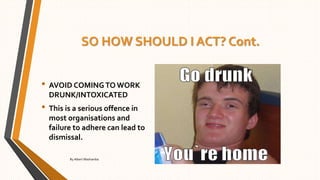
SO HOW SHOULD I ACT? Cont.
• AVOID COMINGTO WORK
DRUNK/INTOXICATED
• This is a serious offence in
most organisations and
failure to adhere can lead to
dismissal.
By Albert Mashamba
SO HOW SHOULD I ACT? Cont.
• STAYTIME CONSCIOUS
• Respect your colleagues and clients time.
• If you set a meeting or have acknowledged going to one be there on time.
By Albert Mashamba
SO HOW SHOULD I ACT? Cont.
• WATCHYOUR LANGUAGE,TONE ANDVOLUME
• Avoid abusive and denigrating language
• No need to shout in an office environment. (However this is not an all encompassing
rule. In work areas with much noise it may be necessary to communicate at high
volume)
By Albert Mashamba
SO HOW SHOULD I ACT? Cont.
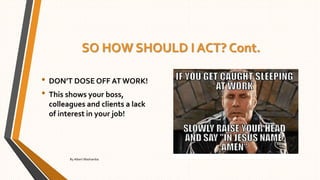
• DON’T DOSE OFF AT WORK!
• This shows your boss,
colleagues and clients a lack
of interest in your job!
By Albert Mashamba
SO HOW SHOULD I ACT? Cont.
• USE PROFESSIONAL COMMUNICATION METHODS
• Always strive to communicate in a manner which leaves a “papertrail”
• Avoid greetings such as “what’s up” or “hi” in professional
communication
By Albert Mashamba
SO HOW SHOULD I ACT? Cont.
• TIDINESS
• Keep your office space clean.
• Don’t mess other peoples spaces either.
• Besides your environment it is also crucial to look presentable too- always chose
your work clothes carefully to portray professionalism.
By Albert Mashamba
SO HOW SHOULD I
ACT? Cont.
• DON’T EAVESDROP OR GOSSIP
By Albert Mashamba
SO HOW SHOULD I
ACT? Cont.
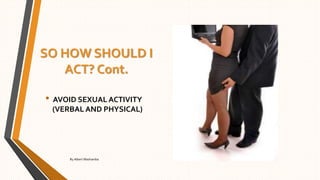
• AVOID SEXUAL ACTIVITY
(VERBAL AND PHYSICAL)
By Albert Mashamba
SO HOW SHOULD I ACT? Cont.
• Avoid replying to an offensive comment immediately.
By Albert Mashamba
DEALING WITH BAD OFFICE ETIQUETTE
• Don’t reciprocate bad office behaviour.
• Document an employees unwanted behaviour if possible.
• Stay calm and don’t get emotional or angry. We all have bad days every now
and then; sometimes a sympathetic comment is the best way to direct a co-
worker toward better behaviour.
By Albert Mashamba
DEALING WITH BAD OFFICE ETIQUETTE Cont.
• Meet with the person in a private location and explain how his or her bad
manners are affecting you.
• Make sure you understand your company’s business ethics and procedures
for reporting infractions.
• If the bad behaviour continues or worsens after you’ve spoken with the
offender, seek help from your manager or a representative from HR.
By Albert Mashamba
SOME STATISTICS
• Research shows that 60-80% of all difficulties in organizations stem from
strained relationships between employees, not from deficits in individual
employee’s skill or motivation
• How does bad office etiquette contribute to strained relationships?
By Albert Mashamba
SOME MORE STATISTICS!
• The typical manager spends 25-40% of his or her time dealing with
workplace conflicts (one to two days of every workweek)
By Albert Mashamba
BAD OFFICE ETTIQUETTE AND CONFLICT
• The above statistics show how management deal with conflict BUT this isn’t
the worst case scenario.
• Conflict resulting from improper employee/employer office etiquette can go
unresolved.
• THIS ISTHEWORST CASE SCENARIO!
By Albert Mashamba
DIFFERENT STROKES FOR DIFFERENT FOLKS
• THERE IS A NEEDTO RECOGNIZE AND APPRECIATE
• Our colleagues preferences
• The working environment (what industry are you in)
• The cultural values which are set out
• It all boils down to Respecting yourself and others.
By Albert Mashamba
THANKYOU
THE END!
By Albert Mashamba

Office Practice and Etiquette

  • 1.
    Office Practice and Etiquette ByAlbert Mashamba Organisational Psychologist & Human Resource Management Consultant By Albert Mashamba
  • 2.
    LEARNING POINTS • OUTCOMES: 1.What is office etiquette 2. Why is it important 3. Aspects of office etiquette 4. Common Do’s and Don’ts 5. Dealing with incorrect etiquette By Albert Mashamba
  • 3.
    “TO LOOK ANDACT EXCELLENTLY ISTO BE EXCELLENT!” • Office etiquette is “the way you conduct yourself through action, inaction or verbally within any given work space” –Albert Mashamba • This is guided by writtenor unspoken code of professional conduct? By Albert Mashamba
  • 4.
    IMPORTANCE OF HAVINGGOOD OFFICE ETIQUETTE • Recognizing the critical link between office practice and profit is key to your success by learning how to correctly interactwith colleagues in ways that make you and your whole organization shine. By Albert Mashamba
  • 5.
    SO WHAT IS‘GOOD’ OFFICE ETIQUETTE • No one answer! • BUT! Each organisation should have some universally applicable rules. By Albert Mashamba
  • 6.
    SO HOW SHOULDI ACT? • STEER CLEAR OF EMOTIVETOPICS! • Politics • Religion • Sex life • Career aspirations • Personal problems By Albert Mashamba
  • 7.
    SO HOW SHOULDI ACT? Cont. • AVOID COMINGTO WORK DRUNK/INTOXICATED • This is a serious offence in most organisations and failure to adhere can lead to dismissal. By Albert Mashamba
  • 8.
    SO HOW SHOULDI ACT? Cont. • STAYTIME CONSCIOUS • Respect your colleagues and clients time. • If you set a meeting or have acknowledged going to one be there on time. By Albert Mashamba
  • 9.
    SO HOW SHOULDI ACT? Cont. • WATCHYOUR LANGUAGE,TONE ANDVOLUME • Avoid abusive and denigrating language • No need to shout in an office environment. (However this is not an all encompassing rule. In work areas with much noise it may be necessary to communicate at high volume) By Albert Mashamba
  • 10.
    SO HOW SHOULDI ACT? Cont. • DON’T DOSE OFF AT WORK! • This shows your boss, colleagues and clients a lack of interest in your job! By Albert Mashamba
  • 11.
    SO HOW SHOULDI ACT? Cont. • USE PROFESSIONAL COMMUNICATION METHODS • Always strive to communicate in a manner which leaves a “papertrail” • Avoid greetings such as “what’s up” or “hi” in professional communication By Albert Mashamba
  • 12.
    SO HOW SHOULDI ACT? Cont. • TIDINESS • Keep your office space clean. • Don’t mess other peoples spaces either. • Besides your environment it is also crucial to look presentable too- always chose your work clothes carefully to portray professionalism. By Albert Mashamba
  • 13.
    SO HOW SHOULDI ACT? Cont. • DON’T EAVESDROP OR GOSSIP By Albert Mashamba
  • 14.
    SO HOW SHOULDI ACT? Cont. • AVOID SEXUAL ACTIVITY (VERBAL AND PHYSICAL) By Albert Mashamba
  • 15.
    SO HOW SHOULDI ACT? Cont. • Avoid replying to an offensive comment immediately. By Albert Mashamba
  • 16.
    DEALING WITH BADOFFICE ETIQUETTE • Don’t reciprocate bad office behaviour. • Document an employees unwanted behaviour if possible. • Stay calm and don’t get emotional or angry. We all have bad days every now and then; sometimes a sympathetic comment is the best way to direct a co- worker toward better behaviour. By Albert Mashamba
  • 17.
    DEALING WITH BADOFFICE ETIQUETTE Cont. • Meet with the person in a private location and explain how his or her bad manners are affecting you. • Make sure you understand your company’s business ethics and procedures for reporting infractions. • If the bad behaviour continues or worsens after you’ve spoken with the offender, seek help from your manager or a representative from HR. By Albert Mashamba
  • 18.
    SOME STATISTICS • Researchshows that 60-80% of all difficulties in organizations stem from strained relationships between employees, not from deficits in individual employee’s skill or motivation • How does bad office etiquette contribute to strained relationships? By Albert Mashamba
  • 19.
    SOME MORE STATISTICS! •The typical manager spends 25-40% of his or her time dealing with workplace conflicts (one to two days of every workweek) By Albert Mashamba
  • 20.
    BAD OFFICE ETTIQUETTEAND CONFLICT • The above statistics show how management deal with conflict BUT this isn’t the worst case scenario. • Conflict resulting from improper employee/employer office etiquette can go unresolved. • THIS ISTHEWORST CASE SCENARIO! By Albert Mashamba
  • 21.
    DIFFERENT STROKES FORDIFFERENT FOLKS • THERE IS A NEEDTO RECOGNIZE AND APPRECIATE • Our colleagues preferences • The working environment (what industry are you in) • The cultural values which are set out • It all boils down to Respecting yourself and others. By Albert Mashamba
  • 22.

Editor's Notes

  • #3 The presentation
  • #4 Etymology of etiquette is quite fascinating. The word’s background and origin is from the Middle French word estiquette which was a ticket or memorandum on how to behave in a court.
  • #5 Good office etiquette is necessitated by the realisation that the effort an employee places to ‘act right’ helps create a more conducive working environment for her/his colleagues. This is just one factor which enhances productivity in the workplace.
  • #6 There are universally acceptable ways in which we are supposed to act in order to keep as serene a working environment as possible. The backbone of etiquette rests on a quote ‘do unto others as you would like them to do unto you’.
  • #8 It is important to understand that under no circumstances is it acceptable for an employee to be at work while being under the influence of alcohol or drugs. In most organisations this is seen as misconduct as is a punishable offence.
  • #9 In some well established companies there is the 5 minute rule which states that if the chair of a meeting is late by more than 5 minutes the meeting is either cancelled or postponed.
  • #11 It should be noted that sleeping at work is not a unseen phenomenon. In Countries such as Finland, Spain and Japan, organisations have resolved to allow “sanctioned siestas” for employees for various reasons. Besides being a permissible culture in various countries some organisation such as google have introduced sleep pods which allow employees to recharge their batteries while at work. Whether or not this is an acceptable practice is determined by overt agreement between employer and employee.
  • #12 When dealing with clients or colleagues it is advisable unless otherwise advised to use form language in all correspondence. Attempt to communicate by means which allow a trace of your interaction with your colleagues. Because of technological advancements in communication it is becoming extremely complex to draw the line on which means of communication is acceptable and which one isn’t. Think about the use of Whatsapp, Skype, ooVoo, Facebook or Instagram. The use of these is undoubtedly convenient but how allowable is it to use them (especially the ones within the public domain).
  • #14 Eavesdropping and gossiping are two extremely unprofessional activities which any individual can perpetrate in the workplace. Eavesdropping can be defined as the clandestine intrusion into another persons conversation. This can be done through several means ie listen to phone calls, intercepting emails, or simply listening to a private conversating without their consent.
  • #15 Sexual activity is a big NO in the workplace whether all parties involved consent or not. It creates a thin line/grey zone on where fun and games stop and where sexual harassment start. Sexual remarks, media or and form of sexual activity should be reframed from at all times between colleagues while in the work place. Sexual bribery is a form of sexual harassment and can be implicit or explicit.
  • #16 In a heated situation(especially with a senior employee) avoid bursting out and using an emotional tone or argument. Always try and take a step back to reassess the situation so that you can respond with a certain level of professionalism and in a rational way. Avoid fighting fire with fire as this usually leads to escalation of the conflict.
  • #19 It is critical to not just understand the inherent relevance of good office etiquette but to also see the different problems that may arise from ignoring it. Etiquette is built on actions and those who choose to act in an unprofessional and inconsiderate manner tend to negatively influence productivity, engagement, morale and many other aspects of their direct environment.