c Superman Supervisor Training
Introductions How long have you been a supervisor? How many people have you supervised? hired? etc? Favorite part about being a supervisor? Superman versus Supervisor
What is your biggest challenge with Staff? Your role? What do you do best? Where can you improve? Superman versus Supervisor
REFLECT 1. How many supervisors have you had? 2. Which one helped you grow and get better? 3. Which one did you hate/love the most? 4. Which one do you want to be like? Superman versus Supervisor
Headline: Superman get’s overwhelmed by the Legion of Doom! Common Misconceptions about Great Supervisors Constant Availability Having all the answers It is better to fix a problem yourself rather than letting others stumble Learning from the gifted master counselor is the best teaching tool Being well liked is crucial to success Superman versus Supervisor
Headline: Our Superheroes Find The Secret Syrum! Antidotes To Misconceptions Consistent Schedule, superb time management Asking good questions that empower the staff to have all the answers Empowering staff to take responsibility is how you duplicate yourself Learning from ones own mistakes is the best tool Being liked doesn’t = being respected as a leader. People can like you for many different reasons but you can only be respected as a leader for helping others perform better Superman versus Supervisor
Structuring Supervision Supervision Reduces Crisis Management! Meet consistently – crises interrupting only create more crises Set expectations at the beginning Goal setting: staff input & your observations equally important in this step Introduce a structure AND follow it Example:  Billing, hot clients, team issues, etc will be discussed every week Always allow time for supervisee driven topics
Structuring Supervision Inform supervisee that you will take notes Review last week’s notes right before next supervision
Pitfalls/Solutions in Supervision Problem:   Staff’s need to process challenges with clients morph into staff’s need to process challenges in personal life.  How to balance being supportive without turning into therapist Solution:   1 st :  Continue to bring conversation back to how this impacts work with client 2 nd :  Consult with supervisor or colleague before next supervision 3 rd :  Refer to EAP (Have phone number memorized!)
Pitfalls/Solutions in Supervision Problem:   Staff are unable to generalize previous problem solving sessions to new problems. Solution:   Provide problem solving model for staff to utilize before coming to you Example:  IDEAL problem solving method
Pitfalls/Solutions in Supervision Problem:   You have to give tough feedback to staff. Solution: Do not postpone.  Problem is not going to go away.  Person deserves feedback for their own growth.  Get support & practice with teammate or supervisor Start from the perspective that you believe the person’s intent was good & help them understand that impact still matters regardless. People do the best they can with the resources they have, so give them tools to do it another way.
Giving Positive Feedback Headline: The Riddler Leaves Staff Guessing About Their Performance Do this frequently (thank them for showing up to work)  Feedback is a critical component of supervision and the primary way staff improve, not to mention essential for morale. Be specific and accurate (don’t generalize or praise the wrong person) Be genuine (don’t force it. Let the appreciation bubble up from within) Do it in the moment (don’t wait for a “better” time) Do it openly (but not sarcastically or in comparison to others)
Giving Positive Feedback Top 5 Critical feedback lines at Lincoln (David Letterman style) 5. Hey can you get to work on time at least once this week?  4. I noticed that you seem to be in crisis more than the clients. They are supposed to model YOUR behavior. 3. Did you notice that staff calling for help when you walked by? Oh that’s right, you were on the phone. 2. Can you check in with someone before you disappear for 30 minutes? 1. I just want you to know that texting while shadowing is NOT best practice.
Difficult Feedback: The 3 Conversations 1.  The “What Happened?” Conversation. Most difficult conversations involve disagreements about what has happened or  what should happen. Who said what and who did what? Who’s right, who meant what, and who’s to blame? What is perceived to have happen must be examined and verified or corrected. TIP: Repeat and rephrase to highlight facts, and exclude judgement. 2.  The Feelings Conversation. Every difficult conversation also asks and answers questions about feelings. Are  my feelings valid? Appropriate? Should I acknowledge or deny them, put them on  the table or check them at the door? What do I do about the other person’s feelings? What if they are angry or hurt? How you feel almost always determines what you perceive happened and what the intent was. In other words, it is very difficult to feel hurt and still perceive good intent.  TIP: Feelings are important. Sometimes more important than facts so be considerate. 3.  The Identity Conversation.   This is the conversation we each have with ourselves about what this situation means to us. We conduct an internal debate over whether this means we are competent or incompetent, a good person or bad, worthy of love or unlovable. What impact might it have on our self-image and self-esteem, our future and our well-being? Our answers to these questions determine in large part whether we feel “balanced” during the conversation, or whether we feel off-center and anxious. This is the end result feeling/assumption of what we are feeling, the core of what the conversation represents for us personally. TIP: It IS personal so don’t pretend it isn’t, just emphasize the professional aspect.
Giving Difficult Feedback Ask them if you can give them some feedback Make eye contact and start with an “I” statement OR a compliment on performance. INSTEAD OF: “Hey come here, I need to talk to you, I saw you talking about client X momma. Don’t ever let me catch you doing that again. TRY: “Hey Macheo, can we check-in? I noticed how you were joking around with client X. That’s totally appropriate as long as it stays light and positive but when they talk about your momma, don’t return fire. Try disengaging or telling them that’s inappropriate.”
Receiving Difficult Feedback Ask for feedback: Take feedback, not personal attacks Example: “How can I do a better job of supporting you Macheo? Well you can start by letting me do my job and quit harassing me, taking the kids side all the time, etc.”  INSTEAD OF: “What? I always got your back! You’re the one cutting out not doing your job.” TRY:“Thank you for sharing your thoughts but, I need you rephrase that so there is no blame and so I can be helpful. Start with a specific example.”
Progressive Disciplinary Process “ If you do that ONE more time…” HIGHLIGHTS: The top 3 rules with the PDP are: 1. Check in with HR  2. Consult with HR 3. Notify with HR Keep your supervisor informed  Direct, clear and consistent feedback is the best prevention for the PDP. REMEMBER: Problems that develop with staff NEVER go away on their own.
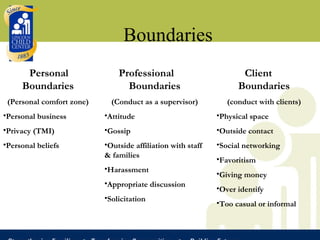
Boundaries Personal Boundaries (Personal comfort zone) Personal business  Privacy (TMI) Personal beliefs Professional  Boundaries (Conduct as a supervisor) Attitude  Gossip  Outside affiliation with staff & families  Harassment Appropriate discussion Solicitation Client  Boundaries (conduct with clients) Physical space Outside contact Social networking Favoritism Giving money Over identify Too casual or informal
Boundaries Personal Boundaries Keeping your personal life separate from your work environment is important.   Examples: Keeping personal information to yourself Not allowing personal issues & challenges infringe on your ability to perform at work Not using your time at work to deal with personal issues not related to the job Talking about your personal habits, vices, adult behavior, etc. Restrict Facebook settings
Boundaries Professional Boundaries Finding the balance between being personable and remaining professional is critical. Always default to a professional demeanor and establish rapport after boundaries are clearly defined and established.   Examples: Maintaining professional demeanor, dress, language, communication & conduct at all times while at work Responding appropriately to challenges on the job despite personal feelings or inclination to respond differently Developing relationships with other staff, contractors risky and blur the line Prevent Staff Splitting
Boundaries Client Boundaries Clients cross boundaries often. It is the responsibility of the staff person to establish and reinforce appropriate boundaries at all times.     Examples: Keeping appropriate physical boundaries with clients; no touching, hugging or physical playfulness with clients Don’t give gifts, money, gum, resources, etc. unless it’s a part of the program Keeping emotional boundaries in all interactions;  be aware of favoritism  clients liking you or you Keeping appropriate social boundaries Not over identifying with clients Not interacting too casually with clients Not allowing clients to interact to familiarly or casually with you or in your presence (always acknowledge inappropriate behavior or language)
Staff Splitting The 5 Forms of Staff Splitting The Direct Qualitative Compliment (staff) Finally, a supervisor who got our back. (unlike some people I know) The Indirect-Comparison Compliment (staff) Lee doesn’t make us do that. He just let’s us do it later. Role Reversal (youth) What if you were in my shoes and had to deal with YOU  Camaraderie: “Us” against “Them” (youth) She’s new, she doesn’t know about that yet.  Inconsistency Trap (staff) Macheo doesn’t make us take off our hat. (reinforce the rule)
Time Management Headline: Time Is Running Out For Our Superheroes! Elements of Keeping Track of Your Precious Time Assess:  Do a 30 min. time audit of a day Layer:  Block out regularly scheduled meetings and let everyone know Prioritize:  Prioritize the most important tasks and let everyone know Eliminate:  Identify lowest priority tasks and duties to reduce or eliminate
Time Management The Best Way To Say “NO”  Prioritize when there is a conflict Predetermined priorities will decide, not you Negotiate or renegotiate Take 1 minute to talk through creative options Consult your supervisor Check with others to build support & buy in Calibrate expectations of your involvement  Get clear on what you are being asked and what you can offer
Lincoln: The New Hall of Justice

Lcc powerpoint superman supervisor

  • 1.
  • 2.
    Introductions How longhave you been a supervisor? How many people have you supervised? hired? etc? Favorite part about being a supervisor? Superman versus Supervisor
  • 3.
    What is yourbiggest challenge with Staff? Your role? What do you do best? Where can you improve? Superman versus Supervisor
  • 4.
    REFLECT 1. Howmany supervisors have you had? 2. Which one helped you grow and get better? 3. Which one did you hate/love the most? 4. Which one do you want to be like? Superman versus Supervisor
  • 5.
    Headline: Superman get’soverwhelmed by the Legion of Doom! Common Misconceptions about Great Supervisors Constant Availability Having all the answers It is better to fix a problem yourself rather than letting others stumble Learning from the gifted master counselor is the best teaching tool Being well liked is crucial to success Superman versus Supervisor
  • 6.
    Headline: Our SuperheroesFind The Secret Syrum! Antidotes To Misconceptions Consistent Schedule, superb time management Asking good questions that empower the staff to have all the answers Empowering staff to take responsibility is how you duplicate yourself Learning from ones own mistakes is the best tool Being liked doesn’t = being respected as a leader. People can like you for many different reasons but you can only be respected as a leader for helping others perform better Superman versus Supervisor
  • 7.
    Structuring Supervision SupervisionReduces Crisis Management! Meet consistently – crises interrupting only create more crises Set expectations at the beginning Goal setting: staff input & your observations equally important in this step Introduce a structure AND follow it Example: Billing, hot clients, team issues, etc will be discussed every week Always allow time for supervisee driven topics
  • 8.
    Structuring Supervision Informsupervisee that you will take notes Review last week’s notes right before next supervision
  • 9.
    Pitfalls/Solutions in SupervisionProblem: Staff’s need to process challenges with clients morph into staff’s need to process challenges in personal life. How to balance being supportive without turning into therapist Solution: 1 st : Continue to bring conversation back to how this impacts work with client 2 nd : Consult with supervisor or colleague before next supervision 3 rd : Refer to EAP (Have phone number memorized!)
  • 10.
    Pitfalls/Solutions in SupervisionProblem: Staff are unable to generalize previous problem solving sessions to new problems. Solution: Provide problem solving model for staff to utilize before coming to you Example: IDEAL problem solving method
  • 11.
    Pitfalls/Solutions in SupervisionProblem: You have to give tough feedback to staff. Solution: Do not postpone. Problem is not going to go away. Person deserves feedback for their own growth. Get support & practice with teammate or supervisor Start from the perspective that you believe the person’s intent was good & help them understand that impact still matters regardless. People do the best they can with the resources they have, so give them tools to do it another way.
  • 12.
    Giving Positive FeedbackHeadline: The Riddler Leaves Staff Guessing About Their Performance Do this frequently (thank them for showing up to work) Feedback is a critical component of supervision and the primary way staff improve, not to mention essential for morale. Be specific and accurate (don’t generalize or praise the wrong person) Be genuine (don’t force it. Let the appreciation bubble up from within) Do it in the moment (don’t wait for a “better” time) Do it openly (but not sarcastically or in comparison to others)
  • 13.
    Giving Positive FeedbackTop 5 Critical feedback lines at Lincoln (David Letterman style) 5. Hey can you get to work on time at least once this week? 4. I noticed that you seem to be in crisis more than the clients. They are supposed to model YOUR behavior. 3. Did you notice that staff calling for help when you walked by? Oh that’s right, you were on the phone. 2. Can you check in with someone before you disappear for 30 minutes? 1. I just want you to know that texting while shadowing is NOT best practice.
  • 14.
    Difficult Feedback: The3 Conversations 1. The “What Happened?” Conversation. Most difficult conversations involve disagreements about what has happened or what should happen. Who said what and who did what? Who’s right, who meant what, and who’s to blame? What is perceived to have happen must be examined and verified or corrected. TIP: Repeat and rephrase to highlight facts, and exclude judgement. 2. The Feelings Conversation. Every difficult conversation also asks and answers questions about feelings. Are my feelings valid? Appropriate? Should I acknowledge or deny them, put them on the table or check them at the door? What do I do about the other person’s feelings? What if they are angry or hurt? How you feel almost always determines what you perceive happened and what the intent was. In other words, it is very difficult to feel hurt and still perceive good intent. TIP: Feelings are important. Sometimes more important than facts so be considerate. 3. The Identity Conversation. This is the conversation we each have with ourselves about what this situation means to us. We conduct an internal debate over whether this means we are competent or incompetent, a good person or bad, worthy of love or unlovable. What impact might it have on our self-image and self-esteem, our future and our well-being? Our answers to these questions determine in large part whether we feel “balanced” during the conversation, or whether we feel off-center and anxious. This is the end result feeling/assumption of what we are feeling, the core of what the conversation represents for us personally. TIP: It IS personal so don’t pretend it isn’t, just emphasize the professional aspect.
  • 15.
    Giving Difficult FeedbackAsk them if you can give them some feedback Make eye contact and start with an “I” statement OR a compliment on performance. INSTEAD OF: “Hey come here, I need to talk to you, I saw you talking about client X momma. Don’t ever let me catch you doing that again. TRY: “Hey Macheo, can we check-in? I noticed how you were joking around with client X. That’s totally appropriate as long as it stays light and positive but when they talk about your momma, don’t return fire. Try disengaging or telling them that’s inappropriate.”
  • 16.
    Receiving Difficult FeedbackAsk for feedback: Take feedback, not personal attacks Example: “How can I do a better job of supporting you Macheo? Well you can start by letting me do my job and quit harassing me, taking the kids side all the time, etc.” INSTEAD OF: “What? I always got your back! You’re the one cutting out not doing your job.” TRY:“Thank you for sharing your thoughts but, I need you rephrase that so there is no blame and so I can be helpful. Start with a specific example.”
  • 17.
    Progressive Disciplinary Process“ If you do that ONE more time…” HIGHLIGHTS: The top 3 rules with the PDP are: 1. Check in with HR 2. Consult with HR 3. Notify with HR Keep your supervisor informed Direct, clear and consistent feedback is the best prevention for the PDP. REMEMBER: Problems that develop with staff NEVER go away on their own.
  • 18.
    Boundaries Personal Boundaries(Personal comfort zone) Personal business Privacy (TMI) Personal beliefs Professional Boundaries (Conduct as a supervisor) Attitude Gossip Outside affiliation with staff & families Harassment Appropriate discussion Solicitation Client Boundaries (conduct with clients) Physical space Outside contact Social networking Favoritism Giving money Over identify Too casual or informal
  • 19.
    Boundaries Personal BoundariesKeeping your personal life separate from your work environment is important. Examples: Keeping personal information to yourself Not allowing personal issues & challenges infringe on your ability to perform at work Not using your time at work to deal with personal issues not related to the job Talking about your personal habits, vices, adult behavior, etc. Restrict Facebook settings
  • 20.
    Boundaries Professional BoundariesFinding the balance between being personable and remaining professional is critical. Always default to a professional demeanor and establish rapport after boundaries are clearly defined and established. Examples: Maintaining professional demeanor, dress, language, communication & conduct at all times while at work Responding appropriately to challenges on the job despite personal feelings or inclination to respond differently Developing relationships with other staff, contractors risky and blur the line Prevent Staff Splitting
  • 21.
    Boundaries Client BoundariesClients cross boundaries often. It is the responsibility of the staff person to establish and reinforce appropriate boundaries at all times. Examples: Keeping appropriate physical boundaries with clients; no touching, hugging or physical playfulness with clients Don’t give gifts, money, gum, resources, etc. unless it’s a part of the program Keeping emotional boundaries in all interactions; be aware of favoritism clients liking you or you Keeping appropriate social boundaries Not over identifying with clients Not interacting too casually with clients Not allowing clients to interact to familiarly or casually with you or in your presence (always acknowledge inappropriate behavior or language)
  • 22.
    Staff Splitting The5 Forms of Staff Splitting The Direct Qualitative Compliment (staff) Finally, a supervisor who got our back. (unlike some people I know) The Indirect-Comparison Compliment (staff) Lee doesn’t make us do that. He just let’s us do it later. Role Reversal (youth) What if you were in my shoes and had to deal with YOU Camaraderie: “Us” against “Them” (youth) She’s new, she doesn’t know about that yet. Inconsistency Trap (staff) Macheo doesn’t make us take off our hat. (reinforce the rule)
  • 23.
    Time Management Headline:Time Is Running Out For Our Superheroes! Elements of Keeping Track of Your Precious Time Assess: Do a 30 min. time audit of a day Layer: Block out regularly scheduled meetings and let everyone know Prioritize: Prioritize the most important tasks and let everyone know Eliminate: Identify lowest priority tasks and duties to reduce or eliminate
  • 24.
    Time Management TheBest Way To Say “NO” Prioritize when there is a conflict Predetermined priorities will decide, not you Negotiate or renegotiate Take 1 minute to talk through creative options Consult your supervisor Check with others to build support & buy in Calibrate expectations of your involvement Get clear on what you are being asked and what you can offer
  • 25.
    Lincoln: The NewHall of Justice